
Grade 6 English Worksheet: First Person Point of View [PDF]
![Grade 6 English Worksheet: First Person Point of View [PDF]](https://cdn5.planetspark.in/media/small_Grade_6_English_Worksheet_First_Person_Point_of_View_b5425f0327.png)

Through the Eyes of the Narrator: Grade 6 English Worksheet on First-Person Point of View
Every story is told from a
specific perspective, which determines how much information the reader receives and how they feel about the events. This Grade 6 English worksheet on First-Person Point of View (POV) helps students identify when a story is being told by a character involved in the action. By learning to spot pronouns like "I," "me," and "we," students can understand the personal connection between the narrator and the story. Mastering point of view is a key literary skill that enhances reading comprehension and allows students to express their own voices in writing.
Download these English grammar worksheets and practice regularly to strengthen your language skills and build a strong foundation. You can also book a free trial to get expert guidance and improve your reading, writing, and comprehension abilities. The worksheets are designed in a simple and structured way to help K–8 students learn grammar concepts easily and use them confidently in everyday communication.
What Is the Topic?
Point of View refers to the "voice" that is telling the story. This worksheet specifically focuses on the First-Person Point of View, where the narrator is a character within the story. Students are expected to learn that in this perspective, the narrator describes their own thoughts, feelings, and experiences directly to the reader. It creates an intimate, personal experience, as if the character is speaking directly to you. Understanding POV is essential for analyzing how a narrator's bias or emotions might affect the way a story is told. For practicing the topic you can Download the Worksheet directly, For better understanding you can Book free Trials.
What’s in This Worksheet?
1. Multiple Choice Questions: Students choose the sentence written in first-person point of view.
2. Fill in the Blanks: Students complete sentences using correct first-person pronouns.
3. True or False: Learners evaluate statements about first-person narration.
4. Underline the Sentences: Students identify sentences written in first-person point of view.
5. Paragraph Writing: Students write a short paragraph describing an experience in first person.
Definitions, Examples, Techniques, and Tips
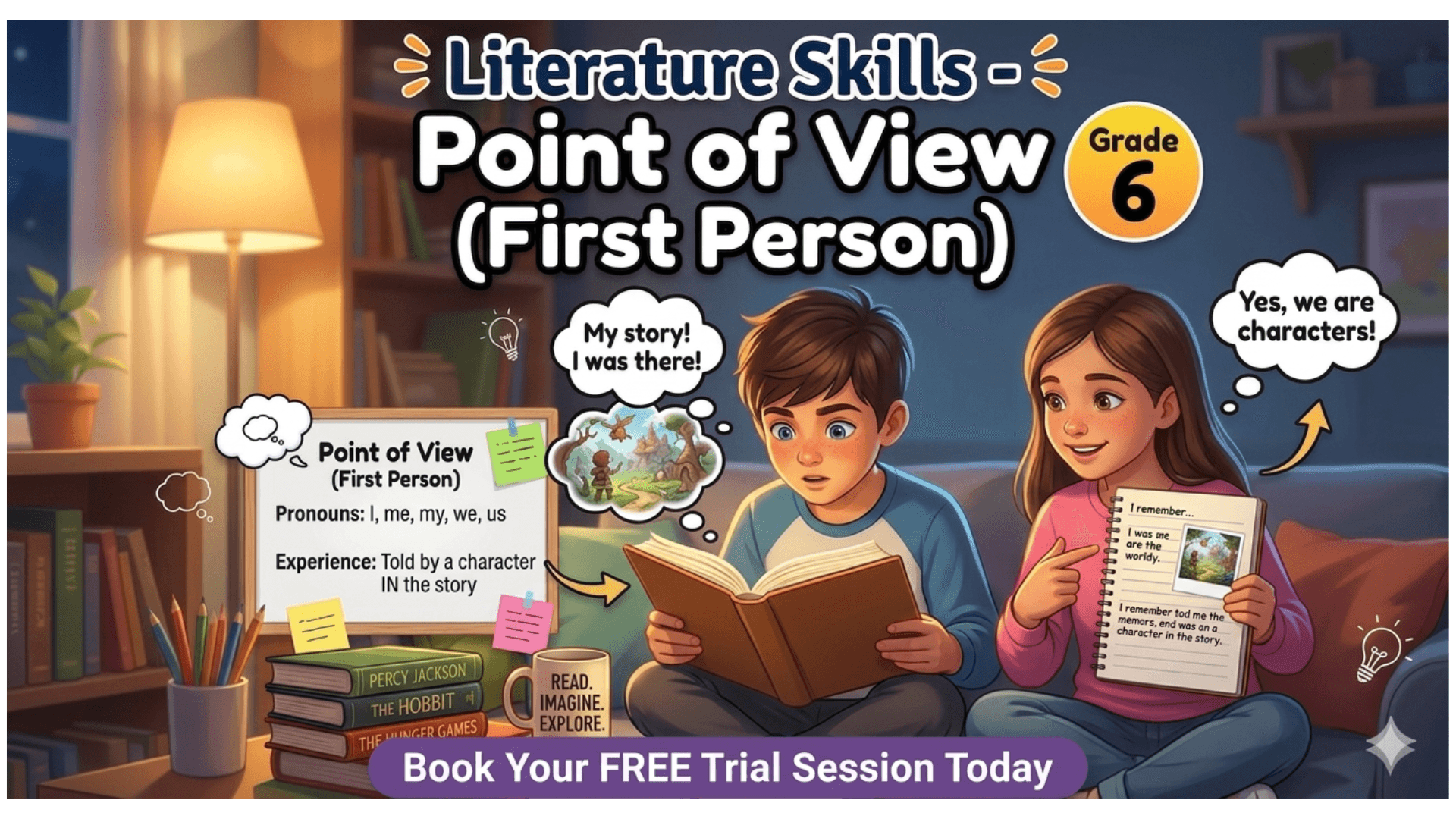
The worksheet provides clear examples of how pronouns signal the point of view. For instance, "I went to the park with my friends" is first-person because it uses the pronoun "I." In contrast, "She went to the park with her friends" is third-person because it uses "she." Techniques for identifying first-person POV involve scanning the text for "I," "me," "my," "we," and "us." Students are encouraged to ask: "Is the person telling the story also a character in the story?"
Why Is It Important to Learn This?
Learning to identify the first-person point of view is important because it changes how we interpret a character's reliability. Since we only see what the narrator sees and feel what they feel, we have to consider if there is more to the story than what they are telling us. This skill strengthens critical reading and empathy. In writing, using the first-person POV allows students to practice "voice" and characterization, making their personal narratives more compelling and believable.
Where Will This Knowledge Help You?
This knowledge is a fundamental part of the Grade 6 literature curriculum and is a common topic in school exams and reading assessments. Beyond English class, understanding point of view is helpful in history (when reading primary sources/journals) and in daily communication. It builds a strong foundation for more advanced literature topics, such as third-person limited vs. omniscient perspectives and the concept of the "unreliable narrator."
How to Use This Worksheet?
1. Start with the matching and general knowledge sections to warm up.
2. When moving to Exercise No. 4, look closely at the pronouns at the beginning of each sentence.
3. If the sentence uses "I" or "we," it is a first-person sentence!
4. For the writing task, imagine you are the main character and describe the sights and sounds from your own perspective.
5. Review your answers with the key to ensure you can distinguish between "I" (first-person) and "He/She/They" (third-person).
The solutions follow the exact worksheet order, so students should compare their answers carefully.
Important Tips and Tricks
1. First-person POV always uses "I," "me," "my," "we," or "us."
2. The narrator is usually the protagonist, but they don't have to be.
3. First-person allows readers to see the narrator's secret thoughts and feelings.
4. Be careful: dialogue (characters talking) might use "I," but the story itself might still be in the third person. Look at the narration outside the quotes!
5. When writing in first-person, try to describe things based on how the narrator specifically feels about them.
✅ Answer Key (For Parents & Educators)
Exercise 1 – Multiple Choice (First Person Sentences)
1. b) I completed the project before time
2. a) We are playing in the park
3. b) I finished my homework quickly
4. c) I chased the ball across the field
5. a) I felt happy after winning
6. b) We celebrated our victory
7. b) I lost my keys in the market
8. c) I explained the lesson clearly
9. a) We went on a trip together
10. a) I scored the winning goal
Exercise 2 – Fill in the Blanks
1. I
2. we
3. personal
4. I
5. own
6. we
7. me
8. mine / my / ours
9. myself
10. ourselves
Exercise 3 – True or False
1. True
2. False
3. True
4. True
5. False
6. True
7. True
8. False
9. True
10. False
Exercise 4 – Underline the Sentences with first person
1. I went to the park with my friends
3. We went to the park together
4. I watched a movie alone
5. I went to the park alone
8. We watched a movie last night
9. I felt nervous before the test
Exercise 5 – Paragraph Writing -My Most Exciting Adventure (Sample Answer)
Last summer, I went on an exciting trip to the mountains with my family. I felt very happy and excited as we started our journey early in the morning. While climbing, I faced some difficulty, but I did not give up. I kept trying and finally reached the top with my family. I felt proud of myself for completing the adventure. It was one of the best experiences of my life. .
Practicing this worksheet on first-person point of view helps students gain confidence in identifying who is telling the story and how that affects the message. With regular practice, learners can improve their literature skills and learn to tell their own stories with a strong, personal voice.
Encourage your child to write confidently and express their own experiences with clarity and creativity today.
🔖Book a free trial!