
Grade 6 English Worksheet: Plot Structure (Beginning–Middle–End)
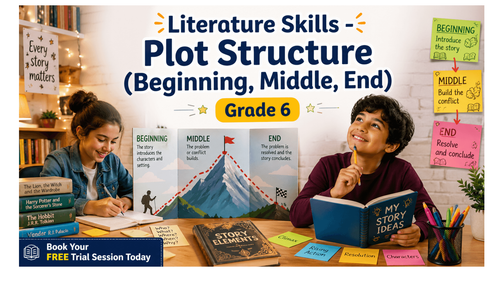

Mastering Narrative Flow: Grade 6 English Worksheet on Plot Structure Skills
Every great story, whether it is
a short tale or a massive novel, follows a specific path that keeps the reader interested from the very first page to the very last. This Grade 6 English worksheet on Plot Structure (Beginning, Middle, End) is designed to help students identify the key components of a narrative. By engaging with these exercises, learners will understand how a story starts, how it builds tension through challenges, and how it reaches a satisfying conclusion. Mastering plot structure is a foundational literature skill that transforms a simple list of events into a compelling story.
Download these English grammar worksheets and practice regularly to strengthen your language skills and build a strong foundation. You can also book a free trial to get expert guidance and improve your reading, writing, and comprehension abilities. The worksheets are designed in a simple and structured way to help K–8 students learn grammar concepts easily and use them confidently in everyday communication.
What Is the Topic?
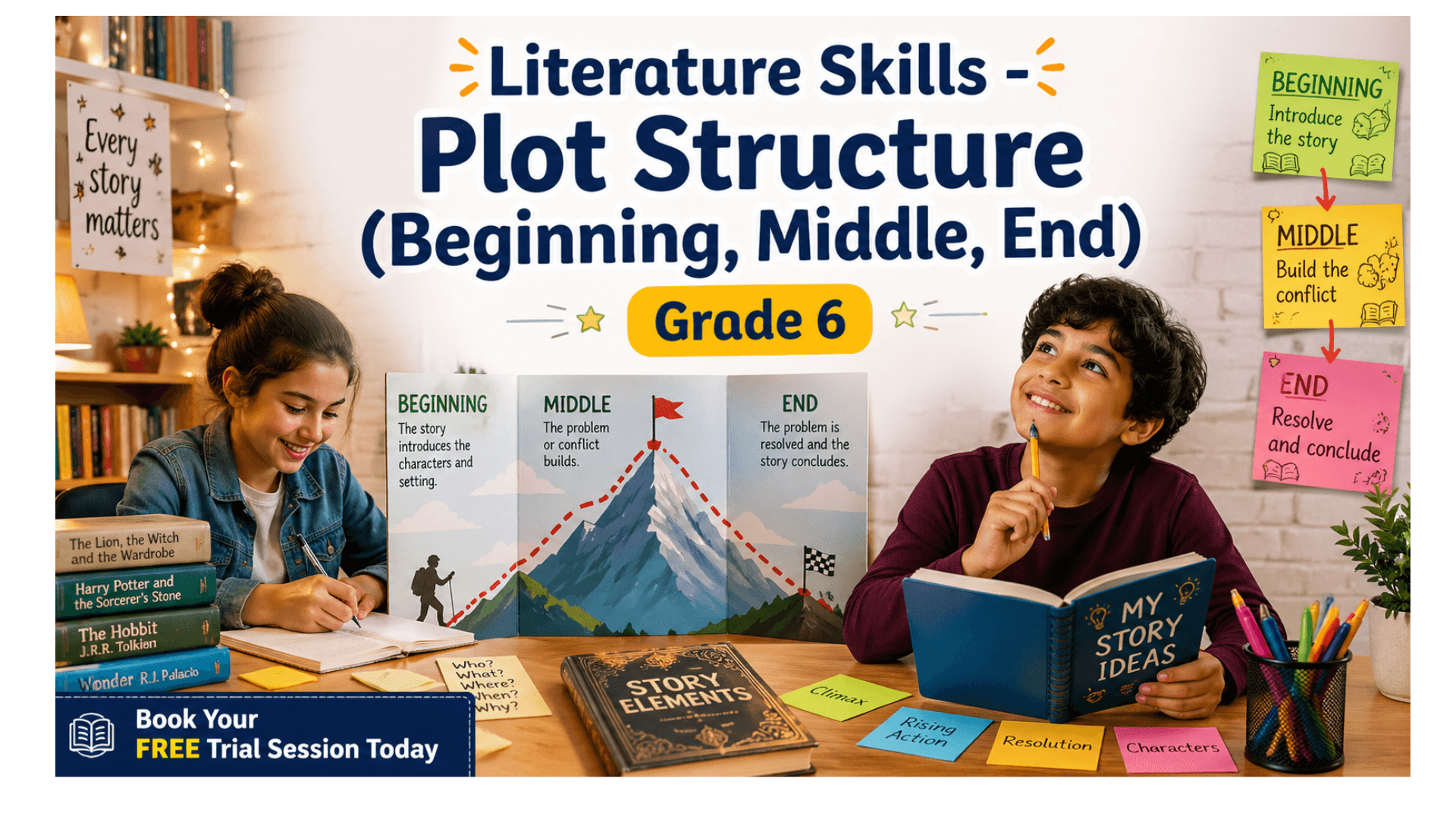
Plot Structure is the organized sequence of events that make up a story. This worksheet focuses on the three primary pillars of any narrative: the Beginning, the Middle, and the End. Students are expected to learn how characters are introduced at the start, how they face obstacles or conflicts in the middle, and how those issues are resolved at the finish. Understanding this framework helps students analyze literature more deeply and improves their own creative writing skills by ensuring their stories have a logical and engaging flow. You can download the worksheet for practice, For better understanding You can Book a Free Trials.
What’s in This Worksheet?
1. Multiple Choice Questions: Students identify whether each event belongs to the Beginning, Middle, or End of a story. 2. Fill in the Blanks: Students complete a story using appropriate events from a word bank, building sequencing and comprehension skills.
3. True or False: Learners evaluate statements about plot structure concepts like climax, resolution, and story flow.
4. Underline the Plot Parts: Students identify and underline parts of sentences that reflect Beginning, Middle, or End stages.
5.Paragraph Writing: Students write a short paragraph using proper plot structure, applying their understanding creatively.
Definitions, Examples, Techniques, and Tips. The worksheet emphasizes identifying the different parts of a story through clear examples. For instance, a "Beginning" might involve a character starting a new journey or moving to a city. The "Middle" is characterized by the character facing challenges, practicing daily, or meeting new friends. The "End" shows the final outcome, such as winning a prize, becoming a champion, or enjoying a successful trip. Students practice these techniques by breaking down sentences like "The boy starts his journey, faces challenges, and wins the race" into its structural components.
Why Is It Important to Learn This?
Learning plot structure is essential because it provides the "skeleton" for all writing. It helps students understand the relationship between cause and effect within a narrative. By recognizing these patterns, students can better predict outcomes in stories they read and become more organized in their own writing. It strengthens comprehension skills and allows students to communicate complex ideas in a way that is easy for others to follow.
Where Will This Knowledge Help You?
This knowledge is a key part of the Grade 6 literature curriculum and will appear in school exams, particularly in reading comprehension and creative writing sections. Beyond school, understanding how to structure information with a clear beginning, middle, and end is useful for giving presentations, writing reports, and even telling jokes or stories to friends. It builds a strong base for more advanced literature topics like climax, conflict, and resolution.
How to Use This Worksheet?
1. Attempt each section independently to see how well you can identify story stages.
2. Read the story prompts in Exercise No. 4 carefully before deciding which part represents the beginning, middle, or end.
3. For the writing task, ensure your paragraph clearly transitions from the start of the event to the conclusion.
4. Review your answers using the key provided to check for accuracy.
5. Practice regularly to become faster at identifying narrative patterns in everything you read.
The solutions follow the exact worksheet order, so students should compare their answers carefully.
Important Tips and Tricks
1. The Beginning usually introduces the "Who," "Where," and "What" of the story.
2. Look for action words (verbs) to find the "Middle" where the conflict or main activity happens.
3. The End should provide a sense of closure or a final result.
4. When identifying verbs, remember they are the "doing" words in the sentence.
5. In multiple-choice sections, read all options before picking the one that best fits the question.
✅ Answer Key (For Parents & Educators)
Exercise 1 – Multiple Choice (Plot Stages)
1.a) Beginning
2.c) End
3.b) Middle
4.b) Beginning
5.a) Middle
6.b) Middle
7.c) Middle (Climax)
8.c) End
9.b) End
10.a) Beginning
Exercise 2 – Fill in the Blanks
1. joins a new school
2. loses her bag
3. searches classroom
4. feels worried
5. asks her friend’s help
6. finds the bag
7. prepares for exam
8. studies hard
9. feels happy
10. thanks her friend
Exercise 3 – True or False
1. True
2. False
3. False
4. True
5. True
6. True
7. True
8. False
9. False
10. True
Exercise 4 – Underline the Plot Parts
(Answers may vary – students underline Beginning, Middle, and End parts in each sentence correctly.) 1. Aditi joins a new college (Beginning) / struggles in class (Middle) / finally succeeds (End)
2. The boy starts his journey (Beginning) / faces challenges (Middle) / wins the race (End)
3. The child learns cycling (Beginning) / falls many times (Middle) / rides well (End)
4. They plan a trip for summer vacation (Beginning) / — (Middle implied) / enjoy the journey (End)
5. Ananya enters a competition (Beginning) / practices daily (Middle) / wins a prize (End)
6. She meets new friends (Beginning) / — (Middle implied) / learns lessons from her problems (End)
7. The team prepares hard to perform well (Beginning/Middle) / wins the match (End)
8. A girl starts school (Beginning) / works hard (Middle) / becomes successful (End)
9. Rahul moves to a city (Beginning) / makes friends (Middle) / who were not loyal (End/Outcome)
10. He begins training (Beginning) / improves skills (Middle) / becomes champion (End)
Exercise 5 – Paragraph Writing
(Answers may vary – students write a 5–6 line paragraph including clear Beginning, Middle, and End.) Riya joined a new school on her first day and felt both excited and nervous.
She met her classmates and started attending her classes regularly.
Soon, she faced a problem when she lost her bag during lunch break.
She searched everywhere and even asked her friends and teachers for help.
Finally, she found her bag near the library with the help of a friend.
In the end, she felt happy, thanked her friend, and became more confident in her new school.
Practicing this worksheet on plot structure helps students gain confidence in understanding how stories are built and how to write their own. With regular practice, learners can improve their literature skills and express their ideas with a clear beginning, middle, and end.
Boost your child’s storytelling skills and help them structure ideas like a pro with guided expert support today.
🔖Book a free trial!