
Grade 6 English Worksheet: Protagonist vs Antagonist [Examples]
![Grade 6 English Worksheet: Protagonist vs Antagonist [Examples]](https://cdn5.planetspark.in/media/small_Grade_6_English_Worksheet_Protagonist_vs_Antagonist_42449b7341.png)

Heroes and Villains: Grade 6 English Worksheet on Protagonist vs. Antagonist
Every great story needs characters that
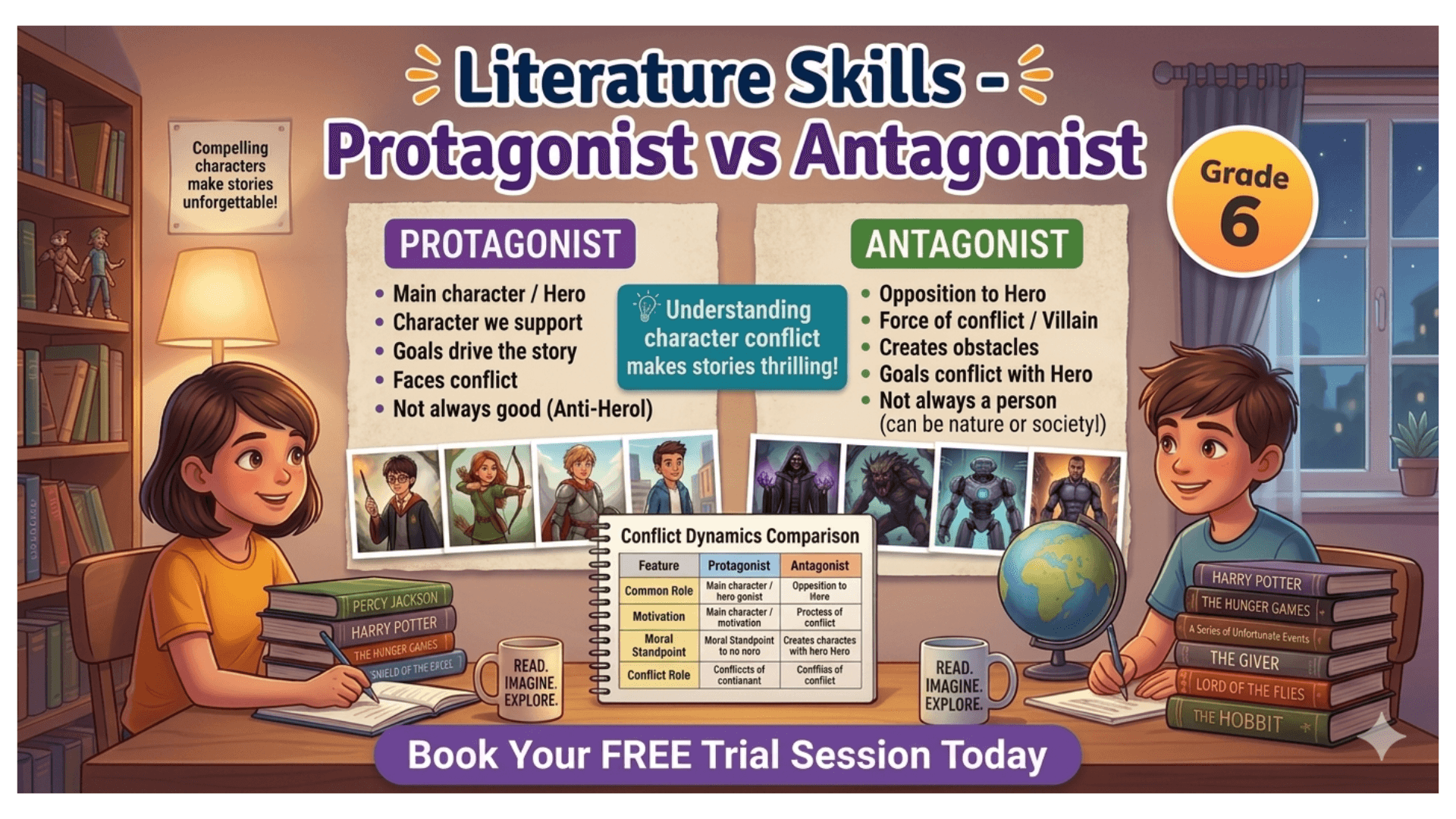
drive the action forward and others that try to stop them. This Grade 6 English worksheet on Protagonist vs. Antagonist helps students identify these two essential roles. By understanding the difference between the "hero" who pursues a goal and the "opposition" that stands in their way, Grade 6 students can better analyze the dynamics of a story. Mastering this concept is a fundamental literary skill that allows students to understand conflict, motivation, and character development.
Download these English grammar worksheets and practice regularly to strengthen your language skills and build a strong foundation. You can also book a free trial to get expert guidance and improve your reading, writing, and comprehension abilities. The worksheets are designed in a simple and structured way to help K–8 students learn grammar concepts easily and use them confidently in everyday communication.
What Is the Topic?
The topic of this worksheet is the distinction between a Protagonist and an Antagonist. A Protagonist is the main character who leads the story and often works toward a positive goal. An Antagonist is the person, group, or force that works against the protagonist, creating the main conflict. Students are expected to learn that while the protagonist is often "good" and the antagonist is often "bad," the most important thing is their role in the story's struggle. This understanding is key to unlocking the meaning of the plots they read and watch. You can Download the Worksheet for practice. For better understanding of topic
you can Book Free Trials.
What’s in This Worksheet?
1. Multiple Choice Questions: Students identify whether a character is the protagonist or antagonist.
2. Fill in the Blanks: Students complete sentences using correct terms like protagonist and antagonist.
3. True or False: Learners evaluate statements about character roles and story structure.
4. Underline the Characters: Students identify and underline protagonist and antagonist roles in sentences.
5. Paragraph Writing: Students write a short paragraph describing a story with a clear protagonist and antagonist.
Definitions, Examples, Techniques, and Tips
The worksheet provides practical examples of how actions define a character's role. For instance, in the sentence "The villain steals the treasure from the cave," the action of stealing identifies the character as an Antagonist. Conversely, in "The boy protects the smaller child," the act of protection identifies him as a Protagonist. Techniques for identifying these roles involve asking: "Who is this story mostly about?" and "Who is trying to stop them?" Students are encouraged to look for keywords like "saves," "helps," or "protects" for protagonists, and "blocks," "destroys," or "cheats" for antagonists.
Why Is It Important to Learn This?
Learning to distinguish between the protagonist and antagonist is important because it helps students identify the core conflict of a story. It allows readers to understand the themes of a narrative by looking at what the hero stands for versus what the opponent represents. This skill strengthens analytical thinking and helps students predict plot twists based on character motivations. In writing, knowing how to create a strong antagonist makes the protagonist's journey feel much more rewarding and exciting.
Where Will This Knowledge Help You?
This knowledge is a fundamental part of the Grade 6 literature curriculum and is frequently tested in reading comprehension and story analysis sections of school exams. Beyond English class, understanding these roles helps when analyzing historical events, movies, and even current news stories where different parties have conflicting goals. It builds a strong foundation for more advanced literature topics such as character arcs, foil characters, and different types of external conflict.
How to Use This Worksheet?
1. Start with the matching and general knowledge sections to warm up your brain.
2. When moving to Exercise No. 4, read each action carefully and think about whether it helps or hurts others.
3. Identify the character as a protagonist (the hero/lead) or an antagonist (the enemy/opponent).
4. For the writing task, think of a simple conflict—like a game or a rescue—and clearly define who is the lead and who is the opposition.
5. Check your work against the answer key to ensure you have correctly identified the roles based on their actions.
The solutions follow the exact worksheet order, so students should compare their answers carefully.
Important Tips and Tricks
1. The Protagonist isn't always perfect; they just have to be the character we follow through the journey.
2. The Antagonist doesn't always have to be a person—it can be a monster, a storm, or even a mean rule.
3. Look for the "Central Conflict"—the protagonist wants something, and the antagonist is the reason they can't have it yet.
4. Sometimes characters change roles! Keep an eye out for "villains" who turn good or "heroes" who make mistakes.
5. When writing your own story, make your antagonist just as strong as your protagonist to make the struggle feel real.
✅ Answer Key (For Parents & Educators)
Exercise 1 – Multiple Choice Questions
1.c) Protagonist
2.b) Antagonist
3.a) Antagonist
4.a) Protagonist
5.b) Antagonist
6.b) Protagonist
7.c) Protagonist
8.a) Antagonist
9.c) Antagonist
10.b) Antagonist
Exercise 2 – Fill in the Blanks
1. protagonist
2. conflict
3. hero
4. villain
5. challenges
6. problem
7. challenge
8. conflict
9. main character
10. story
Exercise 3 – True or False
1. False
2. True
3. True
4. False
5. False
6. True
7. True
8. False
9. True
10. True
Exercise 4 – Underline the Characters
1. hero (Protagonist) / villain (Antagonist)
2. main character (Protagonist) / enemy (Antagonist)
3. boy (Protagonist) / bully (Antagonist)
4. girl (Protagonist) / problem (Antagonist)
5. player (Protagonist) / opponent (Antagonist)
6. detective (Protagonist) / thief (Antagonist)
7. student (Protagonist) / difficulty (Antagonist)
8. leader (Protagonist) / rival (Antagonist)
9. child (Protagonist) / fear (Antagonist)
10. explorer (Protagonist) / danger (Antagonist)
Exercise 5 – Paragraph Writing (Sample Answer)
In a small village, a brave boy named Arjun wanted to save his town from danger. He was the protagonist of the story. A cruel thief was stealing from people and creating fear, making him the antagonist. Arjun decided to face the thief and protect his village. After a clever plan, he caught the thief and returned the stolen items. In the end, the village was safe, and Arjun became a hero. .
Practicing this worksheet on protagonists and antagonists helps students gain confidence in identifying the characters that make stories worth reading. With regular practice, learners can improve their literature skills and learn to build dynamic relationships between their own characters.
Help your child master story characters and understand heroes and villains with confidence today.
🔖Book a free trial!