
Grade 6 English Worksheet: Setting (Time & Place) [Printable]
![Grade 6 English Worksheet: Setting (Time & Place) [Printable]](https://cdn5.planetspark.in/media/small_Grade_6_English_Worksheet_Setting_Time_and_Place_e6e7b31429.png)

Exploring the Scene: Grade 6 English Worksheet on Setting Time and Place
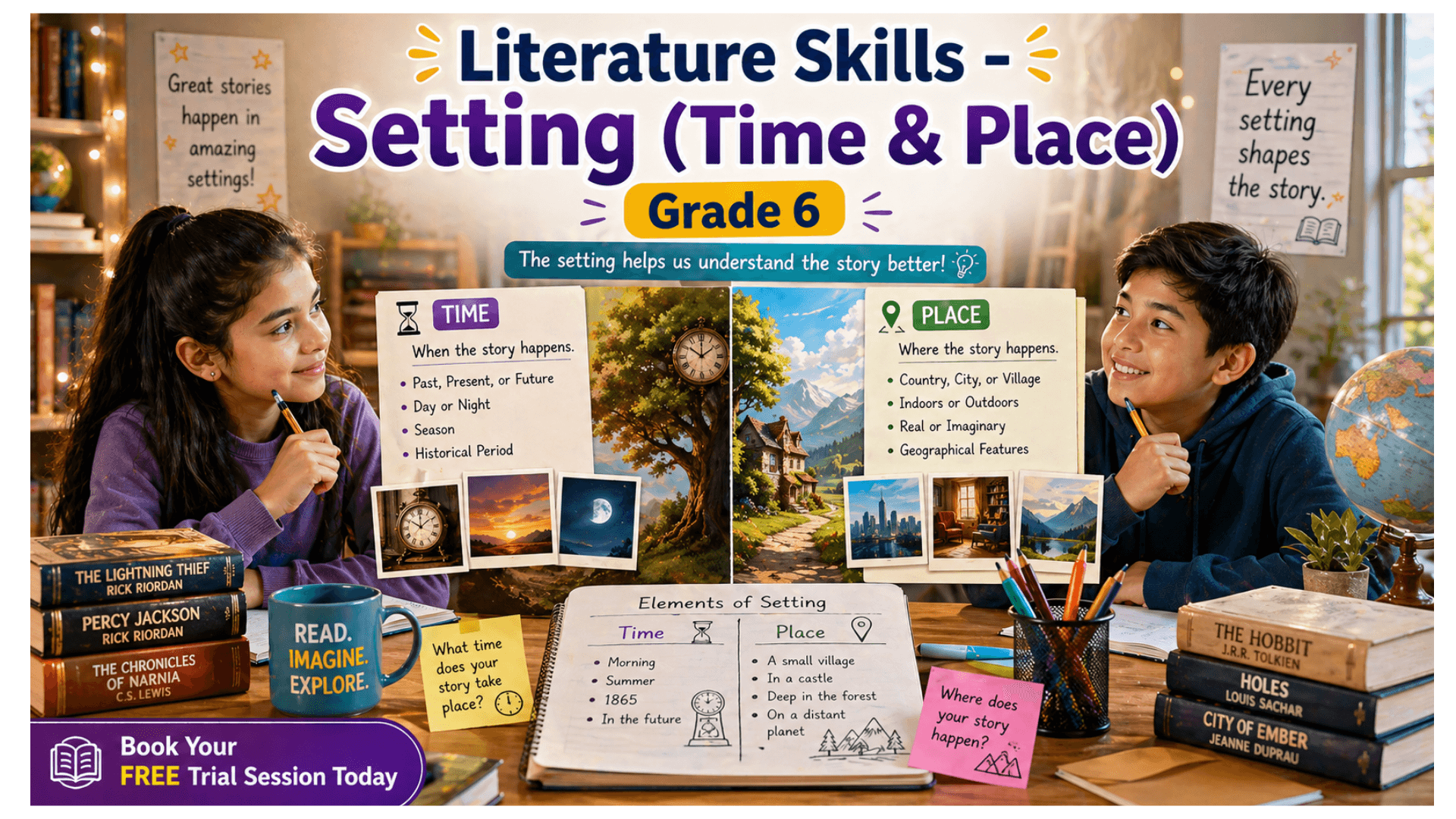
Imagine reading a story that takes place "nowhere" at "no time." It would be quite confusing! This Grade 6 English worksheet on Setting (Time & Place) helps students understand how authors build the world where their stories live. By learning to identify when and where an event occurs, Grade 6 students can better visualize the narrative and understand how the environment influences the characters' actions. Mastering the concept of setting is a key literary skill that enhances both reading comprehension and creative writing.
Download these English grammar worksheets and practice regularly to strengthen your language skills and build a strong foundation. You can also book a free trial to get expert guidance and improve your reading, writing, and comprehension abilities. The worksheets are designed in a simple and structured way to help K–8 students learn grammar concepts easily and use them confidently in everyday communication.
What Is the Topic?
Setting refers to the time and place in which a story occurs. This worksheet focuses on helping students distinguish between these two elements. "Place" describes the physical location, such as a green park, a dark forest, or a large school building. "Time" describes when the action happens, such as a sunny day, midnight, or at sunset. Students are expected to learn how these two details work together to create a complete scene, allowing readers to feel like they are right there with the characters. You can directly Download the worksheet for practicing. For proper understanding of Topic you can Book the Trial.
What’s in This Worksheet?
1. Multiple Choice Questions: Students identify the correct setting (time or place) from given options.
2. Fill in the Blanks: Students complete sentences using suitable words related to time and place.
3. True or False: Learners evaluate statements about the concept and importance of setting.
4. Underline the Setting: Students identify and underline words that describe time and place in each sentence.
5. Paragraph Writing: Students write a short paragraph describing a setting using both time and place details.
Definitions, Examples, Techniques, and Tips
The worksheet provides practical examples to help students master the concept of setting. For instance, in the sentence "The children played in a green park on a sunny day," the place is the "green park" and the time is "a sunny day." Techniques for identifying setting involve looking for prepositions like "in," "at," "near," or "along," which often point toward a location. To find the time, students are encouraged to look for references to the time of day, weather, or specific moments like "dawn" and "dusk."
Why Is It Important to Learn This?
Learning to identify the setting is important because the "where" and "now" of a story often dictate the mood and the plot. For example, a story set in a "dark forest at midnight" feels very different from a story set "by the beach on a warm day." By recognizing these details, students can better predict what might happen next and understand why characters behave in certain ways. This skill is vital for deep literary analysis and helps students write more descriptive and immersive stories.
Where Will This Knowledge Help You?
This knowledge is a fundamental part of the Grade 6 curriculum and is frequently tested in school exams, particularly in reading comprehension sections. Beyond English class, understanding setting helps in geography, history, and even in daily life when describing events to others. It builds a strong foundation for more advanced literature topics, such as atmosphere, tone, and the impact of environment on character development.
How to Use This Worksheet?
1. Start with the matching and general knowledge sections to get into a learning mindset.
2. When moving to Exercise No. 4, read each sentence twice to ensure you find both the time and the place.
3. Ask yourself: "Does this word tell me where they are or when this is happening?"
4. For the writing task, try to use vivid adjectives to make your setting feel "alive."
5. Compare your answers with the key to see if you missed any subtle setting clues.
The solutions follow the exact worksheet order, so students should compare their answers carefully.
Important Tips and Tricks
1. "Place" can be as large as a city or as small as a corner of a room.
2. "Time" can be a specific hour, a season, or a general time of day like "evening."
3. Look for adjectives (like "green," "dark," "busy") that describe the location or the time.
4. Sometimes a single sentence contains multiple setting clues—make sure to find them all!
5. When writing your own paragraph, try to appeal to the senses (what can the character see or feel in that setting?).
✅ Answer Key (For Parents & Educators)
Exercise 1 – Multiple Choice (Setting Identification)
1. a) quiet desert village
2. c) cold winter morning
3. a) crowded railway station
4. a) calm riverside at sunset
5. b) bright afternoon sun
6. c) old library full of dusty books
7. c) small mountain town during snowfall
8. a) sunny beach with sand
9. b) dark cave late at night
10. a) rainy evening in the city
Exercise 2 – Fill in the Blanks 1. city 2. evening 3. forest 4. village 5. morning
6. mountain 7. night 8. river 9. school 10. winter
Exercise 3 – True or False 1. True 2. False 3. True 4. False 5. True
6. True 7. True 8. False 9. False 10. True
Exercise 4 – Underline the Setting
1. green park, sunny day
2. near a river, cool evening
3. old castle, afternoon
4. by the beach, warm day
5. busy market, morning
6. dark forest, midnight
7. quiet road, sunset
8. large school building
9. snowy hill, night
10. small village, dawn
Exercise 5 – Paragraph Writing-A Rainy Evening in a Busy City (Sample Answer)
It was a rainy evening in a busy city, and the streets were full of people rushing home. The sky was dark, and heavy rain was falling continuously. Cars moved slowly through the traffic, and the sound of honking filled the air. Streetlights reflected on the wet roads, making the city look bright and colorful. People carried umbrellas and tried to stay dry as they walked quickly. The setting created a lively yet chaotic atmosphere in the city.
Practicing this worksheet on setting helps students gain confidence in building and analyzing the worlds within stories. With regular practice, learners can improve their literature skills and express their ideas with clear and descriptive settings of time and place.
Help your child bring stories to life with rich descriptions and strong imagination skills today.
🔖Book a free trial!