
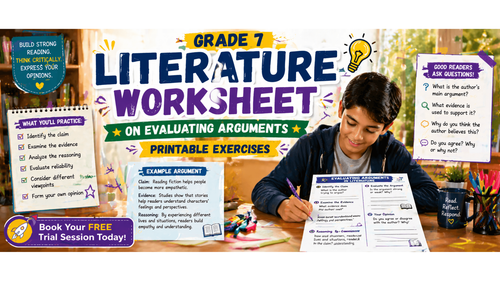
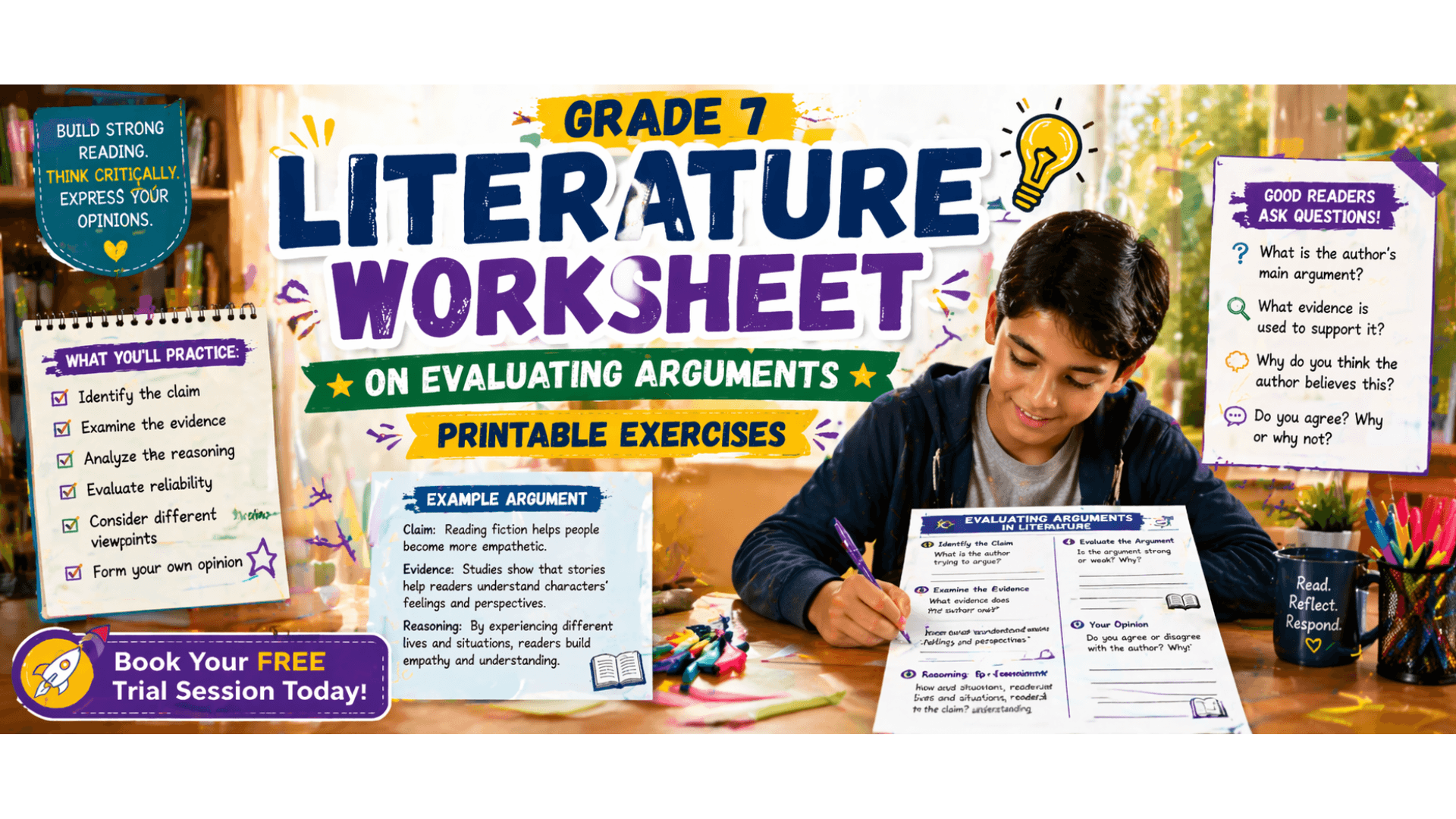
Grade 7 Literature Worksheet on Evaluating Arguments: Printable Exercises

Understanding how to evaluate an author's
argument is crucial for Grade 7 students. This worksheet teaches students how to assess the arguments made by authors in a story and determine whether the message is convincing and well-supported. By practicing these exercises, students can sharpen their analytical skills and become better at understanding and interpreting literature.
Download these English grammar worksheets and practice regularly to strengthen your language skills and build a strong foundation. You can also book a free trial to get expert guidance and improve your reading, writing, and comprehension abilities. The worksheets are designed in a simple and structured way to help K–8 students learn grammar concepts easily and use them confidently in everyday communication.
What is the topic?
"Evaluating Author’s Argument" helps students understand how authors present their ideas and whether they provide convincing evidence or reasoning. The argument in a story is the main point the author wants to make, and evaluating it helps readers understand the story on a deeper level. Students will learn to identify the author’s stance on a particular issue, understand the evidence provided, and analyze the logic of the argument.
What’s in this worksheet?
This worksheet includes various exercises aimed at helping Grade 7 students evaluate the effectiveness of an author's argument. The exercises in this worksheet include:
1. Multiple-choice questions that assess students' understanding of the author’s main argument.
2. Fill-in-the-blank exercises where students complete sentences with key terms related to arguments.
3. True/False questions to check whether statements align with the story’s argument.
4. Underlining the word that does not match the author’s argument.
5. Paragraph writing, where students will write about the author’s argument and its effectiveness.
Definitions, examples, techniques, and tips
Definition
- **Author's Argument**: The main point or claim the author is trying to prove in a story. It includes the reasoning and evidence used to support that claim.
Examples from the worksheet:
- In the story "The Value of Passion Over Status," the author argues that true success comes from following one’s passion, not just adhering to societal expectations.
- The old man in the story explains how he achieved personal happiness by pursuing his love for painting, despite not achieving wealth or status. This argument contrasts societal standards with individual happiness.
Technique students practice
The exercises focus on identifying the author's argument and evaluating its validity. Key techniques include:
1. **Identifying Claims**: Recognizing what the author is trying to argue in the story.
2. **Supporting Evidence**: Analyzing the reasons or examples the author uses to support the argument.
3. **Evaluating Logic**: Determining if the argument is logical and well-supported or if it lacks convincing evidence.
Quick learning tips
- Focus on identifying the author’s main claim in the story.
- Look for examples or experiences in the story that the author uses to support their argument.
- Consider whether the evidence provided in the story is strong or weak in supporting the author’s argument.
- Pay attention to any counterarguments or challenges the author addresses to strengthen their argument.
Why is it important to learn this?
Understanding how to evaluate an author's argument helps students become more critical readers. It sharpens their ability to think critically about the content they encounter, both in literature and in real-world contexts. Evaluating arguments also enhances their ability to write persuasive essays, as they learn how to structure their own arguments effectively.
Where will this knowledge help you?
This knowledge is helpful in multiple areas:
1. **Exams**: Many literature exams assess the ability to identify and evaluate the author’s argument.
2. **Writing Tasks**: In persuasive writing, students can use the same strategies to build and evaluate arguments.
3. **Class Participation**: Engaging in class discussions about stories will be easier when students can evaluate the strength of the arguments being made.
4. **Reading Comprehension**: By evaluating arguments, students gain a deeper understanding of what they read.
How to use this worksheet?
To effectively use this worksheet, follow these steps:
1. **Read the story carefully**. Make sure you understand the context and the author's argument before moving to the exercises.
2. **Attempt the exercises independently**. Focus on identifying the author’s argument and the evidence used to support it.
3. **Review your answers**. After completing the exercises, check your answers carefully to ensure you understood the argument correctly.
4. **Correct any mistakes**. Pay attention to why certain answers are right or wrong, and make sure you understand the logic behind the argument.
Important tips and tricks
1. **Look for repeated ideas**. The author’s main argument will usually be reinforced multiple times throughout the story.
2. **Evaluate the evidence**. Does the author provide convincing examples or reasons to support their argument?
3. **True/False**: Carefully consider the story’s main points to determine if the statement aligns with the author's argument.
4. **Fill in the blanks**: Focus on key terms like "passion," "success," and "society" when completing sentences related to the story’s argument.
5. **Underline the incorrect word**: Identify words or phrases that contradict the author’s argument about passion vs. societal expectations.
Complete answer key
Exercise No. 1
Read the story and select the correct answer for each question.
1. Success is following passion
2. Passion is as valuable as societal norms
3. Happiness comes from passion
4. Meets the old man, gains insight
5. Passion leads to happiness
6. Follow norms or passion
7. Personal happiness
8. He blends passion with success
9. Open to new perspectives
10. True success is passion
Exercise No. 2
Fill in the blanks with the appropriate noun from the word bank.
1. dream
2. family
3. passion
4. success
5. pressure
6. success
7. conflict
8. conflict
9. happiness
10. choice
Exercise No. 3
Tick the box if the statement given is correct or true.
1. True
2. False
3. False
4. False
5. True
6. False
7. True
8. True
9. True
10. False
Exercise No. 4
Underline the word that does not match the theme or author’s message.
1. Grades
2. Grades
3. Society
4. Grades
5. Pressure
6. Society
7. Success
8. Success
9. Society
10. Grades
Exercise No. 5
Write a short paragraph on the theme of "The Value of Passion Over Status."
The theme of "The Value of Passion Over Status" is about prioritizing personal happiness and passion over societal expectations and academic achievements. The story encourages readers to follow their heart and pursue what they love, regardless of the pressure to conform to society’s standards. Arun’s realization that true success comes from following his passion rather than focusing solely on grades highlights the importance of personal fulfillment over status and wealth.
Mastering the skill of evaluating an author’s argument helps students develop stronger analytical and critical thinking abilities. By engaging with this worksheet, students will be better equipped to identify, analyze, and evaluate the arguments presented in stories and texts, which will improve their reading comprehension and writing skills.