
Power Dynamics: Grade 7 literature Worksheet for Students
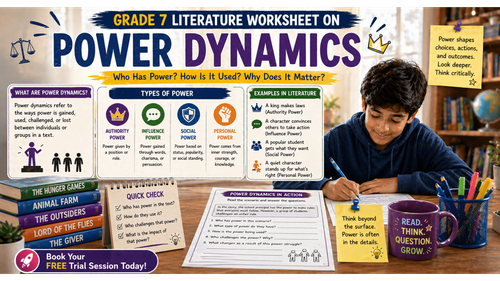

Grade 7 students can deepen their
understanding of power dynamics and leadership through the story *The Disputed Leadership*, which explores the relationship between Arjun and Veer. Despite being childhood friends, their differing perspectives on leadership lead to a power struggle. Arjun, raised in a privileged position, believes leadership is about control, while Veer, from a humble background, believes leadership should serve the people. This worksheet will help students analyze how different leadership styles affect relationships and the community, fostering skills in both critical thinking and effective communication.
Download these English grammar worksheets and practice regularly to strengthen your language skills and build a strong foundation. You can also book a free trial to get expert guidance and improve your reading, writing, and comprehension abilities. The worksheets are designed in a simple and structured way to help K–8 students learn grammar concepts easily and use them confidently in everyday communication.

What is the topic?
This worksheet focuses on power dynamics between characters, using the story *The Disputed Leadership* as a case study. Arjun and Veer, two childhood friends, have contrasting views on leadership. Arjun, who has grown up with power, believes in control and making decisions for others. In contrast, Veer values fairness and the idea that leadership should be about serving others. As the story unfolds, a storm devastates their village, and their differing leadership approaches create tension. Eventually, the villagers support Veer’s approach, and Arjun learns the importance of compassionate leadership.
Students are expected to analyze the impact of power dynamics in relationships and explore how different leadership styles influence both individuals and communities.
What's in this worksheet?
1. **Multiple Choice Questions** – These questions test students' understanding of the story’s themes, character motivations, and leadership styles.
2. **Fill in the Blanks** – This exercise helps students reinforce key vocabulary related to power dynamics and leadership by completing sentences with the appropriate nouns.
3. **True and False** – Students evaluate whether certain statements about the story are true or false based on the content.
4. **Underline the Words** – In this task, students identify words or phrases that do not align with the themes of the story.
5. **Paragraph Writing** – This exercise encourages students to write about the difference between controlling leadership and compassionate leadership, focusing on the conflict between Arjun and Veer.
Definitions, examples, techniques, and tips
Definitions
- **Power Dynamics**: The influence and control one character holds over others, often shaping the decisions and actions of those involved.
- **Leadership**: The ability to guide, direct, or influence others. Leadership can take many forms, from controlling and authoritarian to compassionate and servant based.
- **Compassionate Leadership**: A leadership style that emphasizes empathy, fairness, and serving the needs of others rather than focusing on control or power.
### Examples
- **Arjun’s Leadership**: Arjun’s belief in leadership as control leads him to impose strict rules during the storm crisis, which causes friction with Veer’s more compassionate approach.
- **Veer’s Leadership**: Veer’s belief in fairness and working together for the common good is ultimately embraced by the villagers, proving that compassionate leadership can inspire cooperation and unity.
### Quick Learning Tips
- Focus on how the characters’ backgrounds influence their views on leadership.
- Pay attention to the turning points in the story, particularly when Arjun steps aside and allows Veer to lead.
- When answering multiple-choice questions, eliminate clearly incorrect options first.
Why is it important to learn this?
Learning about power dynamics and leadership is essential for students because it helps them:
- Understand how different leadership styles affect relationships.
- Analyze the impact of leadership on communities and the larger world.
- Develop empathy by exploring how different people approach decision-making and problem-solving.
- Improve critical thinking and writing skills by engaging with complex themes and ideas.
Where will this knowledge help you?
This knowledge will be useful in:
1. **Exams** – Understanding power dynamics and leadership styles will help students answer exam questions related to character analysis and thematic exploration.
2. **Writing Tasks** – Students will be able to apply their understanding of power dynamics when discussing characters and relationships in essays and creative writing.
3. **Class Participation** – This skill will enable students to engage in meaningful discussions about leadership and power in literature and beyond.
How to use this worksheet?
1. **Attempt independently first** – Read the story and complete the exercises on your own to assess your understanding of power dynamics.
2. **Review answers carefully** – After completing the worksheet, review your answers and check for mistakes.
3. **Correct mistakes** – Understand why certain answers are correct and revise any incorrect responses.
4. **Practice regularly** – Revisit the worksheet to reinforce your understanding of leadership and power dynamics in character relationships.
The solutions follow the exact worksheet order, and students should compare their answers carefully.
Important tips and tricks
1. **Common mistakes** – Students often confuse the concept of control with leadership. Focus on the values that different characters bring to their approach to leadership.
2. **Examiners’ expectations** – Examiners look for clear understanding of both characters’ views on leadership and how these views influence their actions and relationships.
3. **How to score full marks** – To score full marks, make sure you understand the underlying themes of the story and can explain how they relate to the power dynamics at play.
4. **Activity-based tasks** – For paragraph writing, focus on the contrast between Arjun’s controlling leadership and Veer’s compassionate approach, and explain why Veer’s leadership ultimately prevailed.
Complete answer key
**Exercise No. 1**
1. It is about maintaining control
2. He became angry
3. It is about serving the people
4. Veer became the leader
5. Arjun’s strict rules and control
6. Share resources, collaborate
7. Work under harsh conditions
8. He stepped aside
9. Because of his fairness
10. Fairness in leadership
Exercise 2
1. leadership, control
2. leadership, compassion
3. leadership, conflict
4. compassionate
5. equality
6. power
7. compassion
8. conflict
9. control, compassionate
10. justice
**Exercise No. 3**
1. True
2. True
3. False
4. True
5. False
6. True
7. True
8. True
9. False
10. False
**Exercise No. 4**
1. Power
2. Control
3. Compassion
4. Empathy
5. Strictness
6. Cooperation
7. Conflict
8. Leadership
9. Conflict
10. Fairness
**Exercise No. 5**
The theme of *Power Dynamics Between Characters* is explored through the conflict between Arjun and Veer. Arjun, who believes in control and strict rules, contrasts with Veer, who believes leadership should serve the people through fairness and collaboration. Despite Arjun’s initial refusal to let go of his power-driven approach, the villagers eventually support Veer’s compassionate leadership, teaching Arjun that true leadership is about serving others, not controlling them.
In this Grade 7 literature worksheet, students analyze the complex power dynamics between Arjun and Veer. They explore how contrasting leadership styles shape relationships and influence communities. Understanding these dynamics will enhance students’ critical thinking and writing skills, allowing them to better engage with literature and real-world issues.