
How to Use Conjunctions in English Grammar Easily Today!


Table of Contents
- How to Use Conjunctions in English Grammar for Beginners
- How to Use Conjunctions in English Grammar with Examples
- Types of Conjunctions with Examples
- Common Mistakes Students Make When Using Conjunctions
- Fun Ways to Learn Conjunctions Creatively
- Conjunctions in Stories and Creative Writing
- Why Are Conjunctions Important for Students?
- Advanced Tips to Improve Your Use of Conjunctions
- Why PlanetSpark Is the Smartest Choice for Your Child’s Engl
- Final Words: Helping Children Stay Calm, Focused, and Ready
How to Use Conjunctions in English Grammar might sound like a small topic, but it’s actually the secret ingredient that turns simple sentences into powerful, meaningful expressions. In this blog, you’ll explore what conjunctions are, how they work, their types, and easy examples that make learning fun and practical. And if you want to boost your grammar skills even faster, PlanetSpark’s futuristic, expert-led classes can help you master communication with confidence.
How to Use Conjunctions in English Grammar for Beginners
For beginners, mastering conjunctions involves understanding their role and practicing with simple sentences. Here’s a step-by-step approach:
Step 1: Identify the Relationship
Determine the relationship between ideas:
- Addition → use and, both…and
- Contrast → use but, although, however
- Cause/Effect → use because, so, therefore
- Choice → use or, either…or, neither…nor
Step 2: Choose the Right Conjunction
Pick a conjunction that clearly expresses the intended relationship.
Step 3: Construct the Sentence
- For coordinating conjunctions: Combine two independent clauses with a comma and the conjunction.
- For subordinating conjunctions: Place the dependent clause before or after the main clause.
Examples for Beginners:
- I like ice cream, and I like chocolate.
- She stayed home because she was sick.
- You can either call me or send me an email.
How to Use Conjunctions in English Grammar with Examples
Using conjunctions correctly requires practice with varied examples. Let’s look at some categorized examples:
Addition
- I like reading and writing.
- She is intelligent, as well as hardworking.
Contrast
- He is tall, but not strong.
- Although it was raining, we went out.
Choice
- Do you want tea or coffee?
- You can either walk or take the bus.
Cause and Effect
- She was late, so she missed the bus.
- I am tired because I stayed up late.
Comparison
- He runs faster than his brother.
- She is as smart as her friend.
Sequence
- First, we went to the park; then, we visited the museum.
- She finished her homework; after that, she played video games.
Types of Conjunctions with Examples
Conjunctions can be divided into several types based on their function. Here’s a detailed look at the main types:
1. Coordinating Conjunctions
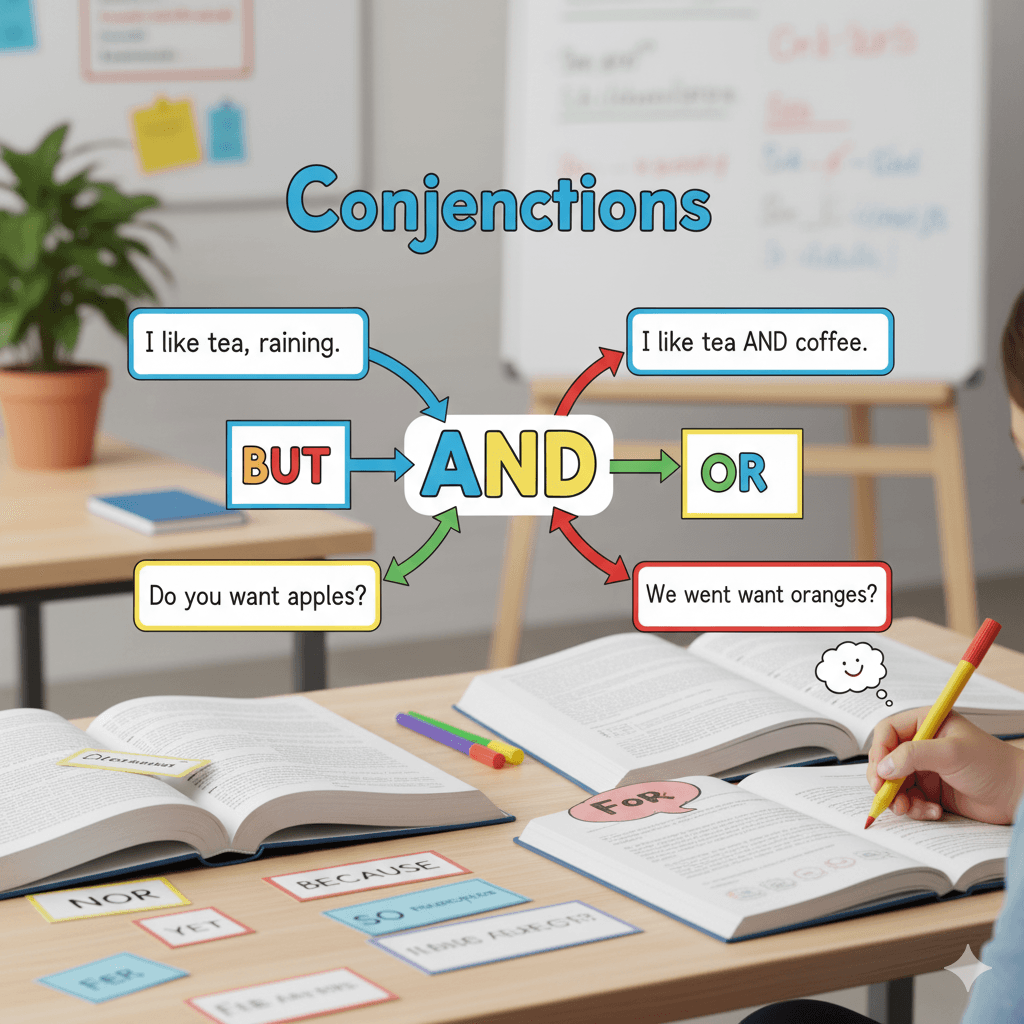
Coordinating conjunctions connect words, phrases, or independent clauses of equal importance. The most common coordinating conjunctions are for, and, nor, but, or, yet, so. A useful mnemonic to remember them is FANBOYS.
Examples:
- I wanted to go for a walk, but it started raining.
- She is smart and hardworking.
- Do you want tea or coffee?
Usage Tips:
- Always place a comma before a coordinating conjunction when joining two independent clauses.
- Use them to show addition, contrast, choice, or result.
2. Subordinating Conjunctions
Subordinating conjunctions connect a dependent clause to an independent clause. They show a relationship such as time, reason, condition, or comparison.
Common subordinating conjunctions include: because, although, since, unless, while, if, after, before, when, and though.
Examples:
- I stayed home because it was raining.
- Although she was tired, she finished her homework.
- We will go for a picnic if the weather is good.
Usage Tips:
- A dependent clause usually cannot stand alone.
- The conjunction can appear at the beginning or middle of a sentence, depending on emphasis.
Help Your Child Master Grammar the Smart and Easy Way!
PlanetSpark’s personalised lessons make learning simple and enjoyable.
3. Correlative Conjunctions
Correlative conjunctions are pairs of words that work together to connect equal sentence elements. Examples include: either…or, neither…nor, both…and, not only…but also, whether…or.
Examples:
- Either you finish your homework, or you cannot watch TV.
- Neither the teacher nor the students knew the answer.
- She is not only intelligent but also very kind.
Usage Tips:
- Always use correlative conjunctions in pairs.
- Ensure that the connected sentence elements are grammatically parallel.
4. Conjunctive Adverbs (Transitional Conjunctions)
Conjunctive adverbs connect independent clauses and indicate relationships such as contrast, cause and effect, or sequence. Examples include: however, therefore, moreover, consequently, meanwhile, otherwise.
Examples:
- I wanted to buy the book; however, it was too expensive.
- She studied hard; therefore, she passed the exam with flying colors.
Usage Tips:
- Use a semicolon before the conjunctive adverb and a comma after it.
- These are useful for formal writing and essay compositions.
Common Mistakes Students Make When Using Conjunctions
Even though conjunctions seem simple, students often make mistakes that affect sentence clarity and grammar. Understanding these errors can help you avoid them and write more confidently. If students want to master all these conjunctions, click here.
1. Using Too Many Conjunctions in One Sentence
Beginners sometimes connect too many ideas using multiple conjunctions, making the sentence long and confusing.
Incorrect: I wanted to go out but it was raining and I was tired so I stayed home.
Correct: I wanted to go out, but it was raining. I was also tired, so I stayed home.
2. Forgetting Commas with Coordinating Conjunctions
When joining two independent clauses, a comma is necessary.
Example:
Correct → I wanted to call you, but my phone died.
Incorrect → I wanted to call you but my phone died.
3. Misplacing Subordinating Conjunctions
If the dependent clause comes first, a comma must follow it.
Example:
Correct → Although it was late, she continued studying.
4. Breaking Parallel Structure with Correlative Conjunctions
Correlative conjunctions must connect grammatically similar elements.
Incorrect: She likes dancing and to sing.
Correct: She likes dancing and singing.
Avoiding these mistakes will make your writing smoother, clearer, and more professional.
Boost English Skills with PlanetSpark’s Proven Learning System!
Watch your child grow through structured grammar and writing practice.
Fun Ways to Learn Conjunctions Creatively
Learning conjunctions doesn’t have to be boring! By using interactive methods, students can understand how ideas connect while having fun. Here are some engaging ways to master conjunctions:
1. Conjunction Story Challenge
Create a short story with friends or classmates, but each sentence must start with a conjunction. This encourages creative thinking and teaches sentence linking naturally.
Example: “Although it was raining, we went out. But we forgot our umbrellas!”
2. Conjunction Comics
Draw a simple comic strip and use conjunctions to connect dialogue or events. This visual approach helps students remember how conjunctions join ideas.
3. Conjunction Role-Play
Act out situations using conjunctions to explain cause, effect, or contrast. For example, “I stayed home because it was raining” or “I wanted cake, but there was none.”
4. Conjunction Hunt
Read a story or watch a short video, and list all the conjunctions used. Then try rewriting sentences using different conjunctions to see how the meaning changes.
5. Gamified Conjunction Quiz
Turn conjunction practice into a fun game. Students can earn points for correct answers, create their own quizzes, or compete in teams.
These creative methods make learning conjunctions memorable, interactive, and fun, helping students apply grammar naturally in speaking, writing, and storytelling
Conjunctions in Stories and Creative Writing
Using conjunctions in stories or creative writing makes ideas flow naturally and keeps readers engaged. Words like and, but, because, and although help link actions, describe events, and show relationships between characters. By practising conjunctions while writing short stories, poems, or dialogues, students not only improve grammar but also enhance imagination, storytelling skills, and sentence variety, making their writing expressive, engaging, and easy to follow.
Turn Grammar Challenges into Daily Strengths!
PlanetSpark teaches through stories, games, and real-life applications.
Why Are Conjunctions Important for Students?
Students often struggle with writing long, coherent sentences, especially when constructing essays or reports. Conjunctions help solve this problem by:
- Connecting Ideas: They allow you to link related ideas clearly.
- Avoiding Repetition: Conjunctions help avoid writing multiple sentences with the same subjects.
- Improving Sentence Variety: Using conjunctions makes your writing more engaging.
- Expressing Relationships: They help show cause-and-effect, contrast, condition, or choice between ideas.
For beginners, understanding how to use conjunctions in English grammar for beginners can be the key to moving from simple sentences to more advanced, cohesive writing.
Advanced Tips to Improve Your Use of Conjunctions
Once you understand the basics of conjunctions, the next step is mastering how to use them smoothly in longer sentences. These advanced tips will help students write more polished, expressive, and grammatically accurate sentences, especially useful for essays, speeches, and exams. Furthermore, parents stuck with their kids in better sentence formation, click here.
Vary Your Conjunctions for Better Writing Style
Using “and” or “but” repeatedly makes writing sound repetitive. Try mixing in subordinating conjunctions like although, since, unless, or conjunctive adverbs like however, meanwhile, consequently to create richer sentences.
Example:
Instead of → I was tired, but I kept working.
Try → Although I was tired, I continued working with determination.
Use Conjunctions to Show Clear Logical Relationships
Students often connect sentences without clearly expressing the relationship. Choosing the right conjunction makes your meaning stronger.
- For contrast → although, but, yet, however
- For reason → because, since
- For results → so, therefore, consequently
- For condition → if, unless
- For time/order → when, before, after, while
Example:
She left early because she had a meeting.
Avoid Run-On Sentences by Using Conjunctions Carefully
Beginners tend to join too many ideas with “and.” Limit each sentence to 1–2 conjunctions to keep it clear.
Poor:
I woke up early and I brushed my teeth and I got ready and I left for school.
Improved:
I woke up early, and after getting ready, I left for school.
4. Place the Conjunction for Emphasis
Where you place the conjunction affects the sentence’s tone.
- Starting with a subordinating conjunction adds emphasis.
Example:
Although it was raining, we continued the match. - Placing it in the middle balances the sentence.
Example:
We continued the match although it was raining.
5. Use Conjunctive Adverbs in Academic Writing
Words like therefore, consequently, moreover, and however make your writing sound more formal and structured.
Example:
She practiced every day; therefore, her fluency improved.
Why PlanetSpark Is the Smartest Choice for Your Child’s English Growth
PlanetSpark offers a complete, modern, and personalised way to help children master English skills with confidence. Through expert trainers, AI tools, gamified learning, and structured progress tracking, kids learn faster, understand better, and speak and write with clarity.
Here are the services that make PlanetSpark exceptional for English grammar and communication:
- 1:1 personalised training with certified English experts
- Customised learning roadmap based on your child’s skill level
- SparkX AI video analysis for grammar, delivery, and clarity
- AI-led practice sessions for speaking and storytelling
- Spark Diary for developing consistent writing habits
- Gamified grammar modules like quizzes, puzzles, and challenges
- Grammar through usage: stories, dialogues, roleplay—not memorisation
- Step-by-step grammar levels from basics to advanced concepts
- Parent-teacher meetings and detailed grammar progress reports
- Safe content-sharing platform (Sparkline) for expression and learning
- Exclusive clubs for debate, writing, speech, and creativity
PlanetSpark turns English learning into a fun, structured, and result-driven journey for every child.
Final Words: Helping Children Stay Calm, Focused, and Ready to Learn Daily
Mastering conjunctions is truly about learning how ideas connect and flow together. Once you understand how these small words function, your writing becomes clearer, smoother, and far more expressive. They help transform basic sentences into meaningful thoughts that reflect confidence and clarity.
With regular practice, students can begin recognizing relationships between ideas and selecting the right connectors naturally. This skill strengthens both academic writing and everyday communication, making expression more accurate and thoughtful.
As you continue exploring grammar, remember that strong writing comes from consistent practice. Keep experimenting with new structures, revising your sentences, and applying the tips shared throughout this guide.
Frequently Asked Questions
Children learn grammar best through usage by reading, writing, speaking, and consistent practice. Activities like quizzes, storytelling, and sentence-building exercises help reinforce concepts in a natural, engaging way.
Grammar helps children express ideas clearly, structure sentences properly, and avoid confusion. Strong grammar builds confidence in speaking and writing, improving overall communication in school, daily life, and future careers.
Parents can use word puzzles, storytelling prompts, flashcards, daily reading time, and games. These activities make learning enjoyable while strengthening grammar, vocabulary, and sentence formation through regular practice.
PlanetSpark teaches grammar through stories, conversations, gamified quizzes, and personalised corrections, not memorisation. Children learn concepts, apply them in writing and speaking, and receive detailed feedback to ensure steady improvement.
Yes. PlanetSpark provides step-by-step grammar levels from basics to advanced topics. Each level includes interactive lessons, writing tasks, and progress reports to track accuracy, fluency, and overall skill development.
Absolutely. PlanetSpark’s SparkBee, AI practice modules, and writing diary offer daily grammar exercises. These tools build consistency, boost confidence, and make grammar learning fun, interactive, and result-oriented.