
Hypothetical in Grammar: Meaning, Features, and Types
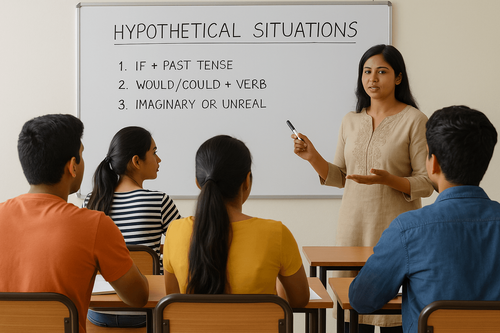

Table of Contents
- What Does “Hypothetical” Mean in English Grammar?
- Types of Hypothetical Situations
- Hypothetical Statements in the Present or Future (Second Con
- Hypothetical Statements About the Past (Third Conditional)
- Mixed Conditionals
- Modal Verbs Used in Hypothetical Sentences
- How to Identify Hypothetical Sentences
- Common Mistakes in Hypothetical Grammar
- Hypothetical Grammar in Everyday English
- How Does PlanetSpark Help in Learning Hypothetical Situation
- Conclusion
Understanding how to express unreal or imagined situations is an essential skill in English. Whether you are describing possibilities, regrets, advice, or alternative outcomes, you are relying on hypothetical grammar rules. These structures help speakers discuss events that did not happen, situations that are unlikely to happen, or ideas that exist only in imagination. Because these forms are used widely in communication, mastering them improves fluency, clarity, and accuracy. This comprehensive guide explains what hypothetical means in English grammar, how to identify hypothetical situations in grammar, and how to construct them through various conditional structures.
What Does “Hypothetical” Mean in English Grammar?
A hypothetical situation in grammar refers to a sentence or idea that describes something unreal, imagined, impossible, or contrary to fact. Instead of discussing events that truly happened or are happening, a hypothetical statement explores what could happen, what might have happened, or what would happen under different circumstances.
Hypothetical situations in English grammar are used to express imagination, suggestions, regrets, predictions, creativity, and reasoning. These structures frequently appear in academic writing, business communication, storytelling, and everyday conversations.

Key Features of Hypothetical Meaning
A hypothetical situation typically includes the following features:
The scenario is not real in the present or past
The speaker imagines something different from reality.
The statement often contains an if-clause
Although if is not always required, it is common because hypothetical grammar rules depend on imagining conditions.
The verb forms follow specific patterns
Different tenses represent different types of unreal conditions.
Modal verbs express unreal results
Would, could, and might show imaginary outcomes.
To understand the concept clearly, consider this hypothetical example sentence:
If I had wings, I would travel around the world.
This expresses an idea that is impossible in real life, which makes it a classic example of a hypothetical situation in grammar.
Types of Hypothetical Situations
Hypothetical grammar is divided into categories based on the time referenced and the type of unreality being described. The three main types include:
Present or future hypothetical situations
These refer to unreal or unlikely conditions in the present or possible future.
Past hypothetical situations
These refer to things that did not happen in the past and their imagined results.
Mixed-time hypothetical situations
These combine a past condition with a present result or a present condition with a past result.
Each structure follows different hypothetical grammar rules, which will be explained in the sections below.
Start your learning journey today. Book a free PlanetSpark demo class and experience interactive English learning firsthand.
Hypothetical Statements in the Present or Future (Second Conditional)
Second conditional sentences express hypothetical situations in the present or future. These situations are not true now, unlikely to become true, or purely imaginary. They help describe dreams, advice, guesses, and imagined outcomes.
Structure
If plus past simple, followed by would, could, or might plus the base verb.
If plus past simple, result clause with would or could or might plus base form.
Meaning
The past tense in the if-clause does not refer to actual past time. Instead, it signals unreality. The speaker is imagining a situation different from the present reality.
Uses
The second conditional is used to:
Give advice
Describe unrealistic dreams
Talk about unlikely future possibilities
Express imagination
Discuss hypothetical decisions
Examples
If I won a million dollars, I would start a charity.
If she studied medicine, she could become a great doctor.
If it snowed tomorrow, we might stay indoors.
If I were taller, I would play basketball professionally.
In each case, the sentence shows how to use hypothetical in a sentence when the speaker imagines a scenario that is not actually true now.
Hypothetical Statements About the Past (Third Conditional)
Third conditional sentences describe hypothetical situations in the past. These refer to events that did not happen and the imagined consequences of those unreal events. They are commonly used to express regret, disappointment, criticism, or reflection.
Structure
If plus had plus past participle, followed by would or could or might have plus past participle.
Meaning
The speaker imagines an alternative past event. Since the action did not occur, the sentence expresses an impossible outcome in the real world.
Uses
The third conditional is used for:
Regrets
Missed opportunities
Imagined alternative outcomes
Explanations of what could have changed
Understanding consequences
Examples
- If I had driven more slowly, I would have avoided the accident.
- If they had prepared earlier, they might have completed the project on time.
- If she had asked for help, we could have solved the problem sooner.
- If he had taken the offer, his career would have improved significantly.
These sentences clearly show hypothetical situations in English grammar that describe unreal past conditions.
Mixed Conditionals
Mixed conditionals describe unreal situations involving two different time periods. In these structures, the if-clause and the result clause refer to different times, which makes the sentence express a more complex hypothetical idea.
There are two primary kinds of mixed conditionals.
Past condition with present result
If plus had plus past participle, would plus base verb.
This structure shows how a past action or inaction affects the present.
Example
If I had practiced regularly, I would be fluent in Spanish now.
Present condition with past result
If plus past simple, would have plus past participle.
This structure shows how a present situation explains why something did or did not happen in the past.
Example
If she were more responsible, she would have completed the assignment yesterday.
Uses of Mixed Conditionals
Mixed conditionals allow speakers to:
Explain how past events influence the present
Discuss how present circumstances could have changed the past
Express ongoing consequences of past actions
Create clearer explanations of time relationships
Additional Examples
If he had invested wisely, he would be wealthy today.
If they were more organized, they would have handled the crisis better.
If I had known her earlier, we would be friends now.

Modal Verbs Used in Hypothetical Sentences
Modal verbs play a major role in forming hypothetical structures because they express unreal, imaginary, or possible results. Hypothetical grammar rules rely heavily on the correct use of these verbs.
Common Modal Verbs in Hypothetical Meaning
Would
Expresses the main imagined result of a hypothetical situation.
Could
Shows possibility, ability, or opportunity in an imagined scenario.
Might
Indicates a weaker or less certain possibility.
Should
Used mainly for hypotheticals involving advice.
Were
Used instead of was in unreal situations, especially after the subject I or he or she or it.
How to Use Hypothetical in a Sentence with Modal Verbs
If I were you, I would apply for the scholarship.
If she tried harder, she could achieve remarkable success.
If he had noticed the signs earlier, he might have reacted differently.
If they were more patient, they would handle conflicts better.
Each sentence demonstrates the connection between modal verbs and hypothetical grammar rules.
How to Identify Hypothetical Sentences
Recognizing hypothetical sentences becomes easier once you understand the key indicators. These clues help you determine whether a sentence describes real or imagined conditions.
Signs of Hypothetical Meaning
Unreal or imagined meaning
The sentence describes something contrary to reality.
Conditional structures
Most hypothetical sentences contain if clauses, though some do not.
Verb tense patterns
The second conditional uses past simple for present unreal situations, and the third conditional uses past perfect for past unreal situations.
Modal verbs in the result clause
Would, could, and might indicate hypothetical results.
Contrary-to-fact statements
If the sentence expresses something that is not true in reality, it is hypothetical.
Examples of Identification
If I were rich, I would travel the world.
This indicates present unreality.
If he had apologized, they would have forgiven him.
This indicates past unreality.
Even without if
I would help you, but I am too far away.
This still expresses a hypothetical meaning.
Want to improve your grammar and communication skills? Join a PlanetSpark demo class and see how expert-led lessons can help.
Common Mistakes in Hypothetical Grammar
Learners often mix tenses, misuse modals, or confuse different conditional structures. Understanding common mistakes helps prevent errors and strengthens grammar skills.
Using will instead of would in an unreal condition
Incorrect: If I will study, I will pass.
Correct: If I studied, I would pass.
Mixing conditional structures
Incorrect: If I had known, I would help you yesterday.
Correct: If I had known, I would have helped you yesterday.
Using was instead of were in unreal conditions
Incorrect: If I was the leader, I would change the rules.
Correct: If I were the leader, I would change the rules.
Mismatched time concepts
Incorrect: If she studied now, she would have passed last year.
Correct: If she had studied last year, she would have passed.
Using real-condition modals in unreal contexts
Incorrect: If you eat, you may feel better.
Correct for hypothetical meaning: If you ate, you might feel better.
How to Avoid These Errors
Understand the relationship between time and verb tense in hypothetical grammar rules.
Check whether the situation is real or unreal before choosing a structure.
Practice identifying whether the sentence refers to the present, future, or past.
Use modal verbs consistently within the same hypothetical sentence.
Hypothetical Grammar in Everyday English
Hypothetical situations in English grammar are used frequently in daily communication, decision-making, professional environments, and academic analysis. They allow speakers to discuss possibilities, consequences, and alternatives in a clear and structured way.
Where Hypothetical Grammar Is Commonly Used
Daily speech
If I had time, I would join you today.
Advice
If I were you, I would consider a different approach.
Professional discussions
If the company increased the budget, productivity could improve.
Storytelling and creativity
If humans lived underwater, our cities would look entirely different.
Regret and reflection
If I had worked harder, I might have achieved more.
Why Hypothetical Grammar Matters
It improves clarity when describing possible or imagined outcomes.
It helps structure logical thinking and reasoning.
It enhances communication in professional and academic contexts.
It strengthens storytelling, creativity, and narrative depth.
It allows speakers to express sensitivity, advice, or polite suggestions.
Discover a smarter way to learn English. Register for a PlanetSpark demo class and take the first step toward confident communication.
How Does PlanetSpark Help in Learning Hypothetical Situations?
PlanetSpark helps students understand hypothetical situations in grammar through personalised teaching, structured lessons, interactive exercises, and smart learning tools. The platform simplifies abstract concepts like second conditional, third conditional, and mixed conditionals by using clear explanations, examples, and guided practice.
- Trained mentors break down every hypothetical grammar rule in simple language. They give customised examples, explain the difference between real and unreal conditions, and help students identify when to use structures like If I were, If I had, or I would have. With individual attention, every learner progresses comfortably at their own pace.
- Lessons follow a structured, step-by-step method: definition, identification, explanation, and practice. This removes confusion and helps students recognise hypothetical situations in any sentence, story, or real-life conversation.
- Students practise through worksheets, speaking activities, and writing tasks where they create and analyse hypothetical sentences. Interactive tools such as quizzes, scenario-based exercises, and storytelling tasks make learning engaging and memorable.
- With consistent practice and expert guidance, students gain the confidence to use hypothetical sentences naturally. This strengthens communication skills, improves academic writing, and helps them express ideas more clearly and creatively.
Conclusion
Hypothetical grammar helps learners express unreal or imagined situations clearly. By mastering second, third, and mixed conditionals along with modal verbs, students improve their writing, speaking, and analytical communication skills. These structures strengthen both academic and everyday English. To build a strong grammar foundation with expert guidance and engaging activities, PlanetSpark offers an effective learning experience for all ages. Begin improving your English today. Book a PlanetSpark demo class and take your first step toward confident communication.
Frequently Asked Questions
A hypothetical situation describes something unreal, imaginary, or contrary to fact. It talks about what could happen, what might have happened, or what would happen under different conditions.
Most hypothetical sentences use an if-clause. ForExample: If I were rich, I would travel the world. The structure changes depending on whether the situation refers to the present, future, or past.
The second conditional talks about unreal or unlikely situations in the present or future. The third conditional talks about unreal past situations and their imagined results.
Common modal verbs include would, could, and might. They help show possibility, ability, or an imagined result in the sentence.
They help you express possibilities, give advice, show regret, imagine outcomes, and communicate more clearly in both writing and speaking.