
Improve Grammar: Interrogative Pronouns Worksheet for Grade 5

Improve Grammar: Interrogative Pronouns Worksheet for Grade 5
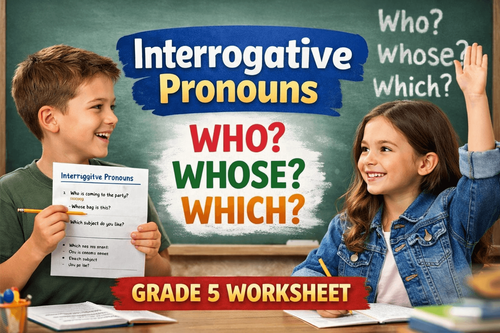
Working on grammar becomes easier when students practice through interesting questions and real examples. In Grade 5, students begin learning how to ask questions correctly using different types of pronouns. One important concept is interrogative pronouns. This English grammar worksheet for Grade 5 focuses on interrogative pronouns such as who, whose, and which. Through engaging exercises like true or false, multiple choice questions, fill-in-the-blanks, sentence rewriting, and paragraph practice, students learn how these pronouns work in everyday language. Practicing these activities helps learners understand how to form questions clearly and improve their grammar accuracy.
What Is Interrogative Pronouns?
Interrogative pronouns are pronouns that are used to ask questions. They help us gather information about people, things, or ownership in a sentence. In this Grade 5 English grammar worksheet, students work with the interrogative pronouns who, whose, and which.
The pronoun “who” is used to ask questions about a person.
The pronoun “whose” is used to ask about possession or ownership.
The pronoun “which” is used to ask about a specific thing or to choose between options.
By practicing these interrogative pronouns, students learn how to identify correct usage, select the appropriate pronoun, and rewrite sentences where repeated nouns can be replaced with interrogative pronouns.
What’s in This Worksheet?
This English grammar worksheet for Grade 5 includes different types of questions that help students practice interrogative pronouns in multiple ways.
1. True and False questions where students decide if interrogative pronouns are used correctly in sentences.
2. Multiple choice questions where students choose the sentence that correctly uses the interrogative pronoun.
3. Fill in the blanks questions where students select the correct interrogative pronoun from the given options.
4. Underline and rewrite sentences where repeated nouns are replaced with appropriate interrogative pronouns.
5. A paragraph activity where students fill in blanks using suitable interrogative pronouns.
These exercises help students recognize correct grammar patterns and improve their ability to form meaningful questions.
Definitions, Examples, Techniques, and Tips
Definitions
Interrogative pronouns are pronouns that are used to ask questions. In this worksheet, the interrogative pronouns practiced are who, whose, and which.
Examples
Who among the teachers will start the meeting.
Which book was given by the librarian.
Whose shoes are lying in the corridor.
These examples show how interrogative pronouns ask questions about people, things, and ownership.
Techniques
To choose the correct interrogative pronoun, students should first understand what the sentence is asking.
If the question is about a person, the correct pronoun is who.
If the question is about possession or ownership, the correct pronoun is whose.
If the question is about choosing a specific item from a group, the correct pronoun is which.
Quick learning tips
Read the sentence carefully before choosing the pronoun.
Identify whether the question refers to a person, ownership, or a specific thing.
Look carefully at the options provided in the worksheet.
Practice similar sentences regularly to strengthen grammar skills.
Why Is It Important to Learn This?
Learning interrogative pronouns is important because they help students ask clear and meaningful questions. When students understand how to use who, whose, and which correctly, they can communicate more effectively.
These pronouns also help avoid repeating nouns in sentences, making writing clearer and smoother. Understanding interrogative pronouns strengthens grammar knowledge, improves reading comprehension, and supports better writing.
For Grade 5 students, mastering this concept also prepares them for grammar questions in exams and classroom activities.
Where Will This Knowledge Help You?
This knowledge is useful in many academic and everyday situations.
Students use interrogative pronouns when answering grammar questions in exams.
They also use them while writing stories, paragraphs, and assignments.
In classroom discussions, interrogative pronouns help students ask questions clearly and participate actively.
Understanding interrogative pronouns also helps students read questions carefully in comprehension passages and answer them correctly.
How to Use This Worksheet?
Students can follow these steps to use this English grammar worksheet effectively.
1. Attempt the worksheet independently and read each sentence carefully.
2. Identify what the sentence is asking before selecting the interrogative pronoun.
3. Complete all sections in the order given in the worksheet.
4. After finishing, review the complete answer key carefully.
5. Compare your answers with the correct responses provided in the same order as the worksheet.
6. Correct mistakes and practice similar sentences regularly to improve accuracy.
Important Tips and Tricks
1. Always determine whether the question refers to a person, possession, or a specific object.
2. Use “who” for people.
3. Use “whose” to show ownership.
4. Use “which” when selecting from specific options.
5. Carefully read both options in multiple choice questions before selecting the correct answer.
6. While rewriting sentences, remove repeated nouns and replace them correctly with interrogative pronouns.
7. In paragraph-based questions, read the entire paragraph first to understand the context before filling the blanks.
Complete Answer Key
Exercise No. 1
1. True
2. False
3. False
4. True
5. True
6. True
7. False
8. True
9. True
10. False
Exercise No. 2
1. Who will lead the pledge.
2. Whose shoes are muddy.
3. Who borrowed the atlas.
4. Which painting is the brightest.
5. Who asked for tickets.
6. Which bag belongs to Meera.
7. Who gave the right answer.
8. Which drama was performed today.
9. Which notebook is red and blue.
10. Who will carry the flag.
Exercise No. 3
1. Who
2. Which
3. Which
4. Whose
5. Who
6. Which
7. Who
8. Whose
9. Which
10. Who
Exercise No. 4
The monitor asked who would collect sheets.
The prefect asked who shut the windows.
The teacher asked which lesson was taught.
The librarian asked whose books were left.
The cricketer asked who hit the ball.
The runner asked who reached last.
The singer asked which song was chosen.
The student asked whose homework was missing.
The painter asked whose colours were spilled.
The helper asked which chairs were broken.
Exercise No. 5
During the annual quiz competition in Kolkata, the teacher began with a smile and asked, “Who can answer the first question?” Riya raised her hand and the teacher nodded, saying, “Good, now tell me whose book was left on the desk.” In the next round, the principal joined and asked, “Which of these pictures shows our national animal?” The audience clapped when Ravi answered quickly. Later, the quizmaster said, “Who solved this riddle so fast?” The students laughed and whispered, “We know whose pen was dropped during the last round.” At the buzzer round, the teacher challenged, “Which team will finish first?” The scoreboard flashed names as excitement grew. After the event, the parents asked, “Who among you prepared these colourful posters?” The competition ended with applause, and the chief guest asked proudly, “Who has enjoyed this evening the most?”
Practicing interrogative pronouns helps students become confident in forming questions and using grammar correctly. This Grade 5 English grammar worksheet on interrogative pronouns gives learners structured practice with who, whose, and which through different types of exercises. By completing these activities and reviewing the answers carefully, students can strengthen their grammar foundation and improve both their writing and speaking skills.