
Learn Infinitive Verbs for Kids Step by Step

Table of Contents
- What Are Infinitive Verbs
- Step-by-Step Guide to Learning Infinitive Verbs
- Types of Infinitive Verbs with Infinitive Examples
- How Infinitive Verbs Work in Sentences
- Common Infinitive Verbs Examples for Kids
- Rules for Using Infinitive Verbs Correctly
- Infinitive Verbs vs Gerunds
- Fun Activities to Practice Infinitive Verbs
- Common Mistakes Kids Make with Infinitive Verbs
- Why Learning Infinitive Verbs Is Important
- Improve Your Child’s Grammar with PlanetSpark English Gramma
- Keep Learning and Growing Every Day
Do you ever see phrases like “to play” or “to eat” and wonder what they really mean? Many kids find grammar confusing, especially when learning Infinitive Verbs for the first time.
What if learning grammar felt like solving a fun puzzle instead of memorising rules?
In this blog, you will learn what infinitive verbs are, how to identify them, and how to use them in sentences with easy infinitive examples. You will also explore fun activities, common mistakes, and simple rules that make learning easier.
By the end, you will feel confident using infinitive verbs in your everyday speaking and writing. Let us begin with the basics.
What Are Infinitive Verbs
Infinitive verbs are the base form of a verb that usually begins with the word “to.” This means the verb is in its simplest form and does not change depending on who is doing the action or when it happens.
For example:
- to run
- to eat
- to read
- to jump
Think of infinitive verbs as the “original version” of a verb. Just like a toy comes in its basic form before you play with it, a verb also has a basic form before it changes into past, present, or future.
These verbs are called infinitives because they are not limited by time or person. They simply show an action in a general way.
Key Characteristics
Structure: “to” + base verb
This is the most common pattern. For example, “to play” or “to learn.”
Non-finite form
Infinitives do not show tense. This means they do not tell us if something happened in the past, is happening now, or will happen later.
Flexible use
Infinitive verbs are special because they can act like different parts of speech in a sentence:
- As a noun: To read is fun
- As an adjective: I have a book to read
- As an adverb: She studies to succeed
Infinitive Examples
- I like to play football.
- She wants to learn singing.
- They decided to watch a movie.
In each sentence, the infinitive verb tells us about an action but does not change its form.
Infinitive verbs are important because they help you express ideas clearly and simply without worrying about tense.
Step-by-Step Guide to Learning Infinitive Verbs
Learning infinitive verbs becomes very easy when you follow simple steps and practice regularly. Let us break it down:
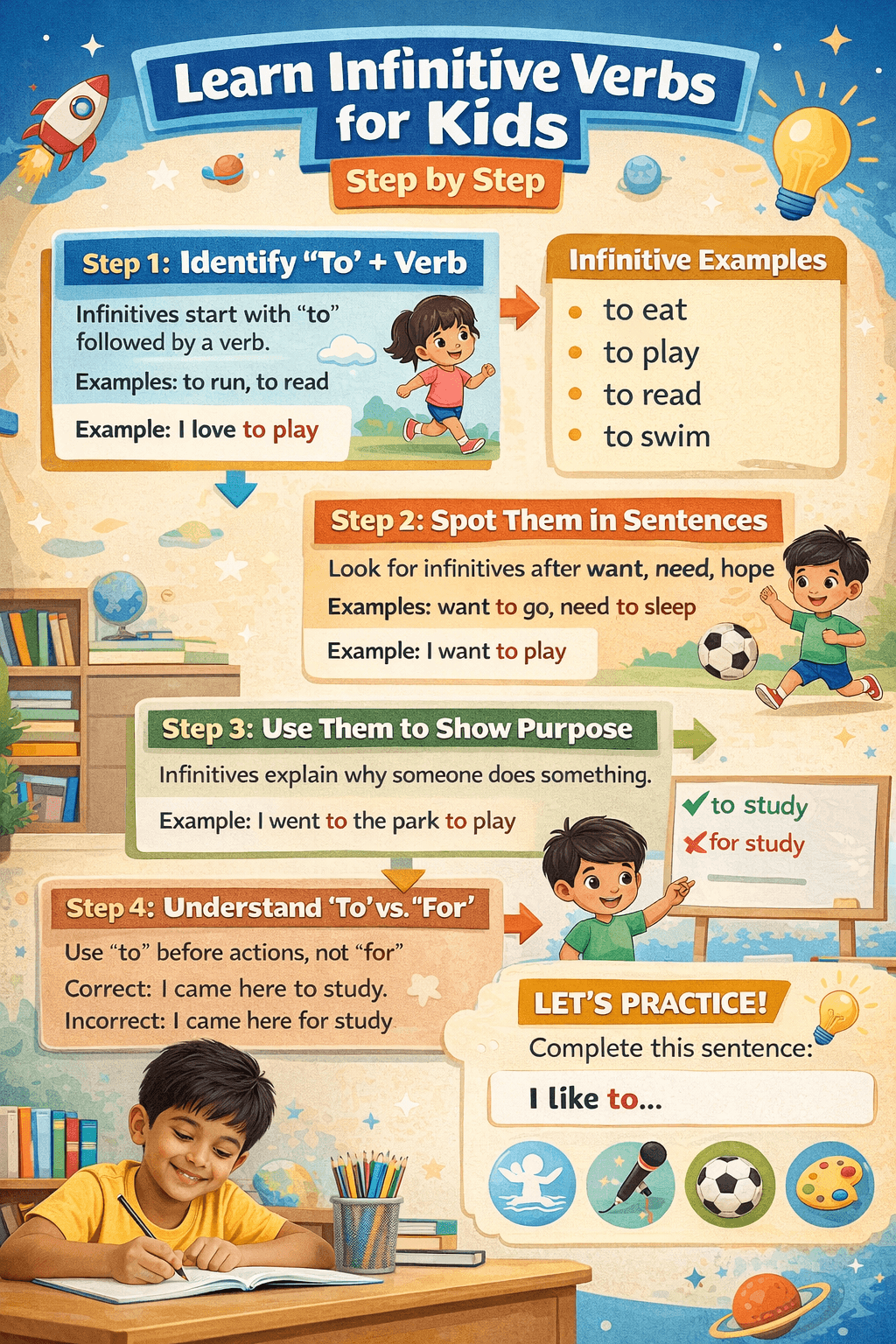
Step 1: Identify “To” + Verb
An infinitive is formed by placing “to” before a base verb.
Examples:
- to run
- to jump
- to read
Easy tip: If you see “to” followed by a verb, it is most likely an infinitive.
Step 2: Spot Them in Sentences
Infinitives often come after certain verbs like want, need, love, try, or hope.
Examples:
- I want to play
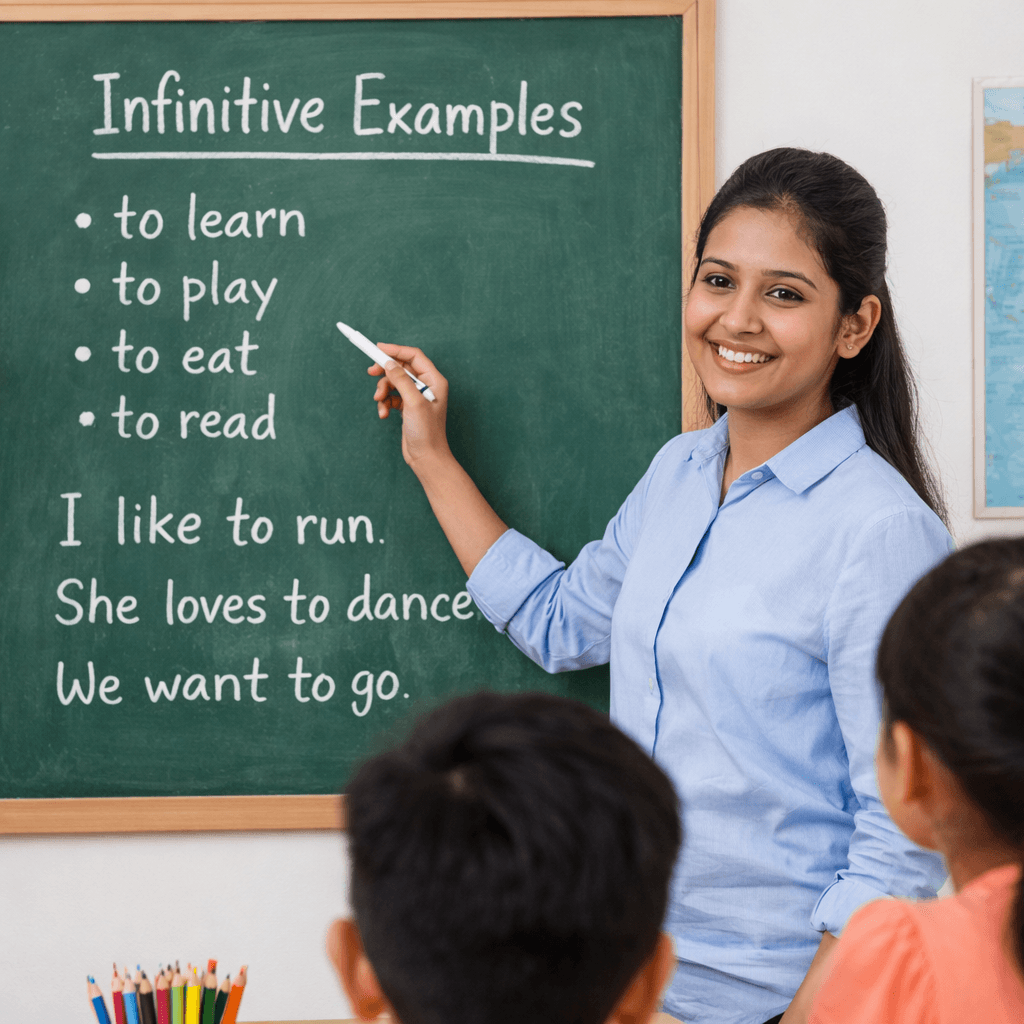
- She loves to dance
- We need to study
Why this matters: These helping verbs are like signals that an infinitive verb is coming next.
Step 3: Use Them to Show Purpose
Infinitive verbs are often used to explain why someone is doing something.
Example:
- I went to the park to play
- She studies hard to score good marks
Simple trick: If you can ask “Why?” and the answer starts with “to,” then it is an infinitive.
Step 4: Understand “To” vs “For”
Kids sometimes confuse “to” with “for.”
- Use “to + verb” when talking about an action
- Use “for + noun” when talking about a thing
Examples:
- Correct: I came here to study
- Correct: This gift is for you
Remember: “To” is for actions, “for” is for things or people.
Step 5: Practice Negative Infinitives
To make an infinitive negative, we simply add “not” before “to.”
Examples:
- He decided not to go
- I chose not to eat junk food
Quick tip: Just add “not” before “to” and keep the verb in its base form.
These steps make learning infinitive verbs simple, structured, and fun for kids. The more you practice, the easier it becomes to recognise and use them in everyday sentences.
Still finding grammar tricky? Book a FREE PlanetSpark trial class and boost your child’s confidence fast before slots fill!
Types of Infinitive Verbs with Infinitive Examples
Infinitive verbs may look simple, but they can appear in different forms depending on how they are used in a sentence. Understanding these types will help kids recognise them easily and use them correctly while speaking and writing.
Full Infinitives
Full infinitives are the most common type. They follow the pattern:
“to” + base verb
Examples:
- to eat
- to sleep
- to read
- to play
Sentence examples:
- I want to eat pizza
- She plans to travel tomorrow
- They like to watch cartoons
Easy tip: If you see “to” followed by a verb, it is usually a full infinitive.
Bare Infinitives
Bare infinitives are verbs used without “to.” They still remain in their base form.
They are commonly used after:
- Modal verbs: can, must, should, may
- Certain verbs: let, make, see, hear
Examples:
- She can run fast
- You must study daily
- Let him go outside
- I saw her dance
Why this matters: Even without “to,” these verbs are still infinitives because they are in their base form.
Split Infinitives
A split infinitive happens when a word comes between “to” and the verb. This is often used to add more detail or emphasis.
Examples:
- to quickly run
- to carefully read
- to happily sing
Sentence examples:
- She decided to quickly finish her homework
- He wants to carefully solve the problem
Fun fact: Split infinitives are common in spoken English and are perfectly fine to use.
Negative Infinitives
Negative infinitives are used to show that an action is not happening.
Structure:
not + to + verb
Examples:
- not to go
- not to eat
- not to speak
Sentence examples:
- He decided not to go to the party
- I chose not to eat junk food
- She promised not to be late
Quick tip: Just add “not” before “to” and keep the verb unchanged.
Understanding these infinitive verb examples helps kids use them confidently in different situations.
How Infinitive Verbs Work in Sentences
Infinitive verbs are very flexible. They can act like different parts of speech in a sentence, which makes them very useful in English.
As Nouns
Infinitives can act like nouns, which means they can be the subject or object of a sentence.
Examples:
- To learn is fun
- To play outdoors is healthy
- I love to read books
- She enjoys singing
Simple idea: If the infinitive is doing the job of a “thing” in a sentence, it is acting as a noun.
As Adjectives
Infinitives can describe nouns, just like adjectives do. They give more information about something.
Examples:
- I have homework to complete
- She found a place to sit
- He has a game to play
Easy trick: Ask “which one?” or “what kind?” If the infinitive answers that, it is acting as an adjective.
As Adverbs
Infinitives can also describe verbs. They often explain why something happens.
Examples:
- He came to help
- She studies hard to succeed
- I woke up early to catch the bus
Helpful tip: If the infinitive answers “why,” it is acting as an adverb.
More Infinitive Examples
- It is important to listen carefully
- He is happy to help others
- They are excited to travel
These sentences show how infinitives can add meaning and clarity.
Why This Is Important
When kids understand how infinitives work:
- Their sentences become clearer
- Their writing becomes more interesting
- They can express ideas more confidently
Infinitive verbs are like building blocks that help you create strong and meaningful sentences.
Want your child to speak and write confidently? Book a PlanetSpark trial class today and give them the expert edge before spots fill!
Common Infinitive Verbs Examples for Kids
Learning grammar becomes much easier when you see lots of examples. Infinitive verbs are used in everyday life, and once you start noticing them, you will find them everywhere.
Let us explore different types of infinitive examples that kids can easily relate to.
Everyday Examples
These are sentences you might use in your daily life:
- I want to eat pizza
- She likes to draw pictures
- They love to play games
- He tries to wake up early
- We like to watch cartoons
These examples show actions that someone wants, likes, or plans to do.
School Examples
Infinitive verbs are also very common in school-related sentences:
- I need to finish my homework
- He forgot to bring his book
- We plan to study together
- She wants to answer the question
- They decided to prepare for the test
These sentences show responsibility and actions related to learning.
Fun Activity Examples
Infinitives are often used when talking about hobbies and fun activities:
- She learned to ride a bike
- They decided to explore the park
- I want to build a sandcastle
- He tried to climb a tree
- We love to play outside
These examples make grammar feel more real and exciting.
Practice Activity
Now it is your turn. Complete the sentence:
“I like to…”
Examples:
- I like to swim
- I like to sing
- I like to dance
- I like to read
This simple activity helps kids think and create their own sentences, which improves learning.
Why Practice Matters
The more you practice the infinitive examples:
- The easier it becomes to recognise them
- Your sentences become more natural
- Your confidence improves
Infinitive verbs become simple when you use them every day.
Rules for Using Infinitive Verbs Correctly
Even though infinitive verbs are simple, following a few rules will help you use them correctly and avoid mistakes.
Rule 1: Use “to” with Most Verbs
Most infinitive verbs follow the pattern “to + base verb.”
Examples:
- I want to eat
- She likes to read
- They hope to win
This is the most common rule and the easiest to remember.
Rule 2: Do Not Use “to” After Modal Verbs
Modal verbs include words like can, must, should, may, and will. After these, we use the base verb without “to.”
Examples:
- She can dance
- You must study
- He should listen
Adding “to” here is incorrect, so be careful.
Rule 3: Use Infinitives After Certain Verbs
Some verbs are always followed by infinitives.
Common verbs include:
- want to
- plan to
- hope to
- decide to
- try to
Examples:
- I want to learn
- She plans to travel
- They hope to win
These verbs act as signals that an infinitive is coming next.
Rule 4: Avoid Repetition
Do not repeat “to” unnecessarily.
Wrong: to to play
Correct: to play
Always check your sentence for extra words.
Rule 5: Use Base Verb Form
After “to,” always use the base form of the verb.
Wrong: to playing
Correct: to play
Never add “ing” or past tense after “to.”
Why These Rules Matter
Following these rules helps you:
- Write correct sentences
- Avoid confusion
- Speak more clearly
Infinitive Verbs vs Gerunds
Many kids get confused between infinitives and gerunds because both refer to actions. Let us understand the difference in a simple way.
Infinitive Verbs
- Use “to” + base verb
- Example: to run, to eat
Gerunds
- End in “ing”
- Example: running, eating
Comparison Examples
- I like to swim
- I like swimming
Both sentences are correct, but they are used slightly differently.
Usage Difference
- Infinitives show purpose or intention
- Gerunds show general activities or habits
Examples:
- I went to the park to play
- I enjoy playing in the park
In the first sentence, “to play” explains why you went.
In the second sentence, “playing” shows something you enjoy in general.
Why This Is Important
Understanding the difference helps you:
- Avoid mistakes
- Write better sentences
- Sounds more natural in English
Is your child mixing up grammar concepts? Secure a PlanetSpark demo class now and build strong foundations before it’s too late!
Fun Activities to Practice Infinitive Verbs
Learning grammar does not have to be boring. With fun activities, kids can learn faster and remember better.
Sentence Builder Game
Pick a verb and create a sentence using an infinitive.
Example:
Verb: run
Sentence: I like to run every morning
This helps kids understand how infinitives fit into sentences.
Fill in the Blanks
Complete the sentences:
- I want ___ eat
- She likes ___ draw
Answer: to
This improves recognition of the infinitive structure.
Story Writing
Write a short story using at least 5 infinitive verbs.
Example idea:
“I went to the park to play and to meet my friends…”
This builds creativity and grammar together.
Find the Infinitive
Read a storybook and underline all the infinitive verbs you find.
This improves observation skills and understanding.
Why Activities Help
- Make learning fun
- Improve memory
- Build confidence
Practice makes grammar easy and enjoyable.
Common Mistakes Kids Make with Infinitive Verbs
Mistakes are normal when learning something new. Understanding them helps you avoid repeating them.
Mistake 1: Extra “to”
Wrong: to to play
Correct: to play
Always check for unnecessary repetition.
Mistake 2: Missing “to”
Wrong: I want eat
Correct: I want to eat
Do not forget “to” when it is needed.
Mistake 3: Mixing with Gerunds
Wrong: enjoy to play
Correct: enjoy playing
Some verbs need gerunds, not infinitives.
Mistake 4: Wrong Verb Form
Wrong: to playing
Correct: to play
Always use the base form after “to.”
Helpful Tip
Always look for the pattern:
to + base verb
This simple check can fix most mistakes.
Why Learning Infinitive Verbs Is Important
Infinitive verbs are one of the most important parts of English grammar. They help kids build strong communication skills.
What Kids Learn
- How to form correct sentences
- How to express purpose clearly
- How to improve writing and speaking
Real-Life Benefits
- Better performance in school
- Strong communication skills
- More confidence while speaking English
When kids understand infinitive verbs, they can express their thoughts more clearly and confidently. Grammar becomes easier, and communication becomes stronger.
Learning infinitive verbs is not just about rules. It is about building a strong foundation for language and confidence.
Improve Your Child’s Grammar with PlanetSpark English Grammar Classes
PlanetSpark English grammar classes are designed with a modern, child-first approach that goes beyond traditional rote learning. These classes help children truly understand grammar concepts such as infinitive verbs through real-world use and interactive experiences.
Instead of memorising rules, kids learn through stories, role plays, dialogues, and error correction. This ensures they can apply grammar confidently in speaking and writing.
Why Choose PlanetSpark English Grammar Classes
- 1:1 Personal Trainers for Every Child: Certified trainers personalise lessons based on learning style and pace.
- Personalised Curriculum and Learning Roadmap: Tailored plans that focus on grammar, vocabulary, and communication
- SparkX AI Video Analysis Tool: Tracks voice, grammar, confidence, and body language
- AI-led Practice Sessions: Helps kids practise speeches and storytelling independently
- Spark Diary for Writing Practice: Builds daily writing habits and creativity
- Gamified Learning with SparkBee: Fun quizzes, challenges, and rewards for grammar mastery
- SparkShop eBooks: Interactive and affordable grammar and vocabulary books
- Learning Clubs and Communities: Debate, storytelling, podcasting, and writing clubs
- Structured PTMs and Progress Reports: Track improvement in grammar, fluency, and confidence
These features ensure that children not only learn grammar but also become confident communicators.

Keep Learning and Growing Every Day
Learning infinitive verbs is an important step in mastering English. With regular practice and the right guidance, kids can easily understand and use them in daily communication.
Grammar is not just about rules. It is about expressing ideas clearly and confidently. Keep practising, stay curious, and enjoy the journey of learning.
Frequently Asked Questions
At PlanetSpark, we explain infinitive verbs as “to + base verb,” such as to eat or to play, which indicate actions without tense.
Examples include to run, to read, to write, and to jump.
Yes, in bare infinitives such as after modal verbs like can, must, or let.
Look for “to” followed by a base verb in a sentence.
Infinitives use “to,” while gerunds end in “ing.”
They help in building strong grammar, better writing, and confident speaking.
Through sentence building, storytelling, and fun grammar activities.