
Practice Jumbled Sentences for Class 4 to Strengthen Grammar Skills
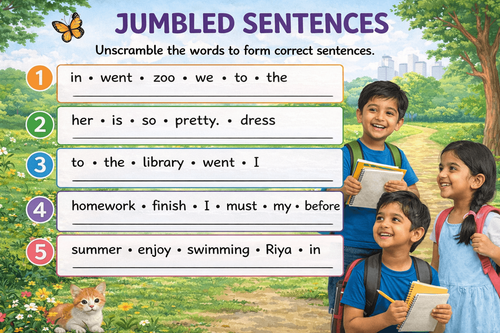

Table of Contents
- What Are Jumbled Sentences?
- Why Jumbled Sentences Are Important for Class 4 Students
- Understanding Sentence Structure for Class 4
- Step-by-Step Method to Solve Jumbled Sentences
- Practice Jumbled Sentences for Class 4
- Common Mistakes Class 4 Students Make
- Fun Activities to Practice Jumbled Sentences
- Worksheets and Practice Exercises
- Role of Parents and Teachers
- How PlanetSpark Helps Improve Grammar Skills
- Benefits of Regular Practice of Jumbled Sentences
As children progress to Class 4, their English learning journey becomes more structured and advanced. At this stage, they are expected not only to form simple sentences but also to understand grammar rules, sentence patterns, and clarity in expression. Strong sentence formation skills are essential because they directly impact reading comprehension, writing ability, and communication confidence.
However, many Class 4 students struggle with grammar concepts such as word order, tenses, and sentence flow. Traditional grammar exercises may sometimes feel repetitive or difficult to grasp. This is where jumbled sentences come into play as an effective and engaging learning tool.
Jumbled sentence exercises require students to rearrange words into meaningful sentences. These activities strengthen grammar skills while also improving logical thinking and problem-solving abilities. In this blog, we will explore how jumbled sentences help Class 4 students, understand sentence structure, and learn effective ways to practice them.
What Are Jumbled Sentences?
Jumbled sentences are exercises in which words are presented in a random or incorrect order. The student’s task is to rearrange these words to form a grammatically correct and meaningful sentence.
This method encourages students to actively think about sentence structure rather than memorizing grammar rules passively. It turns learning into an interactive challenge that improves both understanding and retention.
How Jumbled Sentences Work
In a jumbled sentence activity, students are given a set of words that belong to a sentence but are not arranged correctly. They must identify the correct order by analyzing grammar rules and sentence meaning.
For instance, a set of words like “playing / park / the / are / children / in” requires the student to identify the subject, verb, and other elements to form a proper sentence. This process helps them understand how sentences are constructed in real-life communication.
Through repeated practice, students begin to recognize patterns in sentence formation, which strengthens their overall grammar skills.
Why Jumbled Sentences Are Important for Class 4 Students
Jumbled sentences are not just a practice activity—they are a comprehensive tool for strengthening grammar skills and improving communication.
Strengthens Grammar Concepts
By rearranging words, students learn how grammar rules function in real sentences. They understand how subjects, verbs, and objects are placed and how tenses affect sentence meaning.
This hands-on approach helps students internalize grammar concepts instead of memorizing them mechanically.
Improves Sentence Clarity and Structure
Jumbled sentence exercises teach students how to organize words logically. This improves sentence clarity, making their writing more structured and meaningful.
Students also learn how small changes in word order can affect meaning, which is an important skill in language learning.
Enhances Logical and Analytical Thinking
Solving jumbled sentences requires critical thinking. Students must analyze each word and decide its correct position in the sentence.
This process develops analytical skills that are useful not only in language learning but also in other academic subjects.
Boosts Writing Skills
When students practice jumbled sentences regularly, they become better at forming sentences on their own. This directly improves their writing skills, including paragraph writing and creative expression.
They learn how to connect ideas and express them clearly.
Builds Confidence in Communication
As students become more comfortable with sentence formation, their confidence in speaking and writing increases. They are able to express their thoughts more clearly and participate actively in classroom discussions.
Help your child write clearer sentences—schedule a PlanetSpark demo class today.
Understanding Sentence Structure for Class 4
To solve jumbled sentences effectively, students need a strong understanding of sentence structure. At this level, sentence structure becomes more detailed and includes multiple components.
Subject, Predicate, and Object
The subject is the main part of the sentence that tells us who or what is performing the action. The predicate includes the verb and provides information about the subject.
For example, in the sentence “The teacher explained the lesson,” “the teacher” is the subject, and “explained the lesson” is the predicate.
Understanding these components helps students identify the correct order of words.
Types of Sentences
Class 4 students are introduced to different types of sentences, such as:
- Declarative sentences (statements)
- Interrogative sentences (questions)
- Imperative sentences (commands)
- Exclamatory sentences (expressions of emotion)
Recognizing these types helps students arrange words correctly based on the purpose of the sentence.
Use of Tenses in Sentences
Tenses play a crucial role in sentence formation. Students learn how verbs change depending on whether the action is happening in the present, past, or future.
For example, “She is playing,” “She played,” and “She will play” all have different meanings. Understanding tenses helps students form accurate sentences.
Role of Articles, Prepositions, and Conjunctions
Words like “a,” “an,” and “the” (articles), “in,” “on,” and “under” (prepositions), and “and,” “but,” and “because” (conjunctions) are essential for sentence clarity.
These small words often create confusion, but practicing jumbled sentences helps students understand their correct placement.
Step-by-Step Method to Solve Jumbled Sentences
Solving jumbled sentences becomes easier when students follow a structured approach. This method helps them think systematically and avoid confusion.
Identify the Main Subject
The first step is to find the subject of the sentence. This tells the student who or what the sentence is about.
By identifying the subject, students can determine where the sentence should begin.
Look for the Verb
The next step is to find the verb, which indicates the action. The verb usually comes after the subject and helps form the core of the sentence.
Understanding the verb also helps in identifying the tense of the sentence.
Arrange Supporting Words
Once the subject and verb are identified, the remaining words can be arranged around them. These include objects, prepositions, and descriptive words.
This step completes the sentence and gives it meaning.
Check Grammar Rules
Students should ensure that articles, prepositions, and conjunctions are placed correctly. This step helps refine the sentence and make it grammatically correct.
Read the Sentence for Meaning
Finally, students should read the sentence aloud to check if it makes sense. This helps them identify any errors and improve accuracy.
Practice Jumbled Sentences for Class 4
Regular practice is essential for mastering sentence formation. The following exercises are designed to gradually increase in difficulty and help students build confidence.
Easy Level Sentences
These sentences are suitable for beginners who are just starting with jumbled sentence exercises.
- is / my / this / book
- are / playing / children / the
- likes / she / ice cream
These exercises focus on basic sentence structure and help students build a strong foundation.
Medium Level Sentences
These sentences are slightly more complex and include additional words.
- going / we / market / the / to / are
- teacher / explained / the / lesson / clearly
- in / garden / the / playing / are / they
Students need to pay attention to word order and sentence flow.
Advanced Level Sentences
These sentences involve more complex structures and may include clauses.
- because / was / tired / he / early / slept / he
- finished / homework / after / she / went / to / play
- although / raining / was / it / they / continued / playing
These exercises help students develop advanced grammar skills.
Common Mistakes Class 4 Students Make
While practicing jumbled sentences, students often make mistakes that can affect their learning. Identifying these mistakes is important for improvement.
Incorrect Word Order
Students may place words incorrectly due to confusion about sentence structure. Regular practice and guidance help them understand correct patterns.
Misuse of Tenses
Using the wrong tense can change the meaning of a sentence. Students need to carefully identify the verb form and ensure it matches the context.
Missing Articles and Prepositions
Words like “a,” “an,” “the,” and prepositions are often skipped. These words are essential for clarity and must be used correctly.
Ignoring Punctuation
Students may forget punctuation marks such as full stops and question marks. Teaching proper punctuation helps complete sentences correctly.
Boost grammar and thinking skills with expert-led sessions—book your free demo now.
Fun Activities to Practice Jumbled Sentences
Learning becomes more effective when it is interactive and enjoyable. Activities help students stay engaged and motivated.
Sentence Puzzle Challenge
Students are given multiple jumbled sentences and asked to solve them as puzzles. This activity improves problem-solving skills.
Group Learning Activities
Working in groups encourages discussion and collaboration. Students learn from each other and improve their understanding.
Story Reconstruction Game
Students arrange jumbled sentences to form a story. This improves both sentence formation and comprehension skills.
Timed Sentence Race
Adding a time limit makes the activity exciting and encourages quick thinking.
Worksheets and Practice Exercises
Worksheets provide structured practice and help reinforce learning.
Printable Worksheets
Teachers and parents can use worksheets for regular practice. These can include different difficulty levels.
Daily Practice Exercises
Short daily exercises help students build consistency and improve gradually.
Role of Parents and Teachers
Parents and teachers play an important role in supporting students’ learning.
Creating a Learning Routine
Setting a regular practice schedule helps students stay consistent and disciplined.
Encouraging Practice Through Conversation
Using everyday conversations helps students understand sentence structure naturally.
Providing Constructive Feedback
Positive and helpful feedback encourages improvement and builds confidence.
How PlanetSpark Helps Improve Grammar Skills
PlanetSpark provides a structured and engaging platform for learning English.
Personalized Learning Plans
Each student receives customized lessons based on their learning needs, ensuring effective progress.
Live 1:1 Interactive Classes
Students get individual attention, which helps them understand concepts clearly and confidently.
Activity-Based Learning
PlanetSpark uses fun activities like jumbled sentences to make learning enjoyable.
Focus on Writing and Speaking Skills
Students develop both grammar and communication skills, which are essential for overall growth.
Regular Feedback and Tracking
Parents receive updates on their child’s progress, helping them stay involved in the learning process.
Make sentence building easy and fun for your child—try a Planet Spark demo class today.
Benefits of Regular Practice of Jumbled Sentences
Consistent practice of jumbled sentences leads to long-term improvement.
Strong Grammar Foundation
Students develop a solid understanding of grammar rules.
Improved Writing Skills
They learn to write clear and structured sentences.
Increased Confidence
Students become more confident in expressing their ideas.
Frequently Asked Questions
They are exercises where words are mixed and need to be rearranged into correct sentences.
They include longer sentences, tenses, and more complex structures.
Daily practice of 15–20 minutes is recommended.
Yes, they help students learn sentence structure and improve writing.
Using interactive methods like activities, games, and guided learning is most effective.