
Jumbled Sentences for Class 7: Improve Grammar and Sentence Skills


Table of Contents
- What Are Jumbled Sentences?
- Importance of Learning Jumbled Sentences
- Techniques to Solve Jumbled Sentences
- Real-Life Applications of Jumbled Sentences
- Tips for Parents to Support Learning
- Tools and Resources for Practice
- Common Mistakes You Might Make
- Interactive Ways to Learn Jumbled Sentences
- Common Challenges and How to Overcome Them
- PlanetSpark’s English Grammar Course: A Shortcut to Mastery
- Conclusion
Learning jumbled sentences is an essential skill for class 7 students. It improves grammar, sentence formation, and overall communication. At PlanetSpark, we make this process interactive and fun so that children not only learn but also enjoy practicing. Mastering jumbled sentences also boosts logical thinking as students figure out the correct order of words to convey a clear meaning.
With guided exercises and real-time feedback, PlanetSpark ensures every child develops a strong foundation in English grammar while having an engaging learning experience.
What Are Jumbled Sentences?
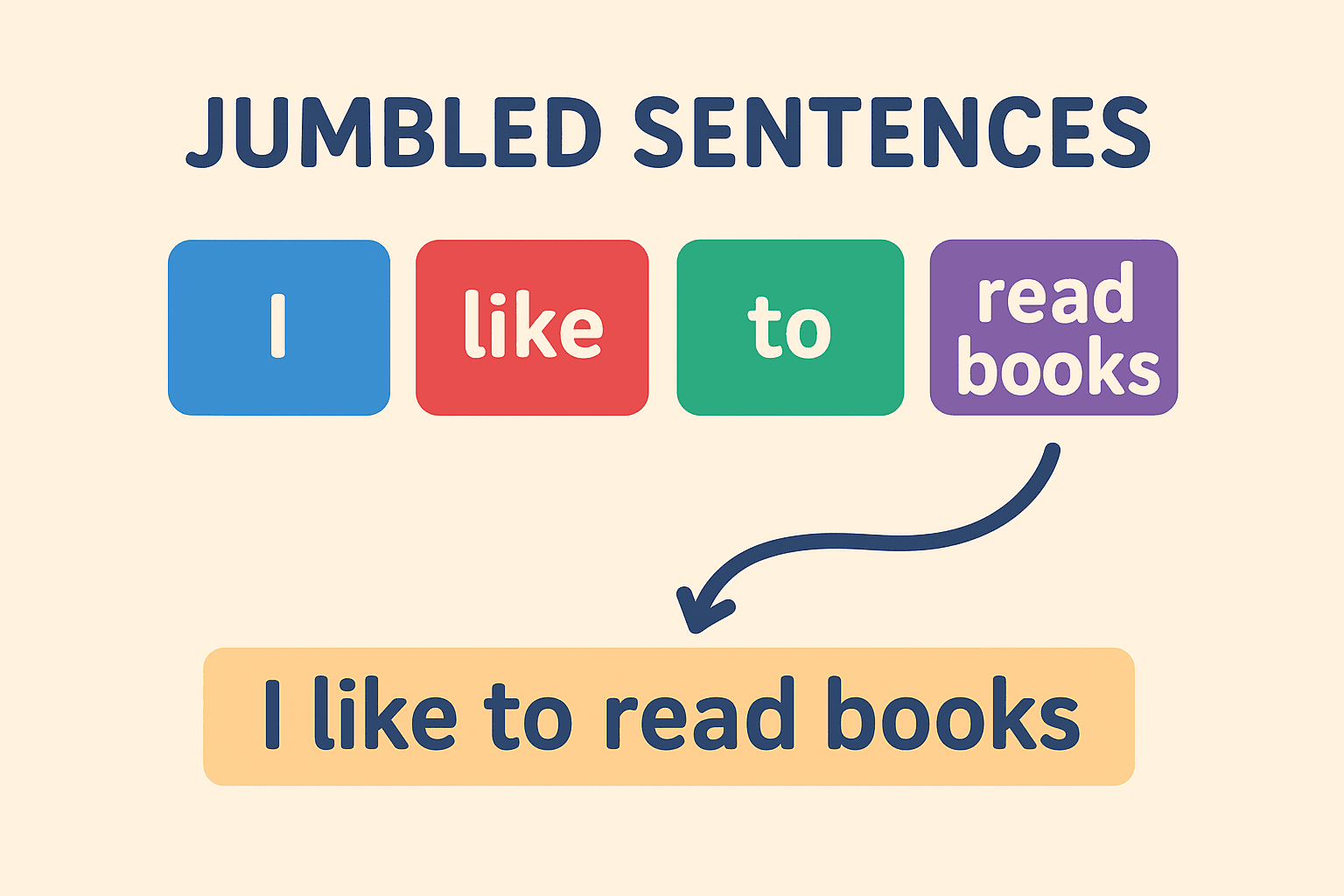
Jumbled sentences are sentences where the words are mixed up, and students have to arrange them in the correct order. This simple-looking activity actually builds a lot of important skills. First, it improves grammar because students learn how subjects, verbs, and objects are positioned in English sentences. Second, it encourages logical thinking because children must figure out which word should come first to make sense. Third, it strengthens vocabulary by showing how words function in different contexts.
Example:
Jumbled: "books my read I like"
Correct: "I like to read my books"
By practicing jumbled sentences, students become familiar with sentence structure and flow. They also learn to spot keywords such as “yesterday,” “quickly,” or “beautifully,” which often help in identifying the right sequence.
Do’s:
Read each word carefully and identify the subject first
Look for the main verb to understand the action
Use small connecting words like “is,” “a,” “the” to make the sentence smooth
Dont’s:
Do not try to guess randomly without understanding the meaning
Avoid ignoring punctuation as it can change the sentence meaning
Do not rush through the sentence; think logically

Importance of Learning Jumbled Sentences
Learning jumbled sentences is not just an exercise but a skill that strengthens multiple areas of English learning. It improves grammar, helps children understand word order, and boosts logical thinking. When students arrange sentences correctly, they develop a sense of how English sentences flow naturally.
Example:
Jumbled: "the sun shining bright is"
Correct: "The sun is shining bright"
Do’s:
Practice with simple sentences first and gradually try longer ones
Break down sentences into subject, verb, object, and other parts
Read aloud to ensure it sounds correct
Dont’s:
Do not ignore small words like “a,” “the,” and “is”
Avoid jumping to conclusions without analyzing the sentence
Do not hesitate to ask for help if unsure
Jumbled sentences also help students in exams and daily writing. They learn to arrange ideas clearly and logically. For instance, arranging story sentences improves storytelling skills.
Techniques to Solve Jumbled Sentences
Jumbled sentences can seem tricky at first, but they become simple once students follow a systematic approach. The first step is to identify the subject.
The subject tells us who or what the sentence is about. It is usually a noun or pronoun and is often placed at the beginning of a sentence in English. Recognizing the subject helps students anchor the rest of the sentence and gives a starting point for arranging other words.
Next, students should find the main verb, which describes the action of the subject. The verb is the backbone of the sentence because it connects the subject to what is happening. Without identifying the verb, it is difficult to make sense of the sentence. For example, in the jumbled sentence "morning the walked he to park," the word “walked” is the verb that indicates the main action.
Once the subject and verb are identified, the objects or complements should be placed to complete the meaning. Objects answer questions like what or whom after the verb. Complements provide additional information that completes the idea. In our example, “to the park” is the object phrase explaining where he walked.
Finally, students should check for time, place, and other modifiers. Words or phrases like “in the morning,” “yesterday,” or “quickly” usually appear at the end of the sentence. These words give context to the action and should not be ignored. Reading the sentence aloud helps ensure that it sounds natural and logical.
Do’s:
Focus on identifying the main action before arranging other words.
Break down the sentence into subject, verb, object, and modifiers.
Read the sentence aloud to verify the flow and meaning.
Practice regularly with examples of different lengths and complexities.
Dont’s:
Do not try to memorize positions without understanding sentence structure.
Avoid placing words randomly or skipping small but important words like “a” or “the.”
Do not ignore keywords that indicate time, place, or manner as they are crucial for meaning.
By following these techniques, students learn to approach jumbled sentences logically rather than guessing. PlanetSpark enhances this learning with interactive exercises where children practice real-time rearrangements, receive instant feedback, and learn the reasoning behind correct answers. Over time, this systematic approach not only helps in exams but also improves overall sentence formation and communication skills.
Real-Life Applications of Jumbled Sentences
Learning jumbled sentences is not just a classroom exercise; it has many practical applications in real life. One of the most obvious benefits is in writing essays and assignments. When students can arrange words correctly, they can express ideas clearly and logically. For example, a student writing a short story will find it easier to construct sentences like:
Jumbled: "played children happily the in park"
Correct: "The children played happily in the park"
Mastering jumbled sentences also improves storytelling skills. Students can narrate events or experiences in a sequence that makes sense, which is important not only in school but also in competitions, debates, and oral presentations.
Another key application is in exams. Many English tests include rearranging sentences as questions to check grammar, understanding, and logical thinking. Students who practice regularly are better prepared to answer such questions quickly and accurately.
Even daily communication benefits. Proper sentence formation helps students speak clearly and write emails, messages, or reports effectively. When children understand how to order words correctly, they gain confidence in expressing themselves.
Do’s:
Practice with real-life examples like short stories or daily activities.
Encourage children to write sentences after rearranging jumbled words.
Discuss why a particular order of words makes the sentence correct.
Dont’s:
Do not focus only on classroom exercises; include everyday examples.
Avoid rote memorization without understanding the logic of word order.
Do not ignore the importance of punctuation and connecting words.
Struggling with sentence formation?
Join a free demo class now
Master grammar with fun and interactive exercises
Tips for Parents to Support Learning
Parents play an essential role in helping children master jumbled sentences. One effective method is daily short practice sessions, where children rearrange 5 to 10 sentences each day. Short, consistent practice is more effective than long, infrequent sessions.
Games and interactive exercises at home can make learning fun. For example, parents can write jumbled sentences on cards and ask children to arrange them correctly. Rewarding correct answers with points or small treats can motivate students to participate actively.
Encouraging children to read aloud after arranging sentences is also beneficial. Reading aloud helps identify if the sentence sounds correct and reinforces sentence structure in memory.
Parents should also monitor mistakes without pressuring children. Mistakes are part of learning, and discussing errors helps children understand where they went wrong. For example, if a child writes:
Jumbled: "to market she went the"
Incorrect: "She to went market the"
Correct: "She went to the market"
Do’s:
Provide encouragement and positive reinforcement.
Practice regularly with short sessions and fun exercises.
Discuss errors constructively and explain the correct sentence structure.
Dont’s:
Do not pressure children to complete too many sentences at once.
Avoid correcting mistakes harshly; this can reduce confidence.
Do not rely solely on worksheets; include interactive and practical exercises.
Tools and Resources for Practice
There are many tools and resources that make learning jumbled sentences easier and more engaging. Worksheets are a traditional method, offering structured exercises that students can complete offline. They allow children to practice at their own pace and gradually tackle longer and more complex sentences.
Flashcards are another powerful tool. Writing each word on a separate card helps children physically rearrange words, improving their understanding of sentence structure. This tactile method reinforces memory and logic.
Digital resources like online quizzes, interactive exercises, and apps provide real-time feedback. Platforms like PlanetSpark offer live classes where students practice rearranging sentences, receive instant feedback, and understand why a sentence is correct or incorrect.
Video lessons are also helpful, as animated explanations and examples make abstract grammar rules easier to understand. For example, a video might show:
Jumbled: "rainy it is day today"
Correct: "It is a rainy day today"
Do’s:
Use a mix of worksheets, flashcards, online quizzes, and videos for varied learning.
Encourage children to explain their answers to reinforce understanding.
Practice consistently and review mistakes to ensure improvement.
Dont’s:
Do not rely on a single type of resource; variety ensures better learning.
Avoid passive learning; children must actively rearrange sentences themselves.
Do not ignore repeated mistakes; focus on correcting them with guidance.
Common Mistakes You Might Make
Jumbled sentences are a common challenge for class 7 students because arranging words correctly requires careful attention to grammar, logic, and sentence flow. Many students struggle because they mix up subjects and verbs, forget small connecting words, ignore punctuation, or place time and place words in the wrong position. Recognizing these common mistakes is the first step toward improvement and mastery of sentence formation.
One of the most frequent errors is mixing up the subject and verb. Students often swap the position of the subject and verb or place them far apart, making the sentence incorrect or confusing. For example:
Jumbled: "park the went children to"
Incorrect rearrangement: "Children to went the park"
Correct: "Children went to the park"
Here, the main verb “went” must immediately follow the subject “Children” for clarity and grammatical correctness.
Another mistake is ignoring small connecting words like “a,” “the,” “is,” or “to.” These words are essential for sentence meaning and smooth flow. Omitting them makes sentences incomplete or grammatically wrong. Students may also ignore punctuation, which can change the sentence meaning, especially in complex sentences.
Placement of time and place words is another common issue. Words like “yesterday,” “in the morning,” or “at the park” usually appear at the end or after the object. Incorrect placement can make a sentence sound awkward or confusing.
Do’s:
Double-check the relationship between the subject and verb to ensure clarity.
Always include small words like “a,” “the,” or “is” to maintain grammatical accuracy.
Read the sentence aloud to ensure it sounds correct and flows naturally.
Pay attention to time and place words and place them logically at the end or appropriate position.
Dont’s:
Do not rush through the sentence; take time to analyze each word.
Avoid skipping logical order or randomly placing words without thinking about meaning.
Do not ignore feedback or repeat the same mistakes; use errors as learning opportunities.
You can easily identify these common mistakes with interactive exercises and live feedback. By practicing systematically and learning from errors, children develop confidence in forming sentences, improve grammar skills, and gain clarity in writing and communication. Regular practice also ensures these mistakes reduce over time, making learning more efficient and enjoyable.
Boost your grammar skills today
Book a free demo class with PlanetSpark
Learn, practice, and speak confidently
Interactive Ways to Learn Jumbled Sentences
Learning jumbled sentences becomes much easier and enjoyable when students engage with interactive exercises. Traditional methods of memorizing rules often fail to hold children’s interest, but interactive learning makes the process fun and effective. One of the best ways to practice is through group activities, where students collaborate to solve jumbled sentences together. Working as a team allows children to share ideas, discuss possible arrangements, and understand sentence structure from multiple perspectives.
Albhabet Flashcards are another excellent tool for learning. Writing each word on a separate card and physically arranging them into the correct order helps students visualize sentence formation. This hands-on approach reinforces memory and logical thinking. For example:
Jumbled: "homework finished she has her"
Correct: "She has finished her homework"
Online quizzes and exercises are highly effective because they provide instant feedback. Platforms like PlanetSpark offer interactive quizzes where students can immediately see if their arrangement is correct. Instant results help identify weak areas and allow children to focus on improving them.
Story creation exercises are particularly engaging. Students are given jumbled sentences that they rearrange to form a story. This method not only strengthens grammar but also encourages creativity, vocabulary use, and logical sequencing of ideas. It transforms learning from a task into a fun, imaginative activity.
Do’s:
Practice regularly with peers to make exercises more engaging and enjoyable.
Encourage children to explain why a sentence is correct; reasoning helps internalize the rules.
Use a variety of exercises, such as flashcards, quizzes, group activities, and story-building, to reinforce learning from multiple angles.
Reward progress to motivate consistent practice and maintain interest.
Dont’s:
Do not stick to only one type of exercise; variety helps reinforce different skills.
Avoid passive reading without attempting to arrange sentences independently. Active participation is key.
Do not ignore incorrect answers; review mistakes and discuss why they were wrong to prevent repetition.
Do not rush through exercises; careful analysis ensures better understanding.
Common Challenges and How to Overcome Them
Many students face challenges while learning jumbled sentences, but these difficulties can be overcome with the right strategies and guidance. One of the most common issues is confusing tenses. Students sometimes mix past, present, and future tense words when rearranging sentences, which changes the meaning entirely. For example:
Jumbled: "yesterday to park they went the"
Incorrect: "They go to the park yesterday"
Correct: "They went to the park yesterday"
Another challenge is dealing with long or complex sentences. Sentences with multiple clauses or extra descriptive words can be intimidating. Breaking the sentence into smaller parts and identifying the subject, verb, object, and modifiers and makes it manageable. For example:
Jumbled: "beautiful the garden in flowers bloomed the spring during"
Correct: "The beautiful flowers bloomed in the garden during spring"
Translating from the mother tongue can also create problems. Students may try to arrange words in the order used in their native language, which does not always match English grammar rules. Encouraging students to think in English and understand sentence logic rather than translating word by word is crucial.
Some students also struggle with skipping small words like “a,” “the,” “is,” or prepositions such as “in,” “on,” and “to.” These words are essential for clarity and correct sentence formation. Ignoring them can make a sentence incomplete or grammatically incorrect.
Do’s:
Break longer sentences into smaller parts to identify subject, verb, object, and modifiers.
Pay attention to tenses and ensure consistency throughout the sentence.
Practice thinking in English rather than translating from the mother tongue.
Read the sentence aloud to ensure it sounds natural and complete.
Encourage children to use small but important words like articles and prepositions.
Dont’s:
Do not rush through sentences, especially longer ones; take time to analyze each part.
Avoid skipping over connecting words or punctuation as they affect meaning.
Do not rely on guesswork; understanding sentence logic is key.
Do not ignore repeated mistakes; review and practice them until correct.
PlanetSpark’s English Grammar Course: A Shortcut to Mastery
At PlanetSpark, grammar is not taught as boring rules. Instead, we make it:
Interactive Grammar Learning –
Grammar is taught through stories, dialogues, role plays, and error correction, making learning engaging and meaningful instead of relying on memorization.
Gamified Learning Tools
Students master grammar using fun quizzes, word puzzles, and interactive exercises, making practice enjoyable and motivating.
Integrated Writing Practice
Each grammar topic is followed by sentence-building and writing tasks, allowing students to apply concepts in real-life contexts and strengthen practical usage.
Grammar Proficiency Levels
Students progress from foundational topics like nouns, verbs, and punctuation to advanced concepts such as conditionals, passive voice, and reported speech, with clear milestones to track growth.
Parent Reports on Grammar Skillsets:
Detailed reports monitor improvement in key areas;
Writing fluency
Sentence structure and complexity
Grammatical accuracy
Logical flow and content organization
Critical thinking and creativity
Confidence, voice modulation, and delivery
Body language and syntax
Learning grammar can be daunting for many students, but PlanetSpark takes a unique approach to make it fun, practical, and confidence-building. Here’s how:
Whether your child is in Grade 5, Grade 8, or preparing for Class 12 exams, our courses are tailored to their level.

Conclusion
Mastering jumbled sentences is a crucial skill for class 7 students, as it strengthens grammar, sentence formation, and overall communication. By practicing regularly and using systematic techniques, children can arrange words logically and express their ideas clearly. Interactive exercises, group activities, flashcards, and online quizzes make learning fun and effective. Parents can support their children at home with short practice sessions and constructive guidance.
Platforms like PlanetSpark provide live classes, personalized feedback, and engaging exercises to ensure every child learns confidently. Overcoming common challenges, such as tense confusion or long sentences, becomes easier with consistent practice and proper strategies. Ultimately, mastering jumbled sentences not only improves academic performance but also builds lifelong communication skills and confidence in English. Start practicing today and watch your child transform into a confident communicator.
Frequently Asked Questions
Jumbled sentences are sentences where the words are mixed up, and students need to arrange them in the correct order. Practicing these helps children understand sentence structure and improves grammar and clarity in writing and speaking.
It strengthens grammar, logical thinking, and sentence formation skills. Mastering jumbled sentences also boosts confidence in writing essays, storytelling, and communicating ideas effectively.
Start with short sentences and gradually move to longer ones. Use flashcards, read the rearranged sentences aloud, and encourage children to explain why the order is correct to reinforce learning.
Daily practice of 10–15 minutes is enough to see steady improvement. Consistent short sessions are more effective than long, infrequent practice.
PlanetSpark provides live interactive classes where teachers guide students step by step. Children receive instant feedback, solve exercises in real-time, and learn through fun quizzes and activities.
Yes, PlanetSpark provides detailed progress reports for parents. These reports highlight improvements, identify weak areas, and suggest exercises to strengthen skills further.
Basic grammar knowledge helps, but it is not necessary. Interactive exercises and guidance at PlanetSpark teach sentence formation even to beginners in a structured and engaging way.