
Myself Paragraph: How to Write About Yourself in English
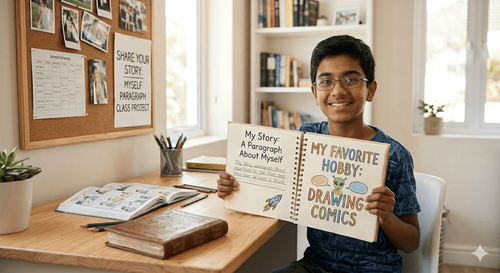

Table of Contents
- What Is a Myself Paragraph and Why Does It Matter?
- What to Include When You Write a Paragraph About Myself
- How PlanetSpark Helps in Writing a Paragraph About Myself in
- How to Introduce Myself in English Paragraph: Learn with Pla
- Paragraph on Myself in Sanskrit: A Quick Overview
- Common Mistakes to Avoid in a Myself Paragraph
- Build Your Writing and Confidence with PlanetSpark
- So, What Will Your Paragraph Say About You?
Writing a paragraph myself sounds simple. You'd think, "I know myself, so this should be easy." But when you actually sit down to write, the words just don't come. What do I say first? How much is too much? Do I sound boring?
This is one of the most common struggles kids and teens face in English class and even in real-life introductions. Whether it's a school assignment, a speech, or just filling out a "Tell us about yourself" form, knowing how to write a paragraph about myself in english is a skill that pays off again and again.
This blog covers everything: what a paragraph actually is, how to structure it, what to include, sample paragraphs, a quick note on paragraphs about myself in Sanskrit, and tips to make yours stand out. Let's get into it.
What Is a Myself Paragraph and Why Does It Matter?
A myself paragraph is a short written self-introduction covering your name, age, family, interests, and goals, used in school assignments, speeches, and profiles.
A myself paragraph is a short written piece where you introduce yourself to a reader or audience. It's usually 5 to 10 sentences long and covers the basics: your name, age, family, interests, school, and maybe a goal or two.
But here's the thing. It's not just a school exercise. Knowing how to write a paragraph about myself in English builds a skill you'll use your whole life. Job applications, college essays, social media bios, speeches, interviews: they all start with "Tell me about yourself." The kid who learns to do this clearly and confidently early on has a serious edge.
What makes a good paragraph? It's honest, specific, and has some personality. Not just "My name is Riya and I like reading." That's fine, but it doesn't stick. A good paragraph about myself in English gives the reader a real sense of who you are. Think of it this way: if someone read your paragraph and then met you, would they feel like they already knew you a little? That's the goal.
Parents, this is also why your child's early writing practice matters so much. Research from the National Literacy Trust found that in 2024, fewer than 3 in 10 children aged 8 to 18 said they enjoy writing in their free time, and daily writing habits have halved in a single year. That's a significant gap. A myself paragraph teaches kids to organise their thoughts, choose the right words, and communicate with confidence. It's the foundation of every kind of self-expression.
What to Include When You Write a Paragraph About Myself
A strong paragraph includes your name, age, school, family, hobbies, and a personal goal, written in simple, specific, and natural language.
Okay, so what actually goes inside a paragraph? Imagine you're meeting someone new. What would you naturally tell them? That's your starting point.
Here's what most strong paragraphs about myself in English include:
- Your name and age. Start here. It's the most natural opener and gets the reader grounded quickly.
- Where you're from or where you study. Your school, city, or grade level gives context and helps the reader picture your world.
- Your family. A quick mention works well. "I live with my parents and a younger brother" is enough.
- Hobbies and interests. This is where your personality shows up. Be specific. "I love drawing comic characters" says way more than "I like art."
- A goal or dream. Even a simple one adds real depth and shows the reader what drives you.
- A closing line. Wrap it up with something warm. Like: "I'm excited to keep learning and growing every day."
One pro tip: avoid starting every sentence with "I." It gets repetitive fast. Mix up your sentence starters and your paragraph will flow much better. If you want to go deeper into how structured writing helps kids communicate better, this guide on descriptive writing for kids is a great next read.
At PlanetSpark, students practise exactly this kind of structured self-expression in live writing classes. They learn not just what to write, but how to make every word count.
Want your child to write with clarity and confidence? Book a free PlanetSpark demo class today.
How PlanetSpark Helps in Writing a Paragraph About Myself in English?
Writing a paragraph myself in English is easy with six steps: brainstorm, pick key points, arrange logically, write simply, read aloud, and refine.
Here's a simple process you can follow. It works whether you're a student doing this for the first time or a parent helping your child get started.
Step 1: Brainstorm first, write later. Jot down 10 things about yourself. Don't filter. Just list: name, age, school, city, siblings, pets, hobbies, favourite food, a dream, something you're proud of. Get it all out.
Step 2: Pick the best 5 or 6. Not everything belongs in one paragraph. Choose what's most interesting and most relevant.
Step 3: Arrange them in a logical order. Start with who you are (name, age, school), move to what your life looks like (family, hobbies), and end with where you're headed (goals, dreams).
Step 4: Write in simple, clear sentences. Avoid fancy words you wouldn't normally use. The best paragraph sounds natural, not forced.
Step 5: Read it out loud. This is the secret step most people skip. Reading aloud helps you catch awkward sentences and flat spots quickly.
Step 6: Polish and refine. Fix any sentence that starts with "I" three times in a row. Add one specific detail that makes it feel real and personal.
This six-step method is exactly what PlanetSpark's English Writing Skills classes teach kids in a structured, fun way. Instead of figuring it out alone, children get a trained teacher guiding every step with real-time feedback.
Help your child master this process with expert support. Try PlanetSpark's free demo class now.
How to Introduce Myself in English Paragraph: Learn with PlanetSpark.
Knowing how to introduce myself in English paragraph form means adapting your tone for school assignments, class speeches, or short online bios confidently.
Knowing how to introduce myself in English paragraph style changes depending on the context. Here are three versions to know:
For school assignments: Keep it factual and clear. Include your name, age, class, hobbies, family, and goals. Around 80 to 100 words is perfect. Neat structure matters more than flair here.
For a class speech or presentation: Make it a bit warmer and more conversational. Add a line about what makes you unique. Maybe a funny memory or a skill you're proud of. Speaking and writing overlap here, so practise saying it out loud too.
For an online profile or bio: Usually shorter. Two to three sentences. Lead with something interesting, not just your name. "Passionate about coding and football, 13-year-old Priya is always building something new" works better than just listing facts.
The structure of how to introduce myself in English paragraph style stays roughly the same: start with identity, add personality, close with aspiration. But the tone shifts based on who's reading or listening. According to the NAEP, only about 27% of students from grades 4 through 12 write at proficiency level, which means most kids genuinely need practice in formats like these to build that edge.
PlanetSpark's classes cover all three formats. Kids learn to shift their tone smartly depending on whether they're writing for a teacher, speaking to a crowd, or presenting themselves online.
Give your child the confidence to introduce themselves in any situation. Try PlanetSpark free today.
Paragraph on Myself in Sanskrit: A Quick Overview
A paragraph on myself in Sanskrit uses phrases like "Mam naam" and "Aham padhami" to introduce your name, school, family, subject, and dream correctly.
Many students are also asked to write a paragraph about themselves in Sanskrit as part of their school curriculum. While it follows the same basic structure as an English paragraph, Sanskrit introductions use specific forms and vocabulary.
A simple paragraph on myself in Sanskrit typically includes:
- Mam naam... (My name is...)
- Aham...kakshayaam padhami (I study in class...)
- Mama pituh naam... (My father's name is...)
- Mama priya vishayah...asti (My favourite subject is...)
- Mama svapna asti... (My dream is...)
It's worth practising this with a teacher or tutor since Sanskrit has specific grammatical rules around gender, case, and verb forms. Getting the basics right makes a big difference in how your paragraph on myself in Sanskrit reads to the examiner. Even a short, correct paragraph is far better than a long one with errors.
While PlanetSpark focuses on English communication and writing, the structured approach to self-expression that students learn here directly supports how they organise thoughts in any language, including Sanskrit assignments. The discipline of thinking clearly before writing is universal.
Build the writing foundation that helps across all subjects. Book your free PlanetSpark class now.
Common Mistakes to Avoid in a Myself Paragraph
Common paragraph mistakes include being too vague, starting every sentence with "I," making it too long, and skipping proofreading before submission.
Even a well-intentioned myself paragraph can go wrong in a few predictable ways. Watch out for these:
Being too vague. "I like sports" tells us nothing. "I play badminton every evening and I'm training for my school tournament" tells us everything. Specificity is what makes writing come alive.
Listing without connecting. Don't just bullet-point your life. Connect things with transitions. "Not only do I love reading, but I also enjoy writing my own short stories" flows much better than two flat sentences back to back.
Making it too long. A paragraph is not an essay. Keep it tight. 80 to 120 words is the sweet spot for most school-level paragraphs.
Starting every sentence with "I." This makes the paragraph feel repetitive and robotic. Vary your openers to keep the reader engaged.
Forgetting to proofread. Spelling mistakes and grammar errors undermine even the best content. Always read it over at least twice before submitting.
These are exactly the habits PlanetSpark teachers catch and correct in real time during live writing sessions. Students don't just write: they learn to evaluate and improve their own work, a skill that sticks for life. If you want to understand why building confidence in writing matters beyond the classroom, this PlanetSpark blog on building confidence in kids explains it really well.
Evidence backs this up too. A comprehensive meta-analysis published in peer-reviewed educational research found that structured writing instruction significantly improves written composition quality in primary-grade students, with the strongest gains seen in children who received personalised, focused guidance.
Help your child write better from draft one. Try a free PlanetSpark demo class and see the difference.
Build Your Writing and Confidence with PlanetSpark
English Writing Skills Classes for Kids and Teens
If your child struggles to find the right words, whether it's for a myself paragraph or any writing task, PlanetSpark's English Writing Skills programme is built exactly for this.
These live, online classes are designed for kids and teens aged 6 to 16 who want to express themselves better in English, both in writing and out loud. Many children can speak, but they freeze when asked to put it on paper. PlanetSpark closes that gap.
- Live, interactive classes with real-time teacher feedback
- Expert teachers who make writing fun and approachable
- Structured curriculum moving from basics to advanced expression
- Real-world writing practice: paragraphs, essays, emails, and more
- Personalised attention so every child progresses at their own pace
- Confidence-building activities woven into every session
- Progress tracking so parents can see growth clearly
Book a free demo class today and watch your child find their voice on paper.
So, What Will Your Paragraph Say About You?
Writing a myself paragraph isn’t just about filling lines on a page. It’s about learning how to express who you are, clearly, honestly, and with a little personality. And yes, it might feel awkward at first. Most people sit there thinking, “Where do I even begin?” That’s normal.
But once you follow a simple structure, pick specific details, and write like you actually speak, things start to click. Your paragraph stops sounding like a school task… and starts sounding like you.
The real question is, if someone reads your paragraph, will they remember you?
That’s the goal. Not perfection. Not fancy words. Just clarity, confidence, and a bit of realness.
And the more you practice, the easier it gets. So go ahead, write your first draft, read it out loud, tweak it a little, and make it yours.
Frequently Asked Questions
Start with your name and age, add details about family and school, mention two or three hobbies, and close with a goal. Keep it 80 to 120 words and use simple, clear language. PlanetSpark's English writing classes teach this exact process step by step through live, interactive sessions.
For most school assignments, 80 to 120 words is ideal. For speeches or longer tasks, you can extend to 150 to 200 words comfortably. PlanetSpark's spoken English course also helps children practice presenting paragraphs like these out loud with confidence.
Make a simple list of facts about yourself first, then turn each one into a sentence. Don't aim for perfection in draft one. Just get it down, then improve. PlanetSpark's speaking English course is built specifically for children who know what they want to say but freeze when putting it into words.
Open with your name and something interesting about yourself. Add your school and a hobby. Close with a goal. Use a warm, natural tone throughout. For children who present regularly, PlanetSpark's online courses for kids blend written introductions with live speaking practice so both skills grow together.