
Learn Possessive Adjectives Easily for Kids
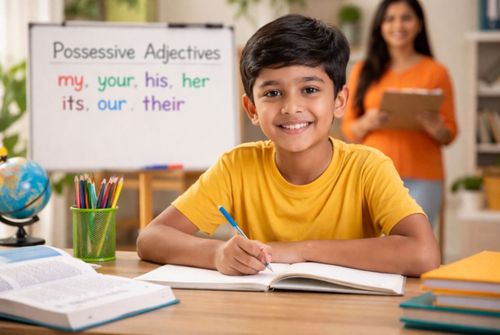

Table of Contents
- What Are Possessive Adjectives?
- List of Possessive Adjectives
- Possessive Adjectives Examples
- How to Use Possessive Adjectives (Simple Rules)
- Possessive Adjectives vs Possessive Pronouns
- Games to Learn Possessive Adjectives
- Key Strategies for Easy Learning
- Why Possessive Adjectives Are Important for Kids?
- How PlanetSpark Classes Help Kids Learn Possessive Adjective
- Conclusion
Learning grammar can sometimes feel confusing for children. For example, Riya once said, “Me book is missing” instead of “My book is missing.” Many kids understand the idea of ownership but struggle to use the correct words while speaking or writing. This is where possessive adjectives become important, as they help show who owns something in a simple way. These words always come before nouns and clearly express belonging, which makes sentences easier to understand.
At PlanetSpark, children learn possessive adjectives through fun activities, storytelling, and real-life practice. Instead of memorising rules, they learn how to use them naturally while speaking and writing. This helps build confidence, improve communication, and make learning English enjoyable for every child.
What Are Possessive Adjectives?
Possessive adjectives are very simple once you understand them clearly. These are words that help us show that something belongs to someone. They are words that show ownership or belonging. They always come before a noun and tell us who owns something.
Simple Examples:
This is my book
- That is her bag
Their house is big
These examples make it easy to see what are possessive adjectives in daily life. They help us speak clearly and avoid confusion when talking about things that belong to someone.
Now that you understand the basic idea, let us look at all the possessive adjectives in one simple and easy list.
List of Possessive Adjectives
To understand the concept better, you will have to learn English possessive adjectives list. This list helps children remember and use the correct words while speaking and writing. Following it makes sentence formation easier and more accurate.
Pronoun | Possessive Adjective | Example |
I | my | My bag |
You | your | Your pencil |
He | his | His toy |
She | her | Her dress |
It | its | Its tail |
We | our | Our school |
They | their | Their house |
This table shows all the commonly used possessive adjectives in a simple format. Most English sentences use these words to show ownership clearly and correctly.
Now that you have learned the list, let us move ahead and explore some fun and real-life examples to understand them even better.
Possessive Adjectives Examples
Examples make learning much easier for children, especially when they connect to daily life. Instead of memorising rules, kids can understand possessive adjectives examples through situations they already know. Check out these fun examples and understand them completely.
Toys:
This is my teddy
- That is his toy car
Her doll is pretty
School:
My teacher is kind
- Her notebook is neat
Their classroom is clean
Family:
Our house is big
- His sister is funny
Their parents are friendly
These possessive adjectives examples show how we use these words naturally while talking about things around us. When children see familiar situations, they learn faster and remember longer.
Build strong grammar skills with structured guidance. Learn possessive adjectives clearly and improve communication and confidence. Start now!
Once examples are clear, the next step is to understand how to use these words correctly in every sentence.
How to Use Possessive Adjectives (Simple Rules)
Learning a few simple rules can help children use possessive adjectives correctly without confusion. These rules are easy to remember and apply in daily conversations. Check these three simple rules to use them correctly.
✔ Rule 1: Comes before a noun
✔ My book is new
❌ Book my is new
✔ Rule 2: No apostrophe is used
✔ Its tail is long
❌ It’s tail is long
✔ Rule 3: Do not use “the” before it
✔ My bag is blue
❌ The my bag is blue
These rules help children form correct sentences because possessive adjectives always come before nouns and show ownership clearly.
Now that the rules are simple and clear to you, it becomes easier to spot and correct common mistakes that children often make. Now, let us move a step ahead and understand a concept that often confuses learners.
Possessive Adjectives vs Possessive Pronouns
Many children get confused between possessive adjectives and possessive pronouns, but the difference is actually very simple. Understanding this helps in forming correct sentences. Let’s understand their main difference through the following checklist.
Simple Difference:
A possessive adjective comes before a noun
This is my bookA possessive pronoun replaces the noun
This book is mine
More Examples:
✔ Her bag is blue (adjective)
- ✔ The bag is hers (pronoun)
- ✔ Their house is big (adjective)
✔ The house is theirs (pronoun)
Possessive adjectives always need a noun after them, while possessive pronouns can stand alone in a sentence.
Now that this difference is clear, learning becomes easier and more structured, especially when we move towards fun and interactive ways to practise these concepts.
Games to Learn Possessive Adjectives
Playing games can make grammar much more enjoyable for children, especially when they get to practise Games to learn possessive adjectives in a fun way instead of boring worksheets.
Game 1: Fill the Blank Race
Write sentences with missing words and ask kids to fill them quickly.
This is ___ (my/her) book
___ (their/our) house is big
Game 2: Role Play
Ask children to talk about their things.
This is my bag
That is his toy
Game 3: Spot the Mistake
Give incorrect sentences and let kids correct them.
❌ Me pencil → ✔ My pencil
❌ The her book → ✔ Her book
These activities make possessive adjectives easier to understand because children learn by doing rather than memorising rules. Interactive learning also improves retention and builds confidence while speaking.
After enjoying these games, children are ready to practise more seriously and test what they have learned.
Key Strategies for Easy Learning
When children understand how to learn possessive adjectives, simple strategies can make the process quicker and more natural. These techniques help avoid confusion and build confidence with everyday use.
Map Pronouns to Adjectives
Memorising direct pairs helps avoid mistakes. For example:
I → My
- You → Your
- He → His
- She → Her
- It → Its
- We → Our
They → Their
This pairing always shows who something belongs to.
Use Everyday Objects
Touch objects around you and say aloud who they belong to, such as “This is my phone” or “That is your chair.” Practising with familiar items makes learning feel natural and fun.
Avoid Common Mistakes
Always remember that possessive adjectives never use apostrophes. For example, “its” shows ownership, whereas “it’s” means “it is” or “it has.”
Contextual Drills
Create simple, personal sentences like “I like their new car” or “She is doing her homework.” The more children practise in real situations, the better they remember.
Make learning fun with expert-led practice. Master possessive adjectives examples and develop clarity in speaking and writing. Join today!
Focus on the Owner
When choosing between words like his, her, and their, focus on the person or people owning the object, not the object itself. This makes it easier to choose the right word quickly.
Here is a quick practice table to help kids remember and use these words correctly:
Subject | Possessive Adjective | Example |
I | My | My keys are here. |
You | Your | Is this your bag? |
He | His | That is his car. |
She | Her | She lost her wallet. |
It | Its | The dog wagged its tail. |
We | Our | Our house is big. |
They | Their | Their team won. |
This table makes it easy to see at a glance how each pronoun links to its corresponding possessive adjective and how to use it in a sentence. Now let’s explore why knowing possessive adjectives matters for young learners beyond just correct grammar.
Why Possessive Adjectives Are Important for Kids?
Possessive adjectives help children speak and write clearly, express ownership confidently, and avoid misunderstandings. These small words play a big role in building strong communication skills and academic success.
Improves Communication
Possessive adjectives make sentences clear and accurate, so listeners and readers understand exactly what a child means. When a child says, “This is my book,” everyone knows who the book belongs to, which makes communication smoother and more enjoyable.
Builds Confidence
When children use grammar correctly, they feel proud of their language skills. This confidence shows when they speak in class, take part in conversations, or share stories with friends and family. A strong foundation in grammar reduces hesitation and encourages active participation.
Helps in Exams
Grammar is an essential part of school assessments. Knowing how to use possessive adjectives correctly helps children write better sentences in their compositions and answer questions accurately in tests, which can lead to higher grades.
Each of these benefits not only strengthens everyday communication but also supports long‑term language growth and confidence in young learners.
How PlanetSpark Classes Help Kids Learn Possessive Adjectives?
Learning possessive adjectives becomes easy and enjoyable when children are guided step by step, rather than expected to memorise rules on their own. At PlanetSpark, kids are not only introduced to grammar concepts but also taught how to apply them confidently in real life. This means moving from confusion to clarity while having fun with interactive lessons and personalised support.
PlanetSpark’s grammar and English classes are designed to make learning fun, engaging and practical. With expert tutors, live 1:1 sessions, and tailored activities, children practise language skills like possessive adjectives through games, stories and real‑world examples, helping them use correct English naturally in their speaking and writing.
- Live, Interactive 1:1 Classes: Each child receives personalised attention from an experienced tutor who explains grammar concepts clearly.
- Structured Curriculum: Lessons follow a well‑planned path that builds from basics to advanced concepts.
- Fun, Engaging Activities: Games, quizzes, and creative exercises make grammar enjoyable, turning abstract rules into lively learning that kids look forward to.
- Real‑Life Application: Classes focus on using language in everyday communication, helping kids say things like “That is my book” or “Her pencil is red” with clarity and confidence.
- Confidence Building: Regular practice and positive reinforcement help children speak and write with assurance, which shows in class discussions, school work, and exam performance.
- Progress Reports for Parents: Parents receive updates on their child’s learning journey, so they can see improvement in grammar skills and communication over time.
With this blend of expert guidance, interactive learning, and real‑world practice, PlanetSpark equips kids to master possessive adjectives easily and use them confidently in school and everyday conversations.

Conclusion
To wrap up, learning possessive adjectives helps children speak and write more clearly, express ownership accurately, and avoid common mistakes. When kids understand how to use these words correctly, they communicate with confidence and perform better in school and everyday conversations. Practise, examples from real life, and fun learning methods all make this grammar topic easy to grasp for young learners.
Improve English skills with PlanetSpark’s guided sessions. Learn how to learn possessive adjectives and build confident language use. Try it today!
PlanetSpark’s expert‑led English and grammar classes make mastering such concepts both enjoyable and effective. With personalised guidance, interactive lessons and real‑world practice, children build strong language skills and self‑assurance that go beyond just classroom learning.
Frequently Asked Questions
The seven main possessive adjectives in English are my, your, his, her, its, our, and their. These words always come before a noun to show who owns something, for example, “my book” or “their toys”.
“My” is a possessive adjective used before a noun, as in “my school”. “Mine” is a possessive pronoun that replaces the noun, as in “That book is mine.”
A gender‑neutral possessive adjective is one that does not refer to a specific gender. In English, “their” is used to show ownership by a person or people without specifying “he” or “she.” For example: “That is their bag.”
“Its” is a possessive adjective showing ownership, like “The dog wagged its tail.” “It’s” is a contraction meaning “it is” or “it has,” as in “It’s raining.”
PlanetSpark offers live 1:1 English and grammar classes where children learn through interactive lessons, real‑life examples, games and personalised feedback. This helps them understand and use grammar naturally in speaking and writing.
Using sentences like “This is my bag” or “Their house is big” helps kids remember grammar rules better. Real‑life examples make learning meaningful and easy to recall during exams and conversations.