
Qualifiers: Meaning, Types, Common Mistakes, Benefits
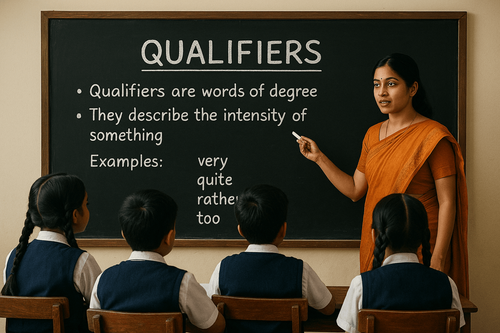

Table of Contents
Have you ever noticed how some sentences sound stronger, softer, or more precise than others? Whether you’re chatting with a friend, giving a speech, or writing an email, the words you choose can change the tone completely.
In English grammar, qualifiers help adjust meaning, show certainty, express frequency, or indicate degree. This blog will guide you through what qualifiers are, the different types, how to use them correctly, common mistakes, and practical examples, everything you need to make your sentences clear, natural, and effective.
What Are Qualifiers?
Qualifiers are words that modify adjectives, adverbs, or verbs to add precision, intensity, or limitation, making your sentences clearer and more effective. They help improve sentence clarity by showing the degree, frequency, or certainty of an action or quality. In both written and spoken English, qualifiers make communication sound natural and polite.
For example, in the sentence, “She is very talented,” the word very is a degree word that strengthens the adjective talented. Similarly, using words like somewhat, quite, or rarely acts as a grammatical modifier, helping you express yourself with nuance and accuracy.
Types of Qualifiers
Qualifiers can be grouped based on their function in a sentence. Using the right type helps improve sentence clarity and makes your writing or spoken English more precise. They allow speakers and writers to express nuances, show politeness, or avoid making absolute statements. Here are the main types:
1. Degree Qualifiers
Degree qualifiers show the intensity or level of an adjective, adverb, or verb. Words like very, extremely, quite, slightly, highly help convey how strong or weak something is.
Example: She is extremely skilled at painting, which makes her artwork stand out in competitions. Using degree words helps your sentences sound more expressive and natural in both spoken and written English.
2. Frequency Qualifiers
Frequency qualifiers indicate how often an action happens. Common words include often, rarely, sometimes, always, occasionally. They provide context about timing and repetition, helping listeners or readers understand patterns.
Example: He rarely misses his morning jog, which shows his dedication to staying fit. Including frequency qualifiers in your sentences improves sentence clarity and makes your descriptions more precise.
3. Certainty Qualifiers
Certainty qualifiers express the level of confidence or likelihood of an event. Words like probably, possibly, surely, definitely, certainly guide the listener about how sure you are.
Example: She will probably attend the meeting if her schedule allows. Using these words as grammar modifiers makes your speech or writing polite and avoids overgeneralization, especially in professional or academic contexts.
4. Quantity Qualifiers
Quantity qualifiers show amounts, numbers, or proportion. Words such as some, many, few, all, several help convey information accurately and avoid absolute statements.
Example: Many students participated in the science fair, but only a few won awards. Using quantity qualifiers adds nuance and helps maintain sentence clarity, making your communication more effective.
5. Time/Extent Qualifiers
Time or extent qualifiers describe time, closeness, or degree of completion. Words like almost, nearly, just, recently, barely help indicate the extent or timing of an action.
Example: I have almost finished my homework, and I will submit it shortly. Including these qualifiers as grammar modifiers gives precision and adds a natural flow to both spoken English and written communication.
Want your child to speak and write English confidently?
Join PlanetSpark and master qualifiers for clear, natural sentences.
How Qualifiers Change the Meaning of a Sentence
Qualifiers play a vital role in shaping the meaning of a sentence. They allow you to express degree, certainty, quantity, or frequency, making your communication more precise and nuanced. Without qualifiers, statements can sound too absolute, harsh, or vague. Using the right grammar modifiers enhances both spoken English and writing, giving your sentences clarity and tone.
1. Adding Intensity or Emphasis
Qualifiers can make a statement stronger or more forceful by emphasizing the adjective or verb.
Example: “She is very talented” is stronger than “She is talented.” The word very as a degree word highlights intensity, making your point clear and persuasive.
2. Softening Statements
Qualifiers can soften statements to make them polite or less absolute, which is important in professional or social communication.
Example: “I am somewhat concerned about the results” is gentler than “I am concerned about the results.” Here, the qualifier somewhat acts as a grammar modifier, avoiding harshness while still expressing opinion.
3. Expressing Likelihood or Certainty
Certainty qualifiers allow speakers to indicate how confident they are about a statement.
Example: “She will probably join the team meeting” signals possibility, while “She will join the team meeting” sounds definite. Using certainty words adds nuance, making sentences more accurate and professional.
4. Indicating Frequency or Repetition
Frequency qualifiers show how often an action occurs, helping the listener or reader understand patterns.
Example: “He often goes for a run in the morning” is clearer than “He goes for a run in the morning.” The word often as a grammar modifier gives insight into routine and consistency.
5. Showing Amount or Extent
Quantity and extent qualifiers clarify the amount or degree of something, preventing overgeneralization.
Example: “Many students completed the assignment on time” gives more information than “Students completed the assignment on time.” Words like many, few, almost, nearly act as degree words to convey precision and sentence clarity.

Common Mistakes to Avoid When Using Qualifiers
Using qualifiers incorrectly can make your writing or spoken English unclear, weak, or awkward. Knowing the common mistakes helps you communicate more confidently and maintain sentence clarity. Here are the most frequent errors and how to avoid them:
Overusing Qualifiers
Using too many qualifiers in a sentence can weaken your message and make it vague.
Example: “She is very extremely talented” is redundant. Instead, say, “She is extremely talented.” Overuse reduces impact, so choose qualifiers carefully to strengthen, not dilute, your sentences.
Using Multiple Qualifiers Unnecessarily
Sometimes writers stack qualifiers unnecessarily, which confuses the reader.
Example: “He almost nearly finished the task” should be simplified to “He almost finished the task.” Correct use of degree words ensures smoother, clearer communication.
Misplacing Qualifiers in a Sentence
Placing qualifiers in the wrong position can change or obscure the meaning.
Example: “She quickly almost finished her work” is awkward. Correct placement: “She almost quickly finished her work.” Proper placement improves readability and clarity in both writing and spoken English.
Confusing Types of Qualifiers
Mixing up degree, frequency, certainty, or quantity qualifiers can make sentences inaccurate.
Example: Saying, “He very often is probably late” is confusing. Better: “He is probably late often.” Using the correct grammar modifiers ensures precise expression.
Using Qualifiers Where They Aren’t Needed
Adding qualifiers when the statement is already clear can make writing weak or wordy.
Example: “She is a very unique artist” is incorrect because “unique” is absolute. Avoid unnecessary qualifiers to maintain strong, effective sentences.
Qualifiers in Spoken English
Qualifiers play a key role in spoken English, helping speakers express themselves more naturally, politely, and accurately. They add nuance to your statements, indicate certainty or frequency, and make conversations sound professional or friendly. Using the right grammar modifiers improves communication, builds confidence, and avoids sounding too harsh or absolute.
Making Speech Polite and Gentle
Qualifiers soften statements, making them sound less blunt or demanding.
Example: Instead of saying, “You are wrong,” say, “You are somewhat mistaken.” Words like somewhat, quite, slightly help you communicate politely and maintain a friendly tone in conversations.
Expressing Uncertainty
In spoken English, qualifiers show how confident or unsure you are about something.
Example: “I will probably attend the meeting tomorrow” indicates possibility rather than certainty. Using certainty words like probably, maybe, or possibly prevents misunderstandings and makes your speech sound thoughtful.
Talking About Frequency or Habit
Frequency qualifiers clarify how often something happens in daily life.
Example: “I often go for a walk in the evening.” Words like often, sometimes, rarely, or always help listeners understand routines and patterns clearly, adding precision to your communication.
Adding Emphasis or Intensity
Degree qualifiers help emphasize points without sounding exaggerated.
Example: “She is very enthusiastic about the project.” Using words like very, extremely, or quite strengthens your statements naturally in spoken English.
Avoiding Overgeneralization
Qualifiers prevent statements from sounding absolute, which can make you sound more reasonable and confident.
Example: “Many students find this topic challenging” is better than “All students find this topic challenging.” Using quantity or degree words as grammar modifiers ensures clarity and accuracy in conversation.
Make learning English fun and effective!
Enroll in PlanetSpark’s program to improve grammar, sentence clarity, and communication skills.
Qualifiers in Written English
Qualifiers are essential in written English because they help make sentences precise, nuanced, and professional. They prevent statements from sounding too absolute or harsh, improve sentence clarity, and allow writers to convey the exact meaning. Whether in essays, reports, or creative writing, using the right grammar modifiers strengthens the quality and tone of your writing.
1. Enhancing Academic Writing
In academic writing, qualifiers prevent overgeneralisation and make arguments more credible.
Example: “This method is probably the most effective” is better than “This method is the most effective.” Using words like probably, somewhat, or slightly shows careful reasoning and supports evidence-based claims.
2. Strengthening Creative Writing
Writers use qualifiers to add depth to descriptions and emotions.
Example: “The garden was very beautiful, with flowers blooming almost everywhere.” Degree and extent words help create vivid imagery and keep the narrative engaging.
3. Polishing Professional Writing
In emails, reports, or proposals, qualifiers convey information politely and accurately.
Example: “We are slightly behind schedule” sounds professional, while “We are behind schedule” may seem abrupt. Using grammar modifiers improves tone and clarity in professional communication.
4. Avoiding Absolute Statements
Qualifiers prevent writing from sounding rigid or overly confident, which is important in formal contexts.
Example: “Many employees appreciated the training session” avoids generalising that all employees felt the same. Quantity words like many, few, some create balance and precision.
5. Adding Nuance to Arguments
Using qualifiers helps writers express degrees of certainty or opinion.
Example: “The results are quite significant” is more precise than “The results are significant.” This use of degree words ensures your writing communicates exactly what you mean.

Benefits of Using Qualifiers Effectively
Using qualifiers effectively can transform both spoken English and writing. They help convey meaning accurately, express politeness, and make sentences more engaging. Correct use of grammar modifiers enhances communication, prevents misunderstandings, and allows you to express subtlety in tone, certainty, or frequency. Here are the main benefits:
Improves Sentence Clarity
Qualifiers make sentences more precise by indicating the exact degree, frequency, or certainty of an action or quality.
Example: “He is quite skilled at coding” is clearer than “He is skilled at coding.” Proper use ensures your ideas are understood correctly.
Adds Politeness and Softens Tone
Using qualifiers softens statements, making them sound polite, non-judgmental, and professional.
Example: “I am somewhat concerned about the results” is gentler than “I am concerned about the results.” This helps maintain positive communication in both personal and professional settings.
Helps Avoid Overgeneralisation
Qualifiers prevent absolute statements, which can be misleading or harsh.
Example: “Many students found the topic challenging” avoids implying that every student struggled. Quantity words like few, many, some enhance accuracy and credibility.
Enhances Expressiveness
Qualifiers allow speakers and writers to add nuance, emotion, or emphasis to their statements.
Example: “The movie was extremely entertaining” conveys excitement more effectively than “The movie was entertaining.” Using degree words makes communication more engaging.
Supports Professional and Academic Communication
In professional reports, emails, or academic writing, qualifiers help present ideas carefully and confidently.
Example: “This approach is probably the most effective method” sounds reasoned, while an absolute statement may seem overconfident. Grammar modifiers ensure clarity, professionalism, and credibility.
Boost your child’s English confidence with interactive lessons on qualifiers.
Book a free trial at PlanetSpark today!
How Planet Spark Helps Your Child Master Qualifiers?
PlanetSpark makes learning qualifiers easy, interactive, and practical for kids. Through expert guidance, structured lessons, and real-world exercises, children develop a strong understanding of grammar modifiers, degree words, and sentence clarity. The platform combines spoken and written English practice, helping students use qualifiers naturally in conversations, essays, and presentations.
- 1:1 Personal Coaching by Expert Mentors: Trained mentors provide individual guidance to help your child understand different types of qualifiers and use them correctly in spoken English and writing.
- Structured Step-by-Step Lessons: Lessons simplify concepts like degree, quantity, certainty, and frequency qualifiers, making it easy for children to grasp and apply them in daily communication.
- Interactive Exercises and Real Practice: Children practice using qualifiers in sentences, stories, and dialogues. Mentors give constructive feedback, helping students improve sentence clarity and expression.
- Engaging Games and Activities: Fun grammar games and storytelling exercises make learning qualifiers enjoyable while reinforcing proper usage in a natural way.
- Progress Tracking with AI Insights: Smart tools track your child’s growth, highlight areas for improvement, and suggest targeted practice to strengthen understanding of grammar modifiers.
Conclusion
Mastering qualifiers is essential for clear, polite, and effective communication in both spoken English and writing. With consistent practice, children can express ideas with precision, confidence, and nuance. Using qualifiers correctly improves sentence clarity, softens tone, and prevents overgeneralisation. Whether in conversations, essays, or presentations, strong qualifier skills help learners communicate thoughtfully and sound more professional. Join PlanetSpark today to help your child master qualifiers and boost their confidence in English
Frequently Asked Questions
Avoid overusing them, misplacing them, or using unnecessary qualifiers with absolute words like “unique” or “perfect.” Practice with sentences to use them correctly.
Yes! Using qualifiers in spoken English helps you sound polite, confident, and natural.
The main types are degree (very, extremely), frequency (often, rarely), certainty (probably, possibly), quantity (many, few), and extent/time (almost, nearly).
Qualifiers make sentences more precise, polite, and natural. They help avoid absolute statements and improve sentence clarity in both writing and speaking.
A qualifier is a word that changes or limits the meaning of an adjective, adverb, or verb. It shows degree, frequency, certainty, or quantity.