
Simple Grammar Games Kids Can Play Easily at Home
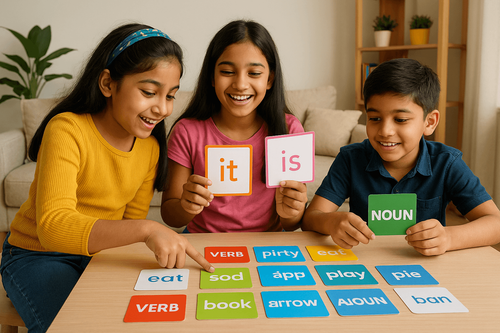

Table of Contents
- Simple Grammar Games Kids Can Play at Home
- Word Sorting Game
- Sentence Building Challenge
- Grammar Treasure Hunt
- Punctuation Relay
- Story Continuation Game
- Fill-in-the-Blank Challenge
- Adjective Detective
- Board Game Twist
- Benefits of Grammar Games for Kids
- Tips for Parents to Make Grammar Fun
- Fun Grammar Warm-Up Activities for Kids
- Quick 5-Minute Grammar Games for Busy Evenings
- Zero-Prep Grammar Games Parents Can Try Anytime
- How to Use Everyday Household Items for Grammar Practice
- Creative DIY Grammar Tools You Can Make at Home
- Age-Wise Grammar Game Ideas for Kids (4–6, 7–9, 10–12)
- How Grammar Games Improve Reading and Writing Skills
- Team Grammar Games for Siblings and Friends
- Printable Grammar Game Ideas for Home Learning
- How to Track Your Child’s Progress Through Play
- Common Grammar Mistakes Kids Make and How Games Fix Them
- How to Make Grammar Games More Challenging as Kids Grow
- Why Play-Based Learning Works Better Than Memorization
- How Teachers and Parents Can Use These Games Together
- Tips to Encourage Shy Kids to Participate in Grammar Games
- Why Choose PlanetSpark?
- Conclusion
Teaching grammar at home doesn’t have to feel boring or complicated. In fact, kids learn best when lessons feel like play and that’s exactly what grammar games offer. These simple, engaging activities turn everyday learning into fun challenges that help children understand words, sentence structure, and punctuation more naturally.
The best part is that these games are easy to set up, require minimal materials, and can be enjoyed by kids of different ages. By adding just a few minutes of grammar play each day, parents can make learning at home both effective and joyful, helping kids master grammar without stress or pressure.
Simple Grammar Games Kids Can Play at Home
Make grammar fun and stress-free with simple games kids can enjoy at home. These playful activities help children build strong language skills while having a great time.
Word Sorting Game
The Word Sorting Game is one of the simplest and most effective activities to help kids understand parts of speech. Children naturally love arranging and categorizing things, which makes this game both engaging and educational. Parents can write different words on small pieces of paper, mixing nouns, verbs, and adjectives—and ask kids to sort them into categories. This hands-on approach helps children visually and mentally recognize the differences between word types.
You can level up the game by:
Using household objects (toy, spoon, pillow) and asking kids to decide which are nouns.
Acting out verbs like jump, run, or clap and letting kids identify the action words.
Showing items and asking kids to describe them using adjectives.
This game not only teaches grammar but also boosts vocabulary, observation skills, and decision-making. Over time, kids begin identifying parts of speech automatically, making reading, writing, and sentence formation much easier.
Sentence Building Challenge
The Sentence Building Challenge helps kids understand how words come together to form meaningful sentences. Parents can create word cards containing nouns, verbs, adjectives, articles, and prepositions. Kids then arrange the cards to create grammatically correct sentences. This activity teaches sentence order, structure, and clarity in a fun, interactive way.
Ways to make it even more engaging:
Give kids a “starter word” and ask them to build a complete sentence around it.
Let kids rearrange mixed-up words to form a correct sentence.
Challenge them to make the sentence funnier or more creative without breaking grammar rules.
For advanced learners, introduce conjunctions (because, but, although).
This game encourages creativity while strengthening grammar rules naturally. Children learn how small changes in order or word choice can completely change sentence meaning, an important skill for both writing and communication.
Grammar Treasure Hunt
The Grammar Treasure Hunt brings movement and learning together. Parents hide small objects or word cards around the house and give children grammar-based clues. For example, “Find an object that is a noun and starts with S” or “Look for something that describes how you feel, an adjective.” This encourages kids to observe their environment, think critically, and apply grammar concepts in real-life contexts.
You can add variations like:
Verb hunt: Find something you can “throw,” “push,” or “roll.”
Adjective hunt: Search for something “soft,” “tiny,” or “colorful.”
Plural hunt: Look for things that come in pairs—shoes, socks, pencils.
Preposition clues: Something “under,” “behind,” or “above.”
The activity is energetic, fun, and perfect for kids who prefer learning through movement. It also improves vocabulary and helps children connect grammar with everyday items, improving retention.
Punctuation Relay
Punctuation Relay is a high-energy indoor game that teaches punctuation marks like full stops, commas, exclamation marks, and question marks. Parents can write several sentences without punctuation on paper. Kids run to the table, pick a strip, read it, and add the correct punctuation. Once done, they run back to tag the next person or pick another strip.
To add more excitement:
Use flashcards of punctuation marks and let kids choose the correct one.
Create a “punctuation station” where kids arrange symbols to complete sentences.
Add bonus rounds where kids read the sentence aloud with the correct expression.
This game helps kids understand how punctuation affects meaning and tone. It sharpens reading skills, improves sentence clarity, and teaches expression through voice modulation, an essential part of communication.
Story Continuation Game
The Story Continuation Game encourages creativity, grammar accuracy, and quick thinking. One person starts with a simple sentence like “Once upon a time, a small bird wanted to learn how to fly.” Each child then adds one line to continue the story. The challenge is to keep the grammar correct while maintaining the story flow.
Benefits include:
Learning how to construct sentences that connect smoothly
Practicing tenses in context
Using imagination to build meaningful ideas
Improving narrative and sequencing skills
To enhance the game, parents can set themes, jungle adventure, mystery day, space travel or use picture prompts to spark ideas. Kids learn how grammar supports storytelling and how good sentence structure makes stories clearer and more engaging.
Fill-in-the-Blank Challenge
The Fill-in-the-Blank Challenge is excellent for teaching vocabulary and grammar at the same time. Parents prepare sentences with missing words, and kids choose appropriate words to complete them. For example, “The cat is ___ (adjective)” or “I like to ___ (verb).” This helps children understand how words function in a sentence and how meaning changes depending on the chosen word.
Enhancements:
Offer 3–4 word choices for beginners.
Leave blanks open-ended for advanced learners.
Add time challenges: complete 5 sentences in 1 minute.
Use sentences from their favorite stories or daily conversations.
This activity improves grammatical understanding, sentence structure, and vocabulary usage. It also boosts decision-making and comprehension.
Adjective Detective
Adjective Detective turns kids into little explorers searching for descriptive words around the house. Parents can ask kids to find or list adjectives that describe everyday objects, soft pillow, shiny spoon, big window. Children can also find adjectives in storybooks, newspapers, or product labels.
Fun ways to extend the game:
Create a notebook where kids collect new adjectives daily.
Give kids a theme: food adjectives, color adjectives, emotion adjectives.
Ask them to describe family members using positive adjectives.
Turn it into a 5-minute mission: “Find 8 adjectives in the room!”
This helps children build strong descriptive vocabulary, improves their writing skills, and teaches them how adjectives enhance expression.
Book a FREE PlanetSpark demo class today and see your child fall in love with learning!
Board Game Twist
Classic board games like Ludo, Snakes & Ladders, or UNO can easily be turned into grammar games. Add small grammar challenges to certain squares or cards—such as “Name 2 nouns,” “Fix this sentence,” or “Add an adjective to this word.”
Ideas to customize:
Each time a player climbs a ladder, they must complete a grammar task.
Landing on specific colors triggers a grammar challenge.
UNO card colors can represent grammar categories: red for nouns, blue for adjectives, yellow for verbs.
This allows kids to learn grammar effortlessly during playtime, making it perfect for family bonding and weekend fun.
Benefits of Grammar Games for Kids
Grammar games make learning enjoyable, natural, and stress-free. They help kids develop strong foundational skills without feeling like they’re studying. Games improve vocabulary, encourage creativity, and help children understand how words function together.
Key benefits:
Better sentence formation
Stronger reading and writing skills
Improved attention and thinking skills
Greater creativity and imagination
Higher confidence in using language
Active, hands-on learning instead of memorization
These benefits support a lifetime of communication skills, academic success, and self-expression.
Tips for Parents to Make Grammar Fun
Parents play a big role in making learning enjoyable. Simple changes in approach can turn grammar practice into fun bonding time.
Practical tips:
Keep games short and exciting.
Celebrate small wins to build confidence.
Use colorful cards, stickers, and rewards.
Add real-life examples from daily conversations.
Allow kids to make mistakes, they’re part of the learning process.
Rotate games to keep interest alive.
Join the games yourself to make it more engaging.
With these tips, kids will start seeing grammar as something enjoyable rather than a chore.
Fun Grammar Warm-Up Activities for Kids
Grammar warm-ups are quick, engaging mini-activities that prepare kids for deeper learning. These warm-ups activate their thinking, help them recall basic concepts, and set a positive tone for the lesson. They work best when kept short, fun, and energetic—almost like a brain stretch before real learning begins.
Warm-Up Ideas:
Word of the Day: Introduce a new word every morning. Ask your child to use it in a sentence.
Part-of-Speech Snap: Say a word and let the child quickly label it as noun, verb, or adjective.
Rhyme Time: Give a word and let kids shout out as many rhyming words as possible.
Fix the Silly Sentence: Share a funny incorrect sentence like “The dog eating were happy.” Ask kids to correct it.
These warm-ups help children transition smoothly into learning mode. They make grammar approachable, enjoyable, and something kids start looking forward to instead of dreading.
Quick 5-Minute Grammar Games for Busy Evenings
Short evenings don’t mean kids have to skip learning. Five-minute grammar games are perfect for parents who want to reinforce concepts without committing to long sessions. These games are designed to be fast, effective, and fun—ideal for tight schedules.
Great 5-Minute Grammar Games:
One-Minute Noun Hunt: Kids quickly list objects around them that are nouns.
Verb Acting: Parents act out a verb; kids guess and say a sentence using that verb.
Adjective Rush: Give kids 30 seconds to list adjectives describing an object in the room.
Sentence Shuffle: Mix up words of a sentence and let your child rearrange them correctly.
These short games sharpen grammar skills, boost quick thinking, and help kids stay connected to learning even on busy days.
Experience PlanetSpark’s fun learning method. Book your free demo class!
Zero-Prep Grammar Games Parents Can Try Anytime
Zero-prep grammar games are perfect when you don’t have time to print materials or prepare activities. They use spontaneous conversation, quick thinking, and imagination, making them ideal for car rides, meal times, or quiet evenings.
Easy Zero-Prep Ideas:
Spot the Error: Make a small grammar mistake while talking. Let kids catch and fix it.
Opposite Words: Say a word, and kids quickly say its opposite.
Describe This: Pick any object around you and ask the child to describe it using 3 adjectives.
Build a Sentence: Start with a word; kids keep adding words to form a correct sentence.
These effortless games strengthen vocabulary, sentence structure, and listening skills. Kids practice grammar naturally, without feeling like they are studying.
How to Use Everyday Household Items for Grammar Practice
Household items can easily become learning tools if used creatively. When kids interact with familiar objects, they understand grammar concepts more quickly because the learning feels meaningful and real. Using items around the house also keeps activities cost-free and engaging.
Ways to Use Household Items:
Labeling Objects: Label items like “chair,” “table,” “window” to help kids identify nouns.
Action Cards: Use toys or objects to act out verbs like “roll,” “push,” or “throw.”
Adjective Hunt: Ask kids to find objects that fit certain adjectives: soft, shiny, big, round.
Preposition Play: Use items to demonstrate terms like under, above, behind, beside.
These object-based games make grammar hands-on. They support sensory learning, improve recall, and turn your home into a fun language lab.
Creative DIY Grammar Tools You Can Make at Home
DIY grammar tools are great for kids who love craft or hands-on learning. These tools add color, creativity, and excitement to grammar practice. When children help create these tools, they become more invested in using them regularly.
DIY Ideas:
Word Jars: Create jars labeled Nouns, Verbs, Adjectives. Kids pull words from each jar to build sentences.
Grammar Dice: Make paper dice with different parts of speech. Kids roll and create sentences using the result.
Punctuation Flashcards: Decorate cards with punctuation marks for quick practice.
Sentence Strips: Cut strips of paper with words and let kids arrange them into meaningful sentences.
These DIY tools make grammar visually appealing and interactive. Kids can use them for independent practice, group play, or simple revision sessions.
Age-Wise Grammar Game Ideas for Kids (4–6, 7–9, 10–12)
Kids learn differently at each age, so grammar games should be matched to their cognitive level. This ensures the activities feel fun—never too easy or too hard.
For Ages 4–6
Picture-based sorting (nouns vs. verbs).
Simple adjective identification.
Matching words with objects.
These introduce early grammar basics in a playful way.
For Ages 7–9
Sentence-building games with cards.
Story continuation activities.
Punctuation challenges.
Kids in this age group enjoy creativity mixed with structure.
For Ages 10–12
Advanced sentence correction.
Role-play grammar challenges.
Creative writing prompts with grammar rules.
Older kids enjoy more complex tasks that test logic and clarity.
Age-wise planning ensures kids stay motivated and progress smoothly through grammar concepts.
How Grammar Games Improve Reading and Writing Skills
Grammar games do much more than teach grammar, they naturally strengthen reading and writing skills. When children play grammar games, they learn how words work together, how sentences are structured, and how punctuation shapes meaning. These insights transfer directly into better reading comprehension and improved writing fluency.
How Games Help:
Better Sentence Formation: Kids understand how to build meaningful sentences.
Stronger Vocabulary: Games introduce new words in memorable ways.
Improved Comprehension: Kids learn to notice word patterns and structure, helping them understand texts faster.
More Confident Writing: They start writing with fewer mistakes and clearer ideas.
Enhanced Expression: Games help kids describe better and communicate creatively.
Because grammar becomes a natural part of play, kids develop strong literacy skills without traditional pressure or memorization.
Ready to boost your child’s communication skills? Claim your free demo class!
Team Grammar Games for Siblings and Friends
Team grammar games encourage collaboration, communication, and healthy competition among kids. When siblings or friends learn together, grammar becomes more dynamic and exciting. These games help children share ideas, debate answers, and work toward a common goal. Learning in a group also boosts confidence, reduces hesitation, and teaches kids how to express themselves clearly.
Fun Team Grammar Games:
Grammar Charades: One child acts out a verb or adjective, and others guess.
Team Sentence Builder: Each child contributes one word to build a long, meaningful sentence.
Grammar Relay: Teams race to fix incorrect sentences or add missing punctuation.
Story Circle: Kids take turns adding a line to the story, while ensuring the grammar stays correct.
Team games teach kids how to listen, cooperate, and support each other while learning important language rules. This shared learning experience also strengthens bonding and makes grammar feel enjoyable rather than competitive.
Printable Grammar Game Ideas for Home Learning
Printable resources make grammar practice simple, organized, and visually appealing. They are perfect for parents looking for ready-made tools that require little preparation. These printables can be used anytime—during study hours, while traveling, or as quick revision sheets. Kids respond well to colorful, interactive printables because they turn learning into a structured yet fun activity.
Useful Grammar Printables:
Match-the-Word Worksheets: Kids match nouns, verbs, and adjectives with their correct categories.
Punctuation Practice Sheets: Mini-stories or sentences with missing punctuation.
Sentence Strip Cards: Printable word cards for building sentences.
Fill-in-the-Blank Sheets: Focus on tenses, adjectives, and prepositions.
Parents can laminate these sheets to make them reusable with markers. Printables also help track a child's progress over time and make grammar practice flexible, you can use them for both short activities and complete home-learning lessons.
How to Track Your Child’s Progress Through Play
Tracking progress doesn’t have to feel formal or stressful. Through grammar games, parents can easily observe how children develop their language skills in a natural, enjoyable way. The goal is not to “test” the child but to notice improvements, patterns, and areas that need support.
Ways to Track Progress:
Observation: Notice if kids use new words correctly in sentences or conversations.
Game Performance: Track how quickly and accurately they complete challenges.
Writing Samples: Collect small writing tasks or story additions to see improvements over time.
Vocabulary Lists: Maintain a growing list of adjectives, verbs, and nouns they have learned.
Punctuation Accuracy: Monitor how often they add the right punctuation during games.
Tracking progress helps parents understand their child’s learning style and adjust activities accordingly. It also gives kids a sense of achievement, motivating them to continue learning in a positive way.
Common Grammar Mistakes Kids Make and How Games Fix Them
Kids often make predictable grammar mistakes while learning, and games offer an effective way to correct them without embarrassment or pressure. Through repetition, context, and fun, games help children understand rules more deeply and use them correctly.
Common Mistakes Include:
Mixing up tenses
Using adjectives instead of adverbs
Incorrect plural forms
Missing punctuation
Confusion between nouns and verbs
Wrong word order in sentences
How Games Help Fix These Issues:
Sentence-building games reinforce word order.
Punctuation relays teach punctuation through action.
Fill-in-the-blank challenges improve tense usage.
Adjective vs. adverb games help kids understand how describing words work.
Treasure hunts help kids apply real-world grammar concepts.
By turning mistakes into learning opportunities, games make grammar correction enjoyable and stress-free.
How to Make Grammar Games More Challenging as Kids Grow
As children grow older, their grammar knowledge deepens. To match their pace, grammar games should become more challenging, helping them expand vocabulary, sharpen logic, and strengthen writing skills. Increasing difficulty keeps the learning experience fresh, stimulating, and rewarding.
Ways to Add Challenge:
Introduce time limits to encourage quick thinking.
Add advanced grammar topics like conjunctions, prepositions, or adverb clauses.
Create multi-step tasks such as “Build a sentence, then rewrite it in past tense.”
Use story prompts that require creative and grammatically correct writing.
Introduce peer review where kids check each other's sentences.
Challenging games help older kids stay motivated and prevent grammar learning from becoming repetitive or too easy. It also prepares them for academic writing and communication.
Why Play-Based Learning Works Better Than Memorization
Play-based learning allows children to absorb grammar naturally, while memorization often leads to short-term understanding. When kids interact with words in games, they experience grammar in context rather than simply repeating rules. This strengthens understanding, engagement, and long-term retention.
Why Play Works:
Kids learn by doing, not just listening.
Activities keep them curious and focused.
Games involve movement, visuals, and creativity—helping different learning styles.
Children feel safe making mistakes, which improves learning.
Play boosts motivation and reduces learning anxiety.
While memorization has its place, play-based learning makes grammar accessible and enjoyable. It encourages children to use grammar confidently in real conversations and writing.
How Teachers and Parents Can Use These Games Together
Collaboration between teachers and parents can greatly boost a child’s grammar skills. When both sides use similar play-based methods, kids get consistent reinforcement at school and home. This ensures smoother learning and helps children develop stronger confidence in language use.
Ways to Collaborate:
Teachers can share printable resources that parents use at home.
Parents can inform teachers about games that work best for their child.
Both can create a weekly grammar theme—adjectives week, punctuation week, etc.
Teachers can assign simple game-based homework that families enjoy together.
This shared approach creates a supportive learning environment. Kids feel surrounded by encouragement, making grammar a fun and meaningful part of daily life.
Tips to Encourage Shy Kids to Participate in Grammar Games
Shy kids often hesitate to speak or participate in learning activities. Grammar games can help them open up by making learning feel playful and low-pressure. The key is to gently build confidence and create a safe, encouraging environment.
Helpful Tips:
Start with one-on-one games to reduce pressure.
Use games involving cards or objects instead of speaking initially.
Praise every small effort, they matter.
Choose games where kids can write instead of talk if they feel more comfortable.
Slowly introduce group activities once they feel ready.
Let them pick the game sometimes to boost confidence.
Over time, shy kids gain courage, speak more freely, and participate without fear. Grammar games become a bridge to stronger communication and self-expression.
Why Choose PlanetSpark?
Building strong grammar skills at home becomes much easier when kids receive the right guidance, practice, and engaging activities. PlanetSpark provides all of this through its structured online learning programs designed specifically for young learners.
Personalized Learning: Every child learns grammar at a different pace, and PlanetSpark understands this well. Kids receive customized lessons based on their current understanding, strengths, and areas for improvement. This helps them build a strong foundation without feeling overwhelmed.
Interactive & Fun Grammar Activities: Instead of boring worksheets, PlanetSpark uses games, storytelling, quizzes, and fun grammar challenges to make learning exciting. Children get to practise grammar rules in simple, real-life scenarios that make concepts easier to remember.
Focus on Speaking, Writing & Sentence Formation: PlanetSpark ensures that children not only learn grammar rules but also know how to use them in conversations and written work. Kids practise sentence building, punctuation, tenses, and correct word usage in a natural, engaging way.
Creative Writing & Vocabulary Development: To support better grammar, kids also learn how to expand their vocabulary, express ideas clearly, and structure sentences effectively. These skills help them become confident writers and smoother speakers.
Conclusion
Grammar doesn’t have to feel boring or difficult for kids, when taught through simple, fun, and interactive games, it becomes something they naturally enjoy. The activities you use at home can help children practise essential grammar skills like sentence building, punctuation, tenses, and vocabulary in an effortless, playful way. These small daily exercises slowly build confidence, improve accuracy, and make kids better speakers and writers. With the right mix of games, guidance, and encouragement, learning grammar becomes an exciting part of their routine rather than a chore.
Frequently Asked Questions
Younger kids enjoy simple activities like flashcard matching, word sorting, fill-in-the-blank games, and “fix the mistake” challenges. These help them learn grammar basics without pressure.
Just 10–15 minutes a day is enough. Short, fun sessions help kids learn faster than long lessons that feel tiring.
Yes! When children practise sentence structure, vocabulary, and punctuation through games, their writing naturally becomes clearer and more accurate.
Absolutely. Older kids can play more advanced games like sentence transformation, story-building challenges, and time-based grammar quizzes.
Both are useful, but games are more engaging. They motivate kids to learn actively rather than simply memorizing rules.
Yes, many grammar games require nothing—just words, imagination, and a few minutes of time.