
Simple Present Tense Examples and Rules Guide
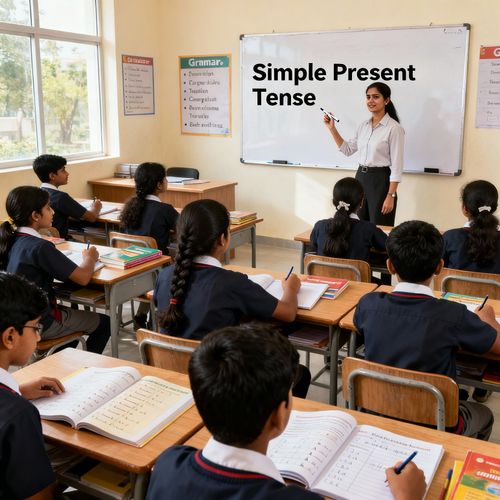

Table of Contents
- What is the Simple Present Tense?
- Structure of the Simple Present Tense
- When to Use the Simple Present Tense
- Simple Present Tense Examples in Everyday Use
- Common Mistakes with the Simple Present Tense
- Practice Exercises for Simple Present Tense
- Learn English Grammar the PlanetSpark Way
- Unlock Your Child’s Grammar Superpower!
Understanding how to use the simple present tense correctly is essential for building strong English communication skills. In this blog, we’ll explore what the simple present tense is, how it’s used in daily conversations, and see multiple simple present tense examples to help you master it. You’ll also learn sentence formation rules, usage in positive, negative, and interrogative sentences, and when to use it naturally in writing and speech.
What is the Simple Present Tense?
The simple present tense is one of the most commonly used tenses in English grammar. It describes actions that are habitual, universal truths, or general facts.
In short, if something happens regularly, always, or never changes, we use the simple present tense.
Examples:
She reads every morning.
The sun rises in the east.
They play football on Sundays.
This tense helps describe daily routines, permanent situations, and facts.
Structure of the Simple Present Tense
The structure of a simple present tense sentence depends on the subject and the type of sentence , affirmative, negative, or interrogative.
1. Affirmative Sentences
Structure: Subject + base form of the verb (+ s/es for he, she, it)
Examples:
I write letters.
He writes letters.
They study at PlanetSpark.
2. Negative Sentences
Structure: Subject + do/does not + base form of verb
Examples:
I do not eat junk food.
She does not like coffee.
We do not play in the rain.
3. Interrogative Sentences
Structure: Do/Does + subject + base form of verb
Examples:
Do you like English grammar?
Does he play cricket?
Do they attend grammar classes?
When to Use the Simple Present Tense
We use the simple present tense for the following situations:
1. Daily Habits and Routines
Used for actions that happen regularly.
Examples:
I go to school every day.
She drinks milk every morning.
2. Universal Truths
Used to express facts that are always true.
Examples:
Water boils at 100°C.
The Earth revolves around the sun.
3. Scheduled Events
Used to describe fixed events or timetables.
Examples:
The train leaves at 9 PM.
The class starts at 8 o’clock.
4. Instructions or Directions
Used to give commands or describe processes.
Examples:
You add sugar to the tea.
First, mix the ingredients.
5. Narration and Commentary
Used in sports or storytelling to describe ongoing events.
Examples:
Rohit hits the ball to the boundary!
The hero enters the scene.
👉 Want your child to understand such examples better?Join PlanetSpark’s Spoken English Course
Simple Present Tense Examples in Everyday Use
Here are some simple present tense example sentences used in daily life:
| Type | Example Sentences |
|---|---|
| Habitual Action | I read the newspaper every day. |
| General Fact | The sun rises in the east. |
| Instruction | Open your book and start reading. |
| Scheduled Event | The flight departs at 6:00 AM. |
| Negative | She doesn’t like spicy food. |
| Question | Do you enjoy English lessons? |
These examples make it easy to identify and apply the tense naturally in real conversations.
Common Mistakes with the Simple Present Tense
Even native speakers sometimes make errors when using this tense. Let’s fix a few of them:
| Mistake | Correct Usage |
|---|---|
| He go to school. | He goes to school. |
| She don’t like coffee. | She doesn’t like coffee. |
| They plays cricket. | They play cricket. |
Practice Exercises for Simple Present Tense
Try these to test your understanding:
Fill in the blanks with the correct form of the verb.
a) She ____ (dance) gracefully.
b) They ____ (study) English.
c) He ____ (not like) tea.
d) ____ you ____ (play) football every Sunday?Correct the following sentences:
He go to office.
She don’t likes ice cream.
Do he live here?
These exercises help reinforce grammar through practice, just like PlanetSpark’s interactive modules.

Learn English Grammar the PlanetSpark Way
About PlanetSpark’s English Grammar Course
Core Goal:
Master sentence structure, tenses, punctuation, and parts of speech through usage-based learning.
Interactive Grammar Learning – No Rote Learning
Grammar is taught through stories, dialogues, and role plays instead of dull memorization.
Gamified Learning Tools
Fun quizzes, word puzzles, and interactive activities make learning engaging and effective.
Integrated Writing Practice
After every grammar topic, students build sentences and write short passages to strengthen application.
Grammar Proficiency Levels
From basic to advanced , every learner progresses with clear milestones.
Parent Reports on Grammar Skills
Track your child’s progress in writing fluency, grammatical accuracy, and confidence.
1:1 Personal Trainers for Every Child
Each student learns with a dedicated communication trainer who offers instant feedback and builds fluency and confidence.
AI-Enabled Tools like SparkX
AI analyses voice clarity, grammar usage, and stage confidence for personalized improvement.
Gamified Practice Sessions
Students play grammar games like Grammar Guru Challenge and Word Wisdom, making English fun!
Unlock Your Child’s Grammar Superpower!
Grammar isn’t just about following rules; it’s about expressing yourself with clarity and confidence. The simple present tense is the foundation of fluent English. Once you master it, every other tense becomes easier.At PlanetSpark, learners go beyond theory. They apply grammar through storytelling, games, writing tasks, and AI-led practice sessions. It’s a learning experience that’s dynamic, interactive, and built for the modern learner.
Empower your child’s communication journey with PlanetSpark , where every sentence sparks confidence!
You may also read :
Frequently Asked Questions
It’s used to describe regular actions, universal truths, and fixed events.
Use the base verb for plural subjects and add -s/-es for singular subjects (he, she, it).
If the action happens regularly or expresses a fact, it’s in the simple present tense.
Yes. “Do” is used with I/you/we/they, and “does” with he/she/it in questions and negatives.
PlanetSpark offers interactive, AI-based grammar and speaking lessons through one-on-one live classes that make learning engaging and practical.