
Vocabulary Builder: Synonyms & Antonyms Worksheet for Grade 6

Vocabulary Builder: Synonyms & Antonyms Worksheet for Grade 6
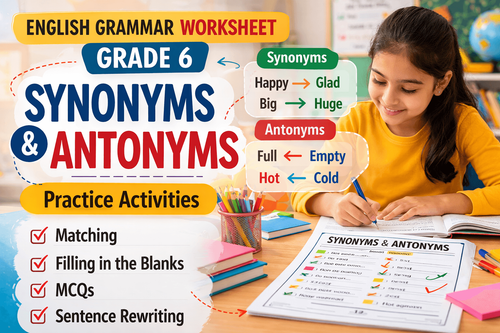
Learning new words can make English much more interesting and expressive. When students understand how words relate to each other through similar and opposite meanings, they become stronger readers and writers. This English grammar worksheet for Grade 6 focuses on Synonyms & Antonyms and gives students the opportunity to practice these important vocabulary skills through engaging activities such as matching, sorting, filling in the blanks, multiple-choice questions, and sentence rewriting. By practicing these exercises, students build confidence in understanding word meanings and using them correctly in sentences.
What Is The Topic?
Synonyms and antonyms are important parts of vocabulary development in English grammar. A synonym is a word that has the same or a very similar meaning as another word. For example, the word glad has a similar meaning to happy. Learning synonyms helps students expand their vocabulary and express ideas in different ways.
An antonym is a word that has the opposite meaning of another word. For example, the opposite of empty is full. Understanding antonyms helps students recognize contrasts in meaning and improve their comprehension skills.
In this English grammar worksheet for Grade 6, students practice identifying words with similar meanings and words with opposite meanings. They also learn to apply these words in sentences and recognize the correct meaning in context. Through different types of exercises, learners strengthen their understanding of how words relate to each other.
What’s in This Worksheet?
This English grammar worksheet for Grade 6 includes several engaging activities designed to help students practice synonyms and antonyms.
1. Match the following activity where students connect words with their correct synonym or antonym.
2. Sorting activity where students place word pairs into Synonyms or Antonyms categories.
3. Fill in the blanks exercise where students choose the correct synonym or antonym to complete a sentence.
4. Multiple choice questions that test understanding of word meanings in sentences.
5. Sentence rewriting activity where students rewrite sentences using a synonym or antonym for the underlined word.
These activities encourage students to observe word meanings carefully and apply their knowledge while reading and writing sentences. The worksheet also helps students practice grammar concepts that are useful in school assignments and exams.
Definitions, Examples, Techniques, and Tips
Definitions
Synonyms are words that have the same or similar meanings.
Examples from the worksheet include:
glad – happy
furious – angry
conceal – hide
broad – wide
ancient – old
fragile – delicate
dawn – sunrise
ascend – climb
Antonyms are words that have opposite meanings.
Examples from the worksheet include:
erect – demolish
victory – defeat
generous – selfish
expand – contract
scarce – plentiful
harmony – conflict
shallow – deep
timid – courageous
Examples
Some examples used in the worksheet show how synonyms and antonyms are used in sentences.
The cave looked pitch black and scary.
The shop was packed after the sale.
The hall was deserted of people.
These examples help students see how different words can express similar or opposite ideas depending on the sentence.
Techniques
Students can improve their understanding of synonyms and antonyms by following simple techniques:
Look carefully at the meaning of the word given in the bracket.
Read the entire sentence before choosing the correct option.
Check whether the sentence needs a similar meaning word or an opposite meaning word.
Choose the word that makes the sentence meaningful.
Quick learning tips
Practice matching words with similar meanings.
Try to notice opposite meanings when reading sentences.
Build vocabulary by learning new synonyms and antonyms.
Use these words in sentences to understand their meaning better.
Why Is It Important to Learn This?
Learning synonyms and antonyms helps students expand their vocabulary and understand language more clearly. When students know different words with similar meanings, they can express ideas in more interesting ways. It also helps them avoid repeating the same words again and again.
Understanding antonyms helps students recognize contrasts and opposites in language. This skill improves reading comprehension because students can better understand the meaning of passages and sentences.
For Grade 6 learners, practicing synonyms and antonyms also supports grammar learning, writing development, and better communication skills.
Where Will This Knowledge Help You?
Knowledge of synonyms and antonyms is useful in many areas of learning.
In exams, students may need to identify similar or opposite meanings of words.
In writing tasks, using synonyms makes sentences more varied and interesting.
In class discussions, a strong vocabulary helps students explain their ideas clearly.
In reading activities, understanding word meanings improves comprehension.
By practicing with this English grammar worksheet, Grade 6 students can strengthen their vocabulary and feel more confident while using English.
How to Use This Worksheet?
Students can use this worksheet effectively by following a few simple steps.
1. Attempt all the questions independently and think carefully about the meaning of each word.
2. Read each sentence fully before choosing the correct synonym or antonym.
3. After completing the worksheet, review the answers carefully.
4. Compare your responses with the correct answers provided below.
5. Correct any mistakes and try to understand why the correct word fits the sentence.
The solutions provided below follow the exact worksheet order. Students should compare their answers carefully to identify any mistakes and improve their understanding of synonyms and antonyms.
Important Tips and Tricks
1. Always read the complete sentence before selecting a synonym or antonym.
2. Check whether the sentence requires a word with a similar meaning or an opposite meaning.
3. Avoid choosing a word only because it looks familiar. Focus on the meaning.
4. In multiple choice questions, eliminate options that do not fit the sentence meaning.
5. For sentence rewriting tasks, replace the underlined word with a synonym or antonym that keeps the sentence meaningful.
6. Practicing vocabulary regularly helps students answer such questions quickly in exams.
7. Understanding word meanings improves both reading comprehension and writing skills.
Complete Answer Key
Exercise No. 1
1. glad – happy
2. dull – bright
3. weak – strong
4. cruel – kind
5. empty – full
6. angry – fury
7. big – huge
8. joyful – happy
9. timid – valiant
10. strong – delicate
Exercise No. 2
Synonyms
1. furious / angry
2. conceal / hide
3. broad / wide
4. ancient / old
5. fragile / delicate
6. dawn / sunrise
7. ascend / climb
Antonyms
8. erect / demolish
9. victory / defeat
10. generous / selfish
11. expand / contract
12. scarce / plentiful
13. harmony / conflict
14. shallow / deep
15. timid / courageous
Exercise No. 3
1. happy
2. pitch black
3. courageous
4. clever
5. packed
6. kind
7. powerful
8. disappointed
9. boastful
10. deserted
Exercise No. 4
1. elated
2. full
3. brave
4. dull
5. harsh
6. dark
7. cruel
8. polite
9. glad
10. full
Exercise No. 5
1. The boy was sad after seeing the result.
2. Her answer was dull in class today.
3. The soldier was courageous in the war.
4. The bag was huge and hard to carry.
5. He spoke in a furious way to his friend.
6. The lamp was dim in the night.
7. The tiger was delicate in the cage.
8. She looked angry at her brother.
9. The man showed harsh acts to all.
10. The ground was wet after the rain.
Practicing vocabulary regularly can make English learning much easier and more enjoyable. This English grammar worksheet for Grade 6 on Synonyms & Antonyms gives students the opportunity to explore word meanings, recognize similarities and opposites, and apply them in sentences. With regular practice, students can improve their vocabulary, become more confident in writing and speaking, and perform better in grammar exercises and school assessments.