
Vocabulary Words Kids Should Learn by Age 10


Table of Contents
- Vocabulary Words Kids Should Learn by Age 10
- Why Vocabulary Development Matters for Children
- What Are Vocabulary Words for 10 Year Olds
- Daily Use English Words for Child Development
- Table: Simple English Words for Daily Use (With Meaning)
- A to Z Vocabulary Words With Meaning
- Ten Important Vocabulary Words With Meaning
- How Children Learn Vocabulary Naturally
- Checkpoints for Parents
- Fun Activities to Build Vocabulary
- Word Lists for Daily Use by Children
- Reading as a Tool for Vocabulary Growth
- Practice Sentences for Better Vocabulary
- Common Mistakes Children Make With Vocabulary
- Tips for Parents to Improve a Child’s Vocabulary
- Approach to Vocabulary Development
- Conclusion
- About PlanetSpark : English Grammar
A strong vocabulary is one of the most powerful tools a child can develop by the age of 10. The right words help children think clearly, speak with confidence, understand new ideas, and express themselves in school and daily life. As children explore bigger concepts, a good vocabulary becomes their key to learning faster and communicating better.
At PlanetSpark, children grow their vocabulary through fun games, speaking activities, reading tasks, and storytelling that make learning exciting. In this blog, you will discover the most useful vocabulary words kids should learn by age 10, along with simple meanings, examples, activities, and tips for parents. Let’s help your child become a confident and expressive communicators.
Vocabulary Words Kids Should Learn by Age 10
A strong vocabulary helps children think clearly, speak confidently, and understand new ideas. By the age of 10, kids should know words that help them express feelings, describe objects, ask questions, and share thoughts in school and daily life. Good vocabulary skills also improve reading, writing, and communication.
Children learn many new concepts, and the right words make learning easier and more enjoyable. Through reading, conversations, and fun activities, kids can quickly build a vocabulary that helps them succeed. This blog lists the most important vocabulary words every 10-year-old should learn and use effectively.
Master Grammar, Write Confidently!
Book a Free Demo Class and help your child excel in English grammar.
Why Vocabulary Development Matters for Children
Vocabulary development is the foundation of communication and learning. A child who knows more words can describe experiences, share ideas, and understand lessons more easily. A strong vocabulary also helps children build confidence in all subjects, including science, mathematics, and social studies.
Vocabulary helps children:
• express emotions clearly
• answer questions confidently
• understand textbooks easily
• communicate ideas during class discussions
• write better sentences and paragraphs
• perform well in speaking and writing exams
Children who learn new words regularly become more curious, creative, and active learners. When parents support vocabulary development at home, children learn faster and use the words naturally in daily life.
What Are Vocabulary Words for 10 Year Olds
Vocabulary words for 10-year-olds are simple English words for daily use that help children talk about their ideas, feelings, activities, school work, and surroundings. These words should be meaningful, practical, and easy to use in conversations, writing, and classroom tasks.
Most children at age 10 learn:
• action words
• describing words
• emotion words
• school-related words
• everyday conversation words
• reading and story words
Children do not need long or complicated words. They need useful words they can use every day. When children understand these words with meaning, their communication becomes strong and natural.
Daily Use English Words for Child Development
Daily use English words are the words children hear and use every day at home, school, playgrounds, and social activities. These words help children express their needs, share stories, ask questions, and learn new things.
Examples of daily use words include:
• listen
• answer
• quiet
• promise
• borrow
• prepare
• tidy
• improve
Children must learn these words with meaning and practice using them in real sentences. This builds fluency and confidence.
Table: Simple English Words for Daily Use (With Meaning)
Below is a useful table of simple daily use English words with clear meanings.
| Word | Meaning |
|---|---|
| Curious | Wanting to know more about something |
| Brave | Ready to face fear or difficulty |
| Calm | Quiet and relaxed |
| Gather | To collect things or people |
| Silent | Very quiet |
| Complete | To finish something |
| Release | To let go |
| Warn | To tell someone about possible danger |
| Arrange | To put things in order |
| Discover | To find something new |
These words are easy for children and can be used in both speaking and writing.
A to Z Vocabulary Words With Meaning
Here is a simple A to Z list of vocabulary words children should learn by age 10. This list includes easy meanings for quick understanding.
| Letter | Word | Meaning |
|---|---|---|
| A | Active | Always moving or doing something |
| B | Balance | Staying steady and equal |
| C | Confident | Feeling sure about yourself |
| D | Decide | To choose something |
| E | Encourage | To give someone support |
| F | Focus | To pay close attention |
| G | Gentle | Soft and kind |
| H | Honest | Telling the truth |
| I | Imagine | To form pictures in your mind |
| J | Journey | A long trip |
| K | Kindness | Being caring and helpful |
| L | Limit | A point that cannot be passed |
| M | Manage | To control or take care of something |
| N | Notice | To see or observe |
| O | Organize | To arrange things neatly |
| P | Participate | To take part in something |
| Q | Question | To ask for information |
| R | Respect | To treat others politely |
| S | Suggest | To give an idea |
| T | Trust | To believe someone is honest |
| U | Understand | To know what something means |
| V | Value | Something important or useful |
| W | Wonder | To think with curiosity |
| X | Examine | To look at something carefully |
| Y | Yell | To shout loudly |
| Z | Zoom | To move quickly |
These words form a strong base for vocabulary development.
Ten Important Vocabulary Words With Meaning
Here are 10 vocabulary words children should definitely know by age 10:
| Word | Meaning | Example Sentence |
|---|---|---|
| Responsibility | Taking care of things you must do | It is your responsibility to finish homework. |
| Encourage | To give hope or support | Teachers encourage students to speak. |
| Confident | Sure of yourself | She felt confident before the test. |
| Observe | To watch carefully | Observe how the plants grow. |
| Respect | To treat others politely | Always show respect to classmates. |
| Creative | Using imagination | He has a creative way of solving problems. |
| Improve | To make better | Practice helps you improve your skills. |
| Decide | To choose something | You must decide what to eat. |
| Achieve | To reach a goal | She achieved high marks in exams. |
| Express | To share feelings or ideas | Express your thoughts clearly. |
These words help children in communication, teamwork, reading, and writing.
How Children Learn Vocabulary Naturally
Children learn vocabulary best when they hear and use new words in meaningful situations. Here are some natural ways children pick up words:
Conversations
Talking at home helps children learn new words and sentence patterns.
Reading
Storybooks introduce children to new words and ideas.
Classroom activities
Discussions, projects, and assignments help them use new words regularly.
Storytelling
Children learn emotional and descriptive words while narrating stories.
Playing
Games and interactions introduce new action words and expressions.
Observation
Children learn words by watching people, surroundings, and actions.
Checkpoints for Parents
Parents can use these checkpoints to see if a child is developing vocabulary properly.
A 10-year-old child should:
• understand and use 1,000 to 2,000 common English words
• read grade-level storybooks comfortably
• form clear sentences using new words
• understand words related to school subjects
• follow multi-step instructions
• use conversation words naturally
• express thoughts clearly
• learn 5 to 10 new words every week
If your child struggles in any area, more reading and practice can help.
Strong Grammar Builds Strong Communication.
Book a Free Demo Class today and see the difference in writing and speaking.
Fun Activities to Build Vocabulary
Children learn best through fun and engagement. Here are some activities that help build vocabulary naturally.
Activity 1: Word Diary
Ask children to write 3 new words every day with meaning and a sentence.
Activity 2: Word Hunt
Choose a storybook and ask children to find 10 new words.
Activity 3: Conversation Challenge
Children must use 5 new words in a conversation at home.
Activity 4: Draw the Word
Children draw pictures based on words like journey, peaceful, active, brave.
Activity 5: Word of the Week
Choose one word every week and use it in sentences daily.
Activity 6: Vocabulary Jar
Write new words on paper slips and pick one daily.
Activity 7: PlanetSpark-style Story Prompts
Give children story starters such as:
He discovered a strange sound behind the door.
She felt confident for the first time.
These help children practice using meaningful words.
Activity 8: Vocabulary Role Play
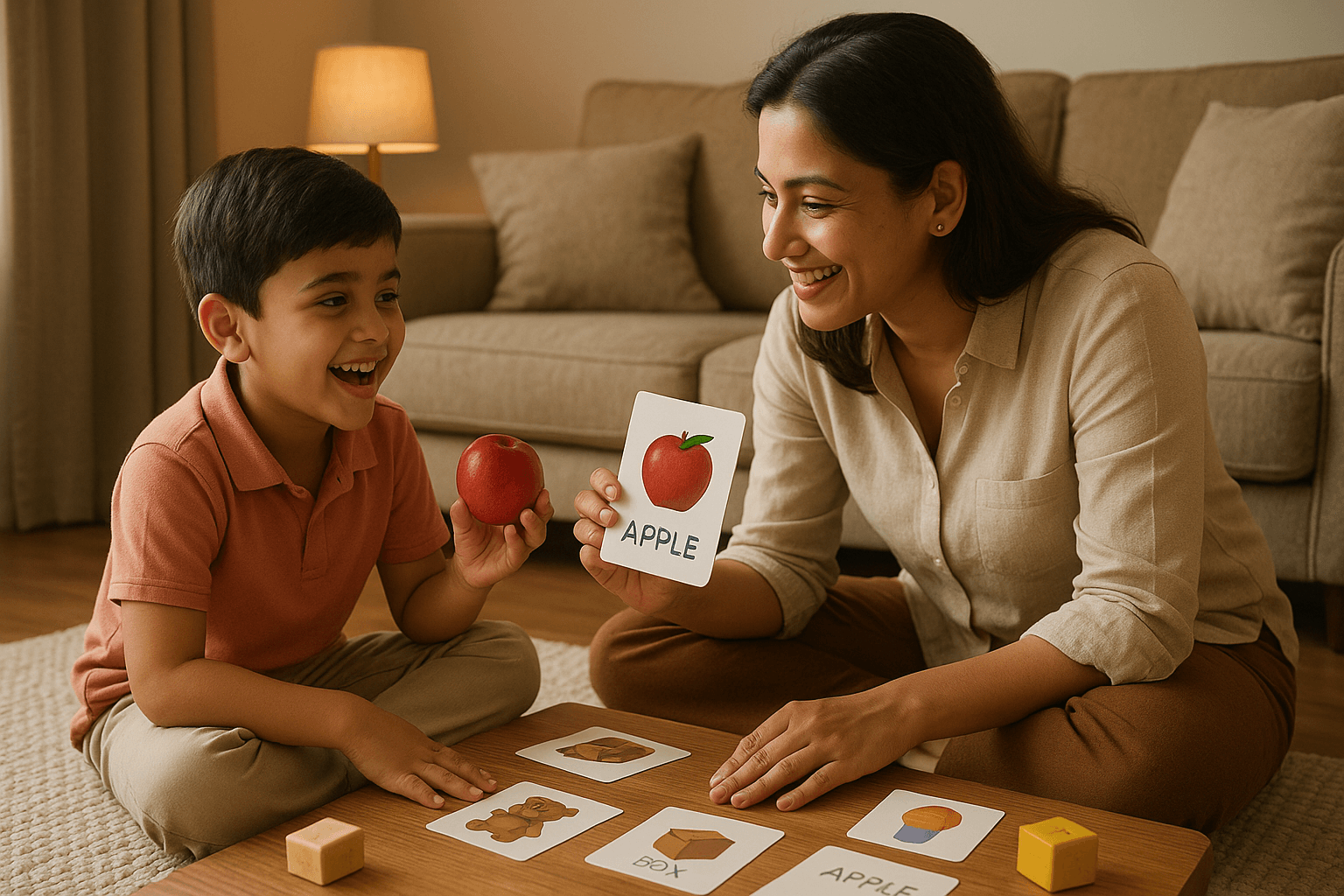
Role play is a fun and interactive activity where children act out stories or real-life situations using new vocabulary words. Parents or teachers can give children a set of five new words such as discover, brave, warn, curious, and protect. Children must create a short scene or dialogue using all the words. This helps them understand the meaning through action, not memorising.
Role plays encourage teamwork, imagination, and communication. Children learn how to use words naturally in conversations. It also removes fear of speaking and builds confidence. This activity works very well in classrooms, group sessions, and PlanetSpark workshops.
Activity 9: Build a Story Box
A story box is a small box filled with slips of paper. Each slip has a simple vocabulary word written on it. Children pick any five words from the box and use them to create a short story. For example, if the words are quiet, explore, forest, gentle, and surprise, the child can create an exciting adventure story.
This activity improves creativity, sentence formation, imagination, and understanding of word meanings. Children enjoy it because they feel like storytellers and learn without pressure.
Word Lists for Daily Use by Children
Here is a list of daily use English words with meanings that all 10-year-olds should know.
Action Words
• participate – take part
• arrange – put in order
• reply – answer
• whisper – speak quietly
• prepare – get ready
Feeling Words
• nervous – worried
• excited – happy and eager
• confused – not sure
• upset – sad or troubled
• relieved – free from worry
Describing Words
• tiny – very small
• heavy – difficult to lift
• bright – full of light
• polite – respectful
• lazy – not wanting to work
School Words
• subject – topic of study
• project – school assignment
• explain – make something clear
• discuss – talk about
• method – a way of doing something
Reading as a Tool for Vocabulary Growth
Reading is one of the best ways for children to learn new words. When children read stories, articles, and textbooks, they naturally discover new words in context. This helps them understand how to use the words correctly.
Benefits of reading for vocabulary:
• improves imagination
• strengthens memory
• teaches sentence patterns
• introduces new ideas
• builds reading confidence
• helps in writing and speaking
Parents can encourage children to read 15 to 20 minutes every day.
Practice Sentences for Better Vocabulary
Children can try these simple sentences to practice vocabulary words:
• I decided to join the drawing competition.
• She encouraged her friend to try again.
• We observed birds sitting on the tree.
• He completed his homework before playing.
• They arranged the books neatly on the shelf.
These sentences help children understand meaning while using words naturally.
Common Mistakes Children Make With Vocabulary
Many children misunderstand or misuse words. Here are common mistakes:
• using a new word without understanding the meaning
• memorising words without using them
• confusing similar words
• forgetting spelling patterns
• depending only on textbooks
Children can avoid these mistakes by practicing regularly, reading daily, and using words in writing and speaking tasks.
Tips for Parents to Improve a Child’s Vocabulary
Parents play an important role in helping children learn new words. Here are some simple tips:
Use new words at home
Speak naturally using simple descriptive words.
Ask questions
Encourage children to express themselves.
Introduce new words through daily tasks
For example, while cooking, cleaning, travelling, or reading signs.
Play word games
Games like word puzzles and crosswords improve vocabulary.
Encourage storytelling
Ask children to describe their day using new words.
Listen patiently
Allow children time to think and speak.
Transform Writing & Speaking with Perfect Grammar.
Book a Free Demo Class today and help your child communicate confidently.
Approach to Vocabulary Development
Build vocabulary in a natural, fun, and engaging way. Instead of memorising word lists, children learn through activities, speaking practice, stories, debates, and role-plays.
Some learning methods:
• storytelling and narration
• reading comprehension tasks
• word games and puzzles
• speaking practice and presentations
• fun quizzes
• creative writing exercises
These methods help children use vocabulary confidently in real life.
Conclusion
Vocabulary development is a key skill for children . When children learn simple English words for daily use, understand their meanings, and practice them regularly, they become confident speakers and thinkers. A strong vocabulary supports school learning, social communication, and emotional expression. Parents and teachers play a very important role in guiding children to learn new words naturally every day.
Developing vocabulary by age 10 is not about memorising long lists. It is about building the habit of learning and using meaningful words in real life. With the right guidance, practice, and activities, every child can become a clear, confident, and expressive communicator.
About PlanetSpark : English Grammar
PlanetSpark helps children build strong English grammar skills through engaging 1:1 live classes. Our English Grammar Program strengthens sentence structure, tenses, parts of speech, vocabulary, and writing accuracy helping kids communicate clearly and confidently in school and everyday life.
1. 1:1 Expert Grammar Coaching
Each child learns with a certified English trainer who explains grammar in simple, interactive ways. Lessons are customised to the child’s pace, ensuring clarity, understanding, and steady improvement.
2. Personalised Grammar Learning Path
A tailored curriculum helps students master tenses, parts of speech, sentence construction, punctuation, and error-free writing progressing from basic rules to advanced application.
3. AI-Powered Grammar Practice & Feedback
With SparkX and AI-supported exercises, learners receive instant feedback on sentence accuracy, grammar usage, and writing clarity making corrections faster and more effective.
4. Interactive & Gamified Grammar Learning
Fun tools like Grammar Guru, Word Builders, and Sentence Fixer turn complex grammar rules into enjoyable activities, helping kids practise consistently through play-based learning.
5. Confidence in Writing & Communication
Through guided writing tasks, story construction, and real-life language activities, students develop the confidence to write and speak with clarity whether in exams, schoolwork, or daily communication.
Frequently Asked Questions
Vocabulary words for 10-year-olds include simple daily use words, academic words, and expressive words that help children speak clearly and understand what they read.
A strong vocabulary improves reading, writing, communication skills, and overall confidence in school and daily life.
Parents can help by reading with their child, encouraging conversations, using new words in sentences, and doing fun word games at home.
Words like observe, explain, create, peaceful, arrange, and improve are useful for everyday communication.
PlanetSpark teaches vocabulary through stories, speaking tasks, activities, reading exercises, and personalised practice worksheets.