
What Is Subjunctive Mood Simply Explained for Students


Table of Contents
- Introduction to the Subjunctive Mood
- Subjunctive Mood Definition and Examples
- Why Students Should Learn the Subjunctive Mood
- What Is Subjunctive Mood in English? A Detailed Explanation
- Key Grammar Rules of the Subjunctive Mood
- Types of Subjunctive Mood
- Common Mistakes Students Make (and How to Fix Them)
- Subjunctive Mood vs. Indicative Mood
- How the Subjunctive Mood Improves Writing
- Subjunctive Mood in Everyday Conversations
- Subjunctive Mood in Literature, Movies, and Songs
- Quick Checklist to Identify the Subjunctive Mood
- Why PlanetSpark Is the Ultimate Destination for English Mast
- Moving Forward with Stronger Grammar Skills at PlanetSpark
Subjunctive mood is well-known for adding colour in language by helping us express wishes, possibilities, and situations that exist only in imagination. This guide will break the concept down into simple explanations, clear rules, and relatable examples designed for students. It also highlights how to use it confidently in both writing and speech. With personalised sessions and interactive learning, PlanetSpark can help you understand what is Subjunctive Mood and apply it effortlessly in real communication.
Introduction to the Subjunctive Mood
Before learning complicated rules, you need a simple definition.
The subjunctive mood refers to verb forms used when a speaker expresses conditions that are hypothetical, unreal, desired, recommended, doubtful, or dependent on something else happening. It shifts the tone from describing the real world to describing possibilities or imagined scenarios.
In everyday English, we use the subjunctive without even realising it. Statements such as “I wish it were easier,” “If I were you,” or “It is important that he attend the meeting” all contain the subjunctive mood.
Many students confuse the subjunctive with verb tenses, but they are completely different. A tense tells when something happens. A mood tells how the speaker feels about what is happening. The subjunctive expresses emotion, desire, or imagination.

Subjunctive Mood Definition and Examples
Students repeatedly search for a clear and practical explanation, so here it is:
Subjunctive mood definition and examples:
The subjunctive mood is a grammatical mood used to talk about wishes, hypothetical situations, unreal conditions, demands, suggestions, or actions that depend on something else.
Examples include:
- I wish it were sunny today.
- If I were taller, I would join the basketball team.
- They insisted that she arrive early.
- It is essential that he submit the assignment.
Notice how the verbs do not follow the usual subject-verb agreement. Words like were, be, and base verb forms appear even when they look grammatically unusual. That irregularity is the sign that a sentence is in the subjunctive mood.
Why Students Should Learn the Subjunctive Mood
Understanding this mood is important for several reasons:
1. Academic Writing
In essays, reports, and exams, students must express opinions, arguments, and hypothetical cases. The subjunctive helps you write more clearly:
- It is recommended that students revise daily.
2. Speaking Confidently
It allows you to express polite suggestions and formal requests:
- I suggest that you focus on chapter three.
3. Understanding English Literature
Authors frequently use the subjunctive when describing wishes, dreams, or imagined events:
- “If he were here, things would be different.”
4. Professional Communication
Workplaces often use the subjunctive in formal instructions:
- The manager requested that the report be completed by Monday.
5. Grammar Exams
Competitive exams, English proficiency tests, and school assessments often include questions on the subjunctive mood.
Learning it once will help you for life.
Turn Grammar Learning Into a Daily Confidence Booster
Get your child started with a free demo class.
What Is Subjunctive Mood in English? A Detailed Explanation
To fully answer what is subjunctive mood in English, we must understand its purpose: it lets speakers talk about situations that do not reflect actual reality.
Here are the main uses:
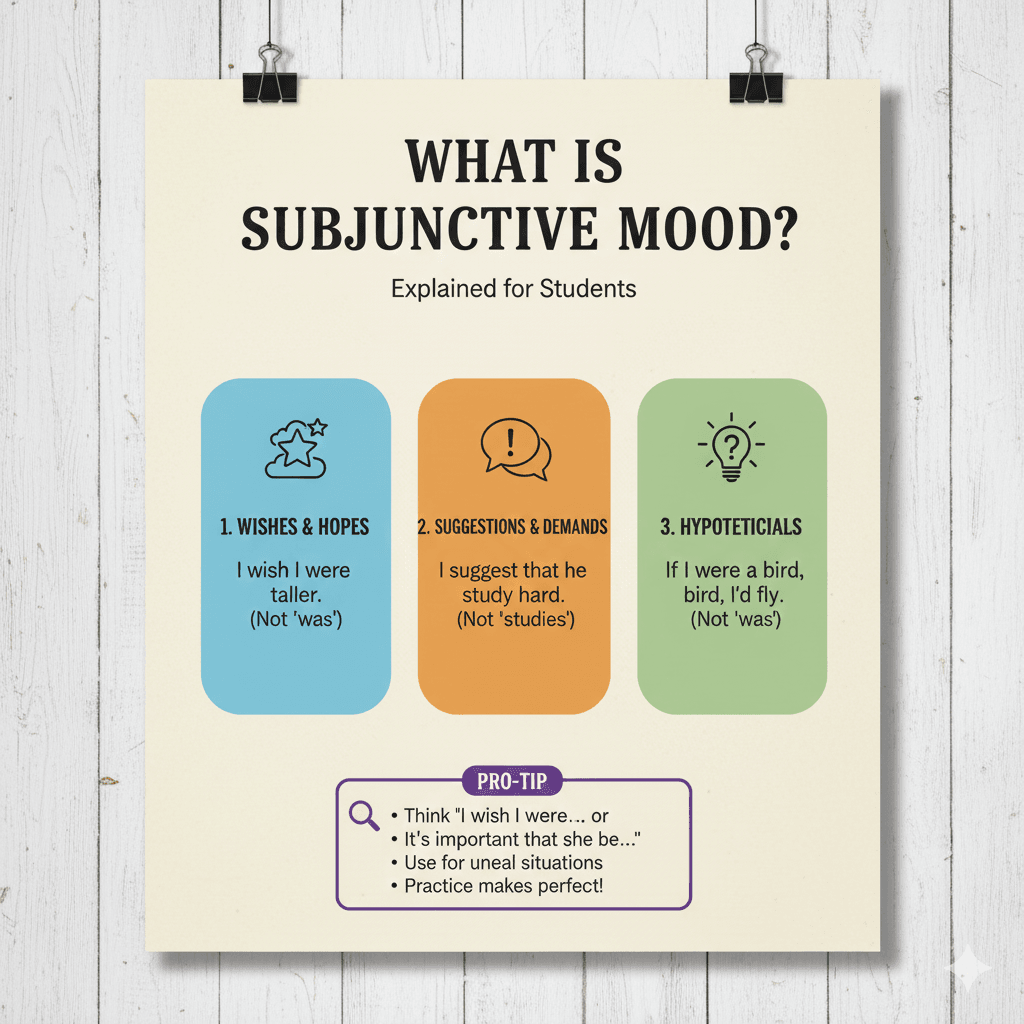
1. Wishes and Desires
Used with the verb wish:
- I wish I were on vacation.
- She wishes it were easier to learn grammar.
2. Hypothetical or Imaginary Conditions
Used with if:
- If he were older, he could drive.
- If I were invisible, I would explore the world.
3. Demands, Suggestions, and Recommendations
Used after verbs such as suggest, recommend, insist, demand, and request:
- They suggested that he study more.
- The teacher insisted that she be present for the test.
4. Expressions of Necessity
Used with phrases like it is essential that, it is important that, it is necessary that:
- It is essential that every student submit their project on time.
5. Formal and Legal Language
Often found in rules:
- The applicant must be at least 18 years old.
Though the last example looks normal, the phrase must be reflects necessity, which aligns with the mood’s use. Here, students can also learn sentence structure from a proper guide by clicking this link.
Key Grammar Rules of the Subjunctive Mood
English does not have many special verb forms for the subjunctive, so the rules are simple once understood.
Rule 1: Use “were” with singular subjects in unreal situations
Even with I, he, or she, we use were instead of was:
- I wish I were a better singer.
- If he were more careful, he would avoid mistakes.
This is the most recognised form.
Rule 2: Use the base verb form after expressions of demand or recommendation
After verbs like suggest, recommend, insist, ask, and demand, the verb following that remains in its base form:
- They recommended that she practice daily.
- The coach insisted that he train harder.
No -s, -es, or to is added.
Rule 3: Use “be” in formal instructions
The verb be stays in its base form:
- It is important that he be present.
- The rule requires that all equipment be inspected.
Rule 4: Use the subjunctive after certain adjectives
Adjectives expressing urgency or importance require the subjunctive:
- It is vital that students be aware of deadlines.
- It is crucial that the experiment be repeated correctly.
Rule 5: The subjunctive does not use tense markers
There is no past, present, or future in the subjunctive, only mood.
Give Your Child the Advantage of Expert Grammar Training
Enroll your child for a complimentary trial lesson.
Types of Subjunctive Mood
Students often learn better when categories are clearly separated. The subjunctive has three main types:
1. The Present Subjunctive
Used in commands, requests, and suggestions.
Structure:
Verb of demand/suggestion + that + subject + base verb
Examples:
- The teacher suggests that he read more.
- I insist that she join the meeting.
- They request that everyone arrive early.
2. The Past Subjunctive
Used mainly in imaginative or unreal conditions.
Examples:
- If I were you, I would choose the science stream.
- I wish it were easier to solve this problem.
3. The Perfect Subjunctive
Used to talk about something that should have happened but did not.
Structure:
should have + past participle (in some cases)
Examples:
- I wish he had listened to me.
- It is important that she have completed her research by now.
Common Mistakes Students Make (and How to Fix Them)
Students often make these errors because they rely on everyday speech rather than formal grammar rules. Understanding the subjunctive helps you express wishes, suggestions, and hypotheticals more accurately in academic and professional writing.
Mistake 1: Using “was” instead of “were”
Incorrect: I wish I was smarter.
Correct: I wish I were smarter.
Mistake 2: Adding “to” before the base verb
Incorrect: They insisted that he to come.
Correct: They insisted that he come.
Mistake 3: Using “comes” instead of “come” after formal expressions
Incorrect: It is important that she comes on time.
Correct: It is important that she come on time.
Mistake 4: Confusing tense with mood
The subjunctive is about possibility, not time.
Subjunctive Mood vs. Indicative Mood
Students often confuse these two, so comparing them helps.
Indicative Mood
Used for facts and reality:
- She works every day.
- It is raining.
Subjunctive Mood
Used for imaginary or unreal situations:
- I wish it were not raining.
- It is important that she work harder.
The difference lies in meaning, not time.
Give Your Child a Strong Grammar Foundation Today
Schedule a complimentary demo session for your child now.
How the Subjunctive Mood Improves Writing
When students master the subjunctive, their sentences become clearer and more sophisticated.
Better Academic Writing
- Instead of: Students should study regularly.
- Better: It is recommended that students study regularly.
Stronger Arguments
- If the government were to invest more, education would improve.
More Polite Suggestions
- I suggest that you complete the assignment today.
Subjunctive Mood in Everyday Conversations
Even though the subjunctive sounds formal, it appears in casual speech more often than expected.
Examples:
- I wish it were Saturday already.
- If I were rich, I would buy a new laptop.
- She asked that he call her.
When students recognise these forms, they understand how common the mood actually is. Students interested in learning descriptive writing to captivate readers than click here.
Subjunctive Mood in Literature, Movies, and Songs
Writers use the subjunctive to express emotion and imagination.
Examples from culture:
- “If I Were a Boy” – Beyoncé
- “I wish it were easier to say goodbye.” (from various movies)
- Classic novels: characters often say, “If I were you” or “I wish it were different.”
This demonstrates that mood is essential for effective storytelling.
Quick Checklist to Identify the Subjunctive Mood
Look for:
- Wishes
- Unreal conditions
- Recommendations
- Importance or necessity
- Statements with that + base verb
- Sentences using were for all subjects
- Formal instructions
If any apply, the sentence probably uses the subjunctive mood.

Why PlanetSpark Is the Ultimate Destination for English Mastery
PlanetSpark offers a complete, future-ready learning ecosystem designed to strengthen every aspect of a child’s English grammar, communication, and confidence. With personalised one-on-one training, AI-powered tools, and engaging practice modules, PlanetSpark ensures children not only learn, but they transform. Here’s what makes our platform exceptional:
Services That Build Strong English Grammar & Communication Skills
- 1:1 Personal Trainers for personalised grammar correction, fluency development, and concept mastery
- Customised Learning Roadmaps tailored to your child’s grammar level and growth needs
- SparkX AI Analysis for evaluating grammar usage, sentence structure, and clarity
- AI-Led Practice Sessions to reinforce grammar, fluency, and speaking accuracy
- Spark Diary for daily grammar application through writing
- Gamified Learning Tools like Grammar Guru, Antonyms Quiz, Spell Knockout & Word Wisdom
- SparkBee Daily Quizzes to improve spelling, vocabulary, and grammar foundations
- SparkShop eBooks covering grammar, writing, reading, and vocabulary skills
- Progress Reports & PTMs for tracking grammar improvement with actionable insights
With PlanetSpark, your child gains confidence, clarity, and a strong command of English—skills that last a lifetime.
Moving Forward with Stronger Grammar Skills at PlanetSpark
To sum it up, the subjunctive mood may seem unfamiliar at first, but it is one of the most powerful tools in English grammar. It helps students express wishes, hopes, possibilities, imaginary scenarios, recommendations, and formal instructions. Knowing what is subjunctive mood in English and understanding its rules gives learners the confidence to write better essays, speak more clearly, and understand advanced texts.
Whether you are preparing for exams, writing academic papers, or simply improving your communication skills, mastering the subjunctive mood will make your English more expressive and effective.
Frequently Asked Questions
The subjunctive mood is used to express wishes, unreal situations, suggestions, or conditions that are not true now. It often uses base verbs like be, go, or come without changes.
Students should use the subjunctive when expressing wishes (“I wish I were taller”), giving suggestions (“She recommended he study”), or describing unreal conditions (“If I were you”). It shows imagination or possibility.
In unreal or hypothetical situations, English uses were for all subjects to show that the action isn’t real. This helps clearly separate imagination from fact, especially in wishes or conditional sentences.
Breaking it into examples helps: wishes (I wish it were summer), suggestions (They insisted he join), and unreal conditions (If she were here). Practising patterns gradually improves understanding and confidence.
PlanetSpark uses personalised lessons, 1:1 trainers, and fun grammar activities to simplify difficult concepts. Children practise through real examples, speaking tasks, and writing exercises that strengthen usage naturally.
Yes. PlanetSpark’s AI tools highlight errors in sentences, show correct patterns, and give instant feedback. This helps students practise the subjunctive mood accurately until it becomes easy and automatic.