
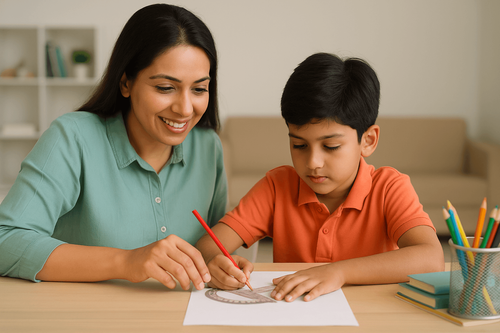

Understanding angle measurement is an important part of early geometry learning. Children use angles in shapes, clocks, direction, designs, and even in real life activities without realising it. A clear understanding of angle measurement helps them build strong reasoning skills and confidence in maths. This blog explains what angle measurement means, the tools used, how to read angles, and simple ways to teach these concepts at home and in school.
What Is Angle Measurement
Angle measurement is the process of finding out how wide or narrow an angle is. Angles are formed when two rays or lines meet at a point called the vertex. Children often learn the idea of angles through shapes and turning movements.
Key ideas
An angle shows a turn or opening
The size of the turn tells us how big the angle is
Angle measurement helps compare angles
Angles appear in daily life, from scissors to door hinges
When children understand what angle and measurement involve, they start seeing angles everywhere, which makes geometry more meaningful.
Why Angle Measurement Is Important for Kids
Angle measurement builds essential mathematical thinking. It helps children understand shapes, measure distances, and solve geometry problems.
Benefits for learners
Improves spatial awareness
Strengthens problem solving
Helps in reading maps and directions
Builds understanding of shapes and designs
Supports higher geometry learning in later grades
Solid understanding of angle measurement boosts confidence because children learn how to measure, compare, and classify angles correctly.
Angle Measurement Units Explained
Angles are measured using a standard unit known as the degree. One full circle has 360 degrees. Understanding the angle measurement unit helps children measure accurately.
Key facts
The symbol for degrees is °
Right angle is 90°
Straight angle is 180°
Full turn is 360°
Acute angles are less than 90°
Obtuse angles are between 90° and 180°
When children learn angle measurement units early, they find it easier to classify angles during later lessons.
Help your child understand character depth and expressive storytelling.
Book a free PlanetSpark trial class today.
Angle Measurement Tools Children Should Know
To measure angles correctly, children use different tools depending on the situation. Knowing each angle measurement tool helps them choose correctly during exercises.
Common tools
Protractor: The most common angle measurement instrument
Geometry compass: Helps to draw circles and arcs
Set squares: Used for right angles and simple geometry
Ruler and edge: Used for constructing lines before angle measurement
Children feel more confident when they know which angle measurement instrument to use for different tasks.
How to Use a Protractor for Angle Measurement
A protractor is the main tool used in classrooms. Children often struggle at first, so a step by step explanation helps them measure angles properly.
Simple steps
Place the midpoint of the protractor on the angle’s vertex
Align the base line with one of the rays
Read the number where the second ray points
Check if you should use the inner or outer scale
Record the angle measurement in degrees
This process helps children measure angles with accuracy and confidence.
Types of Angles Kids Should Learn
Understanding angle types is an important part of learning angle and measurement. It helps children recognise how angle size changes shape and direction.
Main angle types
Acute angles: less than 90°
Right angles: exactly 90°
Obtuse angles: between 90° and 180°
Straight angles: exactly 180°
Reflex angles: between 180° and 360°
Knowing these types helps children identify angles quickly when using an angle measurement instrument.
Don’t wait to help your child strengthen creativity and expression.
Sign up for a PlanetSpark storytelling session today.
Where Children See Angles in Real Life
Angle measurement becomes easier when children understand how angles appear in daily situations.
Real life examples
The hands of a clock form different angles
A ladder leaning on a wall
Opening and closing a door
Paper folding in origami
Scissors forming angles when cutting
Road intersections creating angle shapes
These examples help children connect classroom learning with practical everyday experiences.
Angle Measurement in Shapes and Designs
Geometry becomes more interesting when children apply angle and measurement concepts to shapes. Every polygon contains a set of angles that help define its structure.
Examples
A square has four right angles
A triangle’s angles add up to 180°
A pentagon has five interior angles
A rectangle has equal opposite angles
Knowing these properties strengthens children's reasoning skills.
Easy Activities to Teach Angle Measurement at Home
Parents can teach angle measurement through simple and fun activities.
Activity ideas
Use two pencils to form angles
Fold paper corners to make right angles
Use the clock to show changing angles
Draw shapes and measure all angles
Compare angles in daily objects
These activities help children understand angle measurement naturally.
Classroom Activities That Build Angle Measurement Skills
Teachers often use hands-on tasks to help children understand angle measurement. These activities make the concept easier and more engaging.
Effective classroom activities
Angle hunt: Students search around the classroom for acute, right, and obtuse angles
Protractor practice sheets: Children measure real angles drawn on worksheets
Group measuring challenge: Teams measure angles in shapes to compare results
Clock angle activity: Students measure angles made by the clock hands at different times
Fold and measure: Paper folding to create angles and measure them
Children understand angle measurement better when they learn through active exploration.
Using Technology to Teach Angle Measurement
Digital tools can make geometry more interactive. Today, children learn angle and measurement more effectively when they see animated examples or use online practice tools.
Useful tech based resources
Virtual protractors
Interactive geometry apps
Angle drawing tools
Online measurement quizzes
Digital worksheets
These tools help children experiment with angle size, shape, and orientation, deepening their understanding of angle measurement units and tools.
Common Mistakes Children Make While Measuring Angles
Learning angle measurement takes practice. Children often make errors when they begin using a protractor or when they try to classify angles.
Frequent mistakes
Not aligning the protractor baseline correctly
Misreading the wrong number on the protractor
Confusing acute and obtuse angles
Forgetting that a straight line equals 180°
Using the wrong angle measurement tool
Holding the protractor at an angle instead of flat
Parents and teachers can correct these mistakes early with step-by-step guidance.
Help your child understand character depth and expressive storytelling.
Book a free PlanetSpark trial class today.
Advanced Angle Measurement Techniques
Once children understand the basics, they can learn advanced methods that improve accuracy and problem solving.
Higher level techniques
Measuring reflex angles by subtracting from 360°
Splitting complex shapes into simpler ones
Using complementary and supplementary relationships
Estimating before measuring
Checking answers with alternative approaches
Teaching these advanced techniques strengthens mathematical flexibility.
Using Angle Measurement Instruments Correctly
Children often encounter more than one angle measurement instrument, and learning the purpose of each improves confidence.
Instruments and uses
Protractor: Measures exact angles
Compass: Helps draw arcs and construct angles
Set squares: Used for right angles and simple measurements
Ruler: Helps construct clean lines before measuring
Understanding each instrument’s use helps children choose the correct tool for each geometry task.
Angle Measurement Through Construction Activities
Constructing angles is as important as measuring them. Children learn the relationship between an angle’s construction and its measurement.
Construction activities
Drawing 60° and 120° using a compass
Constructing 90° using a set square
Creating polygons and measuring each angle
Using arcs to check measurement accuracy
Dividing angles into smaller parts
These activities build strong practical geometry skills.
Don’t wait to help your child strengthen creativity and expression.
Sign up for a PlanetSpark storytelling session today.
Helping Children Understand Differences Between Angles
To use angle measurement tools correctly, children must know how to compare angles.
Comparison techniques
Visual estimation
Using a protractor to check size
Folding paper to compare angles
Overlaying transparent angle templates
Observing turns (small turn vs big turn)
This strengthens conceptual understanding of angle and measurement.
Angle Measurement in Real Life Situations
Kids become more confident when they see geometry outside their textbooks.
Daily life examples
A skateboard ramp forms an angle with the ground
A kite string creates angles as it moves
Ramps, slides, and bridges use measured angles
Artists use angles in design layouts
Engineers use angle measurement in construction
Connecting lessons with life makes learning meaningful.
Simple Worksheets to Practice Angle Measurement at Home
Parents can help by introducing easy practice worksheets.
Worksheet ideas
Measure and classify given angles
Draw angles of specific degrees
Match angles to their measurements
Compare angles in different shapes
Identify errors in measured angles
Regular practice leads to improved accuracy.

How PlanetSpark Helps Children Master Angle Measurement
PlanetSpark supports children in understanding maths concepts like angles through structured lessons and interactive activities.
What PlanetSpark offers
AI powered guidance for solving maths problems
Gamified learning to make geometry fun
Personalised curriculums based on child’s learning level
Practical worksheets for measuring and drawing angles
Step by step mentoring to improve accuracy
Kids learn to measure, compare, and understand angles with confidence.
Conclusion
Angle measurement is an important maths skill that supports geometry learning, logical thinking, and confidence in problem solving. When children understand angle measurement units, learn to handle each angle measurement instrument, and practice with real examples, they develop stronger mathematical foundations. With guided learning and practice through PlanetSpark, children gain clarity, accuracy, and enthusiasm for maths.