
How Does PlanetSpark Make Area and Perimeter Easy to Learn
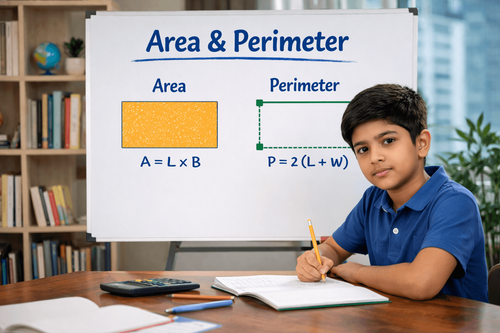

Table of Contents
- What Are Area and Perimeter? (Simple Explanation for Kids)
- Understanding the Perimeter Formula Step by Step
- Understanding the Area Formula with Visual Thinking
- Area of Rectangle Formula Explained in Depth
- Difference Between Area and Perimeter
- Real-Life Examples Kids Can Relate To
- Common Mistakes Students Make in Area and Perimeter
- Why Conceptual Understanding Matters More Than Memorization
- How PlanetSpark Makes Area and Perimeter Easy to Learn
- Key Takeaways
Mathematics becomes exciting when children understand the logic behind it instead of memorizing formulas. One of the most important foundational math concepts children learn in primary school is area and perimeter. These two ideas help students understand shapes, measurements, and space in a practical way.
However, many children get confused between the area formula and the perimeter formula. They often memorize formulas without truly understanding what they mean. This leads to mistakes and fear of math.
This guide explains area and perimeter in the simplest possible way for kids and shows how PlanetSpark makes learning these concepts structured, fun, and confidence-boosting.
What Are Area and Perimeter? (Simple Explanation for Kids)
Before learning formulas, children must understand meaning.
Imagine you have a playground.
If you walk all around the playground fence, you are measuring its perimeter.
If you look at the space inside the playground where children play, that space is the area.

What is Perimeter?
Perimeter is the total distance around the boundary of a shape.
It answers the question:
“How long is the border?”
Perimeter is always measured in simple units like:
- centimeters (cm)
- meters (m)
- kilometers (km)
What is Area?
Area is the amount of surface inside a shape.
It answers the question:
“How much space does this shape cover?”
Area is measured in square units like:
- cm²
- m²
- km²
Why Do Students Get Confused?
Children often memorize formulas without understanding:
- Perimeter = walking around
- Area = covering inside
When they remember this visualization, confusion reduces dramatically.
Turn math confusion into clarity. Enroll your child in PlanetSpark’s structured math program now.
Understanding the Perimeter Formula Step by Step
Perimeter is about adding sides.
Let’s understand this deeply.
Perimeter of a Rectangle
A rectangle has:
- 2 lengths
- 2 widths
So if we add all sides:
Length + Width + Length + Width
Instead of writing that long expression, mathematicians simplified it to:
Perimeter formula = 2 × (Length + Width)
Example:
Length = 10 cm
Width = 6 cm
Perimeter = 2(10 + 6)
= 2 × 16
= 32 cm
Why multiply by 2?
Because there are two pairs of equal sides.
Build problem-solving confidence early. Schedule a trial class with PlanetSpark today.
Perimeter of a Square
A square has 4 equal sides.
So perimeter formula becomes:
Perimeter = 4 × side
If side = 7 cm
Perimeter = 4 × 7 = 28 cm
Very simple.
Why Addition is Used in Perimeter
Perimeter measures boundary distance.
Distance is always calculated by adding lengths.
That is why perimeter formula involves addition.
When children understand the logic, they stop memorizing blindly.
Make math simple, visual, and engaging for your child.
Understanding the Area Formula with Visual Thinking
Area is different from perimeter because it measures space, not distance.
What Does Area Really Mean?
Imagine you are tiling a floor.
You want to know:
How many tiles will fit inside?
That is the area.
Area counts how many square units fit inside a shape.
Area of Rectangle Formula
Area of a rectangle formula = Length × Breadth
But why multiply?
Let’s visualize.
If a rectangle has:
5 rows
Each row has 8 squares
Total squares = 5 × 8 = 40
That is the area.
Multiplication works because we are counting rows and columns.
Example of Area Formula
- Length = 9 cm
- Breadth = 4 cm
Area = 9 × 4 = 36 cm²
Notice the square unit.
The square symbol is extremely important.
Without it, the answer is incomplete.
Set your child up for long-term math success. Start their PlanetSpark journey now.
Area of Rectangle Formula Explained in Depth
The Area of rectangle formula is one of the most frequently used math formulas in school.
Area = Length × Breadth
But let’s go deeper.
Understanding Through Grid Method
Draw a rectangle on graph paper.
Count:
- Number of squares in one row
- Number of rows
Multiply them.
This is visual proof of the formula.
Real-Life Application of Area of Rectangle
- Measuring classroom floor
- Buying carpet
- Painting a wall
- Designing a garden
All require area calculation.
Children should understand that area is not just a school topic. It is practical life mathematics.
Ready to make Area and Perimeter easy for your child?
Difference Between Area and Perimeter
This is one of the most searched questions: difference between area and perimeter.
Let’s break it clearly.
Key Differences
Perimeter:
- Measures boundary
- Uses addition
- Units are simple (cm, m)
- Represents distance
Area:
- Measures surface
- Uses multiplication
- Units are square (cm², m²)
- Represents space
Example to Compare
Rectangle:
Length = 12 m
Width = 4 m
Perimeter = 2(12 + 4) = 32 m
Area = 12 × 4 = 48 m²
Notice:
Same shape
Different answers
Different meaning
Even two shapes with same perimeter can have different areas.
This is an important higher-level concept.
Build problem-solving confidence early. Schedule a trial class with PlanetSpark today.
Real-Life Examples Kids Can Relate To
Math becomes easy when connected to daily life.
Perimeter Examples
- Putting a fence around a garden
- Decorating a photo frame with ribbon
- Building a boundary wall
- Running around a park
All measure boundary.
Area Examples
- Painting a wall
- Tiling a floor
- Laying carpet
- Designing a football field
All measure inside space.
When children link math to real life, retention increases permanently.

Common Mistakes Students Make in Area and Perimeter
Understanding mistakes prevents repetition.
Mistake 1: Mixing Formulas
Students use area formula when question asks perimeter.
Reason:
They memorize without understanding.
Mistake 2: Forgetting Square Units
Area answers must have square units.
Forgetting this loses marks.
Mistake 3: Not Multiplying by 2 in Perimeter Formula
They write:
Perimeter = L + W
Instead of:
2(L + W)
Mistake 4: Arithmetic Errors
Incorrect addition or multiplication.
Mistake 5: Not Reading the Question Properly
Sometimes question asks:
“Find the length if perimeter is given.”
Students directly apply formula without rearranging.
Concept clarity reduces all these errors.
Give your child a strong foundation in geometry. Start learning Area and Perimeter the right way.
Why Conceptual Understanding Matters More Than Memorization
When children memorize formulas:
They forget easily.
They panic in exams.
They apply wrong formulas.
When children understand logic:
They derive formulas if forgotten.
They solve word problems confidently.
They enjoy mathematics.
Area and perimeter are foundational topics.
If learned properly, geometry becomes easier in higher classes.
How PlanetSpark Makes Area and Perimeter Easy to Learn
PlanetSpark believes mathematics is about understanding, not memorization.
The key USPs of PlanetSpark’s maths course include:
- Live interactive sessions led by experienced educators who introduce mental-calculation shortcuts (including Vedic maths tricks) and connect them directly to NCERT/CBSE exam problems.
- Customised practise modules focusing on arithmetic operations, algebraic expressions, quadratic equations, and roots, so students apply the tricks within actual syllabus-aligned questions.
- Performance analytics & error-tracking tools that identify recurring calculation mistakes, helping students focus on improving speed and accuracy.
- Dedicated doubt-resolution and revision-boosters, which means that if any student is lagging on applying the tricks, the mentor provides targeted support and extra practise.
- Board-exam simulators with time-bound mock tests that help students learn to use tricks under realistic exam conditions, building confidence and speed.
Help your child master Area and Perimeter with confidence.
Book a personalized learning session with PlanetSpark today.
Key Takeaways
Understanding Area and Perimeter becomes simple when children focus on meaning instead of memorizing formulas. Perimeter measures the total distance around a shape and is calculated by adding all its sides, while area measures the space inside a shape and is calculated by multiplying dimensions such as length and breadth.
The area formula and perimeter formula are based on logic. Perimeter uses addition because it measures boundary length, and area uses multiplication because it counts square units covering a surface. The Area of a rectangle formula (Length × Breadth) helps children understand how rows and columns create total space, while the rectangle perimeter formula (2 × (Length + Width)) explains how opposite sides are equal.
Recognizing the difference between area and perimeter prevents common exam mistakes, especially confusion between units and formulas. When students connect these concepts to real-life examples like fencing a garden or tiling a floor, their understanding becomes stronger and long-lasting. With structured teaching and conceptual clarity, children not only solve problems accurately but also build lasting confidence in mathematics.
Frequently Asked Questions
Perimeter measures the total distance around the boundary of a shape, while area measures the space inside the shape. Perimeter uses addition because we add all sides together. Area uses multiplication because it counts square units that cover a surface. Perimeter is measured in simple units like cm or m, whereas area is measured in square units like cm² or m².
The perimeter formula for a rectangle is 2 × (Length + Width). This works because a rectangle has two equal lengths and two equal widths. Instead of adding all four sides separately, we add length and width once and multiply by 2. The answer is always written in linear units like centimeters or meters.
The Area of rectangle formula is Length × Breadth (or Width). It works because we are counting how many rows and columns of square units fit inside the shape. Multiplication helps us calculate the total number of squares quickly. The final answer is written in square units such as cm² or m².
Area represents the surface covered inside a shape, so it counts square units that fit within it. For example, if one square measures 1 cm by 1 cm, it covers 1 cm² of space. When we multiply length and breadth, we calculate how many such squares fit inside. That is why area is written with a small square symbol.
Students usually confuse them because both concepts are taught together and involve measurements. Without understanding the meaning, children may mix up the area formula and perimeter formula. Memorizing formulas without visualization increases confusion. Learning through examples like fencing (perimeter) and tiling (area) helps avoid mistakes.
Yes, two shapes can have the same perimeter but different areas. For example, a long thin rectangle and a nearly square rectangle may have equal boundary length. However, the space inside them can vary greatly. This shows why area and perimeter measure completely different things.
Children can remember the area formula by visualizing rows and columns. Drawing a rectangle on graph paper and counting squares makes the logic clear. Instead of memorizing Length × Breadth, they understand that multiplication counts total squares. Conceptual understanding makes formulas easier to recall.
Perimeter is used when measuring boundaries, such as fencing a garden or framing a photo. It is also helpful when building walls or putting decorative borders around objects. Any situation where you measure around something involves perimeter. It is practical math used in daily life.
Area is used when measuring surface space, like tiling a floor or painting a wall. It helps determine how much material is needed to cover a surface. Farmers use area to measure land size. Interior designers also calculate area before placing furniture or carpets.
Children improve by practicing word problems and using visual methods like drawing diagrams. Understanding the logic behind the area formula and perimeter formula builds confidence. Regular revision and real-life examples make learning stronger. Guided teaching and structured practice further strengthen conceptual clarity.