
NCERT Class 10 Areas Related to Circles: Formulas, Concepts, and Questions


Table of Contents
- What are Areas Related to Circles?
- Key Terms You Must Know
- Important Formulas of Areas Related to Circles
- Area of a Sector of a Circle
- Area of a Segment of a Circle
- Visual Understanding of Areas Related to Circles
- Real-Life Applications of Areas Related to Circles
- Common Mistakes Students Make
- Tips to Solve Questions Faster
- Step-by-Step Approach to Solve Questions
- Practice Questions
- Quick Revision Notes (Last-Minute Prep)
- Why Learn Areas Related to Circles with PlanetSpark
- Let’s Recap What You Learned About Circles
Imagine sharing a pizza with your friends; each slice is not just food, it’s a perfect example of mathematics in action. From Ferris wheels to circular gardens, circles are everywhere around us. But what about the parts of a circle?
In this chapter, you’ll explore Areas Related to Circles, including sectors and segments, along with important formulas. You’ll also learn how to solve application-based questions that connect maths to real-life situations in a simple and engaging way.
What are Areas Related to Circles?
In simple terms, Areas Related to Circles deal with finding the area of not just a full circle, but also its different parts, like sectors and segments. Instead of calculating the whole pizza, you might need to find the area of just one slice; that’s what this topic is all about.
The area of a circle gives the space inside the entire boundary, calculated using πr². However, areas related to circles focus on smaller portions like sectors (a slice) and segments (a cut portion formed by a chord).
These concepts are widely used in real life. In engineering, they help design wheels and machine parts. In architecture and design, they are used to create domes, parks, and decorative patterns. Even in daily life, calculating portions of circular objects—like dividing land or food—uses these ideas.
Before diving deeper, let’s quickly recall basics:
- Radius (r): Distance from the center to the boundary
- Diameter (d): Twice the radius (d = 2r)
Understanding these basics will make the upcoming concepts much easier.
Key Terms You Must Know
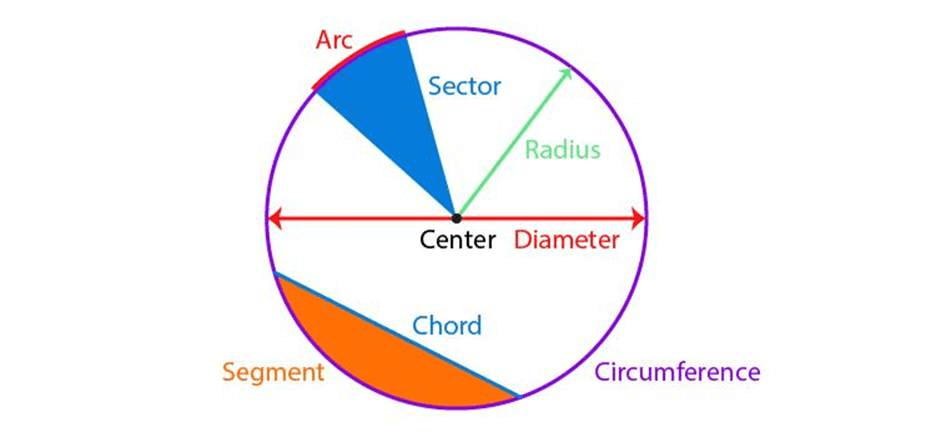
Before learning formulas, it’s important to understand the key terms clearly. Here are the most important ones:
Important Terms:
- Circle
A round shape where all points are equidistant from the center.
Example: A coin or a clock. - Radius
The distance from the center of the circle to any point on its boundary.
Example: Half the diameter of a pizza. - Diameter
A straight line passing through the center connecting two points on the circle.
Example: The full width of a circular plate. - Circumference
The total boundary length of the circle.
Example: The edge of a wheel. - Sector
A portion of a circle formed by two radii and the included angle.
Example: A slice of pizza - Segment
A part of a circle formed between a chord and its arc.
Example: The shape formed when you cut a curved piece from a circle. - Arc
A curved part of the circle’s boundary.
Example: The curved edge of a pizza slice. - Chord
A line segment joining any two points on the circle.
Example: A straight cut across a round cake.
These terms form the foundation of the chapter. Once you understand them, formulas and questions become much easier to solve.

Important Formulas of Areas Related to Circles
Understanding formulas is the key to solving questions quickly and accurately. Let’s break down the core formulas in a simple way:
Area of a Circle = πr²
This formula gives the total space inside a circle. Here, r is the radius.
Example: If r = 7 cm,
Area = π × 7² = 49π ≈ 154 cm²
Circumference of a Circle = 2πr
This is the total boundary length of the circle.
Example: If r = 7 cm,
Circumference = 2 × π × 7 = 14π ≈ 44 cm
Area of a Sector = (θ/360) × πr²
A sector is a portion of a circle (like a slice). θ is the angle at the center.
Example: If θ = 90° and r = 7 cm,
Area = (90/360) × π × 49 = 1/4 × 49π ≈ 38.5 cm²
Length of an Arc = (θ/360) × 2πr
An arc is the curved boundary of a sector.
Example: If θ = 90° and r = 7 cm,
Arc length = (90/360) × 2π × 7 = 1/4 × 14π ≈ 11 cm
Area of a Segment = Area of Sector – Area of Triangle
A segment is the region between a chord and an arc.
Example: If sector area = 50 cm² and triangle area = 20 cm²,
Segment area = 50 – 20 = 30 cm²
These formulas are the foundation of this chapter. Once you understand when and how to use them, most questions become easy to solve.
You May Also Find Useful
Linear Equations in Two Variables Class 10-Concept, Graphs, Tips
Area of a Sector of a Circle
A sector is a part of a circle formed by two radii and the angle between them. The easiest way to understand it is by imagining a pizza slice. Each slice represents a sector of the full pizza (circle).
Formula Explanation
The area of a full circle is πr². A sector is just a fraction of the circle, depending on the angle θ.
So,
Area of sector = (θ/360) × πr²
Here:
- θ = central angle
- r = radius
Types of Sectors
- Minor Sector
The smaller part of the circle (θ < 180°) - Major Sector
The larger part of the circle (θ > 180°)
Together, minor + major sector = full circle
Solved Example
Question:
Find the area of a sector of a circle with radius 7 cm and angle 60°.
Solution:
Step 1: Write formula
Area = (θ/360) × πr²
Step 2: Substitute values
= (60/360) × π × 7²
Step 3: Simplify
= (1/6) × π × 49
Step 4: Final answer
= 49π/6 ≈ 25.67 cm²
This method works for all sector-based questions. Just plug in the values carefully.
Book a Free Demo Class Today.
Area of a Segment of a Circle
A segment is the region formed between a chord and the arc of a circle. Unlike a sector, it does not include the center.
Sector vs Segment (Quick Difference)
- Sector: Formed by two radii and an arc (includes center)
- Segment: Formed by a chord and an arc (does not include center)
Formula Breakdown
To find the area of a segment, we subtract the triangle part from the sector:
Area of Segment = Area of Sector – Area of Triangle
Why?
Because a segment is the leftover part after removing the triangle from the sector.
Solved Example
Question:
Find the area of a segment of a circle with radius 7 cm and angle 60°.
Solution:
Step 1: Area of sector
= (60/360) × π × 49
= 49π/6 ≈ 25.67 cm²
Step 2: Area of triangle
Use formula: (1/2) × r² × sinθ
= 1/2 × 49 × sin60°
= 24.5 × (√3/2) ≈ 21.22 cm²
Step 3: Area of segment
= 25.67 – 21.22
= 4.45 cm²
Always remember:
Segment = Sector – Triangle
This simple idea makes even complex questions easy to solve.
Visual Understanding of Areas Related to Circles
Sometimes, formulas feel confusing until you see what’s happening. Visualizing concepts makes learning much easier.
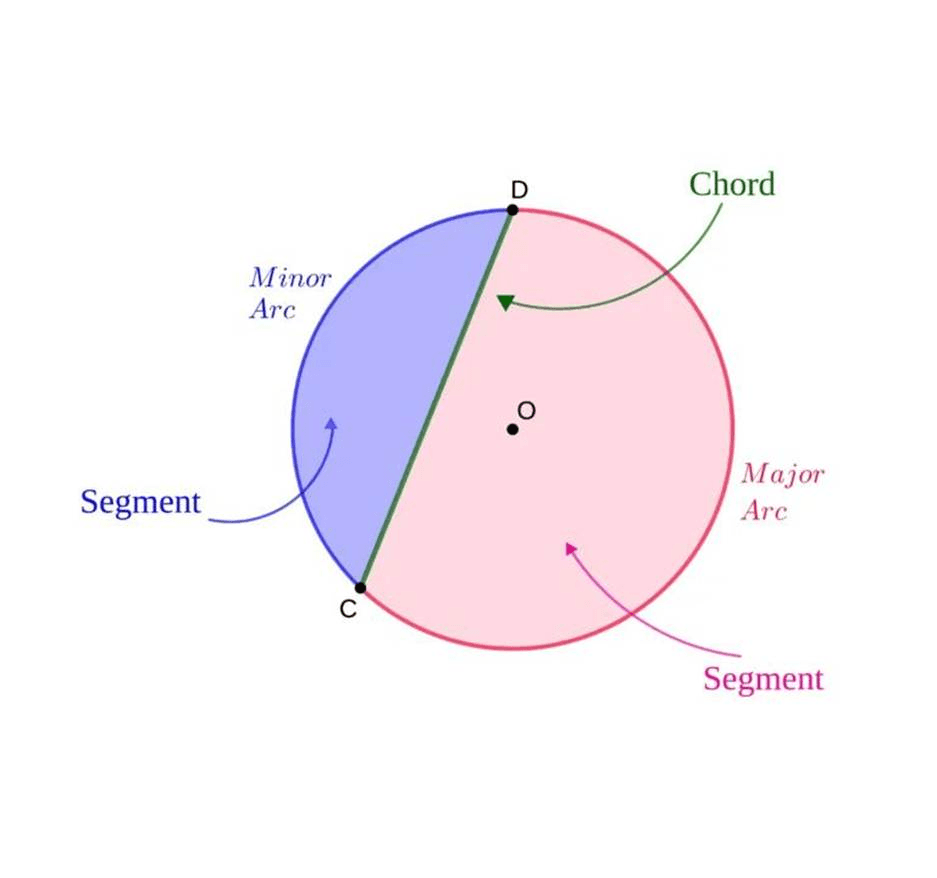
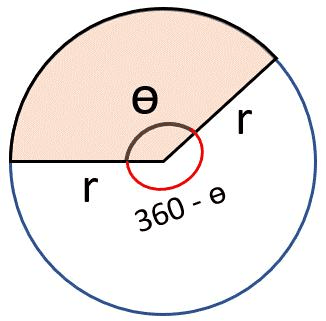
- A sector looks like a slice of pizza, formed by two radii
- A segment is the region between a chord and an arc
- Major and minor sectors depend on whether the angle is greater or less than 180°
When solving questions, always try to sketch a quick diagram. It helps you identify whether the problem is about a sector or a segment.

Real-Life Applications of Areas Related to Circles
Mathematics becomes more interesting when we see how it works in real life. Areas Related to Circles are used in many practical situations around us.
- Road Construction
Engineers use circular calculations while designing roundabouts, curved roads, and flyovers. For example, the turning radius of a road is based on circle concepts. - Architecture & Design
Circular shapes are common in domes, stadium roofs, and parks. When designing a circular garden or fountain, architects calculate sectors and segments to divide space efficiently. - Sports Fields
Many sports fields include circular markings. For instance, the center circle in football or cricket grounds uses circle area formulas for accurate measurement. - Daily Life Examples
Cutting a pizza into slices involves sectors. Sharing land in circular plots or designing circular tiles also uses these concepts. - Graphics & Digital Design
Designers use circular shapes in logos, animations, and patterns. Calculating proportions often involves sectors and arcs.
These examples show that circle concepts are not just theoretical—they are part of everyday life.
Common Mistakes Students Make
Avoiding small mistakes can improve your marks significantly. Watch out for these:
- Confusing Sector and Segment
Sector includes center; segment does not - Using Wrong Angle Units
Always use degrees (not radians) unless specified - Forgetting Value of π
Use π = 22/7 or 3.14 as required - Incorrect Formula Application
Mixing up arc length and sector area formulas - Calculation Errors
Mistakes in squaring radius or simplifying fractions - Skipping Diagram
Not visualizing the figure leads to confusion
Being careful with these points can prevent easy mistakes in exams.
Tips to Solve Questions Faster
Speed and accuracy come with the right approach:
- Understand, Don’t Memorize
Know where formulas come from - Draw Diagrams
Visuals make concepts clearer - Identify Given Values
Note radius, angle, and what is asked - Choose the Right Formula
Sector, segment, or full circle - Practice Regularly
More questions = better speed
Smart practice helps you solve even tricky questions quickly.
Try a Free Demo Class Today.
Step-by-Step Approach to Solve Questions
Many students struggle not because they don’t know formulas, but because they don’t know how to start. Follow this simple method:
- Read the question carefully
Identify what is given (radius, angle, etc.) - Draw a rough diagram
Visual clarity reduces mistakes - Identify the concept
- Full circle → πr²
- Sector → (θ/360) × πr²
- Segment → Sector – Triangle
- Apply the correct formula
Substitute values carefully - Solve step-by-step
Avoid skipping calculations
This structured approach improves both accuracy and speed in exams.
Practice Questions
(A) Based on Area of Circle
- Find the area of a circle with radius 7 cm.
- Calculate the area of a circle with diameter 14 cm.
- Find the radius of a circle whose area is 154 cm².
- A circular park has a radius of 21 m. Find its area.
- Find the circumference and area of a circle with radius 10 cm.
- If the area of a circle is 616 cm², find its radius.
- Compare areas of two circles with radii 7 cm and 14 cm.
- Find the area of a circle using π = 3.14 and r = 5 cm.
- A wire forms a circle of radius 7 cm. Find its length.
- Find the area of a circular plate of radius 14 cm.
(B) Based on Sector
- Find the area of a sector with angle 90° and radius 7 cm.
- Calculate the arc length for θ = 60°, r = 14 cm.
- Find the area of a sector with θ = 120°, r = 7 cm.
- Determine arc length for θ = 45°, r = 21 cm.
- Find the area of a semicircle of radius 14 cm.
- Calculate the area of a sector with θ = 30°, r = 10 cm.
- Find arc length when θ = 180°, r = 7 cm.
- A circle is divided into 6 equal sectors. Find area of one sector.
- Find the area of a sector with θ = 270°, r = 7 cm.
- Calculate arc length for θ = 120°, r = 7 cm.
Schedule a Free Demo Class Today.
(C) Based on Segment
- Find the area of a segment with r = 7 cm and θ = 60°.
- Calculate segment area if sector = 50 cm² and triangle = 20 cm².
- Find the segment area for θ = 90°, r = 14 cm.
- A chord forms a segment of angle 120°. Find its area (r = 7 cm).
- Find segment area when θ = 180° (semicircle case).
- Calculate segment area using sector = 80 cm², triangle = 30 cm².
- Find area of minor segment for θ = 45°, r = 10 cm.
- Find area of major segment if total circle area is known.
- A segment is formed in a circle of radius 14 cm with θ = 60°. Find area.
- Compare areas of two segments with same radius but different angles.
(D) Application-Based Questions
- A pizza of radius 14 cm is cut into 8 equal slices. Find area of one slice.
- A circular park has a path covering 90° sector. Find its area (r = 21 m).
- Find the area of a semicircular window of radius 7 cm.
- A wheel of radius 14 cm rotates once. Find distance covered.
- A circular field is divided into 4 equal parts. Find area of each.
- A sector of 60° is used in design. Find its area (r = 10 cm).
- A circular garden has a chord dividing it into two parts. Find smaller area.
- A clock has a minute hand of length 7 cm. Find area swept in 30 minutes.
- Find area of a circular logo with radius 5 cm.
- A round table is covered with cloth. Find area needed if radius = 1 m.
These questions cover all important concepts and help in exam preparation.
Quick Revision Notes (Last-Minute Prep)
Before exams, you don’t have time to read everything again. Use these quick points:
- Area of circle = πr²
- Sector = fraction of circle based on angle
- Segment = Sector – Triangle
- Always check angle (in degrees)
- Use π = 22/7 unless mentioned
Revise these 5 points and you can solve most questions easily.
Why Learn Areas Related to Circles with PlanetSpark
Learning Areas Related to Circles becomes much easier and more interesting with PlanetSpark. Here’s how it helps students:
- Easy Explanations
Complex formulas are broken down into simple, understandable steps - Concept Clarity
Focus on why formulas work, not just memorizing them - Real-Life Examples
Concepts are connected with daily life like pizza slices and parks - Interactive Learning
Engaging sessions that keep students involved and active - Confidence Building
Regular practice helps students solve questions without fear - Practice + Feedback
Personalized feedback to improve accuracy and speed
With the right guidance, maths becomes less scary and more enjoyable.

Let’s Recap What You Learned About Circles
Areas Related to Circles is an important topic that connects formulas with real-world applications. From understanding sectors and segments to solving practical problems, this chapter builds strong mathematical skills.
The key is simple: practice regularly, understand concepts clearly, and avoid common mistakes. With the right approach and consistent effort, you can master this topic.
Keep practicing, stay curious, and remember, maths becomes easy when you truly understand it!
You May Also Read
Vedic Math Tricks for NCERT Class 10 : Speed & Accuracy Tips
Frequently Asked Questions
PlanetSpark covers all key topics including sectors, segments, arc length, formulas, and application-based questions in a structured way.
It can feel tricky, but with PlanetSpark’s guided approach, students can break down formulas and solve problems with confidence.
By using relatable examples like pizza slices, parks, and real-life designs, PlanetSpark makes learning engaging and easy to understand.
Absolutely! PlanetSpark prepares students with exam-oriented questions, strategies, and revision techniques to score better in maths exams.
Yes, PlanetSpark offers structured practice, worksheets, and expert feedback to improve speed and accuracy in solving circle-related problems.
PlanetSpark focuses on concept clarity instead of rote learning, helping students confidently solve sector, segment, and application-based questions.
PlanetSpark simplifies Areas Related to Circles through interactive sessions, real-life examples, and step-by-step explanations, making concepts easier to grasp.