
Conic Sections Explained for Class 11–12 | PlanetSpark


Table of Contents
What happens when a simple cone is cut at different angles? The answer gives us the fascinating world of conic sections, one of the most important topics in Class 11–12 mathematics. A conic section is formed when a plane intersects a double-napped cone, creating curves like the parabola, ellipse, circle, and hyperbola. Understanding conic sections formula, graphical interpretation, and equations for conic sections helps students build strong problem-solving skills and accuracy in exams.
With clear concepts, standard forms, and proper practice, learners can easily solve higher-order and application-based questions. At PlanetSpark, structured learning and expert guidance make conic sections equations simple, engaging, and confidence-building for every student.

What Is Conic Section?
Conic sections are curves formed when a plane cuts a double-napped cone (both nappes). The shape depends on the angle of the cutting plane.
- Circle: A special ellipse formed when the plane is parallel to the base
- Ellipse: Formed when the plane cuts one nappe at a slant angle
- Parabola: Formed when the plane cuts parallel to the side (surface) of the cone
- Hyperbola: Formed when the plane cuts through both nappes, typically parallel to the cone’s axis
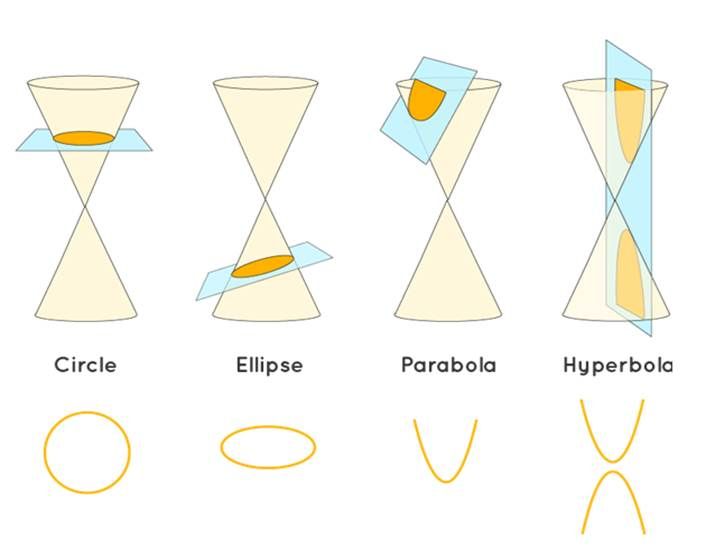
These shapes are studied using conic sections equations and equations for conic sections, along with key conic sections formula in Class 11–12.
Types of Conic Sections and their Properties
Conic sections are curves formed when a plane intersects a double-napped cone at different angles. Depending on the orientation of the plane, different curves are produced. Understanding conic sections is essential in Class 11–12 mathematics because they form the foundation of coordinate geometry and appear frequently in board exams and competitive tests. Each curve has a specific structure, set of properties, and standard equations known as conic sections equations that help in solving analytical problems accurately.
Circle
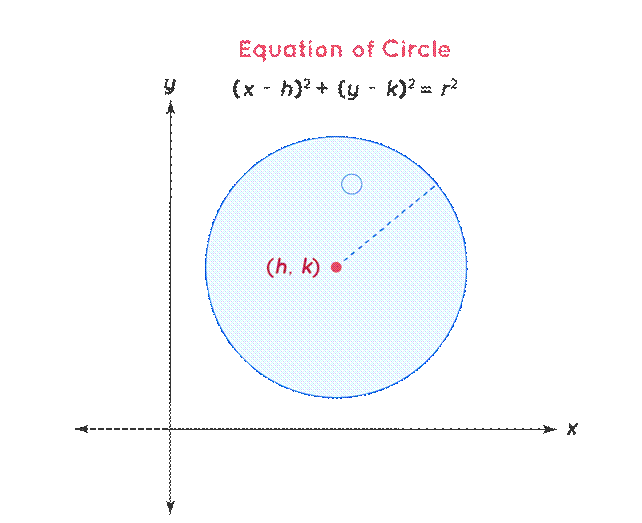
A circle is formed when a plane cuts the cone parallel to its base. It is the locus of all points that are at a constant distance from a fixed point called the center.
Standard Equation:
(x−h)2+(y−k)2=r2
Where (h, k) is the center and r is the radius.
If the circle is centered at the origin, the equation becomes:
x2+y2=r2
Example:
Find the equation of a circle with center (3, –2) and radius 4.
(x−3)2+(y+2)2=16
Properties:
All radii are equal
Diameter = 2r
Symmetric about its center
Eccentricity = 0
Help your child master conic sections with expert guidance at PlanetSpark. Strengthen their concepts and boost exam performance. Schedule a free session now!
Parabola
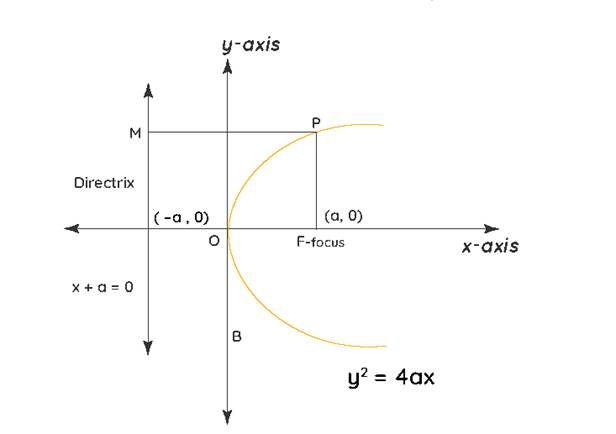
A parabola is also considered as one of the conic sections equations which is formed when the plane cuts the cone parallel to a slant edge. It is the locus of points equidistant from a fixed point (focus) and a fixed line (directrix).
Standard Equations (Vertex at Origin):
y2=4ax (opens right)
y2=−4ax (opens left)
x2=4ay (opens upward)
x2=−4ay (opens downward)
Where “a” is the distance between the vertex and the focus.
Example:
If a=2, then
y2=8x
Properties:
One focus and one directrix
Axis of symmetry
Latus rectum = 4a
Eccentricity = 1
Parabolas are widely used in satellite dishes and headlights due to their reflection property.
Ellipse
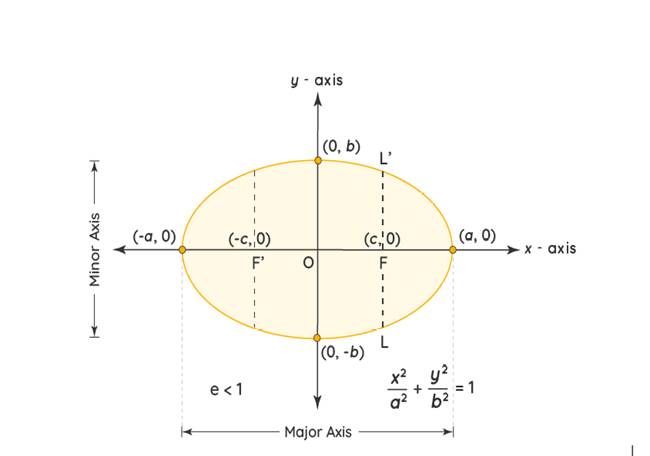
An ellipse is also a conical section that is formed when the plane cuts the cone at an angle but does not intersect the base. It is the locus of points where the sum of distances from two fixed points (foci) remains constant.
Standard Equation (Horizontal Major Axis):
x^2/a^2 + y^2/b^2 = 1
Where:
a = semi-major axis
b = semi-minor axis
c2=a2−b2
Example:
x^2/25 + y^2/9 = 1
Here, a = 5 and b = 3
Properties:
Two foci
Major and minor axes
Eccentricity e = c/a, where 0 < e < 1
Symmetric about both axes
Hyperbola
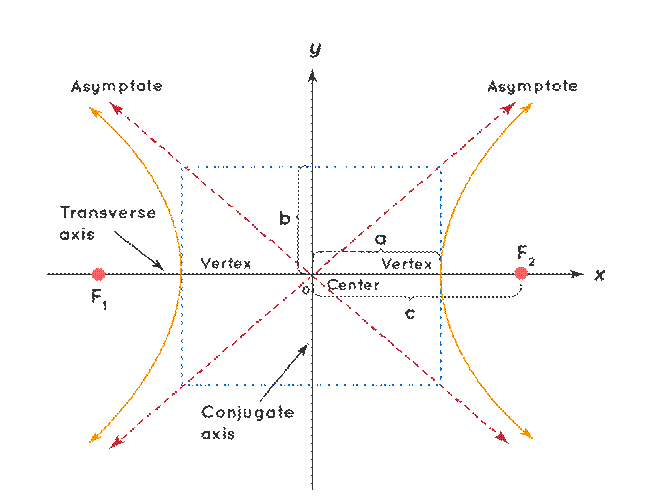
A hyperbola is formed when the plane intersects both nappes of the cone. It consists of two separate open curves.
Standard Equation (Horizontal Transverse Axis):
x^2/a^2 - y^2/b^2 = 1
Where:
c2=a2+b2
Example:
x^2/16 - y^2/9 = 1
Properties:
Two foci
Two asymptotes
Eccentricity > 1
Symmetric about both axes
What Are the Important Parameters and Key Concepts for Class 11–12?
In Class 11–12 coordinate geometry, understanding the important parameters of conic sections equations is crucial for solving analytical and application-based problems. Students must clearly grasp standard equations, geometric definitions, and relationships between different elements such as focus, directrix, vertex, axes, and eccentricity. These parameters help in identifying the type of curve and determining its shape and orientation.
Standard Forms of Equations
Each conic section has a specific algebraic form:
Circle:
(x−h)2+(y−k)2=r2
Here, (h, k) is the center and r is the radius.
Example: If the center is (2, 3) and radius is 4:
(x−2)2+(y−3)2=16
Parabola:
y2=4ax
Vertex = (0, 0), Focus = (a, 0), Directrix = x = –a.
Example: If a=2,
y2=8x
Ellipse:
x2a2+y2b2=1
Relationship:
c2=a2−b2
Example:
x^2/25 + y^2/9 = 1
Hyperbola:
x^2/a^2 - y^2/b^2 = 1
Relationship:
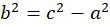
c2=a2+b2
Example:
x^2/16 - y^2/9 = 1
Make conic sections easy with PlanetSpark’s structured lessons. Get the clarity your child needs to tackle every equation confidently. Claim your free session with us!
Key Parameters
Focus: Fixed point that defines the curve.
Directrix: Fixed line used in defining a parabola.
Vertex: Turning point of the curve.
Axes: Major and minor axes (ellipse), transverse and conjugate axes (hyperbola).
Eccentricity (e)
Circle: e=0e = 0e=0
Parabola: e=1e = 1e=1
Ellipse: e = c/a, 0 < e < 1
Hyperbola: e = c/a, e > 1
Mastering these parameters helps students confidently solve board and competitive exam problems.

Examples on Equations for Conic Sections
These examples show how to build conic sections equations using the center, vertex, and focus. Apply the right standard form and use conic sections formula to find missing values like a, b, and c.
Example 1: Find the equation for conic sections (Hyperbola)
Question: Find the equation of a hyperbola with center  , vertex
  , and focus
  .
.
Solution:
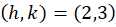
All points lie on the line  , so the transverse axis is horizontal.
- Center
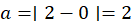
- Distance from center to vertex:
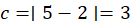
- Distance from center to focus:
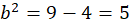
- Use
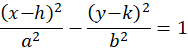
Standard form:
Substitute values:
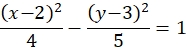
✅ Answer: 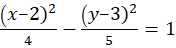
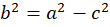
Example 2: Find the conic section equations (Ellipse)
Question: For an ellipse, focus is  , vertex is
  , and center is
  . Find its equation.
Solution:
All points lie on the x-axis, so the major axis is along x.
- Center

- Distance from center to focus:

- Distance from center to vertex:

- Use

Standard form:
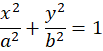
Substitute values:
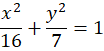
✅ Answer: 
With strong basics in conic sections, conic sections formula, and equations for conic sections, Class 11–12 students can solve problems faster, accurately, and confidently.
Simplify conic sections for your child with PlanetSpark’s expert coaching. Gain in-depth understanding and excel in exams. Book a free session with PlanetSpark!
Study Tips On Conic Sections for Class 11 - 12 Students
Conic sections in Class 11 introduce many new terms and equations for conic sections, so the best way to remember every conic section formula is to learn them with clarity + repeat practice. Here are a few easy tips students can follow:
Use videos/simulations to quickly understand conic sections and conic sections equations.
Re-solve textbook examples to remember each conic sections formula and equations for conic sections.
Practice with apps/worksheets for fast revision of conic section equations and every equation for conic sections.
To master conic sections, focus on formulas, parameters, and graphs. Practice consistently, revise weekly, and solve previous year’s questions. With conceptual clarity and regular problem-solving, this chapter can become one of the highest-scoring topics in Class 11–12 mathematics.
Why PlanetSpark is the Right Learning Partner for Mastering Conic Sections?
While understanding conic sections is essential for Class 11–12 mathematics, students also need strong communication skills to explain concepts clearly in exams, viva, presentations, and competitive interviews. This is where PlanetSpark plays a powerful supporting role in a child’s academic journey.
Strengthens Concept Explanation Skills
While students study conic sections, it is equally important that they can clearly explain concepts like circle, parabola, ellipse, and hyperbola in exams or viva sessions. PlanetSpark’s 1:1 Public Speaking coaching helps students confidently present mathematical ideas, including understanding and explaining the conic sections formula step-by-step.
Improves Logical Structuring of Answers
Many students know the formulas but struggle to structure answers properly. PlanetSpark trains learners to organize explanations clearly, introduction, formula, derivation, and example. This helps when writing or verbally explaining equations for conic sections in board exams or competitive tests.
Boosts Confidence Through Real Practice
With live sessions, debates, and presentation practice, students learn to confidently discuss topics like identifying a curve from given conic section equations. Speaking about mathematical reasoning improves retention and strengthens conceptual clarity.
Encourages Analytical and Critical Thinking
Through personality development and structured communication exercises, students enhance logical thinking, a key requirement while solving an equation for conic sections or interpreting graphs. PlanetSpark’s expert mentors provide continuous feedback, helping learners build confidence, clarity, and strong academic presentation skills.
By combining academic understanding with communication excellence, PlanetSpark ensures students not only solve mathematical problems but also explain them confidently and effectively.
Conclusion
Mastering conic sections is essential for Class 11–12 students as it builds a strong foundation in coordinate geometry and supports success in board and competitive exams. By clearly understanding the concepts, properties, and conic sections formula, students can confidently solve a wide range of analytical and application-based problems. Regular practice, graph interpretation, and conceptual clarity are key to excelling in this topic.
Transform your child’s understanding of conic sections with PlanetSpark’s focused guidance. Build confidence and excel in every exam. Book a free session today!
When students combine strong mathematical understanding with consistent revision and problem-solving strategies, conic sections become one of the most scoring and manageable chapters in higher secondary mathematics.
Frequently Asked Questions
Conic sections are curves formed when a plane intersects a double-napped cone. In Class 11, students study four main types, circle, parabola, ellipse, and hyperbola. Each curve has a standard equation and unique properties related to focus, directrix, and eccentricity.
Conic sections are frequently asked in board exams, JEE, CUET, and other entrance tests. Questions include identifying curves, finding focus or eccentricity, and solving application-based problems. Strong conceptual clarity improves accuracy and speed.
Conic sections have practical uses:
Parabolas in satellite dishes and headlights
Ellipses in planetary orbits
Circles in engineering designs
Hyperbolas in navigation systems
Understanding applications helps students connect theory with real-world examples.
To identify the curve:
If both x2 and y2 have the same sign → Circle or Ellipse
If only one variable is squared → Parabola
If signs are opposite → Hyperbola
Rewriting the equation in standard form makes identification easier.
Students often make common mistakes in conic sections, such as forgetting to convert equations into standard form, confusing a² - b² with a² + b², making errors while completing the square, and misidentifying the direction of opening in parabolas. Regular practice and careful step-by-step solving can help avoid these errors.
To convert a general quadratic equation into standard form, students often use the method of completing the square.
Example:
x2+y2−4x+6y−12=0
Group terms:
(x2−4x)+(y2+6y)=12
Complete the square:
(x−2)2+(y+3)2=25
Conic section equations represent a circle with center (2, –3) and radius 5. Converting to standard form makes identification and solving easier.