
NCERT Class 10 Coordinate Geometry Concepts and Practice


Last Updated At: 7 Apr 2026
21 min read
Table of Contents
- What is Coordinate Geometry?
- Coordinate Plane and Basic Terminology
- Distance Formula in Coordinate Geometry
- Applications of Distance Formula
- Section Formula
- Midpoint Formula
- Special Problems Based on Coordinate Geometry
- Category-Wise Practice Questions
- Common Mistakes Students Make in Coordinate Geometry
- Tips to Score Full Marks in Coordinate Geometry
- Why Students Choose PlanetSpark for Smarter Math Learning
- Key Takeaways from Coordinate Geometry
Have you ever used Google Maps to find a location or played games where characters move to exact positions on the screen? The math behind this is called Coordinate Geometry. It helps us locate points on a plane using numbers.
In Class 10 Coordinate Geometry, students learn how to use the coordinate plane, calculate the distance between two points, find the midpoint of a line, and divide a line using the section formula. In this blog, we will explain these concepts in simple language and include practice questions to help you understand the chapter better.
What is Coordinate Geometry?
Coordinate Geometry is a branch of mathematics that connects algebra and geometry. It allows us to represent geometric shapes and points using numbers and equations instead of only diagrams.
In simple terms, coordinate geometry helps us locate points on a plane using coordinates. Each point on the plane has a specific position that can be written using numbers.
For example, the point (3, 4) means:
- Move 3 units along the horizontal direction (x-axis)
- Then move 4 units upward along the vertical direction (y-axis)
Using coordinates, we can find distances between points, locate midpoints, and divide line segments easily.
Coordinate System
The system used to locate points is called the Cartesian Coordinate System.
It consists of two perpendicular number lines:
- X-axis: The horizontal line
- Y-axis: The vertical line
These two axes intersect at a point called the origin, written as (0,0).
This system creates a plane where any point can be located using coordinates.
Ordered Pairs
Coordinates of a point are written in the form (x, y) and are called ordered pairs.
Here:
- x represents the position on the x-axis
- y represents the position on the y-axis
Example:
- (2, 5) → Move 2 units right and 5 units up
- (-3, 4) → Move 3 units left and 4 units up
The order is important because (2,5) and (5,2) represent different points.
Importance of Coordinate Geometry
Coordinate geometry is very useful in both mathematics and real life.
It helps in:
- Finding distance between two points
- Locating positions on maps and graphs
- Studying lines, shapes, and patterns
It is widely used in fields such as:
- GPS and navigation systems
- Computer graphics and video games
- Architecture and engineering
- Physics and data analysis
Because of these applications, coordinate geometry is an important topic for students to understand.
Coordinate Plane and Basic Terminology
Before learning formulas in coordinate geometry, students must understand the basic structure of the coordinate plane and some important terms. These concepts help in locating points and solving problems easily.
Cartesian Plane
The Cartesian Plane is a two-dimensional plane used to locate points using numbers. It is formed by two perpendicular number lines.
- X-axis: The horizontal line
- Y-axis: The vertical line
These two axes intersect at a point called the origin.
- Origin: The point where the x-axis and y-axis meet.
- It is represented as (0,0).
The Cartesian plane helps us represent points, draw graphs, and study geometric shapes using coordinates.
Example:
If a point has coordinates (4,2), it means:
- Move 4 units along the x-axis
- Move 2 units upward along the y-axis
Coordinates of a Point
The position of a point on the coordinate plane is written as an ordered pair.
An ordered pair is written as:
(x, y)
Where:
- x-coordinate represents the horizontal position
- y-coordinate represents the vertical position
There are two special terms used for these coordinates:
- Abscissa: The x-coordinate of a point
- Ordinate: The y-coordinate of a point
Example
For the point (3,5):
- Abscissa = 3
- Ordinate = 5
This means the point is 3 units to the right and 5 units upward from the origin.
Points on the Axes
Some points lie directly on the axes.
Points on the X-axis
For points on the x-axis, the y-coordinate is always 0.
Examples:
- (3,0)
- (-5,0)
These points lie on the horizontal axis.
Points on the Y-axis
For points on the y-axis, the x-coordinate is always 0.
Examples:
- (0,4)
- (0,-6)
These points lie on the vertical axis.
Quadrants
The x-axis and y-axis divide the coordinate plane into four regions called quadrants.
First Quadrant
- Both coordinates are positive
- Example: (3,4)
Second Quadrant
- x is negative and y is positive
- Example: (-2,5)
Third Quadrant
- Both coordinates are negative
- Example: (-4,-3)
Fourth Quadrant
- x is positive and y is negative
- Example: (5,-2)
Understanding quadrants helps students identify the position of points quickly and makes solving coordinate geometry problems easier.
Distance Formula in Coordinate Geometry
The distance formula is one of the most important concepts in coordinate geometry. It helps us calculate the distance between two points on the coordinate plane without measuring it directly from a graph. This formula is widely used in solving geometry problems and understanding the relationship between points.
Concept of Distance Between Two Points
In coordinate geometry, every point has a fixed position on the plane. Sometimes we need to know how far two points are from each other.
For example, imagine two locations on a map represented by the points A (2,3) and B (6,7). Instead of measuring the distance with a ruler, we can calculate it using the distance formula.
The distance formula gives an exact numerical value of the distance between two points.
Distance Formula
If two points are:
A (x₁, y₁) and B (x₂, y₂)
Then the distance between them is given by:

-10-8-6-4-2246810-10-5510(6.0, 6.0)(-6.0, -6.0)d = 16.97
Where:
- d = distance between the two points
- x₁, y₁ = coordinates of the first point
- x₂, y₂ = coordinates of the second point
This formula helps calculate the straight-line distance between any two points on the coordinate plane.
Distance from Origin
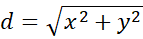
Sometimes we need to find the distance of a point from the origin (0,0).
If a point is (x, y), its distance from the origin is:
-10-8-6-4-2246810-10-5510(6.0, 6.0)(-6.0, -6.0)d = 16.97
Example
Find the distance of the point (6,8) from the origin.
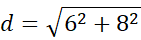
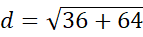
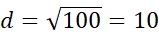
So, the distance from the origin is 10 units.
Derivation Using Pythagoras Theorem
The distance formula is actually derived from the Pythagoras Theorem.
Consider two points:
- A (x₁, y₁)
- B (x₂, y₂)
If we draw horizontal and vertical lines from these points, they form a right-angled triangle.
- Horizontal side = x₂ − x₁
- Vertical side = y₂ − y₁
According to the Pythagoras Theorem:
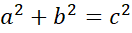




abc
Here:
- a = (x₂ − x₁)
- b = (y₂ − y₁)
- c = distance between the two points
Substituting these values gives the distance formula.
This shows that the formula is simply an application of the Pythagoras theorem on the coordinate plane.
Example Problems
Example 1: Distance Between Two Points
Find the distance between A (2,3) and B (5,7).

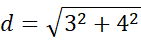
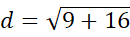
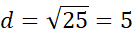
So, the distance between the two points is 5 units.
Example 2: Distance from Origin
Find the distance of point (3,4) from the origin.
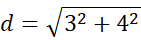
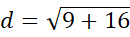
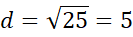
So, the distance of the point from the origin is 5 units.
Understanding the distance formula helps students solve many coordinate geometry problems quickly and accurately. It is also the foundation for learning other concepts such as section formula and midpoint formula.

Applications of Distance Formula
The distance formula is not only used to calculate the distance between two points. It also helps solve many geometric problems in coordinate geometry. By comparing distances between points, we can check whether points lie on the same line, identify triangles, and recognize different geometric shapes.
5.1 Checking Collinearity of Points
Three points are said to be collinear if they lie on the same straight line.
Using the distance formula, we can check this by comparing distances between the points.
Suppose we have three points A, B, and C.
Steps to check collinearity:
- Find the distance AB
- Find the distance BC
- Find the distance AC
If:
AB + BC = AC,
then the three points lie on the same straight line and are collinear.
Example
Points: A(1,2), B(3,4), C(5,6)
After calculating the distances using the distance formula, we find that:
AB + BC = AC
Therefore, these points are collinear.
5.2 Finding the Type of Triangle
The distance formula can also help identify the type of triangle formed by three points.
First, calculate the lengths of all three sides of the triangle.
- If all three sides are equal, the triangle is equilateral.
- If two sides are equal, it is an isosceles triangle.
- If all sides are different, it is a scalene triangle.
We can also check if a triangle is right-angled by using the Pythagoras rule:
If:
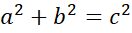
then the triangle is a right triangle.
Example
Points: A(0,0), B(4,0), C(0,3)
Distances:
- AB = 4
- AC = 3
- BC = 5
Since:
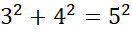
the triangle is a right triangle.
5.3 Identifying Geometric Shapes
The distance formula also helps identify shapes formed by different points on the coordinate plane.
By calculating the distances between points, we can determine whether a shape is a square, rectangle, or another quadrilateral.
Square
A shape is a square if:
- All four sides are equal
- Diagonals are equal
Rectangle
A shape is a rectangle if:
- Opposite sides are equal
- Diagonals are equal
Isosceles Triangle
A triangle is isosceles if two sides have equal length.
Right Triangle
A triangle is right-angled if it satisfies the Pythagoras rule.
Because of these uses, the distance formula is a powerful tool in coordinate geometry. It helps students analyze shapes and relationships between points more accurately.
Section Formula
The section formula is an important concept in coordinate geometry. It helps us find the coordinates of a point that divides a line segment into a given ratio. Instead of measuring the position on a graph, we can directly calculate the coordinates using a formula.
This concept is very useful when studying line segments, triangles, and geometric figures in the coordinate plane.
Concept of Dividing a Line Segment
In coordinate geometry, a line segment connects two points. Sometimes we need to find a point that divides this line segment into a specific ratio.
Suppose we have two points:
- A (x₁, y₁)
- B (x₂, y₂)
Now assume there is a point P on the line segment AB that divides it in the ratio m : n.
This means:
- The distance AP : PB = m : n
Point P lies between points A and B, and its coordinates can be calculated using the section formula.
You May Also Read
NCERT Solutions for Class 10 Mathematics Chapter 7 Coordinate Geometry
Internal Division of Line Segment
When a point divides a line segment between two endpoints, it is called internal division.
For example:
- A (2,4) and B (8,10) are the endpoints of a line segment.
- If point P divides this segment in the ratio 1 : 1, it means P lies exactly in the middle of the line.
If the ratio is 2 : 1, then point P is closer to B than A.
Internal division helps us locate points between two known points on the coordinate plane.
Section Formula
If a point P divides the line joining A(x₁, y₁) and B(x₂, y₂) in the ratio m : n, the coordinates of point P are given by the section formula:

Where:
- (x₁, y₁) = coordinates of point A
- (x₂, y₂) = coordinates of point B
- m : n = ratio in which the line segment is divided
This formula helps calculate the exact position of point P on the coordinate plane.
Understanding the Ratio
The ratio m : n tells us how the line segment is divided.
- m represents the distance from point A to P
- n represents the distance from point P to B
For example:
- If m : n = 1 : 1, the point lies exactly at the middle of the line segment.
- If m : n = 2 : 1, the point is closer to B.
- If m : n = 1 : 3, the point is closer to A.
Understanding the ratio helps us visualize where the point lies on the line segment.
Solved Examples
Example 1: Point Dividing a Line Segment
Find the coordinates of the point that divides the line joining A(2,4) and B(8,10) in the ratio 1 : 2.
Using the section formula:


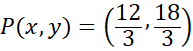

So, the point dividing the line segment in the ratio 1 : 2 is (4,6).
Example 2: Finding the Ratio
A point P(4,6) divides the line joining A(2,4) and B(8,10). Find the ratio in which it divides the line.
First observe the coordinates:
- A = (2,4)
- P = (4,6)
- B = (8,10)
We can see that P lies exactly halfway between A and B.
So, the ratio is:
AP : PB = 1 : 1
The section formula makes it easier to locate points on a line segment and solve coordinate geometry problems efficiently. It also leads to another important concept called the midpoint formula, which we will learn next.
Midpoint Formula
The midpoint formula is a simple and useful concept in coordinate geometry. It helps us find the exact middle point of a line segment that joins two points on a coordinate plane. Instead of measuring the middle point on a graph, we can easily calculate it using a formula.
Concept of Midpoint
The midpoint of a line segment is the point that divides the segment into two equal parts.
Suppose we have two points:
- A (x₁, y₁)
- B (x₂, y₂)
The midpoint lies exactly halfway between A and B. This means the distance from A to the midpoint is equal to the distance from the midpoint to B.
For example, if you draw a line segment between A(2,4) and B(6,8), the midpoint will lie exactly at the center of this line.
Midpoint Formula
The midpoint of the line segment joining A(x₁, y₁) and B(x₂, y₂) can be calculated using the midpoint formula.
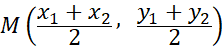
-10-8-6-4-2246810-10-5510A(-7.0, -3.0)B(5.0, 7.0)M = (-1.0, 2.0)
Here:
- (x₁, y₁) are the coordinates of the first point
- (x₂, y₂) are the coordinates of the second point
This formula simply finds the average of the x-coordinates and the y-coordinates.
Solved Example
Find the midpoint of the line joining A(2,4) and B(6,8).
Using the midpoint formula:
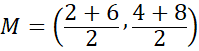
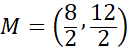
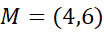
So, the midpoint of the line segment is (4,6).
Practical Applications
The midpoint formula is useful in many mathematical and real-life situations. It helps in:
- Finding the center point of a line segment
- Determining the center of shapes and graphs
- Solving geometry problems involving triangles and quadrilaterals
It is also used in fields like architecture, engineering, computer graphics, and navigation, where finding the exact center between two points is important.
Special Problems Based on Coordinate Geometry
Apart from basic formulas, coordinate geometry also includes special problem types that test students’ understanding of concepts. These questions usually require applying formulas like the distance formula, section formula, and midpoint formula in different situations. Practicing such problems helps students develop stronger problem-solving skills.
Trisection of a Line Segment
Trisection means dividing a line segment into three equal parts.
If a line segment joins two points A and B, the points that divide it into three equal parts lie at the ratios:
- 1 : 2
- 2 : 1
Using the section formula, we can find the coordinates of these two points.
Example
If A(0,0) and B(6,6) are the endpoints, the points that trisect the line segment can be calculated using the ratios 1 : 2 and 2 : 1. These points will divide the segment into three equal parts.
Finding Coordinates in a Parallelogram
In coordinate geometry, if the coordinates of three vertices of a parallelogram are given, the fourth vertex can be found using the midpoint property of diagonals.
In a parallelogram, diagonals bisect each other. This means the midpoint of both diagonals is the same.
So, by using the midpoint formula, we can find the coordinates of the missing vertex.
Example
If three vertices of a parallelogram are A(1,2), B(4,6), and C(6,3), the coordinates of the fourth vertex can be calculated using midpoint relationships.
Equidistant Points
A point is called equidistant if it is at the same distance from two or more points.
To check this, we calculate distances using the distance formula.
Example
If a point P has equal distances from points A and B, then:
- Distance PA = Distance PB
This property is often used in problems involving perpendicular bisectors and triangles.
Finding Unknown Coordinates
Sometimes questions give partial information and ask students to find missing coordinates.
For example:
- The midpoint of a line segment is given.
- One endpoint is known.
- The other endpoint must be found.
Using the midpoint formula, we can form equations and solve them to find the unknown coordinates.
Example
If the midpoint of A(x,2) and B(6,4) is (4,3), we can use the midpoint formula to calculate the value of x.
These special problems help students apply coordinate geometry formulas in different situations and strengthen their understanding of the chapter. Practicing such questions also prepares students for board exam problems and higher-level mathematics.
Category-Wise Practice Questions
Practicing different types of questions helps students understand coordinate geometry concepts more clearly. The following questions are divided into categories based on the formulas and concepts used in the chapter. Students should try solving them step by step to strengthen their understanding.
Basic Coordinate Geometry
- Identify the quadrant in which the following points lie: (3,4), (-2,5), (-4,-3), (5,-2).
- Write the abscissa and ordinate of the point (6,-3).
- Find the coordinates of a point that lies 5 units to the right and 2 units above the origin.
- Which of the following points lie on the x-axis: (4,0), (0,5), (-3,0), (2,7)?
- Which of the following points lie on the y-axis: (0,4), (3,0), (0,-6), (-2,5)?
- Write the coordinates of the origin.
- Plot the points (2,3), (-3,2), (-2,-4), (4,-3) and identify their quadrants.
- Find the coordinates of a point located 3 units left and 5 units down from the origin.
Distance Formula Questions
- Find the distance between A(2,3) and B(5,7).
- Calculate the distance between P(1,2) and Q(4,6).
- Find the distance between the points (-2,3) and (4,-1).
- Find the distance between A(0,0) and B(6,8).
- Find the distance of the point (3,4) from the origin.
- Calculate the distance between (-3,-4) and (3,4).
- Find the distance between (5,2) and (1,-4).
- Calculate the distance between the points (-1,2) and (3,-2).
Collinearity Questions
- Check whether the points A(1,2), B(3,4), C(5,6) are collinear.
- Verify if the points (2,3), (4,7), (6,11) lie on the same straight line.
- Determine whether A(0,0), B(2,2), C(4,4) are collinear.
- Check if the points (1,3), (2,5), (3,7) are collinear.
- Verify whether the points (-1,-2), (0,0), (1,2) lie on the same line.
- Check whether A(2,4), B(4,8), C(6,12) are collinear.
- Determine if the points (3,5), (5,9), (7,13) lie on a straight line.
- Check if A(1,1), B(2,3), C(3,5) are collinear.
Triangle Type Questions
- Determine the type of triangle formed by A(0,0), B(4,0), C(0,3).
- Find whether the triangle formed by (1,2), (4,6), (7,2) is isosceles.
- Check if the triangle with vertices (0,0), (3,0), (3,4) is right-angled.
- Determine whether the triangle formed by (2,3), (5,7), (8,3) is isosceles or scalene.
- Identify the type of triangle formed by (-2,0), (2,0), (0,3).
- Check if the triangle formed by (1,1), (4,5), (7,1) is isosceles.
- Determine whether the triangle formed by (0,0), (5,0), (2,4) is right-angled.
- Identify whether the triangle formed by (2,2), (6,6), (10,2) is isosceles.
Section Formula Questions
- Find the coordinates of the point dividing the line joining A(2,4) and B(8,10) in the ratio 1 : 2.
- Find the point dividing the line joining (1,3) and (5,7) in the ratio 2 : 1.
- Determine the coordinates of a point dividing the line joining (2,6) and (8,4) in the ratio 3 : 1.
- Find the point that divides the line joining (3,5) and (9,11) in the ratio 1 : 1.
- Determine the coordinates of the point dividing the line joining (0,0) and (6,6) in the ratio 2 : 3.
- Find the coordinates of a point dividing the line joining (4,2) and (10,8) in the ratio 3 : 2.
- Determine the coordinates of the point dividing the line joining (-2,4) and (6,8) in the ratio 1 : 3.
- Find the point dividing the line joining (5,1) and (9,7) in the ratio 2 : 3.
Midpoint Questions
- Find the midpoint of the line joining A(2,4) and B(6,8).
- Find the midpoint of the line segment joining (1,3) and (5,7).
- Determine the midpoint of the points (-2,4) and (6,8).
- Find the midpoint of the line joining (0,0) and (8,6).
- Calculate the midpoint of the line joining (3,5) and (7,9).
- Find the midpoint of the line segment joining (-4,-2) and (2,6).
- Determine the midpoint of the points (5,1) and (9,7).
- Find the midpoint of the line joining (-3,4) and (7,-2).
Practicing these questions will help students understand coordinate geometry formulas and apply them correctly in exams. Regular practice also improves accuracy, speed, and confidence in solving coordinate geometry problems.
Common Mistakes Students Make in Coordinate Geometry
Students often make small mistakes while solving coordinate geometry problems. Some common errors include:
- Sign Errors: Ignoring negative signs while calculating distances or applying formulas.
- Incorrect Order of Coordinates: Writing coordinates in the wrong order. Remember that coordinates are always written as (x, y).
- Forgetting the Square Root: While using the distance formula, students sometimes forget to take the square root in the final step.
- Wrong Ratio in Section Formula: Mixing up the ratio m : n can give incorrect coordinates for the required point.
To avoid these mistakes, students should check their calculations carefully and practice problems regularly.
Tips to Score Full Marks in Coordinate Geometry
Scoring full marks in coordinate geometry becomes easier if students follow a few simple strategies.
- Remember the formulas: Learn the important formulas such as the distance formula, section formula, and midpoint formula and practice applying them correctly.
- Practice NCERT examples: Most exam questions are based on NCERT examples and exercises, so solving them thoroughly is very important.
- Draw diagrams: Whenever possible, draw a rough coordinate diagram. It helps you visualize the points and understand the problem better.
- Solve step by step: Write each step clearly while solving problems, especially in board exams.
- Double-check calculations: Always recheck signs, squares, and final answers to avoid small calculation mistakes.
With regular practice and careful problem-solving, students can easily improve accuracy and score well in coordinate geometry questions.
Why Students Choose PlanetSpark for Smarter Math Learning
PlanetSpark helps students build strong math skills through personalized and engaging learning methods.
- 1:1 Live Math Classes – Students learn directly from expert teachers with full individual attention.
- Stronger Problem-Solving Skills – Focus on developing logical thinking and analytical abilities.
- Fun, Game-Based Learning – Interactive activities make math engaging and easier to understand.
- Personalized Progress Reports – Parents receive regular updates on their child’s learning progress.
With expert guidance and interactive learning methods, PlanetSpark helps students build confidence and improve their math performance.

Key Takeaways from Coordinate Geometry
Coordinate geometry helps students understand how to locate points and analyze shapes using numbers. In this chapter, students learn important concepts like the distance formula, which helps find the distance between two points, the section formula, used to divide a line segment in a given ratio, and the midpoint formula, which finds the exact center of a line segment.
These formulas are essential for solving many coordinate geometry problems. With regular practice and clear understanding of formulas, students can solve questions accurately and perform well in exams.
Also Read
Frequently Asked Questions
PlanetSpark helps students understand Coordinate Geometry through interactive lessons, expert teachers, and personalized practice sessions.
Yes, PlanetSpark offers structured practice exercises and guided problem-solving sessions to help students master Coordinate Geometry concepts.
Yes, PlanetSpark provides personalized classes designed to help Class 10 students understand Coordinate Geometry and other important math topics.
PlanetSpark simplifies Coordinate Geometry concepts using step-by-step explanations, visual learning, and interactive teaching methods.
Yes, PlanetSpark focuses on building strong logical thinking and problem-solving skills while teaching Coordinate Geometry.
Students choose PlanetSpark because it offers expert teachers, engaging lessons, and personalized feedback to improve understanding of Coordinate Geometry.
Yes, PlanetSpark provides personalized progress reports and feedback to help students track their improvement in Coordinate Geometry.