
NCERT Class 12 Determinants: Formulas, Properties, and Examples


Table of Contents
- What Are Determinants?
- Determinant of Different Orders
- Determinant of Order 3
- Minors and Cofactors
- Important Properties of Determinants
- Solving Determinants Using Properties
- Area of a Triangle Using Determinants
- Determinants in Solving Linear Equations
- Common Mistakes Students Make While Solving Determinants
- Practice Questions (Category-wise)
- How PlanetSpark Helps Students Master Determinants
- Determinants: What Students Should Remember
n Many students find determinants confusing because of expansions, signs, and long calculations. But once you understand the logic step by step, determinants become one of the most systematic topics in mathematics.
Determinants are important because they help in solving systems of linear equations, finding inverse matrices, and solving problems in algebra and geometry. In this guide, we will simplify the concept of determinants by covering definitions, formulas, properties, solved examples, and practice questions to help Class 12 students build strong conceptual clarity.
What Are Determinants?
A determinant is a special number that can be calculated from a square matrix. It helps us understand important properties of a matrix, such as whether the matrix has an inverse and whether a system of linear equations has a unique solution.
Relationship Between Matrices and Determinants
A matrix is a rectangular arrangement of numbers in rows and columns. However, determinants can only be calculated for square matrices, meaning matrices that have the same number of rows and columns (like 2×2, 3×3, etc.).
Determinants play an important role in many areas of mathematics, including:
- Solving systems of equations
- Finding inverse matrices
- Linear algebra applications
- Geometry and transformations
Determinant Notation
A determinant is usually written using two common notations:
- det(A)
- |A|
Both represent the determinant of matrix A.
Example of a Determinant (2×2 Matrix)
Consider a matrix:
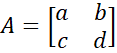
The determinant of this matrix is calculated using the formula:
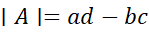
Here, we multiply the main diagonal (a × d) and subtract the product of the other diagonal (b × c).
Solved Example
Find the determinant of the matrix:
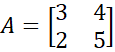
Using the formula:
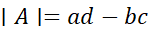
Substitute the values:



Therefore, the determinant of matrix A is 7.
This simple rule makes it easy to calculate determinants for 2×2 matrices, and it forms the foundation for understanding larger determinants like 3×3 matrices, which we will explore next.
Determinant of Different Orders
Determinants can be calculated for square matrices of different sizes, such as 1×1, 2×2, 3×3, and higher orders. The order of a determinant refers to the number of rows or columns in the matrix.
Let’s understand the determinants of different orders step by step.
Determinant of Order 1
A determinant of order 1 comes from a 1 × 1 matrix. This is the simplest type of determinant.
If a matrix has only one element, then the determinant is simply that element itself.
Example:

Here the matrix contains only one value.
So,

Therefore, the determinant of a 1×1 matrix is the element itself.

Determinant of Order 2 (Important)
A determinant of order 2 comes from a 2 × 2 matrix. This is one of the most important formulas students use frequently in Class 12 mathematics.
Consider the matrix:
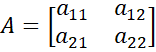
The determinant of this matrix is calculated using the formula:

This means:
- Multiply the main diagonal elements
- Multiply the other diagonal elements
- Subtract the second product from the first
Example 1 (Solved)
Evaluate the determinant:

Step 1: Apply the formula

Step 2: Substitute the values

Step 3: Simplify
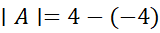
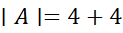

Therefore, the value of the determinant is 8.
Example 2 (Solved – Symbolic Example)
Evaluate the determinant:

Step 1: Apply the determinant formula

Step 2: Substitute the elements

Step 3: Simplify

Therefore, the determinant of the matrix is:

This symbolic form is useful when solving algebraic problems and equations involving determinants.
Determinant of Order 3
A determinant of order 3 comes from a 3 × 3 matrix. Calculating it is slightly longer than a 2×2 determinant, but it becomes easy if you follow the expansion method step by step.
To find a 3×3 determinant, we expand it using minors and cofactors.
What Are Minor Determinants?
A minor of an element in a matrix is the determinant obtained after removing the row and column of that element.
For example, if we remove the row and column of  , the remaining 2×2 matrix forms its minor determinant.
Formula for Determinant of Order 3
For the matrix:
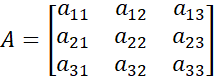
The determinant can be expanded as:

This method is called expansion along the first row.
Row Expansion
In row expansion, we expand the determinant using the elements of a selected row (usually the first row).
Steps:
- Take an element from the row.
- Multiply it with its minor determinant.
- Apply the correct sign pattern.
- Add or subtract the results.
Column Expansion
Similarly, we can expand the determinant using any column instead of a row.
Students often choose a row or column that contains zeros, because it makes the calculation shorter and easier.
Sign Pattern in Cofactor Expansion
When expanding determinants, we follow a fixed sign pattern:
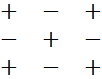
This means:
- The first element is positive
- The second is negative
- The third is positive, and so on.
Remembering this pattern helps avoid common calculation mistakes.
Example (Step-by-Step)
Evaluate the determinant:
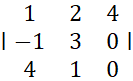
Step 1: Choose the Row or Column
Notice that the third column contains two zeros.
So expanding along this column makes the calculation much easier.
Step 2: Apply the Expansion
Only the first element of the column contributes:
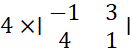
(The other two terms become zero because they are multiplied by 0.)
Step 3: Solve the 2×2 Determinant



Step 4: Multiply with the Element

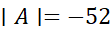
Final Answer: The value of the determinant is −52.
Why Expanding Along Zeros Is Easier
When we expand along a row or column with zeros, most of the terms automatically become zero, which reduces the number of calculations.
This trick helps students solve determinants faster in exams and minimizes chances of mistakes.
Minors and Cofactors
Many students find minors and cofactors confusing, but the concept becomes simple once you understand the logic behind it. These ideas are extremely important because they are used in expanding determinants and finding the inverse of matrices.
Let’s understand them one by one.

Minor
The minor of an element in a determinant is the determinant obtained after deleting the row and column containing that element.
In simple words:
- Choose an element in the matrix.
- Remove the row of that element.
- Remove the column of that element.
- The remaining determinant is called the minor.
Example
Consider the determinant:
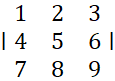
Find the minor of the element 5.
Step 1: Locate the element 5.
It lies in the second row and second column.
Step 2: Delete the second row and second column.
The remaining matrix becomes:

Step 3: Calculate this determinant.

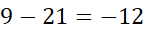
Therefore, the minor of the element 5 is −12.
You may Also Find Useful:
Cofactor
A cofactor is closely related to a minor, but it also includes a sign factor.
The cofactor of an element depends on its position in the matrix.

Where:
 = Cofactor of element in row i and column j
 = Minor of that element
 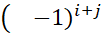 determines the sign
Sign Rule for Cofactors
The sign pattern used for cofactors is:
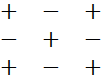
This means:
- Elements where (i + j) is even → positive sign
- Elements where (i + j) is odd → negative sign
Worked Example
Find the cofactor of the element 5 in the determinant:
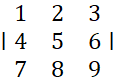
Step 1: Find the minor of 5
From the previous example:
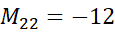
Step 2: Apply the cofactor formula
Here,
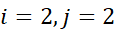

Step 3: Calculate the cofactor

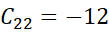
Therefore, the cofactor of the element 5 is −12.
Quick Tip for Students
- Minor → remove row and column
- Cofactor → apply the sign rule to the minor
Understanding this difference clearly will make 3×3 determinant expansion much easier in Class 12 mathematics.
Important Properties of Determinants
Determinants follow several important mathematical properties that make calculations easier. These properties are very useful when solving large determinants, simplifying expressions, and solving linear equations.
Let’s understand each property with clear explanations and examples.
Property 1: Interchanging Rows and Columns
The value of a determinant remains the same if we interchange the rows with the corresponding columns.
This means the determinant of a matrix is equal to the determinant of its transpose.
Example
Consider the determinant:

Calculate its value:


Now interchange rows and columns:

Calculate again:


The determinant value remains the same
Property 2: Interchanging Two Rows
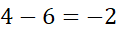
If two rows (or two columns) are interchanged, the sign of the determinant changes.
Example
Original determinant:

Value:

Now interchange the rows:

Value:

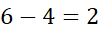
The determinant changed from −2 to +2, so the sign reversed.
Property 3: Two Identical Rows
If two rows (or columns) are identical, the determinant becomes zero.
Example

Calculate:

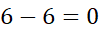
Therefore, determinant = 0 when rows are identical.
Property 4: Multiplying a Row by a Constant
If all elements of a row are multiplied by a constant  , the determinant is also multiplied by
  .
.
Example
Original determinant:

Value:

Now multiply the first row by 2:

Value:

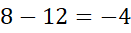
The determinant value became −4, which is 2 times the original determinant.
Property 5: Sum of Elements Property
If the elements of a row or column are expressed as the sum of two terms, the determinant can be written as the sum of two determinants.
Example
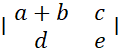
This can be written as:
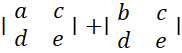
This property helps simplify algebraic determinants and break large expressions into smaller parts.
Property 6: Row Operations
A very useful property is the row operation rule.
If we perform the operation:
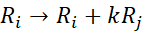
The value of the determinant does not change.
This means we can add a multiple of one row to another row to simplify calculations.
Example
Consider the determinant:

Value:

Now perform the row operation:
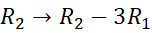
New matrix becomes:

Calculate again:


The determinant value remains the same.
Quick Tip for Students
Remembering these determinant properties helps you:
- Simplify large determinants
- Reduce calculation steps
- Solve exam questions faster
These properties are frequently used in Class 12 board exams and competitive exams.
Solving Determinants Using Properties
When determinants become large or complex, solving them directly using expansion can take a lot of time. This is where the properties of determinants become extremely helpful.
By applying these properties, we can:
- Simplify the determinant
- Create zeros in rows or columns
- Factor out common terms
- Reduce calculations
These tricks help students solve determinant questions much faster in exams.
Why Properties Help Simplify Problems
Expanding a 3×3 determinant normally requires solving three 2×2 determinants. But if we apply properties like row operations or factoring, we can often create zeros in a row or column.
When a row or column contains zeros, many terms in the expansion become zero, which significantly reduces the work.
How to Create Zeros
We can create zeros using row operations, such as:
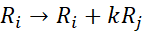
This means we add a multiple of one row to another row. This operation does not change the value of the determinant, but it can help create zeros that simplify calculations.
How to Factor Common Terms
If all elements of a row or column have a common factor, we can take that factor outside the determinant. This simplifies the numbers inside the matrix and makes calculations easier.
Example idea:
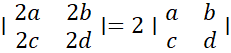
Factoring helps reduce the complexity of expressions.
Example 1 (Easy)
Evaluate the determinant:

Using the formula:
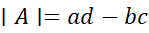

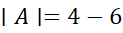

Final Answer: −2
Example 2 (Moderate)
Evaluate the determinant:
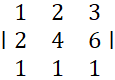
Step 1: Observe the rows
Notice that:
Row 2 = 2 × Row 1
This means two rows are proportional.
Step 2: Apply determinant property
If two rows are proportional, then:

Final Answer: 0
This example shows how recognizing a property can help you solve the determinant instantly without expansion.
Example 3 (Exam-Level)
Evaluate the determinant:
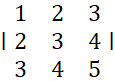
Step 1: Apply Row Operation
Use:
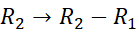
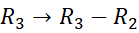
New determinant becomes:
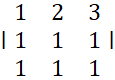
Step 2: Observe the rows
Rows 2 and 3 are identical.
Using the property:
If two rows are identical, then

Final Answer: 0
Exam Tip for Students
Before expanding any determinant, always check these things first:
- Are two rows proportional?
- Are two rows identical?
- Can we apply row operations to create zeros?
- Can we factor out common terms?
Using determinant properties wisely can save valuable time in board exams and help avoid unnecessary calculations.
Area of a Triangle Using Determinants
One of the most important applications of determinants in NCERT Class 12 is finding the area of a triangle using coordinates. This concept connects determinants with coordinate geometry and frequently appears in board exams.
If the coordinates of the three vertices of a triangle are:

Then the area of the triangle is given by the determinant formula:
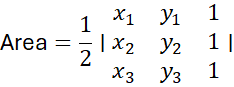
Why Do We Use Absolute Value?
After solving the determinant, the result can sometimes be negative depending on the order of the points.
However, area can never be negative, so we always take the absolute value.

Collinear Points Condition
If the three points lie on the same straight line, they do not form a triangle.
In this case:

So, when the determinant value becomes zero, it means the points are collinear.
This is another common question asked in exams:
Check whether three given points are collinear using determinants.
Solved Example
Find the area of the triangle whose vertices are:

Step 1: Write the Determinant
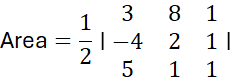
Step 2: Expand the Determinant
Expand along the first row:

Step 3: Solve Each Minor Determinant
First minor:

Second minor:

Third minor:

Step 4: Substitute the Values

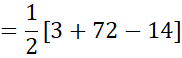

Final Answer
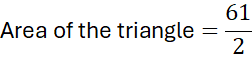

Final Answer: The area of the triangle formed by the points
(3,8), (-4,2), and (5,1) is 30.5 square units.
Quick Exam Tip
When using determinants to find area:
- Always take absolute value of the result.
- If the determinant becomes zero, the points are collinear.
- Expand along the row or column with simpler numbers to reduce calculations.
Determinants in Solving Linear Equations
Determinants play a very important role in solving systems of linear equations. They help us determine whether a system has a unique solution, no solution, or infinitely many solutions.
One of the most common methods that uses determinants is Cramer's Rule.
Why Determinants Are Useful
When we have two or more equations with variables, determinants help us:
- Check the consistency of equations
- Find the exact value of variables
- Solve equations using a systematic algebraic method
If the determinant of the coefficient matrix is not zero, the system has a unique solution.
If the determinant is zero, the equations may either have no solution or infinitely many solutions.
Cramer's Rule (For Two Variables)
Consider the system of equations:
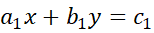
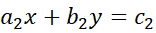
First, we calculate the determinant of the coefficient matrix.
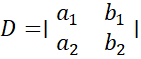
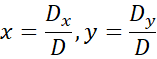
If D ≠ 0, we can find the values of x and y using determinants.
The determinants for x and y are calculated by replacing the respective columns with the constant values.
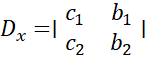
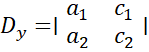
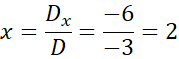
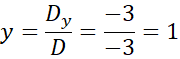
Then the solutions are:
Example (Solved)
Solve the system of equations:
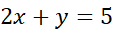
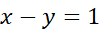
Step 1: Find the Determinant 
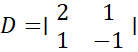


Since D ≠ 0, the system has a unique solution.
Step 2: Find 
Replace the x-column with constants.
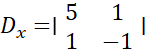


Step 3: Find 
Replace the y-column with constants.
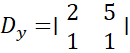


Step 4: Find the Values of Variables
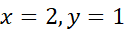
Final Solution
Quick Tip for Students
While solving linear equations using determinants:
- Always calculate the main determinant
first
- If D = 0, Cramer's Rule cannot give a unique solution
- If D ≠ 0, you can easily find the values of variables using
and

This method is especially useful in Class 12 board exams and competitive mathematics problems.
Common Mistakes Students Make While Solving Determinants
Determinants may look straightforward, but many students lose marks in exams due to small conceptual or calculation mistakes. Being aware of these common errors can help you solve determinant problems more accurately and confidently.
Below are some mistakes students frequently make and simple tips to avoid them.
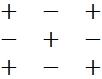
1. Sign Mistakes During Expansion
One of the most common errors happens while expanding a 3×3 determinant. Students often forget the correct sign pattern and end up adding terms that should be subtracted.
The correct sign pattern is:
Quick Tip:
Always write the sign pattern above the determinant before expanding. This reduces the chances of mistakes.
2. Confusing Minors and Cofactors
Students often treat minor and cofactor as the same thing, which leads to incorrect answers.
- Minor: Determinant obtained after deleting the row and column of an element
- Cofactor: Minor multiplied by the sign factor

Quick Tip:
Remember: Cofactor = Minor + Sign Rule.
3. Expanding from the Wrong Row or Column
Many students immediately expand along the first row, even when another row or column contains zeros.
This increases the number of calculations and makes mistakes more likely.
Quick Tip:
Always check the matrix first and expand along the row or column with the most zeros.
4. Ignoring Determinant Properties
Sometimes a determinant can be solved instantly using properties, but students ignore them and perform long calculations.
For example:
- Two identical rows → determinant is 0
- Two proportional rows → determinant is 0
Quick Tip:
Before solving, check for:
- identical rows
- proportional rows
- possible row operations
This can save a lot of time.
5. Calculation Errors
Even when the concept is correct, students often lose marks because of simple multiplication or subtraction mistakes.
For example:

Students sometimes calculate it incorrectly during exam pressure.
Quick Tip:
Solve calculations slowly and carefully, especially when dealing with negative numbers.
Final Exam Tip
Before writing the final answer, quickly check:
- Did you follow the correct sign pattern?
- Did you calculate minors correctly?
- Did you choose the easiest row or column for expansion?
- Did you check for determinant properties first?
These small checks can help you avoid careless mistakes and score full marks in determinant questions.
Practice Questions (Category-wise)
Practicing different types of questions is the best way to master determinants. Below are category-wise practice questions designed to help students strengthen their concepts step by step. Start with the basic problems and gradually move to more challenging ones.
Level 1: Basic Determinant Questions
Evaluate the following determinants.


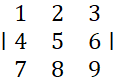
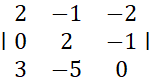
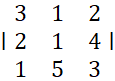
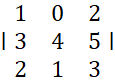
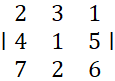
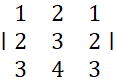
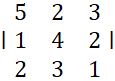
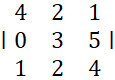
Level 2: Intermediate Determinant Questions
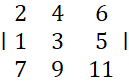
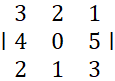
Evaluate the following 3 × 3 determinants.
Start Learning Math the Smart Way. Join a Free Demo Class Today.
Level 3: Concept-Based Determinant Questions
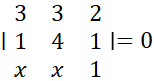
These questions test your conceptual understanding of determinant properties and applications.
- Find the value of
 if
if
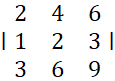
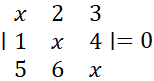
- Show that the determinant is zero using properties:
- Find
 if
if
- Prove that the determinant is zero if two rows are proportional:
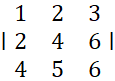
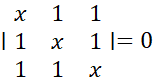
- Find
 if
if
- Verify that the determinant becomes zero if two rows are identical.
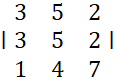
- Find the value of
 if
if
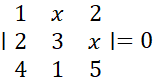
- Prove that
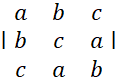
has a special symmetric structure.
- Show that
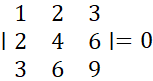
- Find
 if
if
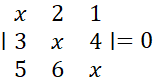
Study Tip for Students
To get better at determinants:
- Practice at least 10–15 problems daily
- Start with 2×2 determinants
- Gradually move to 3×3 determinants
- Use determinant properties to simplify calculations
Consistent practice will help you solve determinant problems quickly and accurately in board exams.
How PlanetSpark Helps Students Master Determinants
Interactive Learning
At PlanetSpark, students learn complex topics like determinants through interactive explanations and engaging learning methods that make difficult concepts easier to understand.
Strong Concept Clarity
Expert teachers break down formulas, properties, and problem-solving techniques into simple, step-by-step explanations, helping students build strong fundamentals.
Problem-Solving Practice
Students get regular practice with multiple questions, NCERT problems, and exam-level exercises, improving their accuracy and problem-solving skills.
Confidence Building
With consistent guidance and practice, students develop speed, clarity, and confidence to solve determinant questions in exams.

Determinants: What Students Should Remember
Determinants are an essential concept in Class 12 mathematics that help students solve systems of equations, work with matrices, and calculate geometric values like the area of a triangle. By understanding the key formulas, properties, and expansion methods, students can solve determinant problems more confidently. Regular practice and clear conceptual understanding make this topic much easier to master. With guided learning and structured practice on platforms like PlanetSpark, students can strengthen their mathematical foundation and develop the problem-solving skills needed for academic success.
You can Also Read:
Frequently Asked Questions
PlanetSpark helps students understand determinants in Class 12 maths through interactive lessons, clear explanations, and guided problem-solving practice.
PlanetSpark provides structured learning, expert guidance, and practical examples that make determinants easier for students to understand and apply.
Yes, PlanetSpark offers guided exercises and concept-based learning that help students practice determinant problems and strengthen their maths skills.
PlanetSpark focuses on concept clarity, helping students learn determinants and matrices step by step with simple explanations and examples.
Yes, PlanetSpark helps students prepare for board exams by teaching determinants clearly and providing regular practice for better accuracy and confidence.
PlanetSpark simplifies determinants with structured lessons, practical examples, and interactive learning methods that improve students’ understanding.
Parents choose PlanetSpark because it supports students with concept clarity, structured maths learning, and strong problem-solving practice for determinants.