
Learn Direct and Inverse Proportion Easily | PlanetSpark
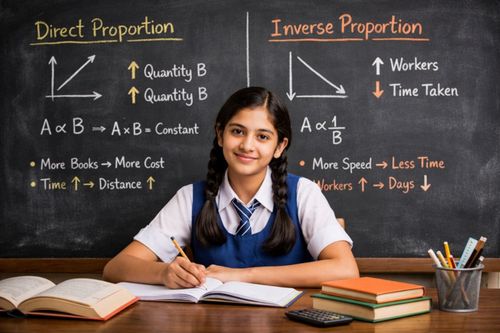

Table of Contents
Direct and inverse proportion are fundamental concepts in class 8 mathematics. These relationships help students understand how quantities are connected in real-world situations, such as when travel time changes with speed or when workers share tasks. In direct proportion, quantities grow together, while in inverse proportion, one increases as the other decreases.
At PlanetSpark, we focus on making direct and inverse proportion easy and enjoyable for students. Rather than memorizing formulas, we help learners observe patterns and understand the logic behind directly proportional and inversely proportional relationships. Using real-life examples and step-by-step guidance, PlanetSpark helps students master direct proportion and inverse proportion, building confidence to solve complex problems.
What Does “Direct Proportional” Mean?
Proportion simply means a relationship between two quantities that change together in a fixed pattern. When one value changes, the other value also changes in a predictable way. Two quantities are said to be directly proportional when they increase or decrease together at the same rate.
This means if one quantity doubles, the other also doubles. If one becomes half, the other becomes half too. This relationship is very common in real-life situations and is easy to spot once students know what to look for.
Formula of Direct Proportion
If two quantities, x and y are directly proportional, then
x / y = k or x = k * y
Where:
x and y are the two quantities that are directly proportional.
k is the constant of proportionality, which remains the same for any pair of values of x and y.
In other words, if x is directly proportional to y, then as x increases, y increases in such a way that their ratio (x/y) remains constant. Similarly, if x decreases, y decreases in a way that keeps the ratio unchanged.
Examples
If 1 notebook costs ₹20, then 5 notebooks will cost ₹100. As the number of notebooks increases, the cost increases too.
If a car travels 40 km in 1 hour, it will travel 80 km in 2 hours at the same speed.
If one worker earns ₹300 for one day’s work, two days of work will earn ₹600.
Understanding what it means to be directly proportional and inversely proportional helps students clearly see patterns, avoid confusion in exams, and answer word problems confidently.
What Is Inverse Proportion?
Two quantities are said to be in inverse proportion when one quantity increases while the other decreases in such a way that their product remains constant. In simple words, when one goes up, the other comes down. This concept helps students understand situations where sharing, time, or speed is involved.
Formula of Inverse Proportion
If two quantities, x and y, are inversely proportional, then
x * y = k,
Here, k is a constant value.
Help your child solve proportion sums the smart way. From basics to direct and inverse proportion Class 8 extra questions, PlanetSpark builds strong exam confidence. Talk to our experts today!
Examples
Example 1: More Workers, Less Time
If 4 workers take 10 days to complete a task, then 8 workers will take only 5 days to complete the same task. As the number of workers increases, the time required decreases. This is a classic example of inverse proportion seen in everyday life.
Example 2: Speed and Time
If a car takes 4 hours to travel a fixed distance at 40 km/h, it will take only 2 hours at 80 km/h. When speed increases, time decreases, showing an inverse relationship.
Understanding inverse proportion makes problem-solving easier and helps students confidently tackle exam questions involving time, work, and speed.
Direct Proportional vs Inverse Proportional
Understanding the difference between directly proportional and inversely proportional quantities helps students decide the correct method to solve word problems quickly. Though both belong to the same topic of proportion, their behaviour is completely opposite. Let’s break it down simply with clear examples and easy comparisons.
How the quantities change?
In direct proportion, both quantities increase or decrease together. For example, when the number of notebooks increases, the total cost also increases at the same rate.
In inverse proportion, one quantity increases while the other decreases. For example, when more workers are hired, the total time required to finish work becomes shorter.
Mathematical relationship
In direct proportion, the ratio between the two quantities always remains constant throughout the problem, no matter how the values change.
In inverse proportion, the product of the two quantities always remains constant even though each value changes differently.
Daily-life examples
In direct proportion, distance travelled increases as time increases when speed remains constant during the journey.
In inverse proportion, the time taken decreases as speed increases when the total distance travelled remains fixed.
Simple Memory Trick
In direct proportion, problems are solved by multiplying or dividing quantities in the same direction logically.
In inverse proportion, problems are solved by adjusting quantities in opposite directions using multiplication carefully.
Solved Examples: Direct Proportion
Understanding direct proportion becomes much easier when students practise step-by-step solved examples. These examples are designed exactly the way questions appear in exams.
Example 1: Cost of Pens vs Number of Pens
If 5 pens cost ₹50, find the cost of 12 pens.
Step-by-step solution:
The cost of pens is directly proportional to the number of pens. This means if the number of pens increases, the cost also increases in the same ratio.
Cost of 1 pen = 50 ÷ 5 = ₹10
Cost of 12 pens = 12 × 10 = ₹120
Final Answer: The cost of 12 pens is ₹120.
Example 2: Distance vs Time
A car travels 60 km in 2 hours. How much distance will it travel in 5 hours at the same speed?
Clear reasoning:
Distance travelled is directly proportional to time when speed is constant.
Distance in 1 hour = 60 ÷ 2 = 30 km
Distance in 5 hours = 30 × 5 = 150 km
Final Answer: The car will travel 150 km in 5 hours.
Exam Tip: How to Show Steps Properly
Always mention that the quantities are directly proportional, write the unit value clearly, and show multiplication steps neatly. This helps examiners follow your logic and ensures full marks in proportion-based questions.
Solved Examples: Inverse Proportion
To master inverse proportion, students must clearly understand how quantities move in opposite directions. These solved examples are framed just like school exam questions, making practice easier and more effective.
Example 1: Workers and Days Problem
8 workers can complete a job in 15 days. How many days will 12 workers take to complete the same job?
Step-by-step logic:
Here, the number of workers and the number of days are in inverse proportion. When the number of workers increases, the time taken decreases.
Workers × Days = constant
So,
8 × 15 = 12 × x
120 = 12x
x = 10
Final Answer: 12 workers will complete the job in 10 days.
Turn tricky word problems into confident answers. Explore interactive lessons on direct and inverse proportion for Class 8 with PlanetSpark. Book a free trial class now!
Example 2: Speed and Time Problem
A car takes 6 hours to travel a fixed distance at a speed of 40 km/h. How long will it take if the speed increases to 60 km/h?
Why it’s inverse:
Speed and time are in inverse proportion because increasing speed reduces travel time for the same distance.
Speed × Time = constant
40 × 6 = 60 × x
240 = 60x
x = 4
Final Answer: The car will take 4 hours.
Common Mistake Alert
Many students wrongly apply direct proportion in such questions. Always check:
✔ If one quantity increases while the other decreases → it is inverse proportion.
Writing this reasoning clearly helps avoid mistakes and earns full marks in exams.
Practice and Application: Fun Learning Tricks & Memory Hacks
Learning direct and inverse proportion can be both fun and easy with a few smart memory hacks. These tricks help students quickly grasp the concepts and apply them in exams without overthinking:
“More–More” Rule: If one quantity increases and the other also increases (or both decrease), think "more–more." This indicates direct proportion.
“More–Less” Rule: When one quantity increases and the other decreases, remember "more–less." This is a clue for inverse proportion.
Keyword Spotting in Word Problems: Look for keywords like “double,” “triple,” or “more items” to recognize direct proportion, while words like “faster,” “more workers,” or “less time” often signal inverse proportion.
These simple strategies make solving direct and inverse proportion class 8 extra questions easier and more efficient.
How PlanetSpark Makes Proportion Easy?
Understanding direct and inverse proportion becomes much easier when students stop memorising formulas and start seeing how maths works in real life. PlanetSpark focuses on helping learners think mathematically instead of feeling scared of word problems. Concepts are introduced using simple situations students already understand, like sharing work, money, speed, and time, so ideas feel familiar, not abstract.

This approach is especially helpful for learners studying direct and inverse proportion for class 8, where confusion often arises from rushed explanations and a lack of clarity. With patient guidance, students gain confidence and start enjoying problem-solving instead of avoiding it.
Concept-first teaching: Students first understand why quantities change before learning formulas, making proportions logical and memorable.
Real-life storytelling approach: Every day examples turn abstract ratios into relatable stories students can visualise easily.
Visual explanations and tables: Charts and tables help students clearly see how values increase or decrease together.
Guided problem-solving: Step-by-step discussions help students avoid common mistakes and think independently.
Encouraging students to explain answers aloud: Speaking through solutions strengthens understanding and reduces exam fear.
Confidence-building learning environment: Encouragement and feedback help students trust their reasoning and improve steadily.
Conclusion
Understanding direct and inverse proportion becomes easy when students focus on real-life connections instead of memorising formulas. With clear concepts, step-by-step logic, and regular practice, these topics turn into scoring areas in exams.
From numbers to real-life logic, maths finally makes sense. PlanetSpark helps students understand concepts deeply, not memorise formulas. Enrol for a free PlanetSpark demo class now!
PlanetSpark helps students observe patterns, think logically, and explain their answers confidently. Our experts treat proportion not just as a maths chapter, but as a practical thinking skill your kid can enjoy and apply effortlessly.
Frequently Asked Questions
In simple terms, direct proportion means two quantities increase or decrease together. In inverse proportion, one quantity increases while the other decreases. These ideas form the foundation of direct and inverse proportion in middle school maths.
Look at how the quantities change. If both increase or decrease together, it is directly proportional. If one increases while the other decreases, it is an inverse proportion. Reading the question carefully and asking “do they move together or opposite?” helps students decide quickly.
Yes, very important. Questions from direct and inverse proportion for class 8 often appear as word problems, HOTS questions, and case-based sums. A strong understanding can easily fetch full marks.
Students often confuse them because they rush into solving without identifying the relationship. Mixing formulas without reasoning is a common mistake, especially in direct and inverse proportion class 8 extra questions.
PlanetSpark uses real-life examples, visual explanations, and guided discussions. Concepts like proportion are taught through stories, activities, and smart questioning, making maths feel logical and fun instead of scary.
PlanetSpark keeps parents informed through regular feedback, progress tracking, and clear learning goals. Parents can see how their child’s confidence and problem-solving skills improve steadily, creating a stress-free and supportive maths learning experience at home.