
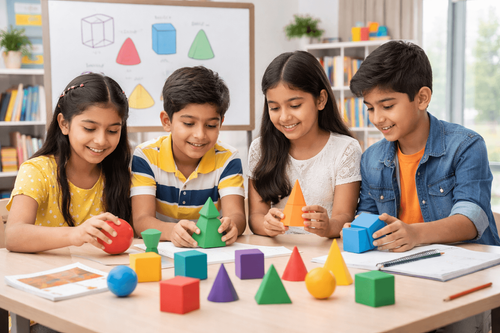

Visualising solid shapes is a skill many children find challenging because it requires them to imagine objects in three dimensions rather than just memorising names and formulas. When concepts like cubes, cylinders, or different views of 3D objects are taught only on paper, children often struggle to connect them to real life. This leads to confusion, low confidence, and mistakes in exams.
A concept-based approach helps children understand what a solid shape is, how its form changes from different angles, and why visualisation matters. With clear explanations and guided practice, children can learn to see, imagine, and understand solid shapes with confidence.
What Is a Solid Shape?
A solid shape is a three-dimensional (3D) shape that has length, width, and height. This means solid shapes take up space and can be held, touched, or moved. In simple words, when a shape has depth and looks real, it is called a solid shape.
To understand what is a solid shape, think of objects like a box, ball, or water bottle. These objects are not flat—they have thickness and volume, which makes them solid.
Difference Between 2D Shapes and 3D Solid Shapes
2D shapes are flat and have only length and width. Examples include squares, circles, and triangles drawn on paper.
3D solid shapes, on the other hand, have length, width, and height. They look more realistic and exist in the real world, like cubes and spheres.
Key Features of Solid Shapes
Solid shapes have special features that help children identify and understand them better:
Faces – Flat or curved surfaces of the shape
Edges – Lines where two faces meet
Vertices – Corner points where edges meet
Learning these features helps children clearly understand the structure of different solid shapes.
Shape of Solid Objects in Everyday Life
The shape of solid objects is all around us, and children come across them every day without even realizing it. From toys to household items, solid shapes are part of daily life.
For example, a dice has the shape of a cube, a football looks like a sphere, and a tin can has the shape of a cylinder. These real-life objects help children easily connect mathematical concepts with what they see and touch.
How Children Naturally Identify Solid Shapes
Children often identify solid shapes through play and observation.
Building blocks help them understand cubes and cuboids
Balls introduce them to spheres
Party hats or ice cream cones show cone shapes
By handling these objects, children start recognizing solid shapes without memorizing definitions.
Why Real-Life Connections Improve Understanding
When learning is connected to real objects, children understand faster and remember longer. Seeing solid shapes in everyday life makes abstract concepts easier and more meaningful. It also builds strong visualisation skills, which are essential for learning geometry confidently.
Solid Shapes Examples Children Learn First
Children usually begin learning solid shapes by observing and handling objects they see every day. These early solid shapes examples help them understand 3D concepts easily and build confidence in geometry.
Some of the first solid shapes children learn include:
Cube – Looks the same from all sides, like a dice or an ice cube
Cuboid – A box-shaped object, such as a book, brick, or lunchbox
Sphere – A round shape with no edges, like a football or an orange
Cylinder – Has circular faces, like a tin can or water bottle
Cone – Has a pointed top, like an ice cream cone or party hat
By relating solid shapes to familiar objects, children quickly understand their structure and appearance.
How Repeated Exposure Builds Strong Visual Memory
When children see and use these shapes repeatedly—through toys, drawings, and activities—they start remembering them easily. Regular exposure helps children recognize solid shapes from different angles and situations, improving their visual memory and spatial thinking skills.
PlanetSpark focuses on repetition through engaging activities so children can confidently identify and visualise solid shapes without confusion.
Understanding Different Views of 3D Objects
A solid shape can look different when viewed from different directions. Learning top, front, and side view helps children understand how 3D objects appear from various angles.
Top view – How the object looks when seen from above
Front view – How the object looks when seen from the front
Side view – How the object looks when seen from the side
These views help children understand the full structure of a 3D object instead of seeing just one face.
Help your child understand solid shapes through real-life examples and visual learning. Book a free PlanetSpark demo class today.
Why Viewing Objects from Different Angles Matters
Understanding different views improves a child’s ability to visualise shapes mentally. It helps them imagine how an object will look when rotated or moved. This skill is important not only in geometry but also in problem-solving and logical thinking.
Top, Front, Side View: Different Views of 3D Objects
Learning top front side view different views of 3D objects helps children connect flat drawings with real objects. For example, a cube may look like a square from the top, front, or side, but it is still a solid object.
PlanetSpark teaches these concepts using real objects, drawings, and guided practice, making it easier for children to understand and apply different views of 3D shapes confidently.
How Children Learn to Visualise Solid Shapes Step by Step
Children do not learn to visualise solid shapes all at once. They develop this skill gradually through observation, imagination, and practice.
Observing Real Objects
Children first learn by looking at real-life objects around them. Holding a box, ball, or bottle helps them understand the shape of solid objects better than pictures alone. This hands-on experience makes learning natural and engaging.
Rotating and Imagining Shapes Mentally
As children grow, they begin to imagine what happens when a solid shape is turned or rotated. For example, they learn that a cube looks the same even when rotated, while a cuboid may look different. This step improves mental visualisation and spatial thinking.
Drawing and Identifying Views
Children then learn to draw what a solid shape looks like from different directions. They practice drawing the top, front, and side view of objects. This helps them connect real 3D objects with flat drawings on paper.
Matching Objects to Their Views
In this stage, children match drawings with actual objects. For example, they identify which solid shape matches a given top or front view. This strengthens their understanding of top front side view different views of 3D objects and builds confidence.
PlanetSpark uses guided activities and visual exercises to help children master each of these steps smoothly.
Common Challenges Children Face While Visualising 3D Shapes
While learning solid shapes, children may face certain difficulties. Identifying these challenges early helps in providing the right support.
Confusion Between Flat and Solid Shapes
Many children mix up 2D and 3D shapes. For example, they may confuse a square with a cube or a circle with a sphere. This happens when they focus only on the face of the object instead of its depth.
Difficulty Understanding Hidden Faces
Children often struggle to imagine faces that are not visible. For instance, they may find it hard to understand that a cube has faces at the back or bottom that cannot be seen directly.
Problems with Visualising Rotation and Depth
Rotating a shape mentally and understanding depth can be challenging. Some children find it difficult to imagine how a solid shape looks when turned or viewed from another angle.
PlanetSpark addresses these challenges through interactive learning, visual cues, and step-by-step guidance, helping children develop strong 3D visualisation skills without confusion.
Build strong geometry foundations with guided 3D visualisation practice. Start your child’s learning journey with PlanetSpark.
Benefits of Strong Solid Shape Visualisation Skills
When children clearly understand and visualise solid shapes, it supports their overall learning and thinking abilities in many ways.
Improves spatial thinking: Visualising solid shapes helps children understand space, distance, and position. They learn how objects fit together and how they look from different angles.
Builds a strong foundation for geometry: Knowing what is a solid shape and how it appears from different views prepares children for advanced geometry concepts like volume, surface area, and nets.
Helps in higher-level math and problem-solving: Skills like imagining rotation, understanding hidden faces, and comparing shapes are useful in word problems, diagrams, and logical reasoning.
Strong solid shape visualisation also supports skills used in science, design, and everyday problem-solving.
How PlanetSpark Helps Children Visualise Solid Shapes Easily
PlanetSpark uses a concept-based and visual learning approach to help children truly understand solid shapes instead of memorising definitions.
Concept-first explanations: Children first learn what is a solid shape, how it is formed, and why it looks different from various angles.
Real-life solid shapes examples: Everyday objects like boxes, bottles, balls, and cones are used to explain the shape of solid figures clearly.
Visualisation through guided practice: Trainers help children understand top, front, and side views by breaking them down step by step.
Interactive activities: Drawing, describing, and mentally rotating 3D objects strengthens spatial thinking.
One-to-one personalised guidance: Each child receives focused support to overcome confusion and build confidence.
Conclusion
Learning to visualise solid shapes is an important part of early math education. When children understand the shape of solid objects and can recognise them from different views, math becomes less confusing and more meaningful.
With the right guidance, real-life examples, and structured practice, children can easily master solid shapes and 3D visualisation. PlanetSpark makes this learning process enjoyable, interactive, and confidence-building for young learners.