
Linear Programming Problems Explained with PlanetSpark


In Mathematics, linear programming is a method of optimising results while working within given constraints. The goal is to maximize or minimize a numerical value (like profit, cost, or time) using linear functions, where the restrictions are written as linear equations or inequalities. Simply put, it helps you find the best possible outcome from multiple valid options.
From linear programming class 12 to real-world decision-making, this concept is used to solve linear programming problems in economics, business, telecom, and manufacturing. Whether you’re exploring what is linear programming, looking for clear linear programming examples, using a linear programming calculator, or even learning about integer linear programming, this topic builds a strong foundation for smart optimisation.

What is Linear Programming?
Linear programming (LP) or linear optimisation is the process of maximizing or minimizing a linear objective function under linear constraints, written as equalities or inequalities. These optimisation problems often involve profit and loss and help in identifying the feasible region to obtain the highest or lowest value of the function.
In linear programming, a situation is represented through inequalities, and the best possible value is calculated within those conditions. Key assumptions include constraints expressed quantitatively and a linear relationship between constraints and the objective function.
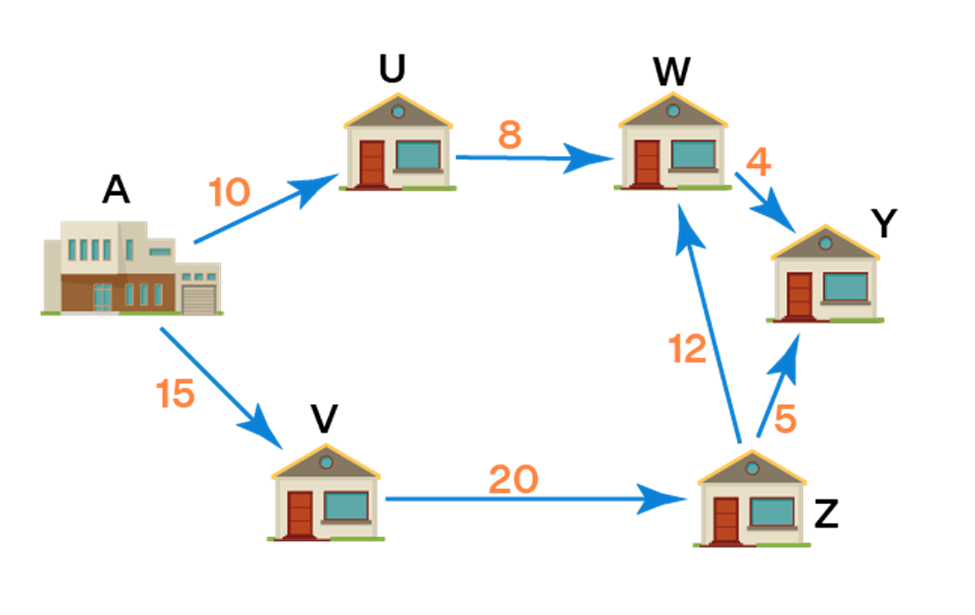
The general form is:
Maximize/Minimize:
Z=ax+by
Subject to constraints such as:
a1x+b1y≤c1
a2x+b2y≤c2
x,y≥0
Here, ZZ is the objective function, while the inequalities represent constraints.
For example, suppose a company produces two products xxx and yyy. If profit per unit is ₹40 and ₹30, the objective function becomes:
Z=40x+30y
Subject to:
2x+y≤100
X+y≤80
x,y≥0
In schools, especially while solving linear programming problems, students graph constraints to find feasible regions and optimal points. This concept is important in academic and competitive exams because it strengthens logical reasoning, problem-solving accuracy, and real-world decision-making skills.
What Are the Key Components of Linear Programming?
Understanding the core elements of linear programming helps students solve exam-based and real-world optimization questions confidently. Every problem is built using structured mathematical components that work together to determine the best possible solution. Let us break them down clearly with formulas and diagram explanations for better conceptual clarity.
1. Objective Function
The objective function represents what we want to maximize or minimize. It is written in the form:
Z=ax+by
For example, if profit per unit of products xxx and yyy is ₹50 and ₹40, then:
Z=50x+40y
Here,
𝑍
is the value to be maximized. In many linear programming problems, this function determines profit, cost, or output.
2. Constraints
Constraints are restrictions expressed as linear inequalities. For example:
2x+y≤100
x+3y≤90
x,y≥0
These inequalities limit production based on resources like labor or materials. In a graph, each constraint is plotted as a straight line, and the solution lies on one side of that line.
3. Decision Variables
Decision variables are unknown quantities (usually xxx and yyy) representing choices such as number of products produced. In linear programming class 12, students learn to define these variables clearly before forming equations.
4. Feasible Region
When constraints are plotted on a graph, the overlapping shaded area formed by all inequalities is called the feasible region. This region contains all possible solutions that satisfy the given constraints. Using a linear programming calculator can help verify feasible points, but graphical understanding is essential.
5. Optimal Solution
The optimal solution is found at the corner (vertex) points of the feasible region. By substituting these points into the objective function, we determine the maximum or minimum value of ZZZ.
If you’re preparing for linear programming class 12, PlanetSpark offers structured guidance, doubt-clearing sessions, and practice through engaging linear programming worksheets. Visit PlanetSpark to boost your academic performance today.
Steps to Solve Linear Programming Problems
Solving linear programming questions requires a clear, structured approach. Whether you are preparing for board exams or competitive tests, following these steps ensures accuracy while handling different types of linear programming problems.
Step 1: Define Decision Variables
Start by identifying what needs to be determined.
For example, let:
x = number of Product A units
y = number of Product B units
Clear variable definition is essential in linear programming class 12 problems.
Step 2: Form the Objective Function
Write the function to maximize or minimize.
If profit per unit is ₹50 for A and ₹40 for B, then:
Z=50x+40y
Here, Z is the total profit to be maximized. In cost-based questions, the objective function may be minimized instead.
Step 3: Frame the Constraints
Translate given conditions into inequalities.
If labor and material limits are given as:
2x+y≤100
x+3y≤90
x, y≥0
These inequalities form restrictions. Many linear programming examples in exams follows this structure.
Step 4: Plot the Constraints on a Graph
Convert inequalities into equations, such as:
2x+y=100
Plot these lines on a coordinate plane and shade the region satisfying all inequalities. This shaded portion is the feasible region.
Step 5: Find Corner Points
Determine the intersection points of the boundary lines. You may verify intersection values using a linear programming calculator for accuracy.
Step 6: Apply the Corner Point Method
Substitute each corner point into the objective function. The point giving maximum or minimum Z is the optimal solution.
Regular practice through a linear programming worksheet helps students master these steps confidently.

Linear Programming Examples
Linear programming examples help learners understand how to solve optimisation problems step by step. They show how objective functions and constraints work together to find maximum or minimum values, making concepts easier to apply in real-life situations and exam problems.
Example 1: Solve the following linear programming problem using the graphical method.
Objective (Minimize):
Z = 5x + 4y
Constraints:
4x + y >= 40
2x + 3y >= 90
x >= 0, y >= 0
Solution (Graphical Method):
First, convert each inequality into its corresponding boundary line:
4x + y = 40
2x + 3y = 90
For 4x + y = 40, the intercepts are:
- If x = 0, then y = 40 → point (0, 40)
- If y = 0, then x = 10 → point (10, 0)
So, the feasible side for the inequality is:
4x + y >= 40 (region on or above the line)
For 2x + 3y = 90, the intercepts are:
- If x = 0, then y = 30 → point (0, 30)
- If y = 0, then x = 45 → point (45, 0)
So, the feasible side for the inequality is:
2x + 3y >= 90 (region on or above the line)
Finally, plot both lines on the coordinate plane and shade the region that satisfies both inequalities along with:
x >= 0, y >= 0
The overlapping shaded area in the first quadrant represents the feasible region.
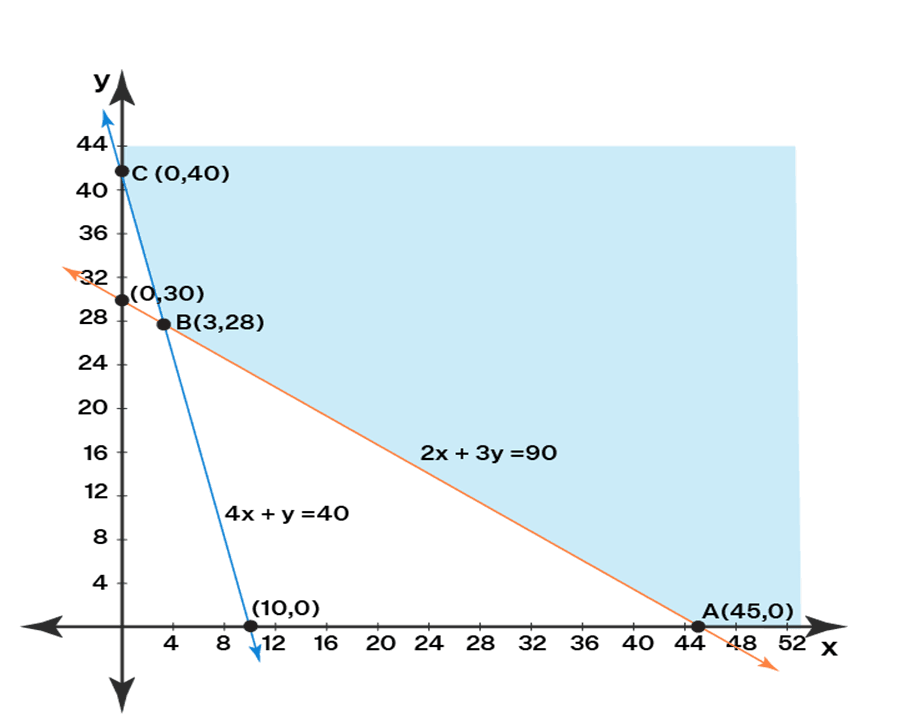
As the minimum value of Z is 127, thus, B (3, 28) gives the optimal solution.
Answer: The minimum value of Z is 127 and the optimal solution is (3, 28)
Want your child to master integer linear programming and real-world linear programming problems confidently? Join PlanetSpark’s personalized learning and turn tough math challenges into high-scoring success.
Example 2: Solve the following linear programming problem using the graphical method.
Objective (Maximize):
Z = 2x + 3y
Constraints:
x + y <= 30
x <= 20
y <= 12
x >= 0, y >= 0
Solution (Graphical Method):
First, convert the inequalities into boundary equations:
x + y = 30
x = 20
y = 12
For x + y = 30, the intercepts are:
- If x = 0, then y = 30 → point (0, 30)
- If y = 0, then x = 30 → point (30, 0)
The feasible region for this inequality is:
x + y <= 30 (region on or below the line)
For x = 20:
- This is a vertical line parallel to the y-axis.
- The feasible side is:
x <= 20 (region on or to the left of the line)
For y = 12:
- This is a horizontal line parallel to the x-axis.
- The feasible side is:
y <= 12 (region on or below the line)
Now, plot all lines on the coordinate plane and shade the area satisfying all constraints along with:
x >= 0, y >= 0
The common shaded region in the first quadrant represents the feasible region, and the maximum value of Z occurs at one of its corner points.
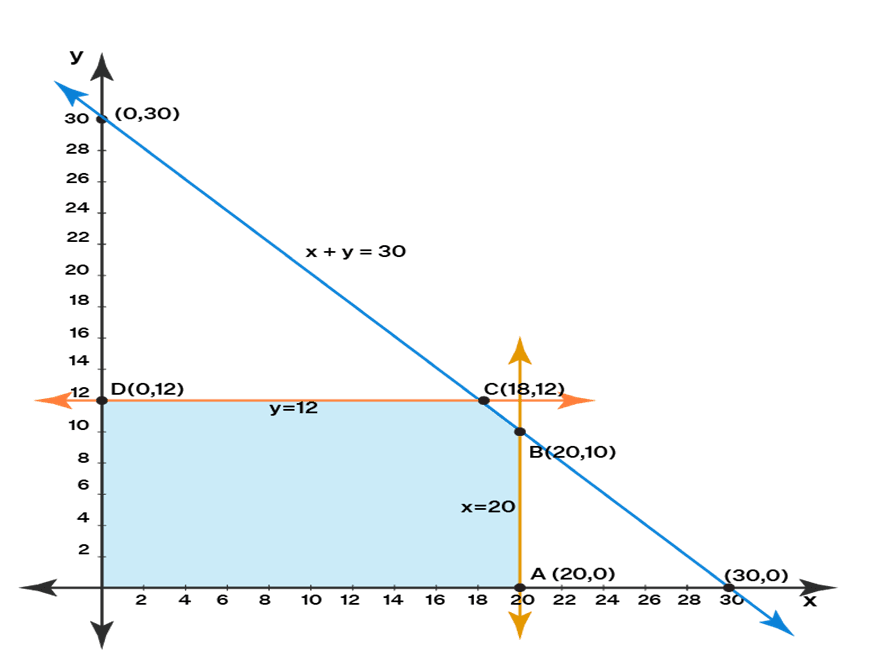
The maximum value of Z = 72 and it occurs at C (18, 12)
Answer: the maximum value of Z = 72 and the optimal solution is (18, 12)
Applications of Linear Programming
Linear programming is widely used in real-world scenarios to make better decisions and optimise available resources. It helps organisations analyse constraints and choose the most efficient solution for achieving maximum profit or minimum cost. Below are some important applications of linear programming:
Manufacturing companies use linear programming to plan and schedule production efficiently while optimizing resources.
Delivery and logistics services apply linear programming to find the shortest routes and reduce time and fuel consumption.
Financial institutions use linear programming to design suitable portfolios and select the best combination of financial products for clients.
These practical applications and linear programming examples make linear programming easier to understand and help students develop logical, analytical thinking skills useful in academics and real life.
How PlanetSpark Builds Confidence Beyond Linear Programming?
Mastering mathematical concepts like linear programming is not just about solving equations, it also requires clarity in thinking, structured explanation, and confident presentation. According to PlanetSpark’s Public Speaking and Personality Development framework, students grow through structured, step-by-step skill building that strengthens both logic and communication.

1. Structured Thinking & Logical Expression
If you want to know what is linear programming, PlanetSpark’s 1:1 coaching helps students learn how to clearly define variables, explain objective functions, and present constraints logically, just like structuring a speech. This strengthens analytical clarity required in problem-solving subjects.
2. Confidence in Academic Presentation
Through TED-style speaking modules and real-time practice sessions, students learn to confidently explain solutions step-by-step. Students can also clear their concept on integer linear programming. This reduces hesitation during viva exams, class participation, and presentations.
3. Critical Thinking & Decision-Making
Personality Development modules focus on goal setting, leadership, and logical reasoning. These skills directly support mathematical problem-solving, where identifying feasible regions and optimal solutions requires clear decision-making.
4. Overcoming Exam Anxiety
Video feedback loops and structured mentorship help students improve communication, self-awareness, and confidence. When students can explain concepts clearly, their exam pressure reduces significantly.
With PlanetSpark’s holistic development approach, students don’t just solve problems, they learn to think, present, and succeed confidently.
Join PlanetSpark to master linear programming with expert mentorship, worksheets, and step-by-step strategies. Build strong Class 12 concepts, solve confidently, and score higher with structured guidance.
Conclusion
Mastering linear programming is not just about learning formulas, it is about developing structured thinking, analytical reasoning, and confident problem-solving skills. From understanding objective functions and constraints to graph plotting and identifying optimal solutions, every step strengthens mathematical clarity. With regular practice, real-life applications, and proper guidance, students can turn complex problems into scoring opportunities.
When concepts are understood deeply rather than memorized, accuracy improves and exam fear reduces. By building strong fundamentals, applying step-by-step methods, and following the linear programming examples, students can confidently approach board exams and competitive tests while developing logical skills that remain valuable beyond academics.
Frequently Asked Questions
Linear programming is a method of finding the best possible outcome, like maximum marks or minimum time, when there are certain limits. It teaches students how to choose wisely using equations, graphs, and logical thinking.
Linear programming in Class 12 is not difficult if students understand how to form inequalities and plot graphs correctly. Most errors happen in graph shading or corner point calculation. With regular practice, it becomes one of the most scoring chapters.
The steps include defining variables, forming the objective function, writing constraints as inequalities, plotting them on a graph, identifying the feasible region, finding corner points, and calculating the optimal value by substitution.
The feasible region is the common area on a graph that satisfies all given constraints simultaneously. The optimal solution always lies at one of the corner points of this region. Integer linear programming gives students a clear concept on the feasible region.
In maximization problems, the objective function is optimized to get the highest value (like profit). In minimization problems, the goal is to reduce cost or time to the lowest possible value within constraints.
No, most board exams require students to solve problems using the graphical method manually. Calculators may help in practice, but conceptual clarity and correct graph plotting are essential for exam success.