
NCERT Class 9 Lines and Angles Key Concepts and Practice


Table of Contents
- What Are Lines and Angles?
- Types of Angle Pairs You Must Know
- Intersecting and Parallel Lines
- Linear Pair Axiom Explained Simply
- Vertically Opposite Angles Theorem
- Angles Formed by a Transversal
- Parallel Lines Theorem
- Solved Examples
- Practice Questions
- Common Mistakes Students Make
- Tips to Master Lines and Angles
- How PlanetSpark Helps Students Master Lines and Angles
- Building Strong Foundations in Lines and Angles
From designing buildings to creating video games and even hitting the perfect cricket shot, angles quietly control how things work around us. Look at roads crossing, a ladder leaning on a wall, or shadows changing with sunlight—lines and angles are everywhere. But how do we actually understand and solve these? In this chapter, you’ll build clear concepts, learn practical applications, and gain the confidence to solve problems step by step.
What Are Lines and Angles?
Basic Definitions
Before solving problems, let’s understand the building blocks:
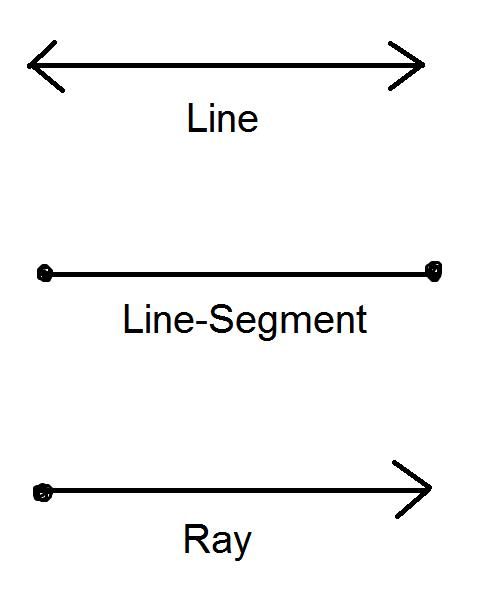
- Line: A straight path that extends infinitely in both directions. It has no endpoints.
Example: The edge of a stretched rope. - Line Segment: A part of a line with two fixed endpoints.
Example: The edge of your notebook. - Ray: A part of a line that starts at one point and extends infinitely in one direction.
Example: A torchlight beam. - Collinear Points: Points that lie on the same straight line.
Example: Three points on a ruler. - Non-collinear Points: Points that do not lie on the same line.
Example: Three corners of a triangle.
Understanding these basics helps you visualize geometry better and avoid confusion later.
What is an Angle?
An angle is formed when two rays meet at a common point.
- The rays are called arms
- The common point is called the vertex
Real-life examples:
- A door opening creates an angle between the door and the wall
- Clock hands form different angles at different times
Angles help us measure rotation, direction, and space between lines.
Types of Angles
Angles are classified based on their measurement:
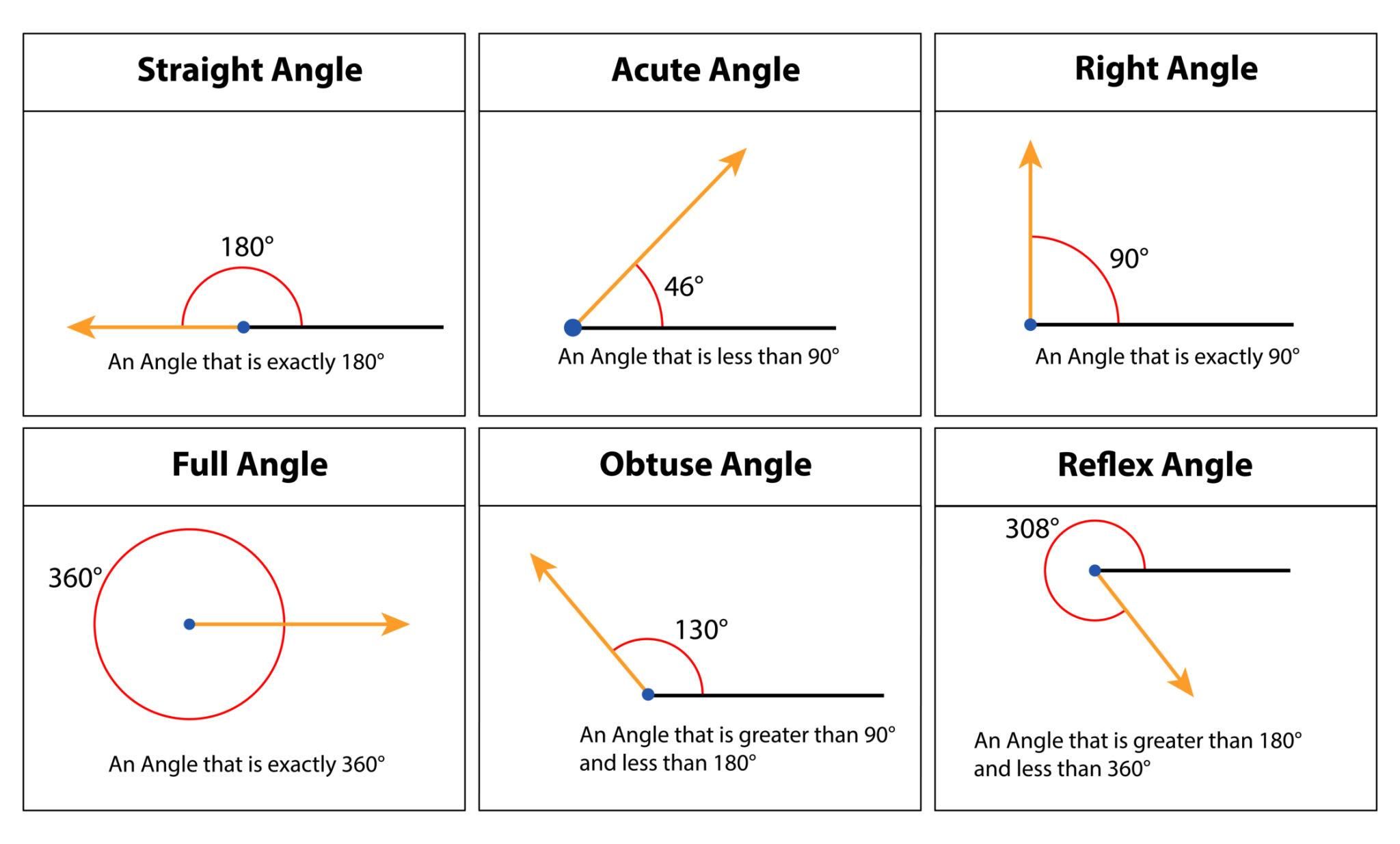
- Acute Angle: Less than 90°
Example: Slightly open scissors - Right Angle: Exactly 90°
Example: Corner of a book - Obtuse Angle: Between 90° and 180°
Example: A wide-open door - Straight Angle: Exactly 180°
Example: A straight line - Reflex Angle: Between 180° and 360°
Example: Turning more than half a circle
Interactive Check
Is 120° an acute or obtuse angle?
Think about it: it is greater than 90° but less than 180°, so it is an obtuse angle.

Types of Angle Pairs You Must Know
Understanding angle pairs is where students usually move from basic definitions to actual problem-solving. These relationships help you quickly identify patterns and solve questions without confusion.
Complementary Angles
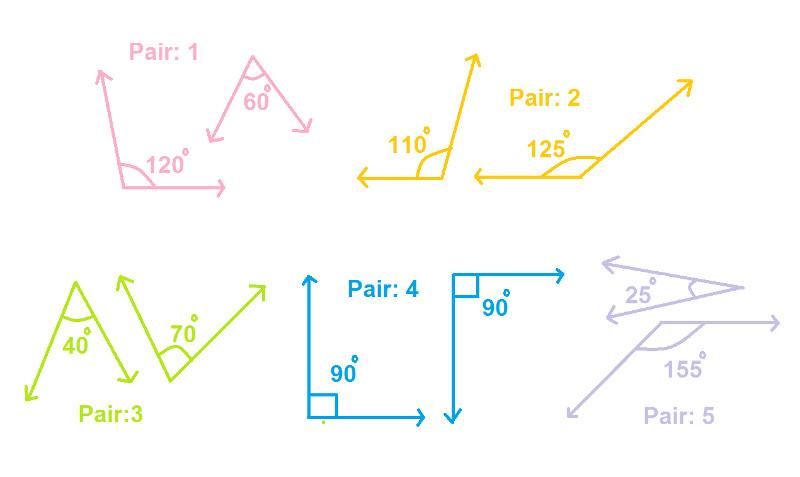
Two angles are called complementary when their sum is 90°.
- Example: 30° + 60° = 90°
- If one angle increases, the other must decrease to maintain the total
Real-life connection:
Think of a corner of a square. If you split it into two angles, they will always add up to 90°.
Supplementary Angles
Two angles are called supplementary when their sum is 180°.
- Example: 110° + 70° = 180°
- They form a straight line when placed together
Real-life connection:
Imagine a straight road. If you stand at a point and look both ways, the angle formed is 180°.
Adjacent Angles
Two angles are adjacent if they:
- Share a common vertex
- Have a common arm
- Do not overlap
Example:
If two angles are side by side like slices of a pizza sharing one edge, they are adjacent.
Important point:
Adjacent angles may or may not add up to 90° or 180°—it depends on the situation.
Linear Pair
A linear pair is a special type of adjacent angles.
- They are adjacent angles
- Their sum is always 180°
- Their non-common arms form a straight line
This leads to an important concept:
Linear Pair Axiom:
If a ray stands on a line, then the sum of the adjacent angles formed is 180°.
Example:
If one angle is 120°, the other must be 60°.
This concept is widely used in solving numerical problems and proofs.
Vertically Opposite Angles
When two lines intersect, they form pairs of vertically opposite angles.
- These angles are always equal
- They lie opposite each other across the intersection
Example:
If one angle is 75°, the angle directly opposite will also be 75°.
This property is extremely useful in solving problems quickly without lengthy calculations.
Concept Tip Box
Students often confuse adjacent angles and linear pairs.
- All linear pairs are adjacent angles
- But not all adjacent angles are linear pairs
Quick check:
If the sum is 180° and they form a straight line → Linear Pair
Otherwise → Just Adjacent Angles
Mastering this distinction can save marks in exams and reduce calculation errors.
Book a Free Demo Class with Expert Teachers.
Intersecting and Parallel Lines
Understanding how lines behave helps you decode most angle problems quickly. Whether lines meet or never meet changes the kind of angles they form and the rules you apply.
Intersecting Lines
Two lines are called intersecting lines when they meet at a point.
- The point where they meet is called the point of intersection
- When lines intersect, they form four angles
- Opposite angles formed are called vertically opposite angles, and they are always equal
Example:
Imagine two roads crossing each other at a junction. The angles formed at the crossing follow the properties of intersecting lines.
Key Idea:
Intersecting lines help you apply concepts like vertically opposite angles and linear pairs while solving problems.
Parallel Lines
Two lines are called parallel lines when they:
- Never meet, even if extended infinitely
- Maintain a constant distance from each other
These lines always move in the same direction without crossing.
Example:
The top and bottom edges of a notebook page never meet—they are parallel.
Key Idea:
Parallel lines become very important when a transversal cuts them, forming special angle pairs like corresponding and alternate angles.
Real-Life Understanding
Geometry becomes easier when you connect it with real life:
- Railway tracks: They appear to meet at a distance but are actually parallel
- Notebook lines: Always equally spaced and never intersect
- Window grills or ladders: Show combinations of parallel and intersecting lines
When you start observing your surroundings, you’ll notice that lines and angles are not just textbook concepts—they are part of everyday structures. This habit of visualizing makes solving geometry problems much faster and more intuitive.
You May Also Read
Linear Pair Axiom Explained Simply
The Linear Pair Axiom is one of the most important ideas in this chapter because it appears in almost every problem.
Statement
If a ray stands on a line, the two adjacent angles formed always add up to 180°.
In simple terms:
- Two angles next to each other
- Forming a straight line
- Will always have a total of 180°
This pair of angles is called a linear pair.
Understanding the Converse
The converse helps build logical thinking:
If the sum of two adjacent angles is 180°, then their non-common arms form a straight line.
This means:
- Not only do linear pairs add up to 180°
- But if two adjacent angles add up to 180°, they must be forming a straight line
This idea is very useful in proof-based questions where you need to justify that points lie on a straight line.
Example (Step-by-Step)
Question:
If one angle is 110°, find the other angle in the linear pair.
Step 1: Recall the property
Sum of angles in a linear pair = 180°
Step 2: Let the second angle be x
So,
110° + x = 180°
Step 3: Solve
x = 180° – 110°
x = 70°
Final Answer:
The other angle is 70°

Student-Friendly Tip
Whenever you see:
- A straight line
- Two angles next to each other
Immediately think:
“Do they form a linear pair?”
If yes, you already know their sum is 180°, which makes solving much faster and easier.
Vertically Opposite Angles Theorem
Statement
When two lines intersect, the vertically opposite angles are equal.
Intuitive Explanation
Imagine two straight lines crossing each other, forming an “X” shape.
- Four angles are created at the point of intersection
- The angles opposite each other (across the intersection) are called vertically opposite angles
- These opposite angles are always equal, no matter how the lines are tilted
Why does this happen?
Each pair of vertically opposite angles shares the same straight-line relationship with adjacent angles (linear pairs). Since adjacent angles sum to 180°, the opposite ones end up being equal.
Example (Step-by-Step)
Question:
Two lines intersect. One angle is 120°. Find its vertically opposite angle.
Step 1: Recall the property
Vertically opposite angles are equal
Step 2: Apply directly
Opposite angle = 120°
Final Answer:
The vertically opposite angle is 120°
Mini Practice
If one angle is 65°, what is the vertically opposite angle?
Think about it:
Since vertically opposite angles are always equal, the answer is 65°.
Student-Friendly Tip
Whenever you see:
- Two lines crossing
- A cross or “X” shape
Immediately identify the opposite angles.
You don’t need to calculate—just copy the value, because vertically opposite angles are always equal.
Angles Formed by a Transversal
This is one of the most important sections in the chapter because it connects lines and angles with real problem-solving and proofs. Once you understand this, many geometry questions become easier.
What is a Transversal?
A transversal is a line that cuts across two or more lines at distinct points.
- It can intersect both parallel and non-parallel lines
- When it cuts two lines, it creates multiple angles at each intersection
Simple way to visualize:
Imagine a straight road crossing two parallel railway tracks. The road acts as a transversal.
Plan Your Free Demo Class Now.
Types of Angles Formed
When a transversal cuts two lines, several pairs of angles are formed. The most important ones are:
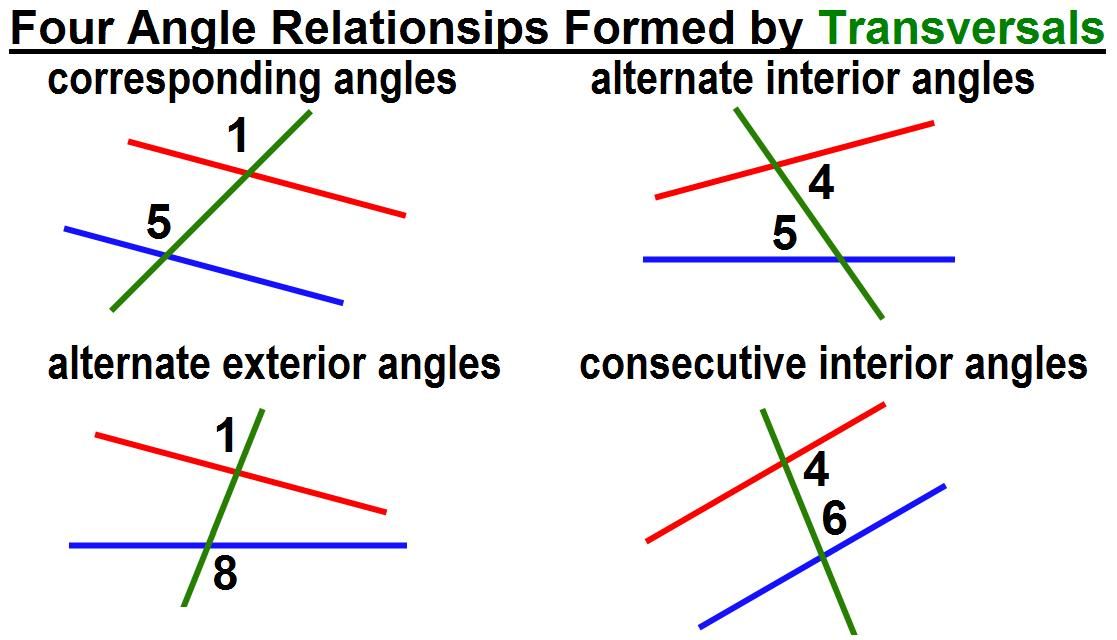
1. Corresponding Angles
- These angles are in the same relative position at each intersection
- They look like matching corners
Example position:
Top-right at first intersection = Top-right at second intersection
2. Alternate Interior Angles
- These lie between the two lines
- On opposite sides of the transversal
Visual idea:
Think of a “Z” shape—the angles at the ends are alternate interior angles
3. Interior Angles on the Same Side
- These are inside the two lines
- On the same side of the transversal
Visual idea:
Think of a “C” shape—these angles lie on the same side
Key Properties (When Lines are Parallel)
If a transversal cuts parallel lines, some powerful rules apply:
- Corresponding angles are equal
- Alternate interior angles are equal
- Interior angles on the same side add up to 180° (supplementary)
These properties are the foundation for solving most numerical problems.
Step-by-Step Visualization
Let’s understand this clearly:
- Draw two parallel lines
- Draw a slanted line cutting both (this is the transversal)
- Focus on angle positions:
- Matching positions → Corresponding
- Inside + opposite sides → Alternate interior
- Inside + same side → Interior same side
Now apply rules:
- If one corresponding angle is 70°, the matching one is also 70°
- If one alternate interior angle is 50°, the other is also 50°
- If one interior angle is 110°, the other on the same side is 70°
Converse
Until now, we used properties assuming lines are parallel.
But the converse works the other way around:
If:
- Corresponding angles are equal, OR
- Alternate interior angles are equal, OR
- Interior angles on the same side sum to 180°
Then you can conclude that the lines are parallel.
Why This Matters
This is extremely important in proof-based questions.
Instead of being told that lines are parallel, you may be given angle values.
Using these relationships, you prove that the lines must be parallel.
Student-Friendly Tip
Whenever you see:
- Two lines + one cutting line
Ask yourself:
- Are the lines parallel?
- Which angle type is formed?
Once you identify the pattern (Z, F, or C shape), solving becomes quick and logical instead of confusing.
Try a Free Demo Class Today.
Parallel Lines Theorem
Statement
If two lines are parallel to the same line, then they are parallel to each other.
Understanding the Idea
This theorem may look simple, but it plays an important role in solving geometry problems.
Think of it like this:
- Line m is parallel to line l
- Line n is also parallel to line l
- Since both lines follow the same direction and never meet line l, they will also never meet each other
So, m || n
Why It Works
When a transversal cuts these lines:
- The corresponding angles formed with line l are equal
- This equality carries over between lines m and n
- Hence, they behave like parallel lines with respect to each other
Example (Step-Based Solving)
Question:
Line m || line l and line n || line l. Prove that m || n.
Step 1: Draw a transversal
Let a line t cut all three lines
Step 2: Use corresponding angles
Since m || l, corresponding angles are equal
Since n || l, corresponding angles are equal
Step 3: Compare angles
Angles formed with m and n are equal
Step 4: Apply converse
If corresponding angles are equal, lines are parallel
Final Conclusion:
m || n
Student-Friendly Tip
Whenever you see:
- Two lines connected through a common parallel line
You can confidently conclude they are parallel to each other.
This shortcut saves time, especially in proofs and multi-line diagrams.
Solved Examples
This section focuses on how to think through problems, not just arrive at answers. Follow each step carefully to understand the logic behind the solution.
Example 1: Linear Pair (Ratio-Based Problem)
Question:
Two adjacent angles form a linear pair. Their ratio is 3 : 5. Find both angles.
Step 1: Recall the concept
Angles in a linear pair sum to 180°
Step 2: Let angles be
3x and 5x
Step 3: Form equation
3x + 5x = 180°
8x = 180°
Step 4: Solve
x = 22.5
Step 5: Find angles
3x = 67.5°
5x = 112.5°
Final Answer:
The angles are 67.5° and 112.5°
Thinking Tip:
Whenever ratio + linear pair appears → directly form equation using 180°
Schedule Your Free Demo Class with Experts.
Example 2: Angle Bisector (Step-by-Step Logic)
Question:
A ray bisects an angle of 80°. Find each part.
Step 1: Understand “bisector”
It divides an angle into two equal parts
Step 2: Apply concept
Each angle = 80° ÷ 2 = 40°
Final Answer:
Each angle is 40°
Extension Thinking:
If total angle was x, each part = x/2
Example 3: Full Angle = 360° (Multi-Angle Addition)
Question:
Four angles around a point are: 90°, 80°, 70°, and x. Find x.
Step 1: Recall property
Sum of angles around a point = 360°
Step 2: Form equation
90 + 80 + 70 + x = 360
Step 3: Simplify
240 + x = 360
Step 4: Solve
x = 120°
Final Answer:
x = 120°
Thinking Tip:
Whenever angles form a complete circle → total is always 360°
Example 4: Parallel Lines Using Transversal
Question:
Two parallel lines are cut by a transversal. One corresponding angle is 75°. Find the matching angle.
Step 1: Identify angle type
Corresponding angles
Step 2: Recall property
Corresponding angles are equal (if lines are parallel)
Step 3: Apply directly
Matching angle = 75°
Final Answer:
The angle is 75°
Extension Thinking:
Same applies to alternate interior angles
Example 5: Proof-Based Question
Question:
If two adjacent angles sum to 180°, prove that they form a straight line.
Step 1: Given
Sum of adjacent angles = 180°
Step 2: Recall converse of linear pair axiom
If adjacent angles sum to 180°, their non-common arms form a straight line
Step 3: Apply reasoning
Since sum = 180°, the angles lie on a straight line
Final Conclusion:
The angles form a linear pair, hence a straight line
Book Your Free Demo Class Today.
Teaching Insight: How to Approach Problems
Instead of memorizing, follow this approach:
- Identify the concept (linear pair, transversal, etc.)
- Recall the property (180°, equal angles, etc.)
- Translate into equation or logic
- Solve step-by-step
When you train your brain to think this way, geometry becomes logical, not confusing.
Practice Questions
Practice is where concepts become clear and confidence builds. Attempt these questions step by step, and try to identify the concept before solving.
Category 1 – Basic Concepts
- Define a ray with an example.
- What is a straight angle? Give a real-life example.
- Identify the type of angle: 135°.
- What is the difference between a line segment and a ray?
- Are the points A, B, C collinear if they lie on the same line? Explain.
- Classify the angle: 45°.
- What type of angle is 180°?
- Define adjacent angles with a diagram.
- Give one real-life example of parallel lines.
- Identify whether 270° is reflex or obtuse.
Category 2 – Linear Pair & Vertically Opposite Angles
- If one angle is 70°, find its linear pair.
- Two angles form a linear pair. One is 120°. Find the other.
- If two intersecting lines form an angle of 85°, find its vertically opposite angle.
- Adjacent angles are x and 2x and form a linear pair. Find x.
- If one vertically opposite angle is 110°, find all four angles formed.
- Two angles in a linear pair are in the ratio 2 : 7. Find both angles.
- If ∠A = 95° and ∠A and ∠B form a linear pair, find ∠B.
- In intersecting lines, one angle is 45°. What are the other three angles?
- Check whether angles of 100° and 80° form a linear pair. Give reason.
- If vertically opposite angles are equal, and one angle is x, express the opposite angle.
Category 3 – Transversal & Parallel Lines
- What are corresponding angles? Define with an example.
- Identify alternate interior angles in a given diagram.
- If two parallel lines are cut by a transversal and one corresponding angle is 60°, find the other.
- If alternate interior angles are equal, what can you conclude about the lines?
- Two interior angles on the same side are 110° and 70°. Are the lines parallel?
- If one interior angle is 130°, find the angle on the same side of the transversal.
- Identify the angle pair formed in a “Z” shape.
- If corresponding angles are unequal, are the lines parallel? Explain.
- A transversal cuts two parallel lines forming an angle of 45°. Find its alternate interior angle.
- Identify angle types formed in an “F” pattern.
Category 4 – Mixed Problems
- Two angles form a linear pair and are in ratio 4 : 5. Find both angles.
- Four angles around a point are x, 2x, 3x, 4x. Find x.
- If two lines intersect and one angle is 100°, find all angles formed.
- A transversal cuts parallel lines. One angle is 75°. Find all related angles.
- If an angle is bisected and one part is 35°, find the full angle.
- Check whether angles 60°, 120° satisfy any angle pair property.
- Find the missing angle in a straight line if one angle is 140°.
- If vertically opposite angles are 3x and 3x, and adjacent angle is 2x, find x.
- Find the value of x if angles around a point are 90°, 80°, x, 100°.
- Two parallel lines are cut by a transversal. If one angle is 110°, find the interior angle on the same side.
Schedule Your Free Demo Class Today.
Category 5 – Assertion & Reason
For each question, choose the correct option:
(A) Both Assertion and Reason are true, and Reason is the correct explanation
(B) Both are true, but Reason is not the correct explanation
(C) Assertion is true, Reason is false
(D) Assertion is false, Reason is true
- Assertion: Vertically opposite angles are equal
Reason: They are adjacent - Assertion: Linear pair angles sum to 180°
Reason: They form a straight line - Assertion: Corresponding angles are equal
Reason: Lines are parallel - Assertion: Interior angles on same side are supplementary
Reason: A transversal cuts parallel lines - Assertion: Two lines parallel to the same line are parallel to each other
Reason: They maintain equal distance - Assertion: Adjacent angles always form a linear pair
Reason: They share a common vertex - Assertion: Alternate interior angles are equal
Reason: Lines are parallel - Assertion: Angles around a point sum to 360°
Reason: A full rotation is 360° - Assertion: If corresponding angles are equal, lines are parallel
Reason: Converse of corresponding angles property - Assertion: A straight angle is 180°
Reason: It forms a line
Student Tip
While solving:
- First identify the concept
- Then apply the correct property
- Avoid guessing—use logic
Consistent practice with these categories will make you confident in both numerical and proof-based questions.
Common Mistakes Students Make
Even when the concepts seem simple, small mistakes can lead to wrong answers. Being aware of them helps you avoid losing marks.
- Confusing adjacent angles and linear pairs:
Not all adjacent angles form a linear pair. A linear pair must add up to 180° and lie on a straight line. - Forgetting the 180° rule:
Students often forget that angles on a straight line always sum to 180°, especially in multi-step problems. - Misidentifying angle types:
Mixing up corresponding, alternate interior, and interior same-side angles is very common. This leads to applying the wrong property. - Not using diagrams properly:
Many students try to solve questions mentally instead of drawing clear diagrams. This increases confusion and errors. - Skipping logical steps:
Writing answers without showing reasoning can cause mistakes, especially in proof-based questions.
Try a Free Demo Class Now.
Tips to Master Lines and Angles
Mastering this chapter is more about clarity than memorization. These simple habits can make a big difference:
- Always draw diagrams:
A neat, labeled diagram makes it easier to identify angle relationships and avoid confusion. - Use color coding:
Highlight corresponding or equal angles using different colors. This improves visual understanding. - Practice daily:
Solve a few questions every day. Consistency helps reinforce concepts and improves speed. - Focus on concepts, not memorization:
Instead of memorizing rules, understand why they work. This helps in solving unfamiliar problems. - Revise properties regularly:
Go through key rules like linear pair, vertically opposite angles, and transversal properties often.
With the right approach, lines and angles become one of the easiest and most scoring topics in geometry.
How PlanetSpark Helps Students Master Lines and Angles
Understanding lines and angles is not just about memorizing rules—it’s about building clarity, logic, and confidence. This is where PlanetSpark transforms the learning experience.
- 1:1 Personalized Learning:
Every student learns differently. With one-on-one sessions, concepts like linear pairs or transversals are explained at the student’s pace, ensuring no confusion is left behind. - Visual Explanation Techniques:
Geometry becomes easier when you can see it. PlanetSpark uses diagrams, real-life examples, and visual breakdowns to make abstract ideas simple and relatable. - Concept Clarity Through Storytelling:
Instead of dry definitions, concepts are taught using engaging stories and situations. This helps students remember and apply ideas naturally. - Real-Time Doubt Solving:
No waiting or hesitation. Students can ask questions instantly and get clear, step-by-step explanations during the session. - Practice with Expert Feedback:
Regular practice is guided by experts who not only correct mistakes but also explain why something is wrong and how to improve.
PlanetSpark goes beyond maths. It helps students develop logical thinking, problem-solving skills, and clear communication, which are essential for academic success and beyond.

Building Strong Foundations in Lines and Angles
Lines and angles form the foundation of geometry and appear in many real-life situations. Once your concepts are clear, solving problems becomes simple and logical. Focus on understanding relationships, practice consistently, and use diagrams to guide your thinking. With the right approach, this chapter can become one of your strongest areas, building both confidence and accuracy in mathematics.
You May Also Find Useful
Master Class 9 Maths NCERT: Complete Guide for Class 9th Students
Frequently Asked Questions
PlanetSpark helps students understand lines and angles through personalized 1:1 sessions, visual explanations, and real-life examples that make concepts easy and engaging.
Yes, PlanetSpark focuses on building strong logical thinking and step-by-step problem-solving skills, helping students confidently solve geometry questions.
PlanetSpark offers expert trainers, interactive teaching methods, and customized learning plans that ensure complete concept clarity and better academic performance.
Yes, PlanetSpark provides structured practice sessions, worksheets, and expert feedback to help students master lines and angles effectively.
PlanetSpark uses storytelling, diagrams, and visual learning techniques to simplify complex geometry concepts like transversals and angle relationships.
Yes, PlanetSpark is designed for all levels, including beginners, with step-by-step explanations and personalized attention to build a strong foundation.
PlanetSpark builds confidence through consistent practice, real-time doubt solving, and expert guidance that helps students understand concepts deeply and apply them correctly.