
10 Hands On Mathematics Acitivity for Preschol & Kinderagarden
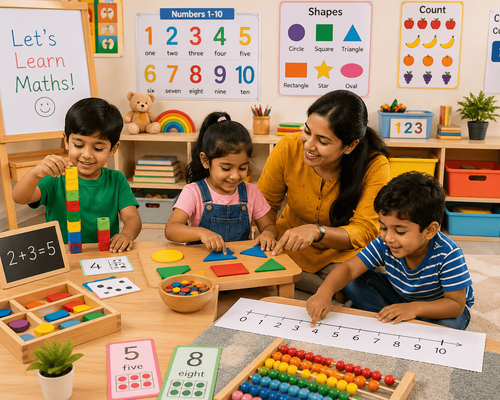

Table of Contents
- 10 Hands On Mathematics Activity for Kids
- Go Beyond Practice with Smart Learning Support
- How Hands-on Maths Activities Build Strong Learning Foundati
- Strengthen Learning with the Right Guidance with PlanetSpark
- Maths Activities for Higher Classes
- Make Maths Learning Easy and Engaging with PlanetSpark
- Build a Strong Future with Fun Learning
Do numbers feel confusing or boring for young learners? Many kids struggle to understand basic maths concepts when learning is limited to books. A simple mathematics activity can turn this experience into something fun, engaging, and easy to understand.
Today, many learners build strong foundational and communication skills through platforms like PlanetSpark, where interactive learning plays a key role. In this blog, you will discover 10 exciting maths activities, understand how they help early learners, and explore ways to make maths enjoyable. Let’s start with why hands-on learning works so well for kids.
10 Hands On Mathematics Activity for Kids
Hands-on learning makes maths simple, fun, and easy to understand for young learners. These maths activities help children connect concepts with real-life experiences. Below are detailed explanations of each activity to help you apply them effectively.
1. Counting Objects Activity
Give children everyday items like toys, fruits, or pencils and ask them to count them one by one. Start with small numbers and gradually increase the quantity as they gain confidence. You can also ask them to group items into sets, such as counting in pairs or groups of five. This activity helps children understand the concept of numbers and quantity. It also improves focus and builds a strong foundation for basic maths skills. Regular practice makes children more confident and accurate while counting.
2. Sorting and Grouping
Provide a variety of objects like buttons, beads, or blocks and ask children to sort them based on color, size, or shape. You can make it more interesting by setting simple challenges such as grouping all red items or arranging objects from smallest to largest. This activity develops logical thinking and helps children understand classification. It also improves observation skills and attention to detail. Sorting and grouping are important early maths concepts that prepare children for more advanced topics like patterns and data organization.
Want to make maths fun and easy?
Join PlanetSpark Learning Classes.
Book a free trial now!
3. Number Matching Game
Create number cards and place them alongside objects such as coins, toys, or fruits. Ask children to match each number with the correct number of items. For example, match the number 4 with four blocks. You can increase the difficulty by mixing up the cards or adding more numbers. This activity strengthens number recognition and counting skills. It also improves memory and concentration. Children enjoy this as a game, which makes learning more engaging and less stressful.
4. Shape Hunt Activity
Encourage children to explore their surroundings and identify different shapes. Ask them to find objects that match shapes like circles, squares, triangles, or rectangles. For example, a clock is a circle and a window can be a rectangle. You can turn this into a fun challenge by asking them to find as many shapes as possible. This activity helps children understand basic geometry concepts and improves their ability to observe details. It also connects classroom learning with real-life situations.
5. Measuring Fun
Use simple tools like cups, spoons, or containers to measure water, rice, or sand. Ask children to compare quantities and identify which container holds more or less. You can also involve them in everyday activities like cooking to make it more practical. This activity introduces basic measurement concepts such as volume and comparison. It helps children understand size and quantity in a hands-on way. Learning through real-life examples makes concepts easier to grasp and remember.
6. Pattern Making
Give children beads, blocks, or colored sticks and ask them to create simple patterns like red-blue-red-blue. You can also create a pattern and ask them to continue it. As they improve, introduce more complex patterns. This activity improves observation skills and logical thinking. It also enhances memory and concentration. Pattern recognition is an important skill that helps children understand sequences and relationships in maths. Making patterns also encourages creativity and keeps children engaged.
7. Counting with Movement
Combine physical activity with learning by asking children to jump, clap, or hop while counting numbers. For example, ask them to clap five times while counting aloud. This makes learning more fun and active. It helps children remember numbers better and improves coordination. Physical involvement keeps children engaged and reduces boredom. This activity is especially useful for young learners who enjoy movement and learn better through action.
8. Number Line Activity
Draw a number line on paper or the floor and ask children to point to or jump on specific numbers. You can also use it to teach simple addition and subtraction. For example, start at number 2 and move forward three steps to reach 5. This activity helps children understand number sequences and relationships between numbers. It also improves their ability to visualize maths concepts. Using a number line makes learning interactive and easier to understand.
Want to solve maths problems with confidence?
Join PlanetSpark Smart Learning Program.
Book your free trial now!
9. Simple Addition with Objects
Use objects like candies, blocks, or toys to explain addition. Show a small number of objects and then add more to demonstrate how numbers combine. For example, show 2 apples and then add 3 more to explain 2 + 3. This visual method makes abstract concepts easier to understand. It helps children grasp addition naturally without memorization. This activity also builds confidence and prepares them for solving problems independently.
10. Puzzle-Based Learning
Introduce simple puzzles such as number matching games, jigsaw puzzles, or logic challenges. These puzzles encourage children to think critically and solve problems. You can choose puzzles based on their age and gradually increase the difficulty level. This activity improves concentration, patience, and reasoning skills. It also promotes independent learning and boosts confidence. Puzzle-based learning makes maths enjoyable and helps children develop a problem-solving mindset.
These maths fun activities make learning interactive and enjoyable for young learners. By using simple materials and creative ideas, you can turn everyday moments into meaningful learning experiences. Over time, these activities help children build a strong foundation in maths while developing confidence and curiosity.
Go Beyond Practice with Smart Learning Support
Hands-on maths activities help you understand concepts, but real improvement happens when you know how to apply them correctly and consistently. Many students practice regularly but still feel stuck when questions change or become slightly challenging.
This is where the right guidance can make a big difference. PlanetSpark focuses on helping learners build strong thinking skills so they can approach any problem with clarity and confidence. Instead of just solving questions, students learn how to break down problems, think logically, and find the right solution step by step.
- Concept-first learning that focuses on understanding, not memorizing
- Interactive sessions that keep students involved and thinking actively
- Step-by-step problem solving to handle new and tricky questions
- Personalized guidance based on each learner’s pace and level
- Confidence-focused approach that removes fear of mistakes
- Real-world application to make maths meaningful and practical
With this approach, students don’t just complete maths fun activities. They learn how to think, solve, and grow with every challenge they face.
How Hands-on Maths Activities Build Strong Learning Foundations
Hands-on learning creates a strong base for future concepts. When children understand basics clearly, they perform better in higher classes.
For example, maths activity for class 5 or maths activity for class 6 becomes easier when early concepts are clear.
How It Helps
- Builds confidence in learning
- Improves memory retention
- Develops problem-solving ability
- Encourages independent thinking
These early activities prepare students for advanced topics like algebra and geometry later.
Strengthen Learning with the Right Guidance with PlanetSpark. Enrol Today!
While hands-on maths activities build a strong foundation, the right guidance helps students use these concepts effectively as they progress. Many learners understand basics but struggle when applying them to new or complex problems.
Structured support, like the approach followed at PlanetSpark, helps students think clearly, solve problems step by step, and stay consistent in their learning. With expert guidance and a clear learning path, students can turn basic understanding into strong academic performance and long-term confidence.
Maths Activities for Higher Classes
As students grow, their learning needs become more structured and concept-focused. At this stage, a well-designed mathematics activity helps them move beyond basic understanding and apply concepts in real-life situations. These maths activities are designed to improve problem-solving, logical thinking, and accuracy while keeping learning engaging.
Maths Activity for Class 5
At this level, students begin to explore more detailed concepts, so activities should focus on clarity and application.
- Fractions using objects: Use items like fruits or paper shapes to show parts of a whole. This helps students visualize fractions easily.
- Multiplication games: Use flashcards, dice, or timed challenges to make multiplication fun and improve speed.
- Measurement exercises: Ask students to measure objects using rulers or estimate lengths and weights to build practical understanding.
These activities make abstract concepts more concrete and easier to understand.
- Maths Activity for Class 5th
Students at this stage benefit from activities that connect maths to daily life and improve reasoning skills.
- Time calculations: Use clocks to teach reading time, calculating durations, and solving real-life time-based problems.
- Basic geometry: Draw and identify shapes, angles, and patterns to build spatial awareness.
- Word problems: Solve simple real-life problems to improve comprehension and application of concepts.
These activities strengthen both understanding and analytical thinking.
Maths Activity for Class 6
As students enter middle school, they are introduced to more advanced topics. Activities should focus on concept clarity and logical thinking.
- Ratio and proportion: Use real-life examples like recipes or sharing items to explain these concepts.
- Algebra basics: Introduce variables using simple patterns and equations to make learning easier.
- Data handling: Create charts or graphs using real data like marks or daily activities to build interpretation skills.
These activities help students transition smoothly into higher-level maths.
Maths Activity for Class 6 to 8
For older students, learning should focus on problem-solving and real-world application.
- Logical puzzles: Solve puzzles that require reasoning and critical thinking.
- Problem-solving challenges: Encourage multi-step problems to improve analytical skills.
- Real-life applications: Use examples like budgeting, shopping calculations, or travel planning to show how maths is used daily.
These maths fun activities not only improve academic performance but also help students develop practical skills. Over time, they build confidence, improve accuracy, and make maths more meaningful and interesting.
Make Maths Learning Easy and Engaging with PlanetSpark
Understanding concepts through maths activities is important, but many students still struggle with consistency, clarity, and confidence while solving problems. This is where structured and guided learning makes a real difference.
PlanetSpark offers a supportive learning environment where students not only practice concepts like maths activity for class 5, maths activity for class 6, and maths activity for class 6 to 8, but also learn how to think clearly and approach problems step by step.
Why Choose PlanetSpark
- Live interactive classes that make learning engaging and easy to follow
- Expert teachers who simplify complex concepts for better understanding
- Activity-based learning approach to make maths fun and practical
- Personalized feedback to help students improve faster
- Confidence-building framework that reduces fear of difficult subjects
- Structured curriculum designed for gradual and consistent progress
- Focus on practical application to connect maths with real-life situations
With the right mix of maths fun activities and guided learning, students can build strong foundations, improve problem-solving skills, and enjoy learning without stress.

Build a Strong Future with Fun Learning
Learning maths does not have to be difficult. With the right mathematics activity, students can enjoy learning and build strong foundations.
By using engaging maths activities, practicing regularly, and focusing on understanding, every student can improve. Over time, these skills help in academics, communication, and overall confidence. Keep learning, stay curious, and enjoy the process.
Also Read- Learn Counting Numbers With PlanetSpark Maths Classes
Frequently Asked Questions
A mathematics activity is a fun and interactive way to learn maths using games, puzzles, and real-life examples.
They make learning engaging, improve understanding, and build confidence in maths.
Multiplication games, fractions with objects, and measurement activities are useful.
PlanetSpark helps students improve communication skills through interactive learning and expert guidance.
PlanetSpark provides structured, interactive learning with expert guidance that helps students build strong thinking skills, improve problem-solving ability, and gain confidence across subjects.