
Master Maths Puzzles for Brain Development in Kids Practice
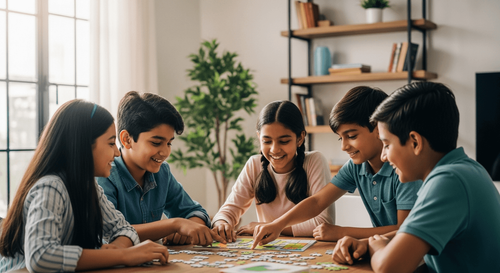

Table of Contents
- What Are Maths Puzzles and Why Do They Matter in Children’s
- How Maths Puzzles Build Cognitive Skills and Problem-Solving
- Types of Maths Puzzles with Simple Examples for Kids
- Age-Wise Practice Methods and Fun Ways to Learn Maths Puzzle
- Common Challenges in Maths Puzzle Solving and Parental Suppo
- How to Make Maths Puzzle Practice More Engaging for Kids
- How PlanetSpark Improves Maths Learning in Children
- Brain Development Through Maths Puzzles
- Conclusion
Maths puzzles are one of the most effective ways to help children build strong thinking and reasoning skills while enjoying the learning process. Instead of rote memorisation, children engage with math riddles, math brain teasers, and math and logic problems that challenge their brain in a fun and interactive way. These activities are especially important during brain development in early childhood, when thinking abilities grow rapidly. This blog explains how maths puzzles improve cognitive skills, the different types of puzzles like math crossword puzzles, age-wise practice methods, common learning challenges, and parental support strategies. By the end, parents will clearly understand how puzzles can transform learning into an enjoyable and meaningful experience for children while building long-term academic strength and curiosity.
What Are Maths Puzzles and Why Do They Matter in Children’s Learning
Maths puzzles are structured thinking activities designed to improve logical reasoning, numerical understanding, and creativity in children. They include math riddles, sequencing tasks, pattern recognition games, and math crossword puzzles that encourage children to think beyond formulas.
They matter because they shift learning from passive memorisation to active problem-solving. When children engage with math and logic problems, they learn how to analyse situations instead of memorising answers. This improves curiosity and builds independent thinking.
Key benefits include:
- Improved concentration and attention span
- Stronger logical reasoning skills
- Reduced fear of mathematics
- Better independent decision-making
For example, solving a math riddle forces children to interpret clues creatively instead of applying direct formulas. Similarly, math crossword puzzles improve numerical recall and pattern recognition.
Parents also notice that children become more confident in classrooms after regular practice. This is because maths puzzles train the brain to stay patient, explore multiple solutions, and enjoy challenges. Over time, learning becomes less stressful and more engaging, helping children build a positive relationship with mathematics.
How Maths Puzzles Build Cognitive Skills and Problem-Solving Ability
Maths puzzles significantly improve cognitive development by activating multiple areas of the brain such as memory, logic, and attention. When children solve math brain teasers, they are required to observe patterns, evaluate options, and eliminate incorrect answers step by step.
This process builds structured thinking, which helps in academic subjects and real-life decision-making. Instead of rushing, children learn to think carefully before responding.
Important cognitive benefits include:
- Strong memory retention
- Faster reasoning ability
- Better focus and patience
- Improved analytical thinking
For example, math and logic problems train children to break complex questions into smaller steps. This skill is useful in exams and everyday problem-solving situations.
Additionally, math riddles encourage creative thinking because they require children to interpret hidden meanings. Repeated exposure to math crossword puzzles improves pattern recognition and recall speed.
Struggling to help your child master maths puzzles and build strong thinking skills? Join PlanetSpark learning programs with a free trial today and help your child develop confidence, focus, and problem-solving ability before they fall behind! Book your free trial now!
A key advantage of maths puzzles is that they act like a brain exercise. Just like physical exercise strengthens the body, puzzles strengthen mental pathways. Over time, children become sharper, more confident, and more capable of handling difficult problems with ease.
Types of Maths Puzzles with Simple Examples for Kids
There are different types of maths puzzles, and each one builds specific thinking skills in children. Understanding these types helps parents choose the right level for their child.
Math Riddles
These are creative questions that require thinking beyond logic.
Example: I am an odd number. Remove one letter, and I become even. What am I?
Math Brain Teasers
These focus on reasoning and pattern identification.
Example: Find the missing number in a sequence pattern like 2, 4, 8, 16, __.
Math Crossword Puzzles
These combine clues with numbers and improve memory and focus. Children fill in answers based on logic rather than guesswork.
Math and Logic Problems
These involve structured reasoning and multi-step thinking. They are often used for higher-level understanding.
Quick Learning Benefits
- Math riddles improve creativity
- Math brain teasers improve logic
- Math crossword puzzles improve memory
- Math and logic problems improve structured thinking
Together, these puzzle types strengthen brain development in early childhood by improving reasoning, attention, and flexibility of thought.
Age-Wise Practice Methods and Fun Ways to Learn Maths Puzzles at Home
Introducing maths puzzles at the right age helps children learn effectively without pressure.
Ages 5–7
- Simple math riddles
- Counting games
- Shape-based puzzles
Focus: curiosity and basic understanding
Ages 8–10
- Math brain teasers
- Number patterns
- Simple math crossword puzzles
Focus: logical thinking and recognition
Ages 11+
- Advanced math and logic problems
- Multi-step puzzles
- Analytical reasoning tasks
Focus: structured thinking and accuracy
Fun Home Learning Methods
- 10–15 minute daily puzzle sessions
- Using toys and real objects for counting
- Family puzzle-solving games
- Reward-based motivation system
Children learn faster when practice is consistent and enjoyable. Even short daily exposure to maths puzzles improves concentration, confidence, and problem-solving ability. Parents should focus on effort rather than speed to build a stress-free learning environment that supports long-term academic growth.
Common Challenges in Maths Puzzle Solving and Parental Support
While maths puzzles are highly beneficial, children may face difficulties while learning.
Common challenges include:
- Frustration when answers are not immediate
- Difficulty understanding math brain teasers
- Confusion in multi-step math and logic problems
- Loss of focus during practice
Parental Support Strategies
- Give hints instead of direct answers
- Break problems into smaller steps
- Encourage repeated attempts
- Maintain a stress-free environment
Want your child to confidently solve math brain teasers, math riddles, and math and logic problems with ease?
Effective Support Techniques
- Use visual aids like blocks or drawings
- Keep sessions short and engaging
- Appreciate effort instead of correct answers
- Avoid comparison with other children
When children feel supported, they develop resilience and patience. This helps them enjoy math crossword puzzles and other challenges without fear. Over time, frustration turns into curiosity, and learning becomes more enjoyable and effective.
How to Make Maths Puzzle Practice More Engaging for Kids
To keep maths puzzles engaging, learning should feel like a game rather than a task.
Engagement Techniques
- Turn math riddles into timed challenges
- Use storytelling for math and logic problems
- Create friendly puzzle competitions
- Mix different puzzle types daily
Interactive Learning Methods
- Use apps and visual tools for math brain teasers
- Solve puzzles in groups or with family
- Introduce reward systems for motivation
- Rotate puzzle types to avoid boredom
Key Outcomes
- Higher engagement
- Better focus
- Stronger curiosity
- Improved consistency
When learning is enjoyable, children naturally stay motivated. This leads to stronger brain development in early childhood, improved reasoning skills, and a positive attitude toward mathematics.
How PlanetSpark Improves Maths Learning in Children
PlanetSpark helps children develop strong thinking and communication skills that support solving maths puzzles effectively. Through structured learning, children improve focus, clarity, and reasoning ability.
These skills directly help in solving math brain teasers, math riddles, and math and logic problems with confidence.
Key Improvements
- Better logical thinking
- Improved concentration
- Strong problem-solving ability
- Higher academic confidence
Children are encouraged to explain their thinking process, which improves clarity during math crossword puzzles and other activities.
PlanetSpark focuses on developing independent learners who think critically instead of memorising answers. This supports brain development in early childhood and builds long-term academic confidence.

Brain Development Through Maths Puzzles
Maths puzzles play a direct role in strengthening brain development by activating multiple cognitive functions at the same time. When children solve math brain teasers, their memory, attention, and logic skills work together.
Key Brain Benefits
- Improved neural connections
- Stronger analytical thinking
- Better memory retention
- Faster decision-making
Math and logic problems help children develop structured thinking by breaking complex questions into smaller steps.
Math riddles improve creativity, while math crossword puzzles enhance focus and recall ability.
Regular practice strengthens mental flexibility and improves academic performance. Over time, children become confident, quick thinkers who enjoy solving challenges instead of avoiding them.
Conclusion
Maths puzzles are a powerful way to build strong thinking skills, creativity, and confidence in children. From math riddles to advanced math brain teasers, they strengthen logic and improve brain development in early childhood. Regular practice helps children master math and logic problems with ease while enjoying the learning process. With the right support and consistent practice, children develop a positive attitude toward mathematics and problem-solving. Parents play a key role in making learning stress-free and engaging.
Is your child struggling with math, crossword puzzles, and logical thinking?
Frequently Asked Questions
Maths puzzles are fun learning activities that improve logic, reasoning, and numerical understanding through engaging challenges.
They strengthen memory, attention, and analytical thinking, supporting brain development in early childhood effectively.
Examples include number sequences, missing pattern puzzles, and logical reasoning challenges.
Yes, they improve concentration, recall ability, and numerical understanding in children.
Daily 10–15 minutes of practice is enough to build strong problem-solving skills and confidence.