
NCERT Solutions for Class 3 Maths Chapter 11
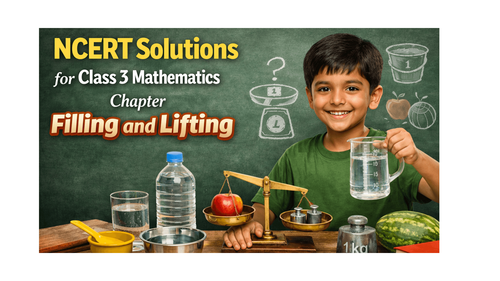

NCERT solutions for Class 3 Mathematics Chapter Filling and Lifting – complete answers & explanations
This NCERT solutions blog for Class 3 Mathematics Chapter Filling and Lifting helps students understand the concepts of capacity and weight through simple and practical activities. The chapter teaches children how to compare quantities, measure using everyday objects, and identify heavier and lighter items. This chapter is important as it builds a strong foundation in measurement using real-life examples. The solutions shared here are complete NCERT solutions strictly based only on the given worksheet and follow the exact order and content without any additions or changes.
What this NCERT chapter covers?
1. Understanding capacity using containers like
bowl, glass, and bottle
2. Comparing quantities using terms like more, less, most, and least
3. Learning about litre, half litre, and quarter litre
4. Identifying heavier and lighter objects through observation
5. Using simple tools like ladles, coins, and matchboxes for measurement
6. Practicing real-life activities like pouring, weighing, and comparing
How to use these NCERT solutions?
1. Read each question carefully before
checking the answers.
2. Try to solve or perform the activity on your own first.
3. Use the solutions only to check your answers.
4. Follow the exact order of sections as given in the worksheet.
5. Parents and teachers can guide students during activity-based tasks.
Important tips & tricks for students
1. Observe carefully before answering picture-based questions
2. Do not assume bigger objects always hold more or are heavier
3. Focus on understanding through activities rather than memorising
4. Practice measuring and comparing objects at home
5. Follow the exact answer format as shown in NCERT solutions
NCERT solutions – complete answer key
Let us Discuss
1. Ritu
2. Nita
3.
a. Less
b. More
c. More
4.
a. Ritu
b. Nita
How much can you drink
Chintu does not take the challenge because the glasses are bigger, so he will have to drink more juice. It will be difficult for him.
Yes, I can take the challenge if I use smaller glasses because I will have to drink less juice.
Let us Do
Take a small bowl, glass, and bottle. First guess how many bowls fill the glass and how many glasses fill the bottle. Then pour water to check your guess.
1.
a. The glass holds the least water.
b. The bottle holds the most water.
2. Bucket, tank, drum.
(Activity – Vessels)
Let us Do
1. Answers may vary depending on the size of the ladle, bowl, and jug.
2. Answers may vary depending on the size of vessels used.
3. Ladle
4. Ladle, because it helps to pour equal amounts into each glass.
5. Answers may vary based on the size of vessels used.
6. Answers may vary based on the size of vessels used.
7. Yes, we can use a ladle, bowl or glass to measure a jug by repeatedly filling and counting how many times it fills the jug.
Let us Discuss
a. The glass holds less than 1 litre.
b. The bowl holds more than 1 litre.
c. Jug holds exactly 1 litre.
Let us Think
a. The mug holds half litre of water.
b. The glass holds Quarter litre of water.
Let us Explore
Use a 1 litre bottle to compare and check capacities of the bucket, mug, and glass by filling and observing.
a. Bucket → more than 1 litre
b. Mug → more than half litre
c. Glass → less than quarter litre
Heavy or Light
Hold objects in both hands and observe which side goes down. The heavier object goes down.
The lunch box is heavier than the pencil box.
The school bag is heavier than the lunch bag.
The watermelon is heavier than the apple.
A basketball is heavier than a balloon.
Let us Do
Use coins or erasers to balance objects on a pan balance and record them.
1.
Pencil – 2 coins
Ping pong ball – 1 coin
Spoon – 3 coins
2. Fill a matchbox with sand and use it as a unit to weigh objects. First guess, then verify.
3. Order (lightest to heaviest): 4 marbles < spoon < pencil box
Let us Do
weight hunt
1. Compare school bags in groups and observe differences in weight.
2. Count the number of books in each bag. The bag with more books is heavier.
3. By making the number of books equal in both bags, their weights can be balanced.
How much is 1 Kilogram
4. Examples of 1 kilogram objects are rice packet, sugar packet, and flour packet.
5. Answers may vary.
Let us Explore
6.
Half kg objects:
Sugar packet (½ kg)
Dal packet (½ kg)
Quarter kg objects:
Butter packet (¼ kg)
Small fruit pack (¼ kg)
Tricky Balls
Identify objects at home that are about half kg and quarter kg. Compare with a 1 kg packet and verify.
1.
a. Only 1 time
b. Weigh any two balls.
- If equal → third ball is heavier
- If not equal → heavier side has the heavy ball
2.
Weigh Red vs Orange
- If equal → Green is different
- If not equal → compare heavier one with green
- From results, identify heaviest and lightest.
Why NCERT solutions help students?
NCERT solutions help students understand concepts clearly and improve their problem-solving skills. They follow the exact CBSE pattern and help students prepare better for exams. These solutions also build confidence and ensure strong conceptual learning.
Help your child build strong Class 3 Mathematics fundamentals with expert-guided learning support.
Book a free trial!