
NCERT Solutions for Class 5 Mathematics Math-Mela Chapter 3
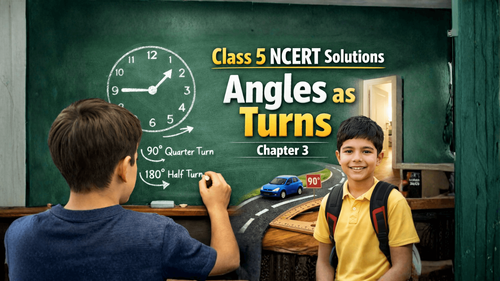

NCERT solutions for class 5 mathematics: chapter 3 angles as turns – complete answers & explanations
This blog provides NCERT solutions for Class 5 Mathematics Chapter 3 Angles as Turns based strictly on the worksheet: This chapter helps students understand how angles are formed through turns using simple real-life examples like fans, wheels, and clock hands. It is important because it builds a clear understanding of angle types and directions through visual and activity-based learning. These solutions are complete and accurate, following the exact worksheet content without any changes.
What does this NCERT chapter cover?
1. Understanding full turn, half turn,
and quarter turn through real-life examples
2. Identifying turns using objects like fans, wheels, and steering wheels
3. Learning types of angles such as acute, right, obtuse, and straight
4. Using measuring tools to identify and classify angles
5. Understanding clockwise and anti-clockwise directions
6. Observing movements and applying concepts through activities
How to use these NCERT solutions?
1. First attempt all questions from
the worksheet independently.
2. Use these solutions to check and correct your answers.
3. Follow the same order of questions as given in the worksheet.
4. Parents and teachers can guide students in understanding mistakes.
5. Use these answers for revision and better concept clarity.
Important tips & tricks for students
1. Observe real-life objects like clocks and fans to understand turns clearly.
2. Remember relationships like 2 half turns make 1 full turn.
3. Do not confuse clockwise and anti-clockwise directions.
4. Practice identifying angle types using visual examples.
5. Follow instructions carefully for activity-based questions.
NCERT solutions – complete answer key
Discussion
Explanation:
The child who returns to the same position has made a full turn.
The child who turns halfway (semicircle) has made a half turn.
Examples of turns: fan, wheel, clock hands, steering wheel
Giant wheel
2 half turns = 1 full turn
2 quarter turns = 1 half turn
4 quarter turns = 1 full turn
taps, fan, wheel, steering wheel and lid
Door with hinge, scissors
Fan, wheel, steering wheel
Straight angle
Let Us Do
a
Explanation:
Fold a rectangular paper at equal intervals, paste sticks, and open the fan to show acute and obtuse angles.
Yes, two acute angles can form:
- an acute angle (if sum < 90°)
- a right angle (if sum = 90°)
- an obtuse angle (if sum > 90°)
b
A – obtuse
B – right
C – acute
D – acute
E – acute
F – right
G – right
H – obtuse
c
Answers may vary.
d
Acute
Right
Obtuse
Obtuse
Straight
Angle Measuring Tool
Make a circular tool divided into equal parts, fix a straw at the centre, and rotate it to show different turns like 1/8, 1/4, 1/2, etc.
2/8 turn = 1/4 turn (Right angle).
4/8 turn = 1/2 turn (Straight angle)
Let Us Think
The starting point is opposite to the arrow direction.
Let Us Do
1
Measure multiple angles using measuring tools.
30°, 45°, 50°, 70° → Acute,
90° → Right,
110°, 120° → obtuse
2
(a) 3/8
(b) 1/8
(c) 5/8
(d) 9/8
3
Measure angles.
4
1/2 turn → Straight angle, 1/4 turn → Right angle
1/8 turn → Acute angle; 1/12 turn → Acute angle
5
Draw angles based on the turns.
6
(a) 1/4 turn
(b) 1/2 turn
(c) 3/4 turn
(d) 5 minutes
(e) 60 minutes
(f) 10 minutes
(g) 20 minutes
Which direction
Clockwise
Clockwise
Clockwise
Clockwise
Try these.
South
North
East
West
East
South
South
Observe real-life movements like opening taps, lids, or nuts to identify clockwise or anticlockwise direction.
Fun with Turns
1
South
North
East
West
East
South
South
2
If she takes a half turn clockwise, she will face the ice cream vendor. She can take a half turn anticlockwise to face the same place.
Why do NCERT solutions help students?
NCERT solutions help students understand concepts clearly and follow the exact curriculum requirements. They improve accuracy, support exam preparation, and build confidence by providing correct and structured answers aligned with NCERT standards.
Help your child build strong mathematics fundamentals with accurate and structured NCERT solutions for better learning outcomes.