
Numerical Scale Concepts Explained Clearly | PlanetSpark
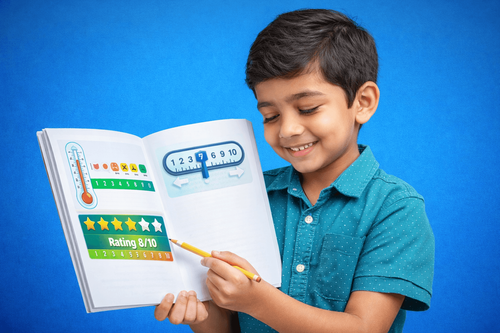

Have you ever seen a rating like “4 out of 5 stars” or “7/10” and wondered what it means? That’s because someone used a numerical scale! Numerical scales are useful tools to measure, compare, and describe things using numbers. In this blog, we will explore what a numerical scale is, how numerical rating scales work, and many easy examples all in simple language for kids to understand. By the end, you’ll know how numerical scales help us describe feelings, scores, size, ratings, and so much more!
What Is a Numerical Scale?
A numerical scale is a way to represent things using numbers in order. The numbers usually show a progression like how big or small something is, how much it is, or how someone feels about it. Unlike words like “good” or “okay,” a numerical scale uses numbers so everyone can compare easily.
For example:
- A score of 8/10 means something is good.
- Temperature can be shown on a scale from 10 to 40.
- On a fun rating card, a smiley face with 5 stars is better than one with 2 stars.
- Numerical scales help make things measurable and understandable.
Why Do We Use Numerical Scales?
Numerical scales help us:
- Compare things (like which game is more fun)
- Show feelings (how much you liked your lunch)
- Measure size or value (height, temperature, scores)
- Make choices easier (picking your favorite toy)
Numbers tell a clear story that everyone can understand. Instead of saying “I liked it a lot,” a kid might choose 9 out of 10 on a numerical scale. This makes it easy for others to know exactly what they mean.
Numerical Rating Scale: What Does It Mean?
A numerical rating scale is a special type of numerical scale used to show preferences or opinions. It’s often used in:
- Games (like scoring)
- Class surveys
- Movie reviews
- Feedback on apps or toys
A rating scale might ask:
- “Rate how much you liked this cartoon from 1 to 5.”
- “Choose a number from 1 to 10 to show how much fun the activity was.”
Numbers on the scale help compare opinions easily. For example, 10 means you liked it a lot, while 1 means you didn’t like it much.
Start learning numbers the smart way. Join PlanetSpark today.
Numerical Scale Examples - Kid Friendly!
Here are some fun examples you might see every day:
1. Fun in School
“How much did you enjoy art class today?”
Choose a number from 1 to 5, where
1 = “Not fun” and 5 = “Super fun!”
2. Game Score
Your video game shows 7/10 stars. That means you did great, better than average!
3. Temperature
We use a scale like –10°C to 40°C to show how cold or hot the weather is.
4. Pizza Rating
You might say your pizza was 9 out of 10 yummyness!
Each example uses a numerical scale to show how much or how well something is.
Different Types of Numerical Scales
Numerical scales can be used for many purposes. Here are a few common types:
Rating Scales
Used for feelings, reviews, or opinions.
Example: Rate your favorite cartoon from 1–5.
Measurement Scales
Used for size, height, distance, weight, or temperature.
Example: A ruler uses scales to show length.
Score Scales
Used in games, tests, and sports.
Example: Getting 8/10 on a quiz.
Each type uses numbers to show progress or comparison.
How Kids Can Use Numerical Scales at Home
Kids can use numerical scales to:
- Rate their favorite games
- Measure score improvements
- Compare favorite snacks
- Track progress in reading or running
For example:
“On a scale of 1–5, how much do you like chocolate ice cream?”
This helps kids think, compare, and communicate clearly.
Using numerical scales also improves critical thinking. Kids start asking, “Why did I choose 8 instead of 9?” and learn to explain their reasoning.
Numerical Scales and Thinking Skills
Numerical scales are great for building thinking skills because they make kids:
- Pay attention to differences
- Notice how things change
- Compare values logically
- Express opinions with numbers
These are skills that help not just in math, but also in communication, games, feedback, and decision-making in life.
Turn everyday numbers into powerful thinking tools. Enroll now.
Favorite Games & Ratings. A Fun Numerical Scale Activity
Do a quick game at home:
Ask your child to rate the following on a scale from 1 to 5:
- Favorite snacks
- Favorite cartoons
- Favorite games
- Favorite books
After rating, ask why they chose a number.
This helps them think and explain, not just pick numbers randomly.
Activities like this enhance reasoning and communication.
Numerical Scales vs Non-Numerical Scales
Sometimes we use words instead of numbers to describe feelings:
- “I liked that a little.”
- “That was the best!”
But numerical scales help express this in a way everyone can compare:
- “I liked it 4 out of 5.”
Non-numerical scales can be vague. Numbers tell a clearer story.
Numerical Scale in Surveys - Simple for Kids to Try
You can create a little survey:
- Rate lunchtime from 1–5
- Rate playtime from 1–10
Ask friends or classmates and see what numbers they pick! This is a fun way to collect opinions using numerical scales.
Surveys like this teach kids how numbers help represent many opinions.
What Happens When Numbers Change on a Scale?
When a number increases on a scale, the idea usually becomes stronger, like more fun, more tasty, more exciting. When a number decreases, it becomes weaker.
For example:
- Rating of 4 means “very nice”
- Rating of 2 means “not so great”
Understanding this helps kids know how numbers reflect feelings or value.
Numerical Scale Concepts for Future Learning
Once kids master numerical scales, they are ready for:
- Graphs
- Charts
- Data comparison
- Percentages
- Ratings in apps and media
Numerical scales are stepping stones for bigger ideas in math and science.
Fun Numerical Scale Worksheets for Kids
Here are some topics kids can try with numerical scales:
- How happy are you today? (1–5)
- How do you rate your breakfast? (1–10)
- How was PE class? (1–5)
- How much are you learning at PlanetSpark? (10–10!)
Worksheets like these make numbers fun and personal.
Make learning numerical scales fun and meaningful. Get started now.
How Numerical Scales Help Kids Make Better Decisions
Numerical scales are not just about numbers, they help kids make choices. When children learn to rate things using numbers, they begin to think more clearly about their preferences. For example, instead of saying “I like drawing,” a child might say “I like drawing 8 out of 10.” This shows how strong their liking is.
Using numerical scales helps kids:
- Compare options before choosing
- Explain their decisions better
- Think logically instead of guessing
This decision-making skill is useful in school, games, friendships, and daily routines.
Using Numerical Scales to Track Progress
Numerical scales are excellent tools for tracking improvement. Kids can use them to see how they are getting better over time.
Examples:
- Reading confidence today: 6/10, after one month: 8/10
- Sports performance last week: 5/10, this week: 7/10
- Speaking confidence before a class activity: 4/10, after practice: 9/10
Seeing progress on a numerical scale motivates kids and builds confidence. It also teaches them that improvement happens step by step.
Numerical Scale Meaning Explained with Real-Life Situations
The meaning of a numerical scale becomes clearer when kids connect it with daily life.
Imagine these situations:
- A pain scale at the doctor's from 1 to 10
- A happiness scale after a school picnic
- A weather scale showing how hot or cold the day is
- A classroom feedback chart with numbers
In all these cases, numbers replace long explanations. One number can quickly show how someone feels or what they think.
Numerical Scales and Emotions
Numerical scales are very useful for understanding emotions, especially for kids who find it hard to explain feelings using words.
For example:
- “How happy are you today?” → 7/10
- “How nervous do you feel before the test?” → 3/10
- “How excited are you for your birthday?” → 10/10
Using numbers helps kids recognize emotions, express them clearly, and talk about them confidently. This improves emotional intelligence along with number skills.
Transform numbers into real-life skills. Enroll with PlanetSpark now.
Learning Numerical Scales Through Games and Activities
Games make learning numerical scales fun and memorable.
Some simple activities:
- Rating favorite cartoons after watching them
- Scoring board games or team games
- Giving points for creativity or teamwork
- Creating a “Fun Meter” at home or school
When kids use numerical scales while playing, they naturally understand how numbers represent value, effort, and enjoyment.
Numerical Scale for Kids in Classroom Learning
Teachers often use numerical scales to understand how students are learning.
Examples include:
- Confidence scale before a lesson
- Understanding scale after a topic
- Interest scale for different subjects
These scales help teachers adjust teaching methods and help kids feel involved in their own learning process.
Why Numerical Scales Are Important for Future Skills
Learning numerical scales early prepares kids for advanced skills later in life. These include:
- Reading graphs and charts
- Understanding surveys and reports
- Giving structured feedback
- Analyzing information logically
Numerical scales are the foundation for data interpretation, problem-solving, and analytical thinking.
Support your child’s learning journey with expert guidance. Join now.
Common Mistakes Kids Make While Using Numerical Scales
Sometimes kids choose numbers randomly without thinking. This is a normal part of learning.
Common mistakes include:
- Picking the highest number every time
- Not understanding what each number represents
- Changing ratings without reason
With guidance and practice, kids learn to justify their choices, which improves reasoning skills.
How Parents Can Encourage Numerical Scale Thinking
Parents can help kids practice numerical scales at home easily.
Simple ways include:
- Asking kids to rate their day
- Using scales for bedtime routines
- Letting kids score family games
- Tracking habits like reading or exercise
These small habits make numbers meaningful and useful in daily life.
Numerical Rating Scale vs Yes/No Questions
Yes/No questions give limited answers, but numerical rating scales give more information.
Example:
- “Did you like the story?” → Yes
- “How much did you like the story (1–10)?” → 9
The second answer tells much more. This teaches kids to think deeper and express opinions clearly.
Help your child explain ideas clearly using numbers. Start today.
How PlanetSpark Helps Kids Understand Numerical Scales
PlanetSpark focuses on teaching kids how to think, not just what to calculate. Through interactive learning, kids understand how numerical scales work in real life.
The key USPs of PlanetSpark’s maths course include:
- Live interactive sessions led by experienced educators who introduce mental-calculation shortcuts (including Vedic maths tricks) and connect them directly to NCERT/CBSE exam problems.
- Customised practise modules focusing on arithmetic operations, algebraic expressions, quadratic equations, and roots, so students apply the tricks within actual syllabus-aligned questions.
- Performance analytics & error-tracking tools that identify recurring calculation mistakes, helping students focus on improving speed and accuracy.
- Dedicated doubt-resolution and revision-boosters, which means that if any student is lagging on applying the tricks, the mentor provides targeted support and extra practise.
- Board-exam simulators with time-bound mock tests, where students learn to use tricks under realistic exam conditions, building confidence and speed.
Key Takeaway
Numerical scales help us use numbers to show how much, how good, or how strong something is. From games to reviews, weather to school ratings, numerical scales help make data understandable and comparable. Learning numerical scales builds thinking skills, confidence, and number sense qualities every child needs in school and life.
Numerical scales are not just math tools, they are a way of thinking.
Unlock smarter learning through interactive math concepts. Sign up now.
Frequently Asked Questions
A numerical scale is a way to use numbers to measure, compare, or rate things. It helps us understand how big, small, high, or low something is. Numerical scales are used in marks, temperature, ratings, and distances. They make information easier to read and compare. Kids use numerical scales in both math and daily life.
Numerical scales help kids understand numbers beyond counting. They teach comparison, order, and value. This skill improves logical thinking and decision-making. It also prepares children for advanced math and real-world problem-solving. Understanding scales builds confidence with numbers.
Common examples include exam marks out of 100, temperature scales like Celsius, and rating scales from 1 to 5. Speedometers, rulers, and scoreboards also use numerical scales. These examples show how numbers represent real values. Kids see numerical scales everywhere in daily life.
A numerical rating scale uses numbers to show opinions or levels, such as happiness, difficulty, or quality. For example, rating a movie from 1 to 5. It helps express thoughts clearly using numbers. Kids often use rating scales in surveys and classroom activities. This improves communication skills.
Counting tells how many items there are, but a numerical scale shows position, comparison, or measurement. Scales include spacing and order between numbers. They help understand differences between values. This makes numerical scales more useful than counting alone. Kids learn deeper number meaning through scales.
Kids use numerical scales in school grades, test scores, and sports points. They see scales on thermometers, clocks, and measuring tapes. Even height charts and progress levels use numerical scales. These experiences help kids connect math to real situations. Learning becomes more practical and relatable.
Numerical scales help kids compare values and notice patterns. They encourage logical reasoning and analysis. Children learn to interpret data instead of memorizing numbers. This builds problem-solving skills. It also strengthens math and critical thinking abilities.
No, numerical scales are used in many subjects beyond math. Science uses scales for temperature and measurement. Social studies and surveys use rating scales. Even daily decisions like judging effort or performance use scales. Learning this concept helps across subjects.
Using real-life examples makes numerical scales easy to understand. Visual tools like charts, rulers, and number lines help a lot. Simple comparisons such as “more” or “less” build clarity. Interactive activities also improve understanding. Practice helps kids feel confident.
PlanetSpark explains numerical scales using simple language and relatable examples. Lessons focus on understanding rather than rote calculation. Kids learn through guided practice and real-world connections. This approach builds clarity and confidence. It helps children think logically and express ideas better.