
NCERT Class 10 Linear Equations in Two Variables


Table of Contents
- What is a Pair of Linear Equations in Two Variables?
- Real-Life Situations Represented by Pair of Linear Equations
- Graphical Method of Solving a Pair of Linear Equations
- Types of Solutions in Graphical Method
- Example of Graphical Method (Step-by-Step)
- Algebraic Methods to Solve Pair of Linear Equations
- Substitution Method
- Elimination Method
- Important Conditions for Pair of Linear Equations
- Category-Wise Practice Questions
- Common Mistakes Students Make
- Tips to Master Pair of Linear Equations
- How PlanetSpark Helps Students Learn Maths Better
- Building Strong Concepts in Pair of Linear Equations
Imagine you buy notebooks and pens from a shop, and the total cost depends on how many of each you purchase. To find the exact price of each item, you need to work with two unknown values. Situations like these can be solved using a pair of linear equations in two variables. In this chapter, students learn how to represent such problems mathematically and solve them using graphical and algebraic methods. In this article, we will explain the concepts, methods, solved examples, and practice questions to help Class 10 students understand the topic easily.
What is a Pair of Linear Equations in Two Variables?
Definition
A linear equation in two variables is an equation that contains two variables and each variable has the highest power of 1. Such equations represent straight lines when plotted on a graph.
The general form of a linear equation in two variables is:
ax + by + c = 0
Here:
- a and b are called the coefficients of the variables. These are real numbers that multiply the variables.
- c is the constant term.
- x and y are the variables whose values we need to determine.
For example:
2x + 3y = 6
This equation has two variables (x and y) and represents a straight line when graphed.
A linear equation in two variables can have infinitely many solutions because many pairs of values of x and y can satisfy the equation.
What is a Pair of Linear Equations?
A pair of linear equations in two variables consists of two linear equations involving the same variables.
Example:
Equation 1
x + 2y = 6
Equation 2
2x – y = 3
In this case:
- There are two equations.
- Both equations contain the same variables (x and y).
- The goal is to find the values of x and y that satisfy both equations at the same time.
The pair of equations is usually written in the form:
a₁x + b₁y + c₁ = 0
a₂x + b₂y + c₂ = 0
Solving these equations helps us find a common solution, which means the values of x and y that satisfy both equations simultaneously.

Real-Life Situations Represented by Pair of Linear Equations
Many real-life problems involve two unknown quantities. To find these unknown values, we can represent the situation using a pair of linear equations.
Let us understand this with examples.
Example 1: Fair Ride Example
Suppose a girl goes to a fair and spends money on two activities: rides and hoopla games.
Let:
x = number of rides
y = number of hoopla games
We are given the following information:
- The number of hoopla games is half the number of rides.
- Each ride costs ₹3 and each hoopla game costs ₹4.
- The total amount spent is ₹20.
From this information we can form two equations.
Equation 1
y = x / 2
Equation 2
3x + 4y = 20
Here, the real-life situation has been converted into two linear equations, which can be solved to find the values of x and y.
Example 2: Shopping Example
Suppose a student buys notebooks and pens from a shop.
Let:
x = cost of one notebook
y = cost of one pen
If:
5 notebooks and 2 pens cost ₹70
3 notebooks and 4 pens cost ₹60
Then we can form the equations:
5x + 2y = 70
3x + 4y = 60
By solving these equations, we can find the cost of each item.
Example 3: Age Problem
Age-related questions are also common examples.
Let:
x = age of a father
y = age of his son
Suppose:
Five years ago, the father's age was three times the son's age.
Equation:
x – 5 = 3(y – 5)
Another condition may give us a second equation. By solving both equations, we can determine the actual ages.
These examples show how real-life situations can be translated into mathematical equations and solved systematically.
Graphical Method of Solving a Pair of Linear Equations
One of the simplest ways to solve a pair of linear equations is the graphical method.
What is the Graphical Method?
In the graphical method:
- Each linear equation represents a straight line on a graph.
- When both equations are drawn on the same coordinate plane, the point where the lines intersect represents the solution.
That intersection point gives the values of x and y that satisfy both equations.
Steps to Solve Using the Graphical Method
Step 1
Rewrite the equation in a convenient form if required.
Step 2
Find two or more solution points for each equation.
Step 3
Plot these points on a coordinate graph.
Step 4
Join the points to draw a straight line for each equation.
Step 5
Identify the point where the two lines intersect. That point represents the solution of the pair of equations.
If the lines intersect at a point such as (3,2), it means:
x = 3
y = 2
Book Your Free Math Demo Class Today!
Types of Solutions in Graphical Method
When two linear equations are represented on a graph, three different situations can occur depending on how the lines are positioned.
Unique Solution (Intersecting Lines)
A unique solution occurs when the two lines intersect at exactly one point.
Condition:
a₁ / a₂ ≠ b₁ / b₂
Example:
x + 3y = 6
2x – 3y = 12
When these equations are plotted on a graph, the two lines intersect at a single point.
That point represents the unique solution, meaning there is only one pair of values (x, y) that satisfies both equations.
You May Also Read
Pythagoras Theorem for 10 Class: Formula, Tips & Exam Questions
Infinitely Many Solutions (Coincident Lines)
Sometimes both equations represent the same line on the graph.
Condition:
a₁ / a₂ = b₁ / b₂ = c₁ / c₂
Example:
2x + 3y – 9 = 0
4x + 6y – 18 = 0
If we observe carefully, the second equation is just twice the first equation. Therefore, both equations represent the same straight line.
Since every point on the line satisfies both equations, the pair of equations has infinitely many solutions.
No Solution (Parallel Lines)
In some cases, the two lines are parallel and never intersect.
Condition:
a₁ / a₂ = b₁ / b₂ ≠ c₁ / c₂
Example:
x + 2y – 4 = 0
2x + 4y – 12 = 0
When these equations are plotted on a graph, the lines remain parallel and never meet.
Since there is no common point, the pair of equations has no solution.
These three situations help students understand the relationship between equations and their graphical representation, which is an important concept in the chapter Pair of Linear Equations in Two Variables.
Example of Graphical Method (Step-by-Step)
Let us solve the following pair of linear equations using the graphical method:
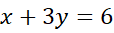
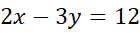
Step 1: Convert Each Equation into a Table of Values
Equation 1: 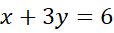
| x | y |
|---|---|
| 0 | 2 |
| 6 | 0 |
Equation 2: 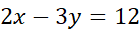
| x | y |
|---|---|
| 0 | -4 |
| 3 | -2 |
Step 2: Plot the Points on a Graph
Plot the points of both equations on a graph paper and draw straight lines passing through them.
Step 3: Find the Point of Intersection
The point where both lines intersect represents the solution of the pair of linear equations.
Explanation:
If the two lines intersect at a single point, that point satisfies both equations simultaneously.

Algebraic Methods to Solve Pair of Linear Equations
While the graphical method helps us understand the solution visually, it is not always practical.
Sometimes:
- The coordinates may involve fractions
- The values may be large numbers
- The intersection may lie between decimal points, making it difficult to read accurately.
Because of these limitations, mathematicians use algebraic methods to solve pairs of linear equations.
The two most common algebraic methods are:
- Substitution Method
- Elimination Method
These methods give exact solutions without drawing graphs.
Substitution Method
The substitution method involves expressing one variable in terms of the other and substituting it into the second equation.
Steps of the Substitution Method
Step 1:
Find the value of one variable from one equation.
Step 2:
Substitute that value into the second equation.
Step 3:
Solve the resulting equation to find the value of one variable.
Step 4:
Substitute this value back into the first equation to find the second variable.
Example (Solved)
Solve:
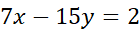
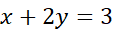
Step 1: Express  from the second equation
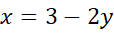
Step 2: Substitute in the first equation

Step 3: Solve

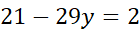
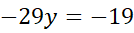

Step 4: Substitute the value of 
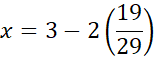

Final Solution
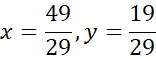
Word Problem Example (Age Problem)
Suppose a father and daughter have the following relationship between their ages.
Let:
 = father’s age
  = daughter’s age
Equation 1

Equation 2

These equations can be solved using the substitution method by expressing one variable in terms of the other and substituting it into the second equation.
Start Your Free Math Demo Class Now
Elimination Method
The elimination method works by removing one variable from the equations.
This is done by:
- Multiplying equations
- Making coefficients of one variable equal
- Adding or subtracting the equations
Once one variable is eliminated, the remaining variable can be easily solved.
Steps of Elimination Method
- Multiply the equations if necessary.
- Make the coefficients of one variable the same.
- Add or subtract the equations to eliminate that variable.
- Solve the remaining variable.
- Substitute the value back to find the other variable.
Example (Solved)
Solve:


Step 1: Make coefficients of  equal
equal
Multiply:
First equation by 3

Second equation by 4

Step 2: Subtract the equations


Step 3: Substitute the value of 
Substitute in any original equation to find  .
.

Example: Digit Problem
Let:
 = tens digit
  = units digit
Given:
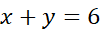
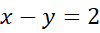
Add the equations:


Substitute in the first equation:
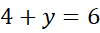

Number Formed

Important Conditions for Pair of Linear Equations
The general form of two linear equations is:


The number of solutions depends on the ratio of coefficients.
Case 1: One Solution (Intersecting Lines)

The two lines intersect at one point, giving one unique solution.
Try a Free Math Demo Class with Expert Teachers
Case 2: No Solution (Parallel Lines)
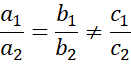
The lines are parallel and never intersect, so there is no solution.
Case 3: Infinite Solutions (Coincident Lines)
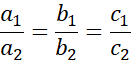
Both equations represent the same line, so there are infinitely many solutions.
Category-Wise Practice Questions
Practicing different types of questions helps students build a strong understanding of pair of linear equations in two variables. The following questions are divided into categories so that students can practice concepts, graphical methods, algebraic methods, and word problems effectively.
Concept-Based Questions
- What is a pair of linear equations in two variables?
- Write the general form of a pair of linear equations.
- Define a consistent pair of linear equations.
- Define an inconsistent pair of linear equations.
- What is a dependent pair of linear equations?
- What does the point of intersection of two lines represent in a graphical solution?
- What condition represents parallel lines in a pair of linear equations?
- What condition represents coincident lines?
- What do you mean by unique solution?
- How can we determine the number of solutions using the ratios of coefficients?
Also Read
Arithmetic Progression Formula Explained For Class 10 Students
Graphical Method Practice
Solve the following pairs of linear equations using the graphical method.
x + y = 4
x – y = 2
2x + y = 6
x + 3y = 6
x + 2y = 6
x – y = 3
2x + y = 5
x + y = 4
x + y = 8
x – y = 0
2x + 3y = 12
x + y = 5
x – y = 1
x + y = 7
x + 2y = 10
2x – y = 1
x + y = 5
2x + y = 7
3x + y = 9
x + y = 5
Book Your Free Math Class Today!
Substitution Method Practice
Solve the following equations using the substitution method.
x + y = 10
x – y = 4
3x – y = 5
x + y = 7
2x + y = 9
x – y = 1
x + 2y = 8
x – y = 2
3x + y = 11
x + y = 5
x + y = 6
2x – y = 3
2x + y = 7
x + y = 5
x + 3y = 13
x – y = 1
2x – y = 5
x + y = 9
x + y = 12
2x – y = 3
Elimination Method Practice
Solve the following equations using the elimination method.
2x + 3y = 11
2x – 4y = –24
3x + 4y = 10
2x – 2y = 2
4x + 3y = 19
2x + 3y = 11
3x + 2y = 13
2x + 2y = 10
5x + 2y = 14
3x + 2y = 10
4x + y = 13
2x + y = 7
3x + 5y = 21
3x – 2y = 6
2x + 3y = 13
4x + 3y = 19
5x + 3y = 16
2x + 3y = 7
4x + 2y = 12
3x + 2y = 10
Schedule Your Free Math Demo Class Now
Word Problems
Solve the following real-life problems by forming pairs of linear equations.
- Cost of Pencil and Pen Problem
The cost of a pen and a pencil together is ₹30. The pen costs ₹10 more than the pencil. Find the cost of each. - Taxi Fare Problem
A taxi charges ₹50 as base fare and ₹10 per kilometre. Another taxi charges ₹30 as base fare and ₹15 per kilometre. For how many kilometres will both fares be the same? - Age Problem
The sum of the ages of a father and son is 50 years. The father is 20 years older than the son. Find their ages. - Number Digit Problem
The sum of the digits of a two-digit number is 9. The number obtained by reversing the digits is 27 more than the original number. Find the number. - Library Charges Problem
A library charges ₹5 for the first day and ₹3 for each additional day. Another library charges ₹2 per day but requires a membership fee of ₹12. After how many days will both charges be equal? - The sum of two numbers is 15 and their difference is 3. Find the numbers.
- Two numbers differ by 8 and their sum is 24. Find the numbers.
- The sum of two numbers is 18 and one number is twice the other. Find the numbers.
- The sum of the digits of a number is 10 and the difference is 2. Find the digits.
- A shopkeeper sells two types of notebooks whose total cost is ₹120. One type costs ₹10 more than the other. Find the cost of each notebook.
Common Mistakes Students Make
While solving pairs of linear equations, students often make the following mistakes:
- Incorrect substitution when replacing variables in equations
- Sign mistakes while adding or subtracting equations
- Plotting wrong points while drawing graphs
- Misunderstanding coefficient ratios in solution conditions
- Forgetting to substitute back to find the second variable
Avoiding these mistakes can significantly improve accuracy in exams.
Tips to Master Pair of Linear Equations
Here are some simple tips that can help students solve these problems more effectively:
- Understand the concept first before attempting questions
- Practice different types of word problems regularly
- Use elimination method when coefficients are easy to match
- Always verify your solution in both equations
- Practice plotting graphs to understand solutions visually
Consistent practice will help students build both speed and accuracy.
How PlanetSpark Helps Students Learn Maths Better
Learning mathematics becomes easier when students receive the right guidance and structured practice. Platforms like PlanetSpark help students strengthen their concepts through engaging learning methods.
PlanetSpark supports students by providing:
- Interactive math learning sessions that make concepts easy to understand
- Personal mentorship from experienced educators
- Concept clarity through real-life examples and simplified explanations
- Strong problem-solving practice with guided exercises
- Confidence-building for exams through regular assessments
- A fun and engaging learning environment that keeps students motivated
This approach helps students develop strong analytical thinking and problem-solving skills.

Building Strong Concepts in Pair of Linear Equations
Pairs of linear equations in two variables are an important topic in Class 10 mathematics. Students learn different ways to solve them, including the graphical method, substitution method, and elimination method. While graphical solutions help visualize the intersection of lines, algebraic methods provide more accurate results.
Understanding when to use substitution or elimination can make problem-solving easier. With regular practice and clear conceptual understanding, students can confidently solve these equations and perform well in exams.
You May Also Find Useful
Linear Equations in Two Variables Class 10-Concept, Graphs, Tips
Frequently Asked Questions
PlanetSpark helps students understand pair of linear equations in two variables through interactive classes, step-by-step explanations, and real-life problem-solving practice.
Yes, PlanetSpark provides expert guidance, structured lessons, and practice exercises that help Class 10 students confidently master pair of linear equations in two variables.
Yes, PlanetSpark teachers explain both graphical and algebraic methods for solving pair of linear equations in two variables with easy examples and guided practice.
PlanetSpark makes learning pair of linear equations in two variables easier by breaking complex concepts into simple steps and helping students practice regularly.
PlanetSpark provides structured exercises, real-life examples, and expert feedback that help students improve their problem-solving skills in pair of linear equations.
Yes, PlanetSpark classes help students prepare for Class 10 maths exams by strengthening concepts like pair of linear equations through practice and concept clarity.
Students can join PlanetSpark’s interactive learning programs where expert teachers guide them step-by-step to master pair of linear equations in two variables.