
Permutations and Combinations Made Easy for Students

Last Updated At: 13 Apr 2026
11 min read
Table of Contents
- What Are Permutations and Combinations in Mathematics?
- Understanding Permutations with Simple Examples
- Understanding Combinations with Easy Examples
- Common Real-Life Uses of Permutations and Combinations
- Key Differences Between Permutations and Combinations
- How Permutations and Combinations Build Probability Skills a
- How PlanetSpark Helps Students Master Permutations and Combi
- Conclusion
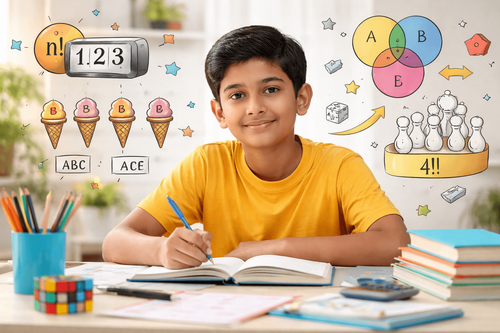
Permutations and combinations are key ideas in mathematics that help students understand counting in a logical way. They show how many arrangements or selections are possible in everyday situations such as seating, choosing teams, or organizing objects.
Students learn what permutations and combinations are and why order sometimes matters. Clear explanations and simple examples make these ideas easier to remember and apply in exams.
At PlanetSpark, learning focuses on clarity and confidence. Children practise explaining mathematical ideas aloud, receive guidance, and build strong thinking skills that help them master counting concepts with ease.
What Are Permutations and Combinations in Mathematics?
Permutations and combinations help students understand counting in an organised and logical way. These concepts explain how objects can be arranged or selected under different conditions.
Learning them lays a strong foundation for higher mathematics and helps students approach counting problems with clarity rather than confusion. This helps students count outcomes correctly by understanding whether order matters or only selection matters.
Examples:
Arranging three students in a line creates different results when the positions change
Choosing two colours from a box gives the same result regardless of order
Ranking winners depends on order, while selecting team members does not
Why Students Often Get Confused Between Them?
Students often feel confused because both ideas involve counting and may look similar at first. The main difference depends on whether order matters. When students do not check this carefully, they choose the wrong method and make mistakes. Learning to pause and think about the order helps reduce confusion and improve accuracy when solving questions.
Understanding Permutations with Simple Examples
Permutations focus on arranging items in different orders. Understanding this idea helps students see why order matters and how changing positions can lead to different results in counting problems.
What Is a Permutation? (Order Matters)
Permutation and combination concepts help students understand counting clearly. A permutation means arranging objects where order matters. When the positions of items change, the arrangement also changes. Even when the same objects are used, a different order gives a different result. This understanding helps learners recognise situations where arrangement-based counting is required.
Permutation Formula Explained Step by Step
Permutations are used when order matters (arrangement / sequence changes the answer).
Example: ABC and ACB are two different arrangements.
Step 1: Identify what you’re arranging
Ask: “Are positions changing?”
If yes → it’s a permutation.
Examples:
- Shoes on a rack → left-to-right order changes
- Friends on chairs → seat positions change
- Books on a table → arrangement changes
Step 2: Decide the “total” and the “chosen”
- n = total items available
- r = items you are placing / selecting
Example: 8 friends are there, but only 3 chairs → n = 8, r = 3
Step 3: Use the basic “reducing choices” logic (the real meaning)
For arranging r items out of n, you reduce choices step by step:
- 1st place: n choices
- 2nd place: n − 1 choices
- 3rd place: n − 2 choices
- …
- rth place: n − (r − 1) choices
So the total ways become:

This is the step-by-step counting method students find easiest.
Permutations and combinations become easier when students understand logic rather than memorizing formulas. Learn how arrangements and selections work with practical examples that improve exam performance. Contact us today!
Step 4: Convert it into the permutation formula
That same multiplication is written as:

Why?
- n! means multiplying from n down to 1
- (n−r)! cancels the extra leftover part you don’t need
Example 1: Arranging shoes on a rack
Suppose you have 5 pairs of shoes and you want to place 3 shoes-pairs in a line.
- n = 5, r = 3
Step-by-step: - 1st spot: 5 choices
- 2nd spot: 4 choices
- 3rd spot: 3 choices
Total:

Formula check:

Example 2: Ordering books on a study table
You have 7 books, and you want to arrange all 7 in a row.
- n = 7, r = 7
Step-by-step:

So:

Understanding Combinations with Easy Examples
Combinations focus on selecting items without worrying about order. This idea helps students understand grouping situations clearly and recognise when the same selection remains unchanged. With this understanding, counting problems become simpler, clearer, and easier to approach confidently in mathematics.
What Is a Combination? (Order Does Not Matter)
A combination is used when order does NOT matter.
Only the selection is important, not the arrangement.
Example:
Choosing Apple and Banana is the same as choosing Banana and Apple.
So this is a combination, not a permutation.
Step 1: Understand the main idea
Ask yourself:
“If I change the order, does the answer stay the same?”
- If yes → Combination
- If no → Permutation
Combinations focus on grouping, not positioning.
Step 2: Identify n and r
- n = total items available
- r = items you are selecting
Example:
From 10 fruits, choose 3 →
n = 10, r = 3
PlanetSpark’s 1:1 expert coaching helps students understand concepts deeply. With proper guidance, structure answers logically, and explain solutions with confidence and ensure long-term learning success. Start Learning with PlanetSpark today!
Step 3: Combination Formula
The formula for combinations is:

This formula removes all the repeated arrangements that look different but mean the same group.
Why do we divide by r! ?
Because in combinations, the same items can be arranged in many ways, but they should be counted only once.
Example:
Selecting A, B, C
All these are the same group:
- ABC
- ACB
- BAC
- BCA
- CAB
- CBA
That is 3! = 6 ways, but they all represent the same combination.
So we divide by r! to remove repetition.

Common Real-Life Uses of Permutations and Combinations
Counting ideas appear in many everyday situations, such as arranging objects or selecting groups. Understanding where permutations and combinations are used in what area helps students relate maths to real life, making counting concepts easier to remember and apply confidently in different problems.
Using Counting in Daily Arrangements
Counting helps when items are placed in different positions, and each change creates a new result. Understanding this helps students recognise arrangement-based situations and apply the correct method while solving counting problems confidently.
Examples:
- Arranging books in different orders on a shelf
- Seating family members on a sofa
- Placing trophies in different positions
Using Counting While Selecting Groups
Counting is also useful when choosing items or people without caring about order. In such cases, the same group is counted once. This understanding helps students avoid repeated counting and solve selection-based questions correctly.
Examples:
- Choosing players for a school team
- Selecting fruits for a lunch box
- Picking students for a group activity
A clear grasp of permutations and combinations helps students avoid confusion and common mistakes in probability. Know how we help your kid learn counting questions, making problem-solving faster and more reliable. Talk to our experts!
Using Counting in Games, Sports, and Activities
Many games and activities involve counting choices or positions. Recognising whether order or selection matters helps students apply counting methods correctly and understand how these concepts appear naturally in everyday activities.
Examples:
- Deciding winners in a race
- Forming teams during sports day
- Choosing turns while playing a board game
Key Differences Between Permutations and Combinations
Although permutations and combinations both involve counting, they are used in different situations. Knowing how they differ helps students select the correct method and solve questions more accurately.
| Basis of Comparison | Permutations | Combinations |
|---|---|---|
| Meaning | Permutations are used for arranging items in a specific order. | Combinations are used for selecting items as a group. |
| Purpose of Counting | Used when the goal is to place items into particular positions. | Used when the goal is only to choose items, not arrange them. |
| Order of Items | Order matters. Every different arrangement gives a new result. | Order does not matter. Different orders give the same result. |
| How Items Are Treated | Items are treated as positions, so changing places changes the answer. | Items are treated as a group, so changing order does not change the answer. |
| Example Situation | Seating students on chairs. | Selecting students for a team. |
| Example | ABC and ACB are different. | ABC and ACB are the same. |
| Formula | ⁿPᵣ = n! / (n − r)! | ⁿCᵣ = n! / [r!(n − r)!] |
| Keywords in Questions | Arrange, order, rank, position, line, seating. | Choose, select, group, team, committee. |
| Real-Life Use | Timetable arrangement, race ranking. | Lottery selection, choosing subjects. |
| Common Mistake | Students forget that order matters. | Students count the same group multiple times. |
How Permutations and Combinations Build Probability Skills and Stronger Thinking?
Permutations and combinations are the backbone of probability, because probability always starts with counting outcomes. When students learn how to count correctly (whether order matters or not), they stop guessing and start solving questions step by step. This also sharpens thinking skills because students learn to analyse a situation, break it into parts, and choose the right method before calculating.
Proper Examples (Easy + Exam Style)
Example 1: Selecting cards (Combination)
A student picks 2 cards from 5 cards.
Here, order does not matter (Card A then B is same as B then A), so we use combinations.
Total ways:

Now, probability questions become easier because you can say: Probability = favourable outcomes / total outcomes, and total outcomes came from combinations.
Example 2: Arranging students for a photo (Permutation)
If 4 students are standing in a line for a photo, order matters because positions change the photo.
Total arrangements:

Now, if the question asks, “What is the probability that a specific student stands first?”
You can count favourable cases and divide by 24.
This comparison teaches students the most important habit in maths: first understand the situation, then decide the method.
✅ Result: Students think more logically, reduce mistakes in probability, and build calm, step-by-step reasoning that helps in advanced maths and other subjects too.
Build a strong understanding of permutations and combinations through clear explanations and step-by-step examples. When concepts are simple, students solve counting problems accurately and with confidence. Enroll now!
How PlanetSpark Helps Students Master Permutations and Combinations Confidently?
Learning permutations and combinations becomes far more effective when students not only solve problems but also understand the logic behind each step. PlanetSpark helps learners build this strong foundation by focusing on concept clarity, structured problem-solving, and confident communication.
Through interactive sessions and guided practice, students learn how to break down complex counting problems into simple steps, identify whether order matters, and apply the correct formulas without confusion.
This supportive learning environment encourages students to think logically, ask questions freely, and explain their reasoning clearly, which builds long-term confidence and prepares them for advanced topics in mathematics and probability.
Explanation-Based Learning for Concept Clarity
At PlanetSpark, students learn permutation and combination by explaining ideas in their own words. This explanation-based learning helps students identify gaps in understanding, strengthens clarity, and makes abstract counting ideas easier to remember.
1:1 Coaching to Break Down Formulas with Examples
PlanetSpark provides one-to-one coaching where trainers adjust teaching to each child’s pace. This personalised approach allows children to ask questions freely, understand each step clearly, and gain confidence while solving problems without feeling rushed.
Structured Thinking and Answer Explanation Practice
Students are trained to structure their answers logically. This habit improves written answers, reduces mistakes, and helps children stay calm and confident while attempting word problems in exams.
Real-Time Feedback to Improve Accuracy and Confidence
PlanetSpark uses live feedback and AI-supported tools to guide students. This support helps children understand mistakes early, improve accuracy, and gain confidence as they apply counting concepts across different maths questions.
At PlanetSpark, students don’t just learn formulas; they explain concepts confidently. Through guided practice and structured thinking, learners gain clarity on topics such as permutations and combinations while strengthening their academic communication. Book a Free 1:1 Demo Class!
Conclusion
Permutations and combinations help students understand counting with clarity and logic. With regular practice and clear examples, these concepts become easier to apply in exams and everyday problem-solving.
PlanetSpark supports learning through guided explanation and confidence-building. With personalised guidance from PlanetSpark, children understand concepts deeply and express solutions clearly.
Frequently Asked Questions
In permutations, the order of selection matters. In combinations, the order does not matter, only the selection does.
In situations where order changes the result, students should use permutations. Here, different positions lead to different outcomes, even with the same items. Because ranking or arranging depends on order, permutation methods are the correct choice in such questions.
Probability problems begin by counting possible outcomes. Permutation and combination formulas help students find how many outcomes exist before calculating probability. With this understanding, probability questions become clearer, easier to solve, and more accurate.
PlanetSpark helps students understand maths concepts through clear explanations, step-by-step guidance, and personalised one-to-one support. Regular feedback and practice help students build clarity, confidence, and strong problem-solving skills.
Students can avoid mistakes by reading questions carefully, checking whether order matters, and solving step by step without rushing. Writing steps clearly helps prevent confusion. Regular practice also improves accuracy and confidence in counting problems.
Yes, PlanetSpark improves exam performance by building clear understanding, structured thinking, and confidence through personalised guidance and regular practice.