
Probability Learning for Kids to Boost Maths Ability
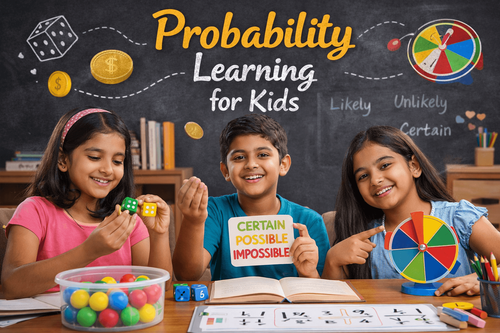

Table of Contents
- What Is Probability?
- Why Probability Is Important for Maths Learning
- Understanding Key Probability Ideas
- Learning Probability Through Dice
- Probability Using Cards
- Probability in Real Life Situations
- Building Foundations for Aptitude-Based Learning
- Using Worksheets to Strengthen Probability Skills
- Common Mistakes Beginners Make Solving Probability Questions
- Everyday Examples to Understand Probability Better
- Learning Probability Through Dice Experiments
- Exploring Probability Using Cards
- Probability and Fractions: A Strong Connection
- Using Worksheets to Build Strong Foundations
- Probability in School Curriculum and Exams
- Common Challenges Students Face While Learning Probability
- Using Digital Tools to Supplement Learning
- Signs That Students Are Improving in Probability
- Conclusion
Mathematics becomes more meaningful for children when they can relate it to real-life situations. One such topic that connects maths with everyday thinking is probability. In simple terms, probability helps children understand how likely or unlikely something is to happen. From guessing the weather to predicting game outcomes, probability is always around us.
Learning probability basics at an early stage builds strong logical and reasoning skills. Instead of memorising formulas, children learn to observe situations, think critically, and make decisions based on chances. This article explains probability concepts in a clear and gradual manner so that students can develop confidence and enjoy learning maths.
What Is Probability?
Probability is the measure of how likely an event is to occur. When children learn probability basics for beginners, they are introduced to the idea of chance. For example, will it rain today? Will a tossed coin land on heads or tails? These everyday questions involve probability.
Probability is not about guessing blindly. It is about understanding possible outcomes and comparing them logically. When children start looking at outcomes instead of random guesses, maths begins to make more sense.
To understand probability with example, imagine a bag with two red balls and one blue ball. If a child picks one ball without looking, they are more likely to pick a red ball. This simple observation teaches probability without using any complex numbers.
Why Probability Is Important for Maths Learning
Learning probability helps children move beyond basic arithmetic. It introduces logical thinking, pattern recognition, and analytical reasoning. When students study probability basics concepts, they also strengthen their understanding of fractions, ratios, and data handling.
Probability helps children learn how to justify answers. Instead of saying “I think this will happen,” they learn to explain why it is more likely. This habit improves problem-solving skills across all areas of maths.
Later, probability becomes useful in subjects like statistics, science, economics, and aptitude-based exams. Early exposure helps children feel comfortable with advanced topics later on.
Give your child the confidence to understand maths with clarity.
Book a free PlanetSpark demo class today and see how personalised coaching makes probability and logical thinking easier.
Understanding Key Probability Ideas
Before solving questions, children must be comfortable with core ideas of probability.
Events and Outcomes
An event is something that can happen, while an outcome is the result of that event. For example, tossing a coin is an event. Getting heads is an outcome. When learning probability basics with examples, children first focus on identifying outcomes correctly.
If a dice is rolled, the event remains the same, but the outcomes can be any number from 1 to 6. Understanding this difference is important before moving to calculations.
Certain, Possible, and Impossible Events
Some events are guaranteed to happen, some may or may not happen, and some cannot happen at all. For example, the sun rising tomorrow is a certain event. Getting a six while rolling a dice is possible. Rolling a seven on a standard dice is impossible.
These ideas are part of early probability basics notes and help children categorise events logically.
Learning Probability Through Dice
Dice are one of the easiest tools to teach probability. When children learn probability with dice, they can physically see outcomes instead of imagining them.
A dice has six faces, each numbered from 1 to 6. Each number has an equal chance of appearing. If a child is asked, “What is the chance of getting a 3?” they learn that all numbers have the same likelihood.
Using dice repeatedly also shows that probability does not guarantee outcomes. Even if a child rolls the dice many times without getting a 6, it does not mean a 6 is “due” next time. This clears common misconceptions.
Probability Using Cards
Cards are another effective way to explain chance and outcomes. While learning cards probability basics, children observe colours, numbers, and symbols.
For example, in a deck of cards, there are red and black cards. If a card is picked randomly, children can compare the chance of getting a red card versus a black card. Since both appear equally, chances are the same.
Card-based learning also introduces variety, making lessons more engaging and interactive, especially for visual learners.
Probability in Real Life Situations
Probability is not limited to classrooms. Everyday decisions involve predicting outcomes. Children use probability when they decide which route may be faster or which team might win a game.
When students understand probability with example drawn from daily life, maths feels less abstract. Teachers and parents can encourage children to explain their predictions instead of just stating answers.
This habit prepares children for structured problem-solving later on.
Building Foundations for Aptitude-Based Learning
As children grow older, probability plays a significant role in competitive and aptitude-based exams. Learning probability basics for aptitude starts with simple reasoning and gradually moves to complex scenarios.
Aptitude questions often test how well students analyse situations rather than apply formulas. Students who understand probability concepts early find these questions easier and less intimidating.
Strong fundamentals also reduce mistakes caused by assumptions and guesswork.
Using Worksheets to Strengthen Probability Skills
Practice is essential to develop confidence. A well-designed probability basics worksheet allows children to apply what they have learned step by step.
Worksheets help students:
- Identify events and outcomes
- Compare likelihoods
- Apply concepts to word problems
When worksheets are used alongside explanations, learning becomes more effective and structured.
Parents can use worksheets as discussion tools instead of tests, helping children explain their reasoning aloud.
Help your child build strong reasoning and problem-solving skills.
Book a free PlanetSpark demo class and experience how guided learning simplifies probability concepts.
Common Mistakes Beginners Make Solving Probability Questions
When students start learning probability, small misunderstandings can lead to repeated errors in problem-solving. These mistakes usually come from guessing instead of logical reasoning or incomplete understanding of concepts. Knowing these common errors in advance helps beginners improve accuracy and approach probability questions with clarity and confidence.
Assuming Past Outcomes Affect Future Results
A very common mistake is believing that previous outcomes influence future ones. For example, if a dice shows low numbers several times, students may think a high number is “due” next. In reality, each roll is independent, and the chance remains the same every time.
Confusing Possibility With Probability
Beginners often mix up what is possible with what is likely. Just because an outcome can happen does not mean it has a high chance. For instance, drawing a specific card from a deck is possible, but the probability depends on how many such cards exist compared to the total.
Ignoring the Total Number of Outcomes
Some students focus only on favourable outcomes and forget to consider all possible outcomes. For example, while finding the probability of getting an even number on a dice, they may count only even numbers and forget to divide by the total six outcomes.
Making Assumptions Without Listing Outcomes
Another mistake is solving questions without first listing all outcomes. Writing down possible results helps avoid missed cases and calculation errors. This step is especially important in problems involving multiple events or combined situations.
Using Formulas Without Understanding the Concept
Many beginners try to memorise formulas instead of understanding why they work. This often leads to confusion when a question is slightly different from practice examples. Understanding the reasoning behind probability concepts helps students apply them correctly in any situation.
Everyday Examples to Understand Probability Better
Probability becomes much easier for students when it is connected to situations they see or experience daily. Real-life examples help remove fear and make abstract concepts more practical.
Using Daily Life Situations to Explain Probability
Children often make predictions without realising they are using probability. For instance, deciding whether they will reach school on time based on traffic, or guessing which flavour of ice cream might get finished first at home. These situations allow students to apply probability basics without formal calculations.
Talking through these situations helps students understand that probability is not guesswork but reasoning based on outcomes.
Weather and Probability Predictions
Weather forecasts often use terms like “high chance” or “low chance.” Discussing these predictions helps students understand uncertainty and likelihood. This discussion strengthens probability basics concepts by showing how probability is used outside textbooks.
Learning Probability Through Dice Experiments
Dice experiments are one of the most effective ways for students to learn probability practically.
Understanding Equal Chances Using Dice
When students explore probability with dice, they observe that each number from 1 to 6 appears with equal chance. Rolling a dice multiple times and recording results helps students visually understand fairness and randomness.
This activity clarifies that probability does not guarantee results but predicts likelihood over time.
Misconceptions Dice Experiments Help Correct
Students often believe that a number not appearing for a long time is “more likely” next. Dice experiments challenge this misconception by reinforcing that each roll is independent. This understanding is crucial for mastering probability basics for beginners.
Exploring Probability Using Cards
Cards add variety and deeper thinking to probability learning.
Understanding Outcomes With Card Selection
When children learn cards probability basics, they consider colours, suits, and numbers. For example, picking a red card from a deck teaches children how total outcomes affect probability.
This also encourages listing outcomes, an essential habit in solving probability problems.
Using Cards to Compare Probabilities
Card-based activities allow students to compare probabilities easily. For instance, comparing the chance of picking a heart versus picking a king builds analytical thinking and strengthens reasoning skills needed for advanced questions.
Probability and Fractions: A Strong Connection
Probability naturally leads students toward fraction-based thinking.
Seeing Probability as Parts of a Whole
When children learn that probability compares favourable outcomes to total outcomes, they begin to understand fractions intuitively. This connection supports long-term maths learning and improves conceptual clarity.
This approach is often emphasised in probability basics notes used in schools.
Improving Maths Confidence Through Logical Thinking
Students who understand probability through reasoning feel less pressure when dealing with numbers. This reduces math anxiety and improves overall academic confidence.
Using Worksheets to Build Strong Foundations
Structured practice plays an important role in mastering probability.
Why Worksheets Matter
A well-designed probability basics worksheet allows students to apply concepts gradually. Worksheets help students practise listing outcomes, calculating probabilities, and explaining answers logically.
Unlike rote practice, these worksheets encourage thinking rather than memorisation.
Using Worksheets for Discussion, Not Just Answers
Parents and teachers should encourage students to explain their thought process when solving worksheet problems. This method strengthens understanding and prevents careless mistakes.
Turn maths confusion into confident thinking for your child.
Book a free PlanetSpark demo class today and discover how PlanetSpark helps students master probability through personalised support.
Probability in School Curriculum and Exams
Probability is a recurring topic throughout school mathematics.
How Probability Appears in Exams
As students progress, probability questions become part of regular assessments and competitive exams. Early familiarity with probability basics for aptitude ensures students do not feel overwhelmed later.
Many aptitude questions rely more on logical reasoning than complex calculations.
Preparing for Higher-Level Questions
Strong fundamentals allow students to approach advanced topics like combined events and conditional probability with confidence. Students who understand basics early adapt more quickly.
Common Challenges Students Face While Learning Probability
Learning probability is not difficult, but it requires clarity and practice.
Confusing Randomness With Control
Some students believe they can “predict” probability outcomes based on patterns that don’t exist. Understanding randomness helps avoid such thinking errors and builds scientific reasoning.
Skipping Outcome Listing
Many students jump to answers without listing outcomes. Reinforcing this habit helps reduce mistakes and improves accuracy in probability problems
Using Digital Tools to Supplement Learning
Technology can be a powerful support in probability learning when it is used with clear purpose. Digital tools help students visualise outcomes, repeat experiments quickly, and observe patterns that may take a long time to notice through manual practice. However, these tools work best when combined with thinking and discussion, not passive tapping or guessing.
Interactive Games
Interactive simulations allow students to repeat probability experiments many times within seconds. For example, a digital dice simulator can roll a dice hundreds of times and display how often each number appears. This helps students clearly see that all outcomes tend to occur nearly equally over time, reinforcing the concept of fairness and randomness.
Similarly, card-drawing games help students understand how probability changes when cards are replaced or removed. These simulations remove boredom from repetition and allow students to focus on reasoning instead of calculations alone. When students predict results before running a simulation and then compare predictions with outcomes, learning becomes deeper and more meaningful.
Balancing Digital and Hands-On Learning
While digital tools are helpful, they should not replace hands-on activities completely. Physically rolling a dice, drawing cards from a deck, or tossing a coin allows students to experience randomness in a real-world setting. Writing outcomes in a notebook helps students slow down and think carefully about what is happening.
For example, after using a dice simulation online, students can roll an actual dice 20 times and record results. This balance strengthens understanding and improves long-term retention.
Signs That Students Are Improving in Probability
Progress in probability learning often happens gradually. Students may not show instant perfection, but clear signs appear as their understanding deepens. Recognising these signs helps parents and teachers support learning effectively.
Better Reasoning and Explanation
One of the strongest signs of improvement is when students begin explaining why an answer makes sense. Instead of guessing, they start talking about outcomes, chances, and comparisons. For example, instead of saying “I just guessed,” a student might say, “There are more red balls than blue ones, so red is more likely.”
Increased Confidence in Maths
As students become comfortable with probability, their confidence in maths improves overall. Probability teaches students that mistakes are part of learning and that outcomes are not always predictable. This reduces fear of being wrong and encourages problem-solving.
Students who gain confidence in probability often approach fractions, data handling, and word problems with less hesitation. They begin to see maths as something they can understand and explain, not just memorise.
How Does PlanetSpark Help in Learning Probability?
PlanetSpark helps students understand probability by breaking down concepts of chance, outcomes, and likelihood through personalised instruction and structured lessons. The platform makes probability easy to grasp by connecting maths concepts with real-life situations, helping students move beyond guessing and develop logical reasoning.
- Experienced mentors guide students to understand what probability means, how outcomes are identified, and why certain events are more or less likely. With individual attention, mentors identify each learner’s misconceptions—such as confusion about randomness or equal chances—and address them through clear explanations and targeted practice.
- Lessons follow a step-by-step learning flow: understanding basic probability ideas → identifying outcomes and events → practising through examples and experiments → applying concepts to word problems and real scenarios. This systematic approach builds strong foundations and removes fear around probability questions.
- Students work on activities like dice and coin experiments, card-based problems, everyday prediction tasks, and problem-solving exercises that require explanation, not just answers. These tasks help students visualise probability and apply logic confidently.
- Interactive simulations, quizzes, hands-on challenges, and guided problem sets make learning engaging and effective. With continuous feedback and encouragement, students begin using probability concepts naturally in maths problems, aptitude questions.
Conclusion
Probability is not just a maths topic—it is a life skill. When students understand chance, outcomes, and likelihood, they develop reasoning skills that extend beyond classrooms. Mastering probability basics through examples, practice, and discussion builds a strong foundation for advanced maths and aptitude-based learning.
With consistent support, engaging activities, and clear explanations, students can enjoy probability and use it confidently in academics and everyday decision-making. Support your child’s maths journey with PlanetSpark’s expert-led learning programs—book a free PlanetSpark demo class today and help your child build strong reasoning and problem-solving skills from an early age.
Frequently Asked Questions
Probability helps children understand how likely or unlikely an event is to happen. Learning it early builds logical thinking, improves decision-making, and helps children connect maths concepts with real-life situations like games, weather, and daily choices.
Probability is not difficult when taught step by step using simple examples. Activities like rolling dice, tossing coins, or picking cards make the concept easy and enjoyable for kids, helping them learn naturally without fear.
Probability strengthens skills such as reasoning, fractions, ratios, and data handling. When children practise explaining outcomes and chances, they develop problem-solving abilities that support many other areas of mathematics.
Children can begin learning basic probability concepts as early as preschool through simple ideas like certain, possible, and impossible events. As they grow older, these concepts gradually expand into more structured probability problems
Parents can use everyday situations, games, and simple questions like “What do you think will happen?” to encourage reasoning. Regular practice, positive discussions, and patience help children become confident and comfortable with probability over time.