
Learn Properties of 2D Shapes Step by Step | PlanetSpark
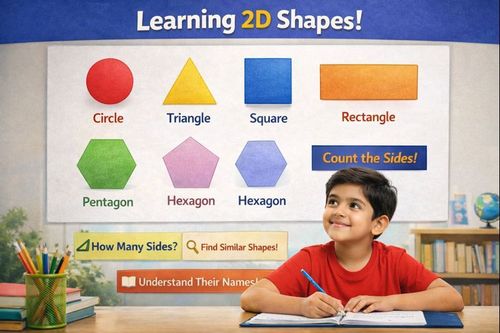

Table of Contents
Understanding shapes is one of the most important building blocks in early mathematics. Among these, 2D shapes form the foundation of geometry, measurement, and logical reasoning. Children encounter flat shapes every day in books, on screens, in classrooms, and in real-world objects. Learning the properties of 2D shapes helps students observe details, compare figures, and develop problem-solving skills. In this guide, we will explore the properties of two-dimensional shapes step-by-step. We will cover common shapes, their defining features, symmetry, perimeter, area, and real-life applications.

What Are 2D Shapes
2D shapes, also known as two-dimensional shapes, are flat figures that have only two dimensions: length and width. They do not have height or depth, which means they cannot be held like solid objects. These shapes can be drawn on paper and seen on flat surfaces.
Understanding basic 2d shape properties is essential because these shapes are used to explain more advanced mathematical ideas later. Each 2D shape is defined by its 2d shape attributes, such as the number of sides, corners, and angles.
Common Types of 2D Shapes
There are many types of 2D shapes, but some are introduced early because they are seen frequently in everyday life. These include squares, rectangles, triangles, and circles. Polygons such as pentagons, hexagons, and octagons are also important.
Each shape has unique 2d shapes characteristics that help students identify and differentiate them. Learning these shapes allows children to understand how the properties of 2D shapes change based on sides, angles, and symmetry.
Start Exploring 2D Shapes With Fun Activities.
Key Properties of 2D Shapes
The properties of 2D shapes describe what makes each shape unique. These properties include:
- Number of sides
- Number of vertices or corners
- Types of angles
- Length of sides
- Presence of curved or straight edges
Understanding these properties of two-dimensional shapes helps students classify shapes correctly and apply logic while solving geometry problems.
Shape-Wise Breakdown of Common 2D Shapes
Properties of a Square
A square is a regular quadrilateral and one of the most balanced 2D shapes.
Properties of a Rectangle
Rectangles share many 2d shape properties with squares, but differ in side equality.
Learning shapes is made so fun like never before!
Book a Free Demo Class to Master 2D Shapes With Expert Guidance!
Properties of a Triangle
Types of Triangles by Sides
- Equilateral triangle: All sides equal and all angles equal
- Isosceles triangle: Two sides are equal, and two angles are equal
- Scalene triangle: All sides and angles are different
Types of Triangles by Angles
- Acute triangle: All angles are less than 90 degrees
- Right-angled triangle: One angle is exactly 90 degrees
- Obtuse triangle: One angle is greater than 90 degrees
These classifications help students deeply understand 2d shape attributes and triangle behaviour.
Properties of a Circle
A circle is unique among properties of two-dimensional shapes because it has no angles.
From squares and triangles to perimeter and area, make learning 2D shapes engaging, structured, and concept-driven.
Start Your Child’s Learning Journey With PlanetSpark
How to Identify 2D Shapes
To identify 2D shapes, students should follow a clear process:
- Count the number of sides
- Observe whether the sides are equal or unequal
- Check the number and type of angles
- Look for curved or straight edges
This systematic approach strengthens understanding of 2d shape properties and improves accuracy.
Angles and Sides in 2D Shapes
Angles and sides define the structure of all properties of two-dimensional shapes. Angles are formed when two sides meet at a vertex. These angles can be acute, right, or obtuse.
Sides may be equal or unequal in length. Recognizing these 2d shape attributes helps children distinguish between similar shapes such as squares and rectangles.
Understanding Symmetry in 2D Shapes
Symmetry is an important part of 2d shapes' characteristics. A shape is symmetrical if it can be divided into two identical halves.
- Squares have 4 lines of symmetry
- Rectangles have 2 lines of symmetry
- Circles have infinite lines of symmetry
- Scalene triangles have no symmetry
Understanding symmetry improves visual reasoning and pattern recognition.

Perimeter and Area Basics for 2D Shapes
Perimeter and area are key measurements related to properties of 2D shapes.
Perimeter Examples
- Perimeter of a square = 4 × side
- If one side is 5 cm, perimeter = 20 cm
- Perimeter of a rectangle = 2 × (length + width)
- If the length is 8 cm and the width is 4 cm, perimeter = 24 cm
Area Examples
- Area of a square = side × side
- If the side is 6 cm, the area = 36 square cm
- Area of a rectangle = length × width
- If length is 7 cm and width is 3 cm, area = 21 square cm
These examples help students apply 2d shape properties practically.
Real-Life Examples of 2D Shapes
2D shapes appear everywhere around us, making them easy for children to recognize and understand. Some common real-life examples include:
- Rectangles: Windows, doors, books, blackboards, mobile screens
- Squares: Floor tiles, chessboards, sticky notes, handkerchiefs
- Circles: Wheels, clocks, coins, plates, buttons
- Triangles: Traffic warning signs, pizza slices, roof tops
- Hexagons: Honeycombs, certain floor patterns, bolts and nuts
Connecting daily objects with properties of two-dimensional shapes helps children relate mathematical concepts to the real world, making learning more meaningful and easier to remember
Help your child move beyond memorising shapes and truly understand the properties of 2D shapes through clear explanations and real-life examples.
Book a Free PlanetSpark Demo Class Today
How PlanetSpark Helps Children Master 2D Shapes
- Live interactive classes led by expert educators where children learn the properties of 2D shapes step by step using visual models, diagrams, and real-life examples, ensuring strong concept clarity from the beginning.
- Structured practice modules focused on 2D shape properties and attributes, including sides, angles, symmetry, perimeter, and area, so children apply concepts directly through syllabus-aligned geometry questions.
- Concept-based learning activities that help students identify and compare 2d shapes characteristics, enabling them to explain why a shape is a square, rectangle, triangle, or circle with confidence.
Personalised doubt-resolution and revision support, where mentors provide targeted help if a child struggles with identifying properties of two-dimensional shapes or applying formulas for perimeter and area. - Skill-building exercises using real-life objects, helping children connect classroom learning with everyday examples, and strengthening their understanding of 2d shape attributes beyond textbooks.
Conclusion
A strong understanding of the properties of 2D shapes is essential for mastering geometry. By learning about sides, angles, symmetry, perimeter, and area, children gain clarity about 2d shapes characteristics and properties of two-dimensional shapes.
With step-by-step explanations, tables, examples, and real-life connections, students can confidently identify and explain 2D shapes, building a solid foundation for advanced mathematical learning.
Give your child the confidence to identify, explain, and apply properties of two-dimensional shapes in real life and academics.
Frequently Asked Questions
The properties of 2D shapes include the number of sides, number of vertices, types of angles, side lengths, symmetry, and whether the shape has curved or straight edges. These properties help identify and classify shapes accurately.
2d shape properties explain how flat shapes are formed using sides and angles. For example, a square has four equal sides and four right angles, while a triangle has three sides and angles that add up to 180 degrees.
The main 2d shape attributes are sides, corners or vertices, angles, symmetry, perimeter, and area. These attributes help children understand how shapes differ from one another.
The properties of two-dimensional shapes can be understood through examples such as rectangles having opposite sides equal, circles having no sides or angles, and triangles having three sides with different angle types.
2D shapes characteristics describe how a shape looks and behaves, including its symmetry, angle types, side equality, and real-life appearance. These characteristics help students recognise shapes easily in daily life.