
Learn Properties of 3D Shapes with PlanetSpark
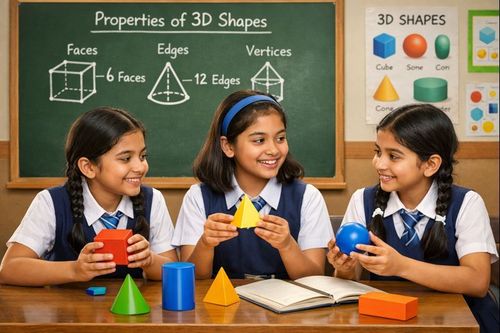

Understanding shapes is a crucial step in a child’s maths journey. While flat figures introduce basic geometry, 3D shapes help children understand space, structure, and measurement in the real world. Objects like boxes, balls, cans, and cones surround children daily, yet many struggle to explain their features clearly. Learning the properties of 3D shapes builds strong foundations in geometry, measurement, and logical thinking. In this guide, children will explore common 3D shapes, their faces, edges, vertices, surface area, and volume through simple explanations, tables, examples, and real-life connections.
What Are 3D Shapes
3D shapes, also called three-dimensional shapes, are solid figures that have length, width, and height. Unlike 2D shapes, they occupy space, which means they can be touched, held, and viewed from different angles. Common examples of 3D shapes include boxes, balls, cans, and cones, which children see and use every day.
Each 3D shape has specific features known as faces, edges, and vertices. Faces are the flat or curved surfaces of a shape, edges are the lines where two faces meet, and vertices are the corners where edges join. These features form the basic structure of solid shapes and help children identify, compare, and classify them correctly.
Understanding the basic properties of 3D shapes helps students develop strong spatial thinking and visualisation skills. This early knowledge prepares them for advanced topics such as volume, surface area, and spatial reasoning, making higher-level geometry easier to understand and apply in real-life situations.
Why 3D Shapes Matter in Maths
Learning 3D shapes is not only about recognising objects. It helps children understand how solid objects exist and interact in the real world in a meaningful way.
Develop spatial awareness
Children learn how objects occupy space and relate to one another. This skill helps them judge size, position, and distance, which is useful in everyday activities and learning tasks.
Visualise objects from different angles
Understanding 3D shapes allows children to imagine how an object looks when turned or viewed from another side. This improves visualisation skills that are important in geometry, design, and problem-solving.
Understand real-world measurements
Learning 3D shapes introduces children to ideas like height, depth, and volume. These concepts help them understand measurements used in real life, such as filling containers or stacking objects.
Strengthen logical and analytical thinking
When children compare faces, edges, and vertices, they practise reasoning and analysis. This strengthens their ability to think logically and solve structured problems.
Apply maths concepts beyond textbooks
Knowledge of 3D shapes helps children connect maths to real-world objects like buildings, boxes, and tools. This makes learning more practical and meaningful.
From cubes to cones, help your child understand shapes beyond memorisation.
Book a Free PlanetSpark Demo Class Today!
Key Properties of 3D Shapes
The properties of 3D shapes describe what makes each solid shape unique and easy to identify. These properties include the number of faces, edges, and vertices, the shape of each face, whether the surface is flat or curved, and how the shape can roll, slide, or stack. Observing these features helps children understand why different objects behave differently in real life.
Knowing these properties helps children compare 3D shapes and explain their differences clearly, instead of just recognising them by name. This skill improves both mathematical understanding and communication.
Faces, Edges, and Vertices Explained
To understand solid shapes clearly, children need to learn three important terms that describe their structure:
Face: A flat or curved surface of a 3D shape. Some shapes have only flat faces, while others have curved surfaces.
Edge: The line where two faces meet. Edges help define the shape and give it structure.
Vertex: A corner where two or more edges meet. Vertices are often called corners and help children count and compare shapes easily.
For example, a cube has several flat faces, straight edges, and sharp vertices, which makes it easy to stack. In contrast, a sphere has only a curved surface, with no edges or vertices, allowing it to roll smoothly.
Common 3D Shapes and Their Characteristics
Properties of a Cube
Examples: Dice, ice cubes, gift boxes
Properties of a Cuboid
Examples: Books, bricks, pencil boxes
Build strong foundations early with expert guidance.
Start Your Child’s Free PlanetSpark Trial
Properties of a Cylinder
Examples: Cans, water bottles, pipes
Properties of a Cone
Examples: Ice cream cones, traffic cones, party hats
Properties of a Sphere
Examples: Balls, oranges, globes
Surface Area and Volume Basics
Surface area and volume describe how much space a 3D shape covers and holds.
- Surface Area: Total area of all faces
- Volume: Space occupied inside the shape
Simple Examples
- A cube with a side of 4 cm has a volume of 64 cubic cm
- A cuboid stores more volume if its height increases
Understanding these concepts helps children solve real-life maths problems involving containers and storage.
3D Shapes in Everyday Life
Children see 3D shapes everywhere around them, even in their daily routine. Connecting these shapes to familiar objects helps children recognise, remember, and understand them more easily.
Cubes: Objects like dice and storage boxes are cube-shaped. Cubes have equal square faces, straight edges, and sharp corners, which makes them easy to stack.
Cuboids: Books, cupboards, and bricks are examples of cuboids. They have rectangular faces and are commonly used in furniture and school materials.
Cylinders: Water bottles, candles, and cans are cylindrical in shape. They have curved surfaces and flat circular faces, allowing them to roll and stand upright.
Cones: Ice cream cones and funnels have a circular base and a pointed top, making them simple and fun for children to identify.
Spheres: Balls and many fruits are spherical in shape. Since they have a completely curved surface, they can roll easily in all directions.
Relating daily objects to the properties of 3D shapes helps children connect learning to real life, making the concept more meaningful, memorable, and enjoyable.
How PlanetSpark Helps Children Master 3D Shapes
PlanetSpark focuses on concept clarity and communication, not rote learning.
- Live interactive classes that explain the properties of 3D shapes visually
- Step-by-step breakdown of faces, edges, and vertices
- Concept-based problem-solving aligned with the school curriculum
- Real-life examples to improve retention
- Communication-focused learning so that children can explain concepts confidently.
Conclusion
A strong understanding of the properties of 3D shapes helps children build confidence in geometry as well as in real-world problem-solving. When children clearly understand how solid shapes are structured, they feel more comfortable analysing objects and answering geometry questions independently.
By learning about faces, edges, vertices, surface area, and volume, students move beyond simple memorisation of shape names. They begin to understand why shapes look and behave the way they do, which leads to deeper mathematical thinking and better application of concepts.
With structured explanations, easy-to-follow tables, and real-life examples, children can grasp complex ideas step by step without feeling overwhelmed. With expert guidance and personalised learning support, PlanetSpark helps children master 3D shapes in a clear, engaging, and confidence-building way, laying a strong foundation for higher-level mathematics.
Frequently Asked Questions
The properties of 3D shapes include faces, edges, vertices, surface area, volume, and the presence of flat or curved surfaces.
A cylinder has two flat circular faces, one curved surface, two edges, and no vertices.
A cone has one flat face, one curved surface, one edge, and one vertex at the top.
3D shapes help children understand space, real-life objects, measurement, and geometry concepts clearly.
PlanetSpark uses live interactive classes, visual learning, and concept-based explanations to help children understand and communicate shape properties confidently.