
Ratios Learning Programs Designed by PlanetSpark
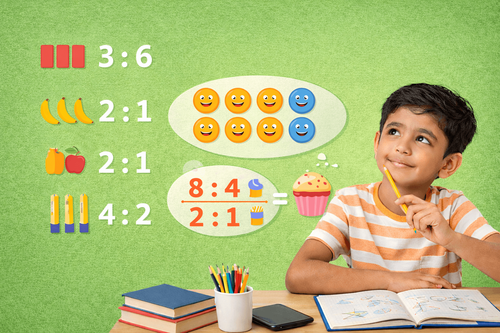

Understanding ratios is one of the most important steps in a child’s maths journey. Ratios help children compare quantities, understand relationships, and think logically. From sharing sweets with friends to understanding scores in sports, ratios quietly appear in everyday life. Yet, many children find ratios confusing because they are often taught using formulas too early.
At PlanetSpark, ratios are introduced as ideas first, numbers later. This blog explains what is ratio, the ratio meaning, how ratios work in maths, and how kids can understand them using simple ratio examples without fear or confusion.
What Is Ratio? A Simple Explanation for Kids
The question what is ratio can be answered in the simplest way: A ratio shows how two or more things compare to each other.
Instead of counting things separately, ratios help us understand their relationship. For example, if there are 2 red balls and 4 blue balls, a ratio helps us describe how red balls compare to blue balls.
Ratios are not about big numbers or difficult calculations. They are about comparison. Kids naturally compare things all the time, who has more chocolates, who scored higher, or which group is bigger. Ratios simply put these comparisons into a clear format.
Understanding Ratio Meaning in Everyday Language
The ratio meaning becomes easy when we stop thinking of it as a maths topic and start thinking of it as a way of describing things.
A ratio answers questions like:
- How much of one thing is there compared to another?
- Are two groups equal or different?
- Which quantity is larger or smaller?
Ratios help us describe balance and proportion. When children understand the meaning behind ratios, they stop seeing them as abstract symbols and start recognizing them as part of real life.
Why Ratios Are Important for Kids
Ratios play a major role in developing:
- Logical thinking
- Observation skills
- Decision-making ability
- Problem understanding
Kids who understand ratios early find it easier to learn fractions, percentages, and even data interpretation later. Ratios train the brain to see relationships, not just numbers.
That is why ratio for kids should always be taught using relatable situations instead of textbook definitions.
Start your child’s journey toward confident ratio learning. Join the program today.
Ratio in Maths Explained Step by Step
In maths, ratios are used to compare quantities of the same kind. The phrase ratio in maths simply means comparing numbers in an organized way.
For example:
- Comparing boys to girls in a class
- Comparing apples to oranges in a basket
- Comparing wins to losses in a game
In maths, ratios help children understand fairness, sharing, and grouping. They also help in recognizing patterns and building number sense.
Ratio for Kids: Learning Without Pressure
Learning ratio for kids should feel natural, not stressful. Children already use ratio thinking when they say:
- “I have more than you”
- “We both have the same number”
- “She has twice as many toys”
These statements are all based on ratio thinking. The goal is to help children connect this natural thinking with formal understanding.
Give your child clarity in ratios through guided learning. Get started now.
Simple Ratio Examples Kids Can Understand
Simple ratio examples make the concept clear instantly.
Imagine:
- 3 pencils and 6 erasers
This means there are twice as many erasers as pencils.
Or:
- 5 girls and 5 boys
This shows equal numbers.
These examples help kids understand that ratios describe how quantities relate, not how big they are individually.
Using simple comparisons builds confidence and prevents confusion later.
Ratio Examples for Kids Using Daily Life
Here are ratio examples for kids from everyday situations:
- In a classroom, 10 students wear glasses and 20 do not
- In a cricket team, 6 players are batsmen and 5 are bowlers
- In a fruit bowl, there are more apples than bananas
Kids instantly understand these examples because they connect to familiar environments. This approach makes learning meaningful and long-lasting.
How to Read and Understand Ratios Easily
Ratios can be read in different ways, but the idea stays the same. When kids learn to read ratios properly, they understand them better.
For example, a ratio can be read as:
- “for every”
- “compared to”
- “in relation to”
Reading ratios in words helps kids explain their thinking clearly, which improves communication skills along with maths understanding.
Help your child move beyond confusion and truly understand ratios. Begin learning today.
Ratio Word Problems Explained Without Stress
The term ratio word problems often scares students, but it shouldn’t. Word problems are simply stories that describe real situations.
Ratio word problems ask kids to:
- Observe information
- Compare quantities
- Explain relationships
Why Ratio Word Problems Improve Thinking Skills
Ratio word problems help kids:
- Analyze situations
- Identify relevant details
- Explain answers in their own words
These skills are useful beyond maths. They help in reading comprehension, reasoning, and even creative writing. That’s why ratio word problems are an important learning tool, not just an exam topic.
Common Mistakes Kids Make While Learning Ratios
Some common mistakes include:
- Comparing unlike quantities
- Focusing only on numbers, not meaning
- Forgetting that ratios show relationships
These mistakes usually happen when concepts are rushed. A strong foundation in ratio meaning helps kids avoid confusion and build clarity.
Make math concepts click with expert-led ratio lessons. Enroll your child now.
How Parents Can Help Kids Understand Ratios
Parents play a big role in learning. They can:
- Use ratios in daily conversations
- Ask kids to explain comparisons
- Encourage explanation instead of memorization
Simple questions like “Who has more?” or “Is this equal?” strengthen ratio thinking naturally.
Why Ratios Matter Beyond the Classroom
Ratios are used in:
- Cooking recipes
- Sports statistics
- Maps and models
- Financial planning
Understanding ratios prepares kids for real-life decision-making. It helps them interpret information correctly and avoid misunderstandings.
How Ratios Help Kids Think Logically
One of the biggest benefits of learning ratios is how they shape logical thinking. Ratios teach children to look at information carefully and understand relationships instead of focusing on individual numbers. When kids learn ratios, they start asking better questions like “Which is more?” and “How are these connected?”
This habit of thinking strengthens reasoning skills. Over time, children become better at analyzing situations, spotting patterns, and explaining their ideas clearly. These thinking skills help not only in maths but also in reading comprehension, science experiments, and everyday problem-solving.
Turn everyday comparisons into strong math skills. Start your child’s learning journey today.
Ratios and Fair Sharing Explained for Kids
Fair sharing is one of the easiest ways to explain ratios to children. When kids divide snacks, toys, or time, they naturally use ratio thinking. If two friends want equal portions, they instinctively compare quantities.
Understanding ratios helps children recognize fairness and balance. It also teaches them to justify their choices logically. Instead of guessing, kids can explain why something is fair or unfair. This builds confidence and communication skills alongside maths understanding.
Using Visual Thinking to Understand Ratios
Visual thinking plays a huge role in ratio learning. Children understand concepts faster when they can imagine or see what is being compared. Pictures, diagrams, and mental images help kids grasp ratios without stress.
PlanetSpark encourages kids to visualize quantities side by side. This method helps them understand proportions naturally. When kids “see” ratios instead of memorizing rules, learning becomes intuitive and enjoyable.
Ratio Thinking in Games and Sports
Ratios appear naturally in games and sports, making them easy for kids to understand. Scores, teams, wins, and losses are all based on comparisons. For example, comparing goals scored by two teams is a form of ratio thinking.
Sports-based examples keep kids engaged and curious. They also show that maths exists beyond classrooms. Learning ratios through games makes the concept relatable and fun.
Build a solid foundation in ratios with structured practice. Sign up and explore now.
How Ratios Build Strong Communication Skills
Explaining ratios helps kids improve communication. When children describe comparisons in words, they practice clarity and structure. They learn to explain “how much more” or “how things relate.”
This skill is valuable in storytelling, presentations, and discussions. Kids who can explain ratios clearly often express ideas better in other subjects too. Maths becomes a tool for communication, not just calculation.
Connecting Ratios to Real-Life Decisions
Ratios help kids understand real-life choices. Whether comparing time spent on activities or understanding proportions in food and health, ratios guide better decisions. Children begin to see how information connects and why balance matters.
Learning ratios early helps kids become thoughtful decision-makers. They learn to weigh options instead of guessing, which builds maturity and confidence.
Why Memorizing Ratios Doesn’t Work
Memorizing ratio formats without understanding leads to confusion. Kids may remember symbols but struggle to apply them. True learning happens when children understand the reason behind comparisons.
PlanetSpark avoids rote learning. Instead, it focuses on meaning, explanation, and application. This approach ensures children remember concepts because they understand them, not because they memorized steps.
Support your child’s math growth with engaging, concept-based lessons. Join now.
Ratios as a Bridge Between Maths Topics
Ratios connect many maths topics together. They help children move smoothly from basic counting to advanced concepts. Understanding ratios prepares kids for fractions, percentages, and data interpretation.
When kids see maths as connected ideas instead of separate chapters, learning becomes easier. Ratios act as a bridge that supports future learning with confidence.
Encouraging Curiosity Through Ratio Questions
Asking the right questions builds curiosity. Questions like “Why is this more?” or “What happens if we change the ratio?” help kids think deeply. Curiosity-driven learning leads to better understanding.
PlanetSpark encourages children to ask questions and explore answers. This creates active learners who enjoy discovering ideas instead of memorizing content.
Ratios and Problem-Solving Mindset
Ratios teach kids how to approach problems step by step. Instead of rushing to answers, children learn to observe and understand first. This mindset improves overall problem-solving ability.
When kids feel confident solving ratio-based situations, they approach challenges calmly. This confidence spreads to other academic and real-life situations.
Help your child learn ratios the smart and simple way. Get access today.
How Teachers Use Ratios to Build Strong Foundations
Teachers often use ratios to introduce logical thinking. Ratios help students understand fairness, balance, and relationships. They also encourage discussion and explanation.
When taught properly, ratios become a foundation topic that supports multiple skills. PlanetSpark’s approach ensures this foundation is strong and long-lasting.
Why Ratio Learning Should Start Early
Early exposure to ratios helps children develop number sense. They begin to understand comparisons naturally instead of struggling later. Early learning also reduces maths anxiety.
Children who learn ratios early feel more comfortable with numbers. This confidence carries forward into higher classes and complex topics.
Ratios as a Life Skill, Not Just a Maths Topic
Ratios are life skills. They help children interpret information, make fair decisions, and understand the world better. From shopping choices to time management, ratios quietly guide everyday actions.
Teaching ratios with meaning ensures children are prepared for real-world situations. Maths becomes useful, not intimidating.
Empower your child with clear thinking and confident math skills. Enroll today.
How PlanetSpark Makes Ratio Learning Easy
Ratios are taught as part of overall cognitive development, not just maths drills. Children learn to explain, reason, and apply ideas, making learning meaningful and enjoyable.
The key USPs of PlanetSpark’s maths course include:
- Live interactive sessions led by experienced educators who introduce mental-calculation shortcuts (including Vedic maths tricks) and connect them directly to NCERT/CBSE exam problems.
- Customised practise modules focusing on arithmetic operations, algebraic expressions, quadratic equations, and roots, so students apply the tricks within actual syllabus-aligned questions.
- Performance analytics & error-tracking tools that identify recurring calculation mistakes, helping students focus on improving speed and accuracy.
- Dedicated doubt-resolution and revision-boosters, which means that if any student is lagging on applying the tricks, the mentor provides targeted support and extra practise.
- Board-exam simulators with time-bound mock tests, where students learn to use tricks under realistic exam conditions, building confidence and speed.
Key Takeaways
Ratios are not just numbers on a page. They are tools that help children understand relationships, comparisons, and balance in the world around them. When taught correctly, ratios become intuitive and enjoyable.
With PlanetSpark’s approach, kids learn what is ratio, understand ratio meaning, explore simple ratio examples, and gain confidence through real-life learning. This foundation helps them think better, learn faster, and grow smarter.
Unlock a better way for your child to understand ratios. Start learning now.
Frequently Asked Questions
A ratio shows how two or more things compare to each other. It helps us understand how much of one thing there is compared to another. Instead of counting items separately, ratios explain their relationship. This makes comparisons easier and clearer for kids. Ratios are commonly used in everyday life.
Ratios help kids develop logical thinking and observation skills. They teach children how to compare quantities and understand balance. Learning ratios early makes it easier to understand future topics like fractions and percentages. Ratios also improve problem-solving abilities. They prepare kids for real-life situations.
Ratios appear in many daily activities such as sharing food, playing sports, and managing time. Kids use ratios when they compare scores, divide snacks, or organize groups. Understanding ratios helps them make fair decisions. It also improves awareness of quantity relationships. These real-life connections make learning meaningful.
A ratio compares two or more quantities, while a fraction shows part of a whole. Ratios focus on relationships between groups, not portions. Fractions usually deal with one whole divided into parts. Understanding ratios first makes fractions easier to learn. Both concepts are connected but used differently.
Parents can use daily situations to explain ratios naturally. Asking questions like “Who has more?” or “Is this equal?” builds understanding. Encouraging children to explain their thinking helps clarity. Visual examples at home make learning fun. Simple conversations strengthen ratio skills.
Ratio word problems can feel confusing when kids focus only on numbers. The key is understanding the situation first. When children learn to read the problem carefully, it becomes easier. Visualizing the comparison helps reduce confusion. Practice improves confidence over time.
PlanetSpark focuses on concept clarity instead of memorization. Ratios are taught using real-life examples and visual thinking. Children are encouraged to explain ideas in their own words. This builds deeper understanding and confidence. Learning becomes enjoyable and stress-free.