
Roman Numerals Explained Simply for Students


Table of Contents
- What Are Roman Numerals and Where Did They Come From?
- Rules to Read and Write Roman Numerals Easily
- Roman Numeral Chart and 1 to 100 in Roman Numerals
- Advanced Roman Numerals: 500, 1000, 2024 and 2026
- Roman Numerals vs Hindu-Arabic Numbers
- Common Mistakes Students Make and How to Avoid Them
- Fun Activities and Practice Worksheet for Kids
- PlanetSpark Maths Classes Make Maths Easy, Clear, and Confid
- Keep Growing with Confidence in Maths
Have you ever looked at a clock and wondered why it shows XII instead of 12 or III instead of 3? That is the fascinating world of Roman Numerals, an ancient number system that is still used today in clocks, books, movies, events, and school lessons.
Many students feel confused when they first see Roman Numerals because they use letters instead of normal digits. But once you learn the symbols and simple rules, they become easy and enjoyable to understand. Roman Numerals are often taught in primary school maths because they improve number sense, pattern recognition, and logical thinking.
In this complete guide, you will learn what Roman Numerals are, their history, symbols, rules, a full roman numeral chart, 1 to 100 in roman numerals, practice questions, common mistakes, real-life uses, and expert tips to learn faster. By the end of this blog, Roman Numerals will feel simple and fun.
What Are Roman Numerals and Where Did They Come From?
Roman Numerals are an ancient number system that first developed in Ancient Rome thousands of years ago. Long before modern digits like 1, 2, and 3 were widely used, the Romans created a simpler way to count and record numbers using letters from their alphabet. This system helped people manage daily activities such as buying and selling goods, keeping records, marking dates, measuring land, and organizing armies.
Roman Numerals were especially useful because they were easy to carve into stone, metal, and wood. Many roads, buildings, monuments, and public records in Rome displayed numbers using this system. Even after the Roman Empire declined, Roman Numerals continued to be used in Europe for centuries.
Today, although modern numbers are used for calculations, Roman Numerals still appear in many places. You can see them on clock faces, book chapters, movie sequels, royal names, sports events, and historic buildings. Learning Roman Numerals helps students understand number patterns, history, and different ways people counted in the past.
The seven basic Roman Numeral symbols are:
- I = 1
- V = 5
- X = 10
- L = 50
- C = 100
- D = 500
- M = 1000
These letters were combined to form many numbers.
Examples:
- II = 2
- III = 3
- VI = 6
- IX = 9
- XII = 12
- XX = 20
Why Were Roman Numerals Used?
Romans used this system because it was practical for carving on stone, writing on walls, and keeping records. Straight-line letters were easier to write and read than complex symbols.
Why Do We Still Learn Them Today?
Roman Numerals are still taught because they:
- Improve understanding of number patterns: Roman Numerals help children notice sequences and number relationships. They learn how symbols combine to create different values.
- Build logical thinking skills: Students use rules of addition and subtraction while reading Roman Numerals. This improves reasoning and problem-solving ability.
- Help children compare systems of counting: Roman Numerals show that numbers can be written in different ways. Children understand how ancient and modern systems are different.
- Appear in daily life even now: Roman Numerals are still used in many places today. Learning them helps students recognize numbers outside the classroom.
You can still see Roman Numerals in:
- Clock faces: Many traditional wall clocks and watches use Roman Numerals instead of regular numbers. Examples include III, VI, IX, and XII.
- Book chapters: Some books number chapters or sections using Roman Numerals. This gives the book a classic and organized style.
- Movie sequels: Films often use Roman Numerals for parts or sequels, such as Part II or Part IV. It adds a dramatic and stylish look.
- Historical monuments: Old buildings and monuments may show years in Roman Numerals. These are often carved into stone or metal plaques.
- Sports events: Major sporting events sometimes use Roman Numerals in titles, such as the Super Bowl. This makes each edition look special.
- Royal names like Henry VIII: Kings and queens often have Roman Numerals after their names. It helps distinguish rulers with the same first name.
Want your child to enjoy maths instead of fearing it?
Book a free PlanetSpark trial class today before limited slots fill up this week.
Rules to Read and Write Roman Numerals Easily
Roman Numerals follow a pattern. Once children understand these rules, they can solve questions confidently.
1. Addition Rule
When a smaller numeral comes after a larger numeral, add the values.
Examples:
- VI = 5 + 1 = 6
- VII = 5 + 1 + 1 = 7
- XI = 10 + 1 = 11
- XV = 10 + 5 = 15
2. Subtraction Rule
When a smaller numeral comes before a larger numeral, subtract it.
Examples:
- IV = 5 - 1 = 4
- IX = 10 - 1 = 9
- XL = 50 - 10 = 40
- XC = 100 - 10 = 90
- CM = 1000 - 100 = 900
3. Repetition Rule
Some symbols can repeat up to three times.
Examples:
- III = 3
- XXX = 30
- CCC = 300
4. Symbols That Cannot Repeat
These symbols do not repeat:
- V
- L
- D
Wrong forms:
- VV
- LL
- DD
5. Order Rule
Numerals are generally written from largest to smallest, unless subtraction is used.
Correct:
- XXI = 21
- LX = 60
Incorrect:
- VX
Quick Trick for Students
Think of Roman Numerals like building blocks. First use the bigger value, then add or subtract the smaller one.
This makes learning faster and easier.
Roman Numeral Chart and 1 to 100 in Roman Numerals
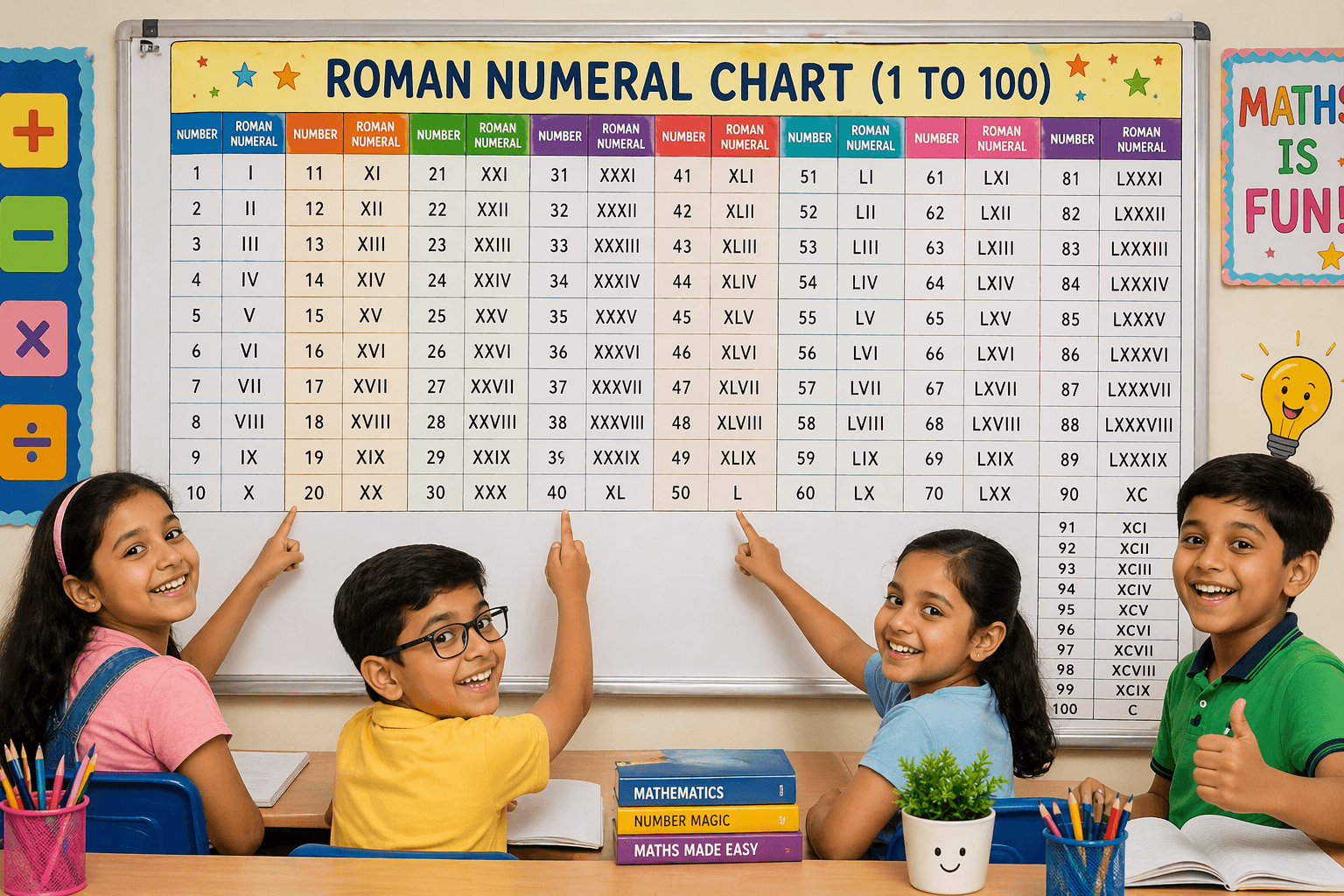
A roman numeral chart is one of the best tools for revision. Students can keep it near their study desk.
Roman Numerals 1 to 20
Important Tens Up to 100
Build Any Number from Patterns
Examples:
- 24 = XXIV
- 36 = XXXVI
- 47 = XLVII
- 58 = LVIII
- 69 = LXIX
- 75 = LXXV
- 82 = LXXXII
- 99 = XCIX
Memory Tip
Remember the base sequence:
I, V, X, L, C, D, M
Students who revise this chart for five minutes daily usually improve much faster.
Need better maths marks before the next test?
Book your PlanetSpark demo class now and start guided practice today.
Advanced Roman Numerals: 500, 1000, 2024 and 2026
Once students learn basic numbers, advanced Roman Numerals become easy.
Hundreds and Thousands
- 100 = C
- 200 = CC
- 300 = CCC
- 400 = CD
- 500 = D
- 600 = DC
- 700 = DCC
- 800 = DCCC
- 900 = CM
- 1000 = M
Year Numbers
- 2024 = MMXXIV
- 2025 = MMXXV
- 2026 = MMXXVI
How 2026 Is Formed
- 2000 = MM
- 20 = XX
- 6 = VI
So:
2026 = MMXXVI
Other Fun Examples
- 1999 = MCMXCIX
- 1500 = MD
- 1754 = MDCCLIV
Why This Matters
Students often see years written in Roman Numerals in:
- Movie copyright dates
- Monuments
- Event names
- Books
Understanding large Roman Numerals gives children confidence in exams and quizzes.
Roman Numerals vs Hindu-Arabic Numbers
Today, most of the world uses the Hindu-Arabic number system, which includes digits 0 to 9. This system came from India and became globally accepted because it is easier for calculations.
Comparison Table
Why Modern Numbers Are Easier
Modern digits are better for:
- Addition
- Subtraction
- Multiplication
- Division
- Decimals
- Large calculations
Why Roman Numerals Are Still Important
Roman Numerals help children learn:
- Number patterns
- Symbol systems
- Logical order
- Historical knowledge
Both systems are useful in different ways. Learning Roman Numerals also makes students stronger in maths thinking overall.

Common Mistakes Students Make and How to Avoid Them
Many children lose marks in simple questions because of avoidable mistakes.
Mistake 1: Writing IIII for 4
Correct:
- IV
Mistake 2: Writing VIIII for 9
Correct:
- IX
Mistake 3: Writing VV for 10
Correct:
- X
Mistake 4: Wrong Symbol Order
8 should be:
- VIII
Not IIV.
Mistake 5: Forgetting the Subtraction Rule
40 is:
- XL
Not XXXX.
How to Avoid These Errors
- Practice 10 conversions daily
- Use flashcards
- Revise the chart weekly
- Say numbers aloud
- Solve worksheets regularly
Quick Self-Test
Convert these:
- 14 = ?
- 19 = ?
- XL = ?
- XC = ?
- XXV = ?
Answers:
- XIV
- XIX
- 40
- 90
- 25
Does your child repeat the same maths mistakes again and again?
Book a free PlanetSpark class now and get expert correction early.
Fun Activities and Practice Worksheet for Kids
Children learn fastest when maths feels fun. Use these activities at home.
1. Roman Numeral Clock Hunt
Find Roman Numerals on clocks and read them aloud.
2. Flashcard Match Game
Match:
- 5 with V
- 10 with X
- 50 with L
3. Speed Quiz
Ask:
- What is 7 in Roman Numerals?
- What is XII?
- What is 40?
- What is XC?
4. Fill in the Blanks
- IX = ___
- ___ = 15
- XX = ___
- ___ = 100
Answers:
- 9
- XV
- 20
- C
5. Convert to Roman Numerals
- 28 = XXVIII
- 34 = XXXIV
- 51 = LI
- 67 = LXVII
6. Treasure Hunt Game
Hide number cards around the room and ask children to convert them.
Why Practice Works
Small daily practice builds speed, memory, and confidence.
Waiting until exams can increase pressure later.
Book your PlanetSpark trial class today and secure your preferred slot now.
PlanetSpark Maths Classes Make Maths Easy, Clear, and Confidence-Building
PlanetSpark maths classes are designed for children who need stronger basics, better confidence, and consistent improvement in school maths topics such as Roman Numerals, fractions, multiplication, mental maths, word problems, and logical reasoning.
PlanetSpark uses structured teaching methods so children understand concepts instead of memorizing without clarity.
What Makes PlanetSpark Valuable for Parents
- Live interactive online classes
- Trained teachers who work with children patiently
- Personalized attention and feedback
- Concept clarity first approach
- Practice worksheets and revision support
- Confidence-building methods
- Progress tracking for parents
Best For Students Who:
- Fear maths
- Forget concepts quickly
- Need stronger basics
- Want better school marks
- Need regular practice support
Why Early Support Matters
When basics become weak, future maths topics feel difficult. Building confidence early helps children enjoy learning for years.

Keep Growing with Confidence in Maths
Roman Numerals may look different at first, but once students understand the symbols and rules, they become simple and enjoyable. With regular practice, charts, worksheets, and expert guidance, children can master them quickly.
Every maths concept learned today builds a stronger future tomorrow. Keep practicing a little each day, stay curious, and remember that confidence grows when learning becomes clear and consistent.
Also Read: Coordinate Plane: Learn Easy Graphing and Quadrant Skills with PlanetSpark
Numeracy Explained Simply for Parents and Students
Importance of Zero Explained with Real Examples | PlanetSpark
Frequently Asked Questions
Roman Numerals are a number system that uses letters such as I, V, X, L, C, D, and M to represent numbers.
Because I come before V, so 1 is subtracted from 5.
9 is written as IX.
They improve pattern recognition, logic, and number understanding.
They are used in clocks, books, movie sequels, events, and monuments.
Use charts, flashcards, games, and daily practice.
PlanetSpark offers live maths classes, expert teachers, practice support, and confidence-building learning methods.
You can begin by booking a trial class to understand your child’s current level and learning needs.
Parents choose PlanetSpark because it focuses on strong fundamentals, interactive learning, and personalised guidance that helps students understand concepts clearly and perform better in exams.