
NCERT Class 10 Some Applications of Trigonometry Concepts and Problems
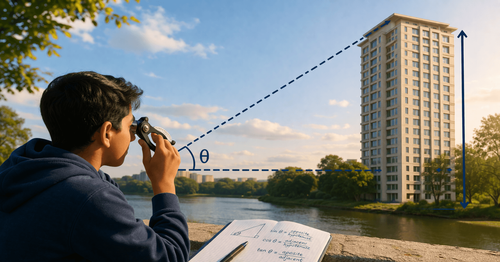

Table of Contents
- What are Some Applications of Trigonometry?
- Important Concepts in Some Applications of Trigonometry
- Visual Explanation of Angle of Elevation and Angle of Depres
- How These Angles Help Solve Trigonometry Problems
- Simple Trick to Remember These Angles
- Why This Concept is Important for Exams
- Trigonometric Ratios Used in Applications
- General Steps to Solve Trigonometry Application Problems
- Types of Problems in Some Applications of Trigonometry
- Real-Life Applications of Trigonometry
- Common Mistakes Students Should Avoid
- Tips to Score Well in This Chapter
- Practice Questions for Students
- Practice Questions on Some Applications of Trigonometry
- Why Students Choose PlanetSpark for Better Learning
- Key Takeaways from Applications of Trigonometry
Have you ever wondered how the height of a tall building or the distance across a river is measured without directly reaching it? This is where trigonometry becomes useful in real life. In NCERT Class 10 Chapter 9 – Some Applications of Trigonometry, students learn how trigonometric ratios help calculate heights and distances using angles. Concepts such as angle of elevation, angle of depression, and line of sight make it possible to solve practical measurement problems. Understanding these ideas helps students apply mathematics beyond textbooks and solve exam questions with confidence.
What are Some Applications of Trigonometry?
Trigonometry is widely used to determine unknown heights, lengths, and distances without measuring them directly. In this chapter, these calculations are done using right-angled triangles and trigonometric ratios.
For example:
- Finding the height of a tower
- Calculating the distance between two buildings
- Measuring the width of a river
- Determining the height of a mountain
- Estimating the length of a ladder leaning against a wall
These types of problems involve angles formed between the observer and the object.
According to NCERT, these calculations are performed using angles of elevation and depression.
Important Concepts in Some Applications of Trigonometry
Before solving problems, students must understand three important terms.
1. Line of Sight
The line of sight is the straight line drawn from the eye of the observer to the object being viewed.
For example:
- Looking at the top of a tower
- Watching a balloon in the sky
- Observing a building from the ground
The imaginary straight line connecting the eye and the object is called the line of sight.
2. Angle of Elevation
When an observer looks upwards to see an object, the angle formed between the horizontal line and the line of sight is called the angle of elevation.
Examples include:
- Looking at the top of a building
- Watching an airplane in the sky
- Seeing the top of a mountain
In simple terms:
Angle of elevation = angle formed when looking upward.
3. Angle of Depression
When the observer looks downward at an object, the angle formed between the horizontal line and the line of sight is called the angle of depression.
Examples include:
- Looking down from a building
- Seeing a car from a bridge
- Observing a river from a hill
Angle of depression = angle formed when looking downward.

Visual Explanation of Angle of Elevation and Angle of Depression
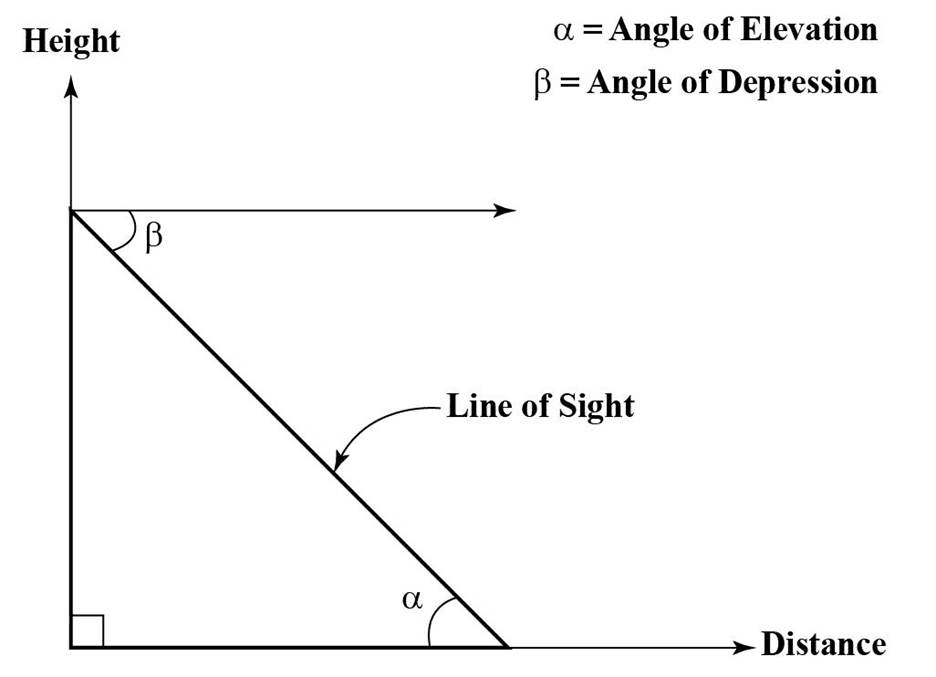
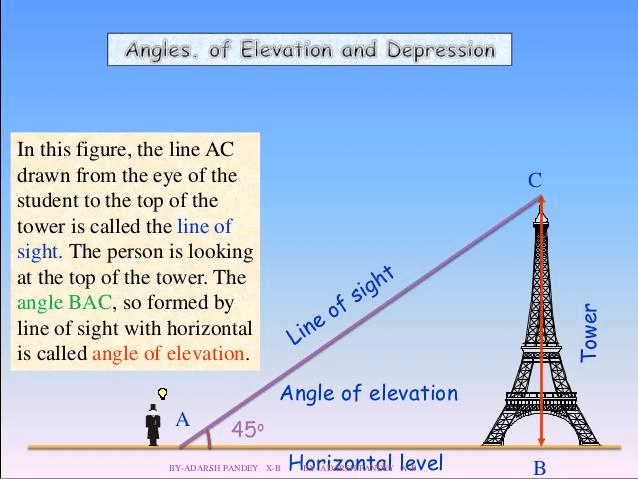
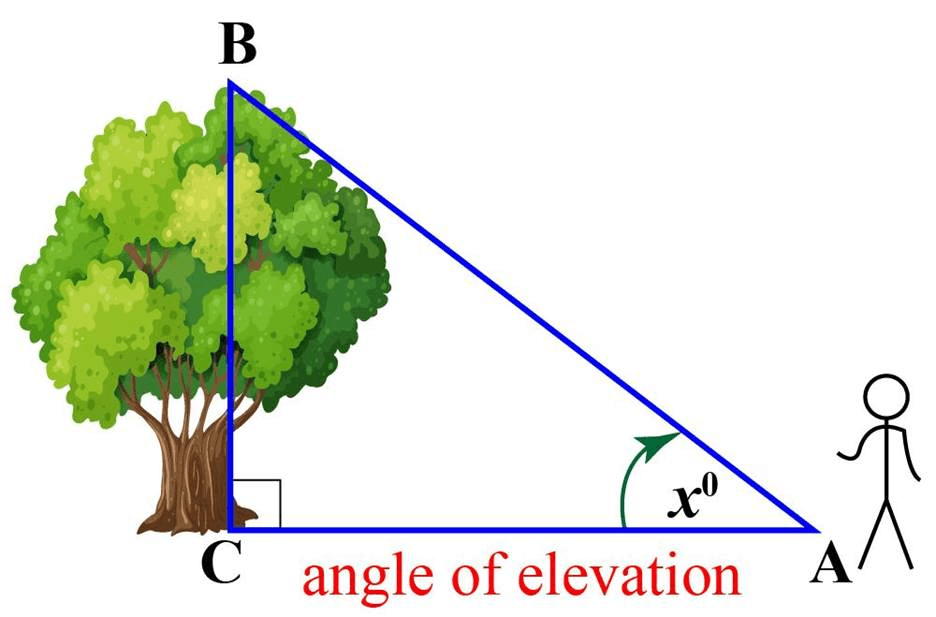
Understanding Some Applications of Trigonometry becomes much easier when students can visualize the situation. Many problems in this chapter are based on how an observer looks at an object either above or below the horizontal line.
The two most important ideas used in these problems are:
- Angle of Elevation
- Angle of Depression
These concepts help us form right-angled triangles, which allow us to apply trigonometric ratios to calculate heights and distances.
What is the Angle of Elevation?
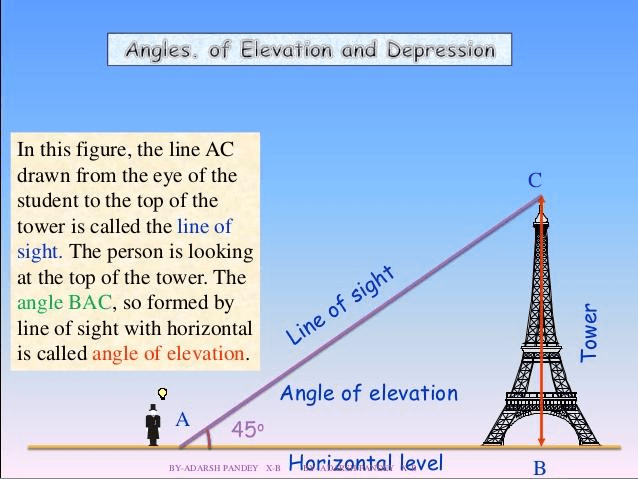
The angle of elevation is the angle formed between the horizontal line and the line of sight when the observer looks upward at an object.
In simpler words, whenever we raise our head to look at something above us, the angle formed is called the angle of elevation.
Example situations
Students can observe this angle in everyday life:
- Looking at the top of a tower
- Watching a kite flying in the sky
- Observing the top of a building
- Looking at a flag on a pole
In the diagram above:
- The observer stands on the ground.
- The horizontal line represents the eye level.
- The line connecting the observer’s eye to the top of the tower is the line of sight.
- The angle between these two lines is the angle of elevation.
Once this triangle is formed, we can apply trigonometric ratios like tan θ to find the height of the object.
Visual Understanding of Angle of Depression
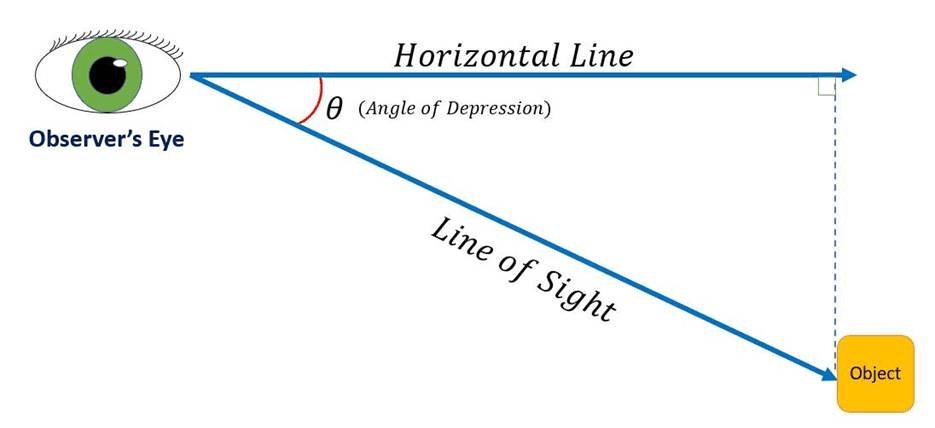
The angle of depression is the angle formed between the horizontal line and the line of sight when the observer looks downward at an object.
This occurs when we lower our head to see something below us.
Real-life examples
You experience the angle of depression when:
- Looking down from a balcony to the ground
- Seeing a car from the top of a bridge
- Observing a boat from a lighthouse
- Looking at people from the top of a building
In the diagram:
- The observer stands at a height.
- The horizontal line represents the eye level.
- The line of sight goes downward to the object.
- The angle formed is called the angle of depression.
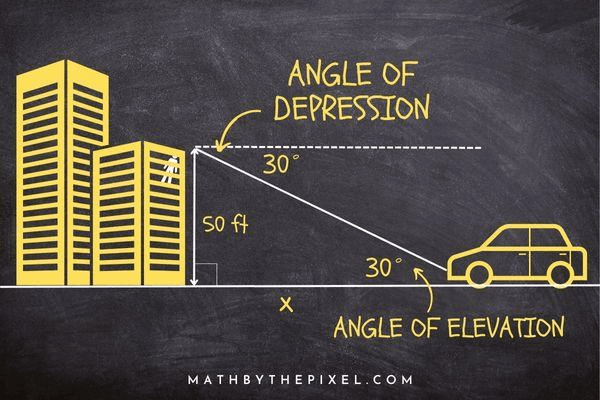
An important point to remember is that the angle of depression and the angle of elevation are often equal because they form alternate interior angles in parallel lines.
This concept helps students solve many problems in Some Applications of Trigonometry.
Key Difference Between Angle of Elevation and Angle of Depression
| Concept | Angle of Elevation | Angle of Depression |
|---|---|---|
| Direction of view | Looking upward | Looking downward |
| Observer position | Observer below the object | Observer above the object |
| Common examples | Watching a tower, airplane, kite | Looking down from a building, bridge, or lighthouse |
| Diagram orientation | Triangle goes upward | Triangle goes downward |
Understanding this difference helps students quickly identify which triangle to draw while solving questions.
How These Angles Help Solve Trigonometry Problems
In Some Applications of Trigonometry, these angles allow us to form right-angled triangles.
Once the triangle is formed, we can use trigonometric ratios to calculate unknown values like:
- Height of a tower
- Distance between buildings
- Width of a river
- Length of a ladder
- Height of mountains or poles
For example:
If we know:
- distance from the object
- angle of elevation
we can calculate the height of the object using the tangent ratio.
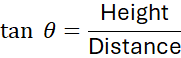
Similarly, if we know the height and angle, we can find the distance from the object.
Simple Trick to Remember These Angles
Students often confuse elevation and depression. A simple trick can help.
- Elevation → Eyes go Up
- Depression → Eyes go Down
Another easy way to remember:
- Elevator goes up → Elevation
- Depression means going down
Using these tricks makes it easier to remember the concepts during exams.

Why This Concept is Important for Exams
Questions based on angle of elevation and depression appear frequently in NCERT exercises, board exams, and competitive tests.
Most problems involve:
- towers
- buildings
- rivers
- ladders
- balloons
- lighthouses
Students who clearly understand the visual meaning of these angles can quickly draw diagrams and solve questions accurately.
Practicing different problems related to Some Applications of Trigonometry will help students master these concepts and perform better in mathematics exams.
Trigonometric Ratios Used in Applications
To solve problems related to heights and distances, we mainly use three trigonometric ratios.
- Sine (sin)
- Cosine (cos)
- Tangent (tan)
However, in most NCERT problems, tan θ is commonly used because it directly relates height and distance.
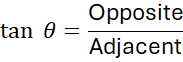
Where:
- Opposite side → height of the object
- Adjacent side → distance from the observer
This relationship helps calculate unknown heights or distances easily.
General Steps to Solve Trigonometry Application Problems
Students should follow these steps when solving problems from this chapter.
Step 1: Draw a Diagram
Always represent the situation using a right-angled triangle.
This helps visualize:
- height
- distance
- angle of elevation/depression
Step 2: Identify Known Values
Look for:
- height
- distance
- angle given
Step 3: Choose the Correct Trigonometric Ratio
Common choices:
- tan θ when height and distance are involved
- sin θ when height and hypotenuse are involved
- cos θ when base and hypotenuse are involved
Step 4: Substitute Values
Use known values in the formula.
Step 5: Solve the Equation
Calculate the unknown height or distance.
Types of Problems in Some Applications of Trigonometry
This chapter contains several types of questions. Understanding each category helps students solve problems quickly.
The main types include:
- Height of a tower or building
- Ladder or rope problems
- Shadow problems
- Angle of elevation and depression problems
- Distance between two objects
- River width problems
Let us understand each type.
Type 1: Finding the Height of a Tower
Example Problem
A tower stands on the ground. A point on the ground is 15 m away from the tower. The angle of elevation is 60°. Find the height of the tower.
Solution
Let:
Height of tower = h
Distance from tower = 15 m
Using tangent ratio:
tan 60° = h / 15
We know:
tan 60° = √3
So,
√3 = h / 15
h = 15√3
Therefore,
Height of tower = 15√3 m
Type 2: Ladder Problems
These problems involve ladders leaning against walls or poles.
Example
An electrician needs to reach 3.7 m up a pole. The ladder makes an angle of 60° with the ground. Find the ladder length.
Using:
sin 60° = opposite / hypotenuse
sin 60° = 3.7 / ladder
Since:
sin 60° = √3/2
Ladder ≈ 4.28 m
So, the electrician needs a ladder of approximately 4.28 m.
Type 3: Height of a Building Using an Observer
Example
An observer 1.5 m tall stands 28.5 m away from a chimney. The angle of elevation is 45°. Find the height of the chimney.
Using tangent:
tan 45° = AE / 28.5
Since:
tan 45° = 1
AE = 28.5
Total height:
28.5 + 1.5 = 30 m
Therefore,
Height of chimney = 30 m
Type 4: Problems with Two Angles
Sometimes problems involve two angles of elevation.
Example
From a point, the angle of elevation of a 10 m building is 30°. The angle of elevation of the top of a flagstaff on the building is 45°.
First calculate distance from the building.
tan 30° = 10 / distance
distance = 10√3
Next find total height.
tan 45° = (10 + x) / distance
Solving gives:
x = 7.32 m
Therefore,
Flagstaff height = 7.32 m
Type 5: Shadow Problems
Shadow problems often involve sun altitude angles.
Example
A tower's shadow is 40 m longer when the sun’s altitude is 30° than when it is 60°.
Let:
height = h
shadow = x
Using tan 60°:
√3 = h / x
Using tan 30°:
1/√3 = h / (x + 40)
Solving equations gives:
h = 20√3 m
So,
Height of tower = 20√3 m
Type 6: Angle of Depression Problems
These problems involve observers looking downwards.
Example
From the top of a building, the angles of depression of the top and bottom of another building are 30° and 45°.
Using right-triangle relationships and tangent ratios, we can find:
- height of the building
- distance between buildings
These problems require drawing two right triangles.
Type 7: River Width Problems
Sometimes trigonometry helps measure distances that cannot be measured directly.
Example
From a bridge 3 m high, the angles of depression of the river banks are 30° and 45°.
Using tangent relationships:
AD = 3√3
BD = 3
Width of river:
AB = AD + BD
AB = 3 + 3√3
Thus,
Width of river = 3(1 + √3) m
Real-Life Applications of Trigonometry
Trigonometry is used in many real-world situations.
Engineering
Engineers use trigonometry to:
- design bridges
- construct buildings
- calculate slopes
Navigation
Pilots and sailors use trigonometry for:
- determining distance
- navigation routes
- calculating altitude
Architecture
Architects use trigonometry to design structures and calculate dimensions.
Astronomy
Scientists use trigonometry to measure distances between stars and planets.
Common Mistakes Students Should Avoid
While solving trigonometry application problems, students often make mistakes such as:
Not drawing diagrams
Always draw a triangle before solving.
Confusing elevation and depression
Remember:
- elevation → looking up
- depression → looking down
Using wrong trigonometric ratio
Choose the ratio that includes known values.
Ignoring observer height
In many questions, the observer's height must be added to the final answer.
Tips to Score Well in This Chapter
Follow these strategies to perform well in exams.
Practice diagrams
Visualizing the situation makes solving easier.
Learn key trigonometric values
Memorize:
- sin 30°, 45°, 60°
- cos 30°, 45°, 60°
- tan 30°, 45°, 60°
Focus on word problems
Most questions are based on real-life situations.
Solve NCERT exercises
Exercise 9.1 contains important questions frequently asked in exams.
Practice Questions for Students
Try solving these problems.
- A rope makes an angle of 30° with the ground and its length is 20 m. Find the height of the pole.
- A tree breaks and its top touches the ground 8 m from the base. The broken part makes an angle of 30° with the ground. Find the original height of the tree.
- A kite is flying at a height of 60 m and the string makes an angle of 60° with the ground. Find the length of the string.
- From a point 30 m away from a tower, the angle of elevation is 30°. Find the height of the tower.
- A 1.5 m tall boy observes a building. The angle of elevation changes from 30° to 60° as he walks closer. Find the distance he walked.
Practicing such questions helps strengthen conceptual understanding.
Practice Questions on Some Applications of Trigonometry
To strengthen your understanding of Some Applications of Trigonometry, it is important to solve different types of problems. The following questions will help students practice concepts such as angle of elevation, angle of depression, heights, and distances.
Try solving these questions using the trigonometric ratios you have learned.
Level 1: Basic Practice Questions
These questions help students practice the basic use of trigonometric ratios.
- A tower stands on the ground. The angle of elevation of the top of the tower from a point on the ground 20 m away from its base is 45°. Find the height of the tower.
- From a point on the ground 30 m away from a building, the angle of elevation of the top of the building is 30°. Find the height of the building.
- A ladder 10 m long rests against a vertical wall and makes an angle of 60° with the ground. Find the height on the wall reached by the ladder.
- A kite is flying at a height of 50 m above the ground. The string attached to the kite makes an angle of 30° with the ground. Find the length of the string.
- A tower casts a shadow 15 m long when the angle of elevation of the sun is 60°. Find the height of the tower.
Level 2: Intermediate Problems
These problems involve slightly more reasoning and multiple steps.
- A 1.5 m tall boy stands 20 m away from a building. The angle of elevation of the top of the building from his eyes is 45°. Find the height of the building.
- The angle of elevation of the top of a tower from a point on the ground is 30°. When the observer moves 10 m closer, the angle of elevation becomes 60°. Find the height of the tower.
- A flagstaff is placed on top of a building 12 m high. From a point on the ground, the angle of elevation of the top of the building is 30°, while the angle of elevation of the top of the flagstaff is 45°. Find the height of the flagstaff.
- A ladder reaches the top of a wall 4 m high when placed 3 m away from the wall. Find the length of the ladder.
- From the top of a 40 m high tower, the angle of depression of a point on the ground is 45°. Find the distance of the point from the tower.
Level 3: Higher-Level Problems
These questions are similar to exam-level NCERT problems.
- From a point on a bridge across a river, the angles of depression of the banks on opposite sides of the river are 30° and 45°. If the bridge is 3 m above the water level, find the width of the river.
- A tree breaks during a storm and the top touches the ground making an angle of 30° with the ground. If the distance from the base of the tree to the point where the top touches the ground is 8 m, find the height of the tree.
- From the top of a 50 m high lighthouse, the angles of depression of two ships in the same straight line are 30° and 60°. Find the distance between the ships.
- From the top of a building, the angle of depression of a car on the road is 30°. After a few seconds, the angle of depression becomes 60°. If the height of the building is 20 m, find how far the car travelled during that time.
- The angle of elevation of the top of a tower from the foot of a building is 30°, and the angle of elevation of the top of the building from the foot of the tower is 60°. If the tower is 40 m high, find the height of the building.
Challenge Questions
Try solving these questions without looking at formulas directly.
- Two poles of equal height stand on opposite sides of a road 80 m wide. From a point between them, the angles of elevation of the tops of the poles are 30° and 60°. Find the height of the poles.
- A balloon is flying horizontally at a height of 80 m above the ground. The angle of elevation of the balloon from a point on the ground changes from 60° to 30°. Find the distance travelled by the balloon.
- A 75 m high lighthouse observes two ships in the same direction. The angles of depression are 30° and 45°. Find the distance between the ships.
Tip for Students
While solving practice questions on Some Applications of Trigonometry, remember these points:
- Always draw a diagram first.
- Identify the right triangle formed in the situation.
- Choose the correct trigonometric ratio such as sine, cosine, or tangent.
- Substitute the known values and solve step by step.
Practicing different types of questions will help you gain confidence in solving trigonometry application problems in exams.
Why Students Choose PlanetSpark for Better Learning
Concept-Based Learning: At PlanetSpark, students learn mathematical and logical concepts step-by-step so they understand the why behind every solution, not just the formula.
Expert Mentors: Experienced teachers at PlanetSpark simplify complex topics and guide students through real examples, helping them build a strong conceptual foundation.
Interactive Classes: PlanetSpark uses engaging teaching methods, visual explanations, and real-life examples to make learning topics like trigonometry more interesting and easier to grasp.
Practice-Focused Approach: Students get plenty of guided practice at PlanetSpark, which helps them strengthen problem-solving skills and prepare confidently for exams.
Personalized Attention: With small batch sizes, PlanetSpark ensures every student receives individual attention and feedback to improve their learning.
Confidence in Communication and Learning: PlanetSpark focuses on building both academic clarity and confidence so students can explain concepts and solve problems independently.

Key Takeaways from Applications of Trigonometry
This chapter explains how trigonometry helps measure heights and distances without direct measurement. Important concepts include line of sight, which connects the observer to the object, angle of elevation when looking upward, and angle of depression when looking downward. Trigonometric ratios such as sin θ, cos θ, and tan θ are used to find unknown values. Most problems involve right-angled triangles. With regular practice, students can easily solve practical problems related to towers, ladders, shadows, rivers, and buildings.
Also Read
Frequently Asked Questions
PlanetSpark teaches students how trigonometry is used to calculate heights and distances in real-life situations such as towers, buildings, and bridges.
PlanetSpark explains angle of elevation and angle of depression using visual diagrams, practical examples, and step-by-step problem-solving methods.
According to PlanetSpark, understanding applications of trigonometry helps students solve real-world measurement problems and strengthens mathematical thinking.
PlanetSpark simplifies trigonometry concepts through interactive classes, expert guidance, and structured practice questions.
Yes, PlanetSpark provides guided practice and real-life examples that help students improve their trigonometry problem-solving abilities.
PlanetSpark offers practice exercises, concept explanations, and mentor support to help students master applications of trigonometry.
Students learning with PlanetSpark gain conceptual clarity, practical understanding, and confidence in solving trigonometry problems effectively.