
Master Surds and Indices Step by Step | PlanetSpark


Understanding the concepts of surds and indices is crucial for enhancing your problem-solving abilities and mathematical skills. By mastering these concepts, you’ll simplify complex roots, work with powers efficiently, and build a strong foundation for algebra and advanced math. Clear examples, rules, and practice make these seemingly tricky ideas easier and much more approachable for learners of all levels.
PlanetSpark supports students with expert 1:1 trainers, personalised lessons, and targeted practice on surds and indices. With AI-led analysis, interactive exercises, and consistent feedback, learners build confidence and accuracy. Engaging tools like SparkX and Spark Diary make math practice fun, while structured progress tracking ensures steady improvement and real results. Understand key mathematical concepts with us and use them in your exams.

What Exactly Are Surds?
Surds are irrational numbers that can’t be simplified into a whole number or a fraction. They typically appear as roots (like square roots, cube roots, etc.) that don't have an exact value. For example, √2 is a surd because it cannot be simplified into a finite decimal or fraction. Surds are important in mathematics for simplifying expressions and solving equations.
Example-
- √2 is a surd (you cannot write it as a simple number).
- √3 and √5 are also surds
- But √4 = 2 is not a surd, because it simplifies to a whole number.
Types of Surds with Simple Examples
Surds are expressions involving roots that cannot be simplified into rational numbers, such as √2 or ∛11. Understanding the different types of surds with Surds examples helps you apply them accurately in algebra and simplification tasks, making problems easier to handle.
- Simple surds- These contain just one root term.
- Pure Surds -These are fully irrational surds with no extra number outside.
- Mixed Surds- These have a number outside the root sign, too.
- Similar Surds- Surds with the same root part.
- Compound Surds- These are two or more surds added or subtracted.
- Binomial Surds- A special type of compound surd with two terms.
Example- √2, √5, ∛7 - each has only one part under the root.
Example- √3, √11 - only the root and nothing else.
Example- 3√2, 2√5 - a rational number multiplied by a root.
Example- √2 and 5√2 - both have √2.
Example- √5 + √3 - more than one surd together.
Example- √3 + √7 - just two surds joined.
Unlock your child’s confidence in surds and indices with expert guidance from PlanetSpark. From formula breakdowns to real-time practice, your child will master concepts with clarity. Start now and transform their math journey!
Rules to Solve Surds
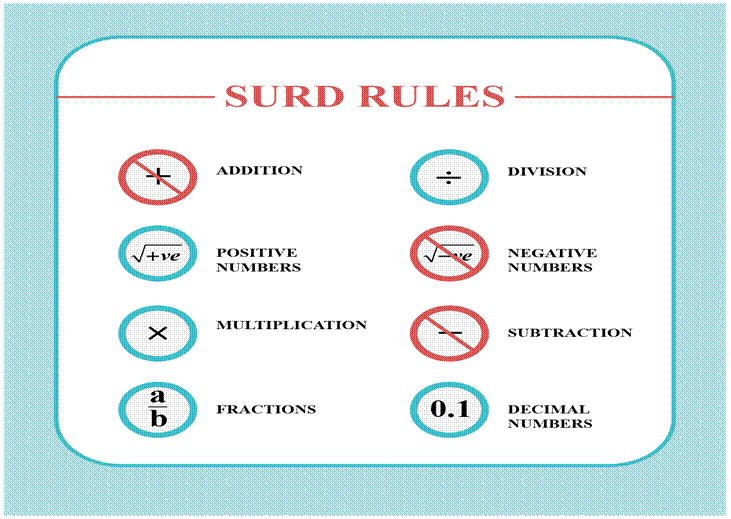
To handle surds effectively, it’s vital to learn the surds rules for simplifying expressions - like multiplying, dividing, combining like surds, and rationalising denominators. These techniques make solving surds much more accurate and manageable.
Rule 1 - Product Rule
Formula:
 =
=  x
x 
This rule lets you separate a surd into parts to simplify it.
Example 1:
√18 = √(9×2)
= √9 × √2
= 3√2
Example 2:
√50 = √(25×2)
= √25 × √2
= 5√2
Rule 2 - Quotient Rule
Formula:
 =
=
A fraction inside a root can split into separate roots.
Example 1:
√(12/121) = √12 / √121
= (2√3) / 11
Example 2:
√(18/2) = √18 / √2
= (3√2) / √2 = 3
Rule 3 - Rationalising a Single Surd in the Denominator
Method: Multiply top and bottom by the surd in the denominator to remove the root from the bottom.
Example 1:
5/√7 × √7/√7
= 5√7 / 7
Example 2:
4/√3 × √3/√3
= 4√3 / 3
Rule 4 - Like Surds Addition/Subtraction
Only surds with the same root part can be combined by adding or subtracting their coefficients.
Example 1:
5√6 + 4√6 = (5+4)√6 = 9√6
Example 2:
7√3 − 2√3 = (7−2)√3 = 5√3
Rule 5 - Rationalising a Binomial Surd Denominator (a + b√n)
Multiply top and bottom by the conjugate (a − b√n) to remove the surd.
Example 1:
3/(2 + √2) × (2 − √2)/(2 − √2)
= (6 − 3√2)/(4 − 2)
= (6 − 3√2)/2
Example 2:
1/(1 + √3) × (1 − √3)/(1 − √3)
= (1 − √3)/(1 − 3)
= (1 − √3)/(-2)
Struggling with surds and indices questions in homework and tests? Join PlanetSpark’s free demo class today!
Rule 6 - Rationalising Binomial Surd Denominator (a- b√n)
Same idea as Rule 5, but with the opposite conjugate.
Example 1:
5/(4 − 2√3) × (4 + 2√3)/(4 + 2√3)
= (20 + 10√3)/(16 − 12)
= (20 + 10√3)/4
Example 2:
2/(3 − √2) × (3 + √2)/(3 + √2)
= (6 + 2√2)/(9 − 2)
= (6 + 2√2)/7
Basic of Indices
An indices (also called an exponent or power) tells us how many times to multiply a number by itself. Indices rule show how many times a number is multiplied by itself. For example,  means 2 × 2 × 2. The small raised number is the exponent, and the base is the main number. Indices follow rules like multiplying powers by adding exponents and dividing powers by subtracting them.
For example:
2 × 2 × 2 × 2 = 2⁴ - here 4 is the index, and 2 is the base. This means “2 multiplied by itself four times.”
In math, we write this as:
2⁴ = 16 - read as “two to the power of four.”
Indices make it easy to write repeated multiplication in short form. Instead of writing long multiplication, we just use the base and index (power).
Rules to Solve Indices
To solve surds and indices problems confidently, it’s essential to know the indices rule. These rules - such as product, quotient, power, zero, and negative indices -form the foundation for simplifying and solving exponential expressions accurately.
Rule 1 - Product Rule (Multiplication of Powers)
Rule: When you multiply powers with the same base, you add the exponents.
Formula:
am x an= am+n
Example 1:
23×24
=23+4
=27
=128
Example 2:
52×53
=52+3
=55
=3125
Rule 2 - Quotient Rule (Division of Powers)
Rule: When you divide powers with the same base, you subtract the exponents.
Formula:
am/an= am-n
Example 1:
35/32
=35−2
=33
=27
Example 2:
106/104
=106−4
=102
=100

Rule 3 - Power of a Power
Rule: When a power itself is raised to another power, you multiply the indices.
Formula:
(am)n=am×n
Example 1:
(23)2
=23×2
=26
=64
Example 2:
(42)3
=42×3
=46
=4096
Rule 4 - Negative Exponent Rule
Rule: A negative exponent means take the reciprocal (turn the base below 1).
Formula:
a-n=1/an
Example 1:
3−2
=1/32
=1/9
Example 2:
5−1
=1/5
Rule 5 - Zero Exponent Rule
Rule: Any number except 0 raised to the power 0 equals 1.
Formula:
a0=1
Example 1:
700=1
Example 2:
10000=1
Rule 6 - Power of a Product Rule
Rule: When a product is raised to a power, apply the power to every part.
Formula:
(ab)n=an x bn
Example 1:
(2×3)2
= 22×32
= 4×9
= 36
Example 2:
(5×4)3
=53×43
= 125×64
= 8000
How to Convert a Surd to Indices?
Converting a surd into indices form involves expressing roots as fractional powers. Using a simple formula, the denominator of the root becomes the denominator of the fraction, and the exponent becomes the numerator. This method simplifies surds, making them easier to handle in equations and solving exam questions. Understanding this conversion is crucial for efficient problem-solving in algebra and higher-level math.
📌 Rule - Surd to Indices
If you have a surd like: 
You convert it to indices as: a1/2
Example 1 - Square Root (√)
 = 81/2
So, instead of writing “√8,” you write it as a power with exponent 1/2 - eight raised to the one-half power.
Example 2 - Cube Root (³√)
 = 271/3
That means “take the cube root of 27.” Writing it as an index lets you work with exponents more easily.
Give your child the edge with structured lessons full of surds examples and formula strategies that make learning intuitive and fun. Join the math revolution with Planetspark!
Surds and Indices Exam-Ready Questions For You
To help you prepare effectively for your exams, here’s a set of surds and indices questions. These carefully selected problems will allow you to practice and reinforce key concepts, ensuring you’re well-equipped to tackle any related questions during your revisions. Challenge yourself with these questions and build confidence for your upcoming exams!
Questions Related to Surds
Q1. √75 + √12 – √27
Solution:
√75 = 5√3, √12 = 2√3, √27 = 3√3 →
5√3 + 2√3 – 3√3 = 4√3
Q2. (√6 + √2)(√6 – √2)
Solution:
Use (a+b)(a−b):
= (√6)² − (√2)² = 6 − 2 = 4
Q3. √8 × √18 ÷ √2
Solution:
= √(8×18) ÷ √2 = √144 ÷ √2
=12/√2 = 6√2
Questions Related to Indices
Q1. 3⁴ × 3⁻² × 3⁵
Solution:
Add powers: 4 − 2 + 5 = 7 →
3⁷ = 2187
Q2. (2/3)⁻³
Solution:
Negative exponent → reciprocal: (3/2)³ = 27/8
Q3. 16(3/4)
Solution:
16 = 2⁴
(2⁴)(3/4) = 2³ = 8
How Does PlanetSpark Help Your Kid Master Surds and Indices?
PlanetSpark helps your child build a solid foundation in surds and indices with personalised 1:1 tutoring by expert maths teachers, ensuring concepts are explained clearly and step by step. Every student receives a personalised learning roadmap that adapts to their pace and confidence level, turning difficult topics into simple building blocks.

With live interactive sessions, kids can ask questions in real-time and get instant feedback to correct mistakes on surds and indices basics. Regular progress reports and performance tracking ensure improvement is measured and sustained, helping learners grow faster and feel confident with every concept. This is how PlanetSpark helps your kid in maths;
Builds Strong Math Foundations: PlanetSpark’s tutors focus on concept clarity, making sure kids truly understand basic and intermediate math concepts rather than just memorising rules. This foundation is essential before tackling tricky topics like powers, roots, surds, or indices.
Personalised, Tutor-Led Problem Solving: Children get one-on-one attention with expert tutors who explain each step and clear doubts instantly. This customised support helps kids confidently approach complex algebraic expressions involving powers and roots.
Enhanced Logical & Analytical Thinking: The program emphasises logical reasoning and structured problem-solving. These skills make it easier for students to simplify expressions, work with powers and roots, and understand why mathematical rules (like exponent laws) work the way they do.
Regular Practice & Real-Time Feedback: PlanetSpark includes guided practice and instant feedback, helping kids correct mistakes, build accuracy, and apply what they’ve learned. Repeated practice strengthens skills needed for mastering surds and indices.
Conclusion
Surds and indices are foundational concepts in mathematics that help students simplify roots and work with powers efficiently. Understanding these ideas strengthens algebra skills and prepares learners for advanced topics by making expressions easier to manage and equations simpler to solve. Mastery of these concepts also builds confidence in handling complex numerical problems step by step and improves overall problem-solving ability.
Don’t let confusion slow progress, from core surds and indices essentials to advanced applications, PlanetSpark equips students with the skills to excel in school and beyond. Sign up today to ignite their maths confidence!
PlanetSpark supports kids in mastering surds and indices with personalised 1:1 tutoring, tailored learning roadmaps, and expert guidance in every lesson. Its interactive practice tools, AI-enabled feedback, and structured progress tracking help learners reinforce rules and formula application effectively. Regular feedback and adaptive sessions ensure students gain clarity, confidence, and accuracy in solving problems, while parents can monitor steady improvement over time.
Frequently Asked Questions
A surd in math is a number expressed with a root (like √), which cannot be simplified into a whole number or exact fraction. These are irrational numbers whose decimal forms go on forever without repeating, so we leave them in root form, such as √2 or ∛11.
To solve surds, simplify the root by breaking it into perfect square factors, apply surd rules for multiplication, division, addition/subtraction of like surds, and rationalise the denominator if needed.
Example- √50 =√(5 x 5 x 2) = 5√2
An index (or exponent) is the small number showing how many times a base is multiplied by itself. In Indices rule, a power refers to the whole expression or the result of that repeated multiplication. For example, in 43=64, 3 is the index, and 64 is the power.
By the laws of exponents, dividing powers with the same base subtracts the exponents:
an/an= an-n =a0
Since any non-zero number divided by itself equals 1, it follows that a0=1 for any non-zero base. This keeps exponent rules consistent without breaking algebraic laws.
Yes, while the curriculum doesn’t list surds and indices explicitly, the coaching emphasises core algebraic thinking, number sense, and logical reasoning. These are essential for mastering powers, roots, surds, and exponent rules.
PlanetSpark’s expert-led curriculum, small live classes, interactive exercises, and detailed progress reports help kids build confidence, creativity, communication, and leadership skills. It also provides personalised feedback and real-time participation to make learning surds and indices engaging and effective.