
NCERT Class 12 Three Dimensional Geometry: Formulas, Concepts, and Examples


Table of Contents
- Understanding Three Dimensional Geometry
- Basic Concepts and Terminology
- Direction Cosines and Direction Ratios
- Equation of a Line in Space
- Shortest Distance Between Lines
- Plane in Three Dimensional Geometry
- Angle Between Line and Plane
- Angle Between Two Planes
- Concept of normals
- Distance Formulas in 3D Geometry
- Concept Mapping: How Everything Connects in 3D Geometry
- Solved Examples (NCERT-Based)
- Visual Interpretation of Common Problems
- Practice Questions
- Exam Strategy for 3D Geometry
- Real-Life Applications of 3D Geometry
- Quick Revision Formula Sheet
- Previous Year Question Trends
- Why Learn Three Dimensional Geometry with PlanetSpark
- Master 3D Geometry with Confidence
Imagine you are playing a 3D game or tracking a flight in the sky. You are not just moving left or right, but also up and down. A simple (x, y) coordinate is no longer enough. This is where Three Dimensional Geometry becomes important. In Class 12 Maths, this chapter helps you understand how objects exist in space. It is also one of the most scoring chapters because of its formula-based approach. In this blog, you will learn all key concepts, formulas, and examples in a simple and clear way.
Understanding Three Dimensional Geometry
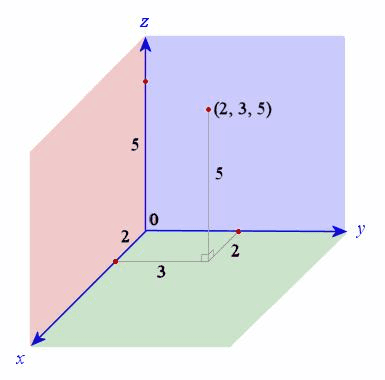
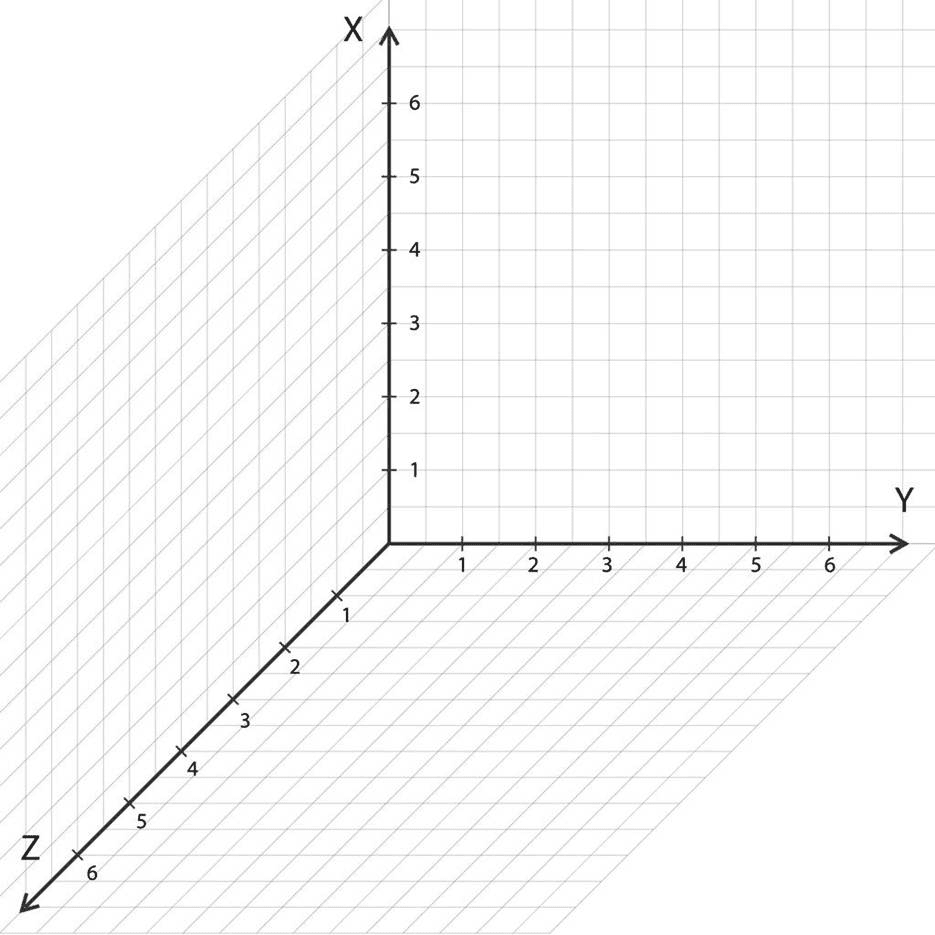
Three Dimensional Geometry is the branch of mathematics that studies points, lines, and planes in space. Unlike 2D geometry, which deals with flat surfaces, 3D geometry adds depth, making it more realistic and practical.
Let’s break it down:
- 2D Geometry uses two coordinates: (x, y)
- 3D Geometry uses three coordinates: (x, y, z)
This third coordinate, z, represents height.
Coordinate Axes
- X-axis: left to right
- Y-axis: forward and backward
- Z-axis: up and down
All three axes meet at a point called the origin (0, 0, 0).
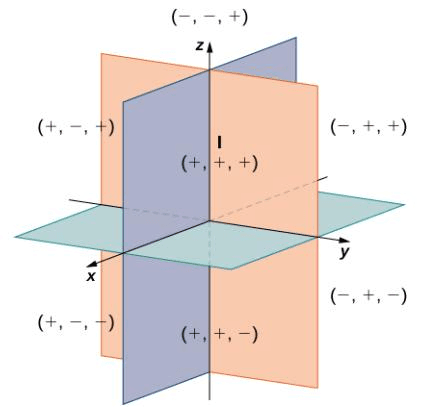
Octants
- These axes divide space into 8 parts, called octants
- The sign of x, y, z determines the octant
Representation of a Point
A point in space is written as (x, y, z)
Example:
- (2, 3, 4) means
- Move 2 units on X
- Move 3 units on Y
- Move 4 units on Z
Visualization
Think of a cube placed at the origin. Every corner and point inside that cube can be located using three coordinates. This helps you imagine how objects exist in space.
Why it is important
- Used in engineering, gaming, and design
- Helps build visualization skills
- Easy to score if concepts are clear
Basic Concepts and Terminology
Before solving problems, you need to be comfortable with basic terms.
Coordinate Axes
Three perpendicular lines (X, Y, Z) that help locate points in space.
Origin
- The point where all axes meet
- Coordinates: (0, 0, 0)
- Acts as the reference point
Octants
- Space is divided into 8 regions
- Each region is defined by the signs of coordinates
Distance Between Two Points
To find how far two points are in space, use:

Example:
Points A (1, 2, 3) and B (4, 6, 3)
Distance:

Section Formula (Internal Division)
If a point divides a line in ratio m:n:

Direction Ratios (DRs)
- Represent direction of a line
- Written as (a, b, c)
- Any multiple represents same direction
Book Your Free Demo Class Today.
Direction Cosines (DCs)
- Cosines of angles made with axes
- Written as (l, m, n)
Relation:

Direction Cosines and Direction Ratios
This is one of the most important concepts in this chapter.
Direction Ratios (DRs)
- Simple numbers representing direction
- Example: (2, 3, 4)
They are not fixed and can be multiplied.
Direction Cosines (DCs)
- Exact direction using angles
- l = cosα, m = cosβ, n = cosγ
These follow:

Relation Between DRs and DCs
If DRs are (a, b, c), then:

Example (Stepwise)
Find DCs of line with DRs (1, 1, 2)
Step 1: Find magnitude

Step 2: Divide each value
- l = 1/√6
- m = 1/√6
- n = 2/√6
Key Exam Insights
- Always normalize DRs
- Do not skip square root
- Check relation l² + m² + n² = 1
Also Read
Equation of a Line in Space
Understanding lines in 3D is about understanding direction and position.
Vector Form
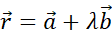
- a is a point on the line
- b is direction
- λ is a parameter
Cartesian Form
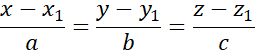
- (x₁, y₁, z₁) is a point
- (a, b, c) are direction ratios
Line Through a Point and Direction
Given:
- Point
- Direction ratios
Directly apply Cartesian form

Line Through Two Points
Steps:
- Subtract coordinates to find DRs
- Use one point + DRs
Angle Between Two Lines

- If result = 0 → perpendicular
- If result = 1 → parallel
Skew Lines
- Lines that do not intersect
- Not parallel
- Exist in different planes
This is unique to 3D Geometry and often asked in exams.
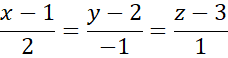
Mini Example
Find equation of line through (1, 2, 3) with DRs (2, -1, 1)
Shortest Distance Between Lines
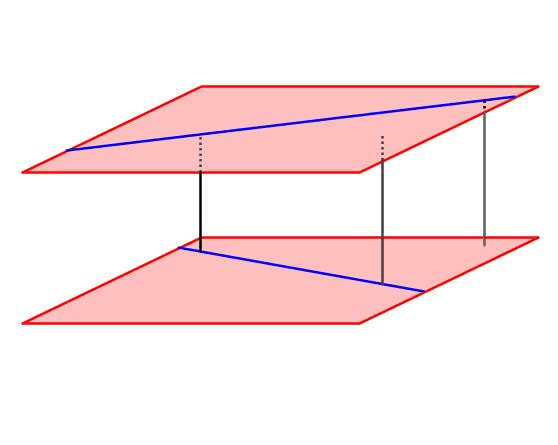
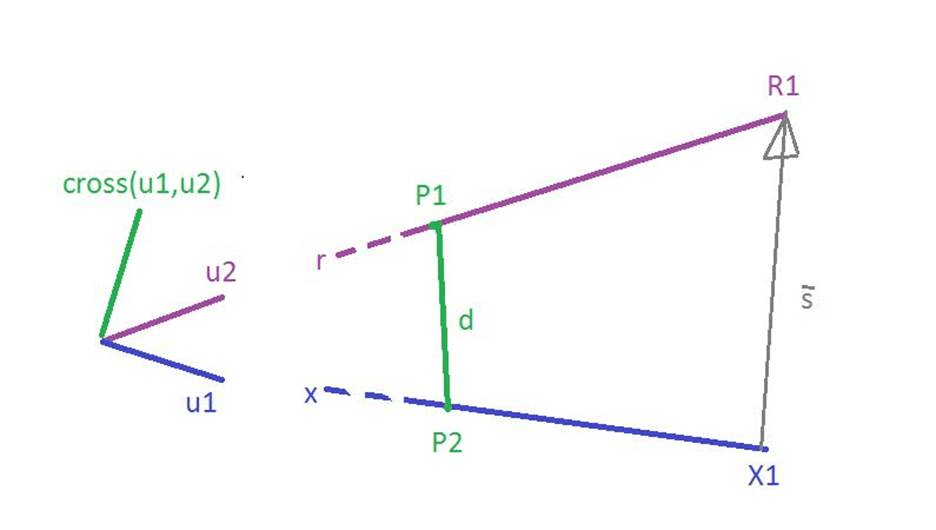
In three dimensional space, not all lines behave like they do on paper. Some lines neither intersect nor remain parallel. These are called skew lines.
What are skew lines
- Lines that do not meet
- Not parallel
- Lie in different planes
Now comes the important question:
How do we measure the distance between them?
Concept of shortest distance
- The shortest distance is always along a line that is
perpendicular to both lines - Think of it as the minimum gap between two lines in space
This is different from 2D geometry, where lines either intersect or are parallel.
Schedule Your Free Demo Class Now.
Formula idea (without heavy derivation)
- Take direction vectors of both lines
- Find a perpendicular direction using cross product
- Project the joining vector onto this direction
You do not need to memorize the derivation
Focus on understanding:
- Direction defines orientation
- Perpendicular gives shortest path
Application understanding
- Used in engineering designs
- Helps in measuring gaps in 3D structures
- Important for advanced problems
Plane in Three Dimensional Geometry
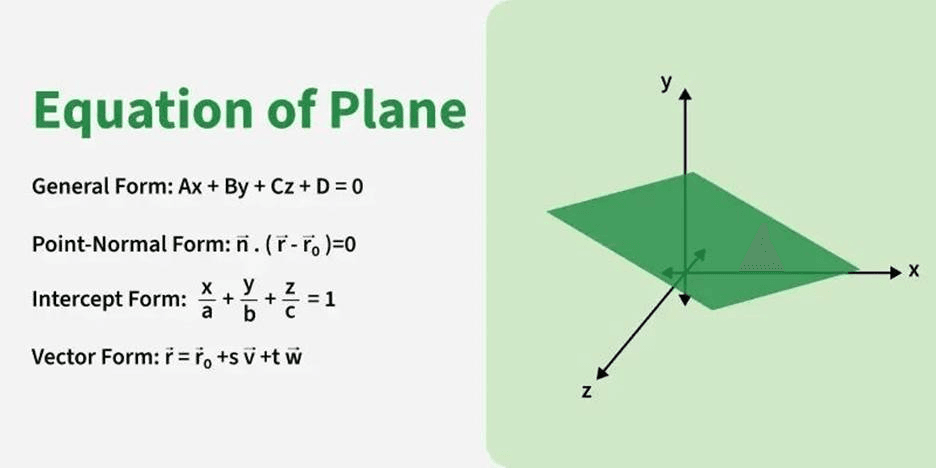
A plane is a flat surface that extends infinitely in all directions. You can think of it like a wall, floor, or sheet.
What is a plane
- A two-dimensional surface in 3D space
- Defined using an equation
General Equation of a Plane

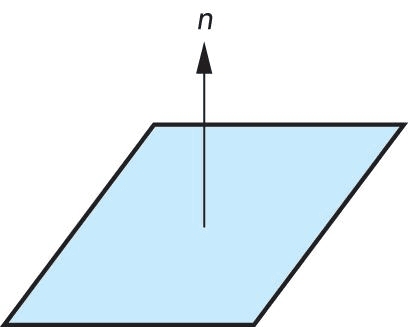
- (a, b, c) represents the normal vector
- This vector is perpendicular to the plane
- d controls the position of the plane
Plane Through a Point
If a plane passes through a point (x₁, y₁, z₁), its equation is:

Concept:
- A plane is fixed by a point and a perpendicular direction
Plan Your Free Demo Class Today.
Plane Through Three Points
- Three non-collinear points uniquely define a plane
- Steps:
- Find two direction vectors
- Use cross product to get normal
- Form equation
Intercept Form
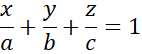
- a, b, c are intercepts on axes
- Shows where the plane cuts X, Y, Z axes
Example:
- Plane cuts axes at (2,0,0), (0,3,0), (0,0,4)
Normal Vector Concept
- Normal vector is perpendicular to plane
- Helps in finding angles and distances
Example
Find equation of plane passing through (1, 2, 3) with normal (2, -1, 1)

Simplified:

Angle Between Line and Plane
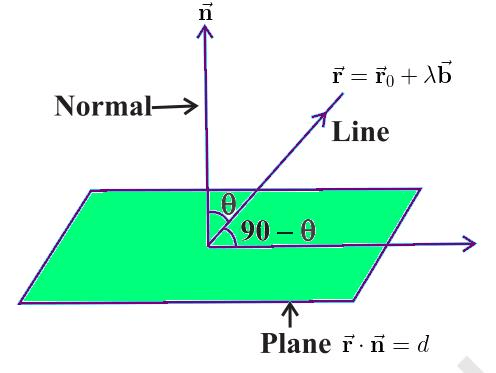
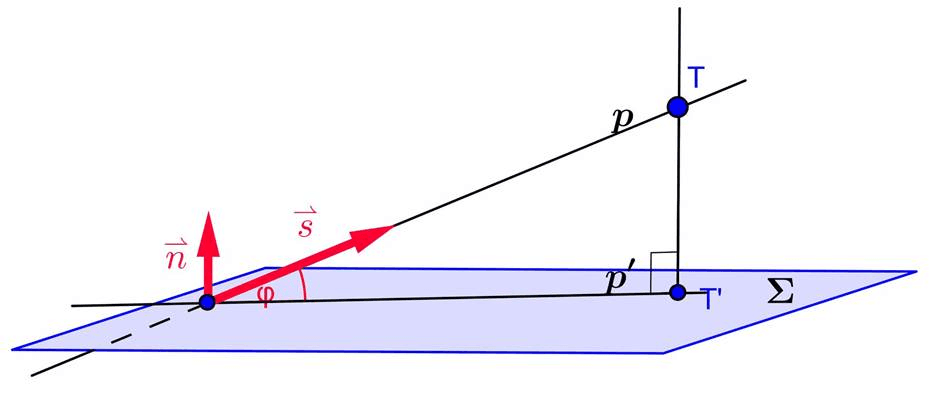
When a line meets a plane, the angle between them is not measured directly.
Concept
- The angle is measured between the line and its projection on the plane
- It is related to the normal of the plane
Relation with normal
- Every plane has a normal vector
- Angle between line and plane depends on angle with this normal
Formula
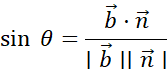
Where:
- b is direction vector of line
- n is normal vector of plane
Interpretation
- If angle = 90°, line is perpendicular to plane
- If angle = 0°, line lies in the plane
Schedule Your Free Math Class with Expert Teachers.
Angle Between Two Planes
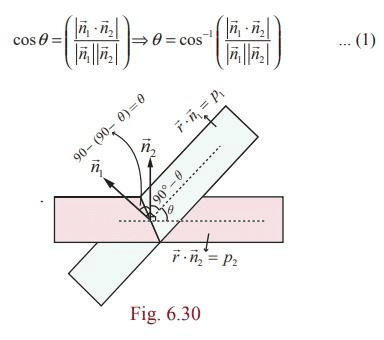
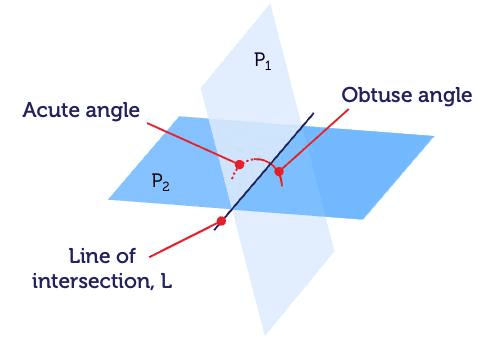
To find the angle between two planes, we do not compare the planes directly.
Concept of normals
- Each plane has a normal vector
- Angle between planes = angle between normals
Formula
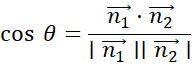
Special cases
- If cosθ = 1 → planes are parallel
- If cosθ = 0 → planes are perpendicular
Key idea
- Reduce plane problem to vector problem
- Makes solving easier
Distance Formulas in 3D Geometry
These formulas help measure distances in space accurately.
Distance Between Point and Plane
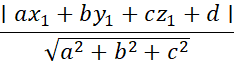
- Gives perpendicular distance
- Always shortest distance
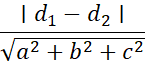
Distance Between Parallel Planes
If planes are:

Distance:
Distance Between Skew Lines
- Use vector method
- Steps:
- Find direction vectors
- Take cross product
- Project joining vector
Concept clarity
- Distance is always shortest path
- Perpendicular direction is key
- Vector methods simplify calculations
Book Your Free Math Class Now.
Usage
- Used in design and construction
- Important for board exams
- Frequently asked concept
Concept Mapping: How Everything Connects in 3D Geometry
Before jumping into solving questions, it is important to understand how all concepts are connected.
Think of Three Dimensional Geometry as a system:
- Points define position in space
- Lines define direction and movement
- Planes define surfaces
- Distance measures separation
- Angles define orientation
Now connect them:
- A line is formed using a point and direction ratios
- A plane is defined using a point and a normal vector
- Angles between lines or planes depend on direction vectors
- Distance formulas often use perpendicular direction
Key takeaway
- Everything is connected through vectors
- If you understand direction and position, most problems become easy
This section helps you stop memorizing and start understanding.
Solved Examples (NCERT-Based)
Let’s understand how concepts are applied through step-by-step examples.
Example 1: Find DCs from DRs
Given DRs: (1, 1, 2)
Step 1: Find magnitude

Step 2: Divide each term
DCs = (1/√6, 1/√6, 2/√6)
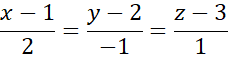
Example 2: Equation of Line
Find equation of line through (1, 2, 3) with DRs (2, -1, 1)
Example 3: Distance Between Two Points
Points: A (1, 2, 3), B (4, 6, 3)

Example 4: Angle Between Two Lines
DRs: (1, 2, 3) and (4, 5, 6)
Use dot product:
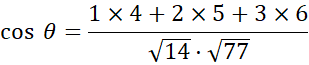
Solve further for θ
Example 5: Equation of Plane
Find plane through (1, 2, 3) with normal (2, -1, 1)

Simplified:

Visual Interpretation of Common Problems
Many students find 3D Geometry difficult because they try to solve questions without visualizing them.
Let’s fix that.
When you see a question, imagine this:
Case 1: Line in space
- Think of a straight rod floating in air
- Direction ratios tell you how it is tilted
Case 2: Plane
- Imagine a flat surface like a wall or table
- Normal vector shows which way the surface is facing
Case 3: Distance problem
- Always think of the shortest path
- Usually a perpendicular line
Case 4: Angle problem
- Angle between lines → how they are inclined
- Angle between planes → compare their normals
Simple habit
Before solving:
- Pause for 5 seconds
- Picture the situation
This small step reduces mistakes and improves understanding.
Schedule Your Free Demo Today.
Practice Questions
A. Direction Cosines & Ratios
- Find the direction cosines of a line whose direction ratios are (2, -1, 2).
- Verify whether the numbers (1/√3, 1/√3, 1/√3) are the direction cosines of a line.
- Find the direction ratios of a line whose direction cosines are (2/3, -1/3, 2/3).
- Prove that for any line, the direction cosines l, m, n satisfy the relation
l² + m² + n² = 1. - Find the angles made by a line with the coordinate axes if its direction cosines are (1/2, 1/2, 1/√2).
- If two direction cosines of a line are 1/2 and 1/3, find the third direction cosine.
- Show that the lines with direction ratios (1, 2, -1) and (2, -1, 1) are perpendicular.
- Find the direction ratios of the line joining the points A (1, 2, 3) and B (4, 6, 3).
- Convert the direction ratios (3, 4, 12) into direction cosines.
- MCQ: Which of the following sets can represent direction cosines of a line?
a) (1, 1, 1)
b) (1/√3, 1/√3, 1/√3)
c) (2, 2, 2)
d) (0, 1, 2)
B. Equation of Line
- Find the equation of the line passing through the point (1, 2, 3) and having direction ratios (2, -1, 1).
- Find the equation of the line passing through the points A (1, 2, 3) and B (4, 6, 3).
- Convert the vector equation
r = (1i + 2j + 3k) + λ(2i - j + k)
into Cartesian form. - Find the value of λ if the point (3, 1, 4) lies on the line
(x-1)/2 = (y-2)/(-1) = (z-3)/1. - Check whether the lines
(x-1)/2 = (y-2)/(-1) = (z-3)/1
and
(x-2)/1 = (y-3)/2 = (z-1)/(-1)
intersect. - Find the condition for the lines
(x-1)/2 = (y-2)/3 = (z-3)/4
and
(x-2)/4 = (y-3)/6 = (z-4)/8
to be parallel. - Find the angle between the lines with direction ratios (1, 2, 3) and (4, 5, 6).
- Find the direction ratios of the line
(x-2)/3 = (y+1)/(-2) = (z-4)/1. - Find the coordinates of a point on the line
(x-1)/2 = (y-2)/3 = (z-3)/4
corresponding to λ = 2. - MCQ: The Cartesian form of a line passing through (1,2,3) and parallel to (2,-1,1) is:
a) (x-1)/2 = (y-2)/(-1) = (z-3)/1
b) x + y + z = 0
c) 2x - y + z = 3
d) x = y = z
C. Planes
- Find the equation of the plane passing through the point (1, 2, 3) and having normal vector (2, -1, 1).
- Find the equation of the plane passing through the points (1, 0, 0), (0, 1, 0), and (0, 0, 1).
- Write the equation of the plane in intercept form which cuts intercepts 2, 3, and 4 on the axes.
- Find the normal vector to the plane 2x - y + z - 3 = 0.
- Find the angle between the planes
x + y + z = 1 and 2x - y + z = 3. - Check whether the planes
x + y + z = 1 and 2x + 2y + 2z = 5
are parallel. - Check whether the planes
x + y + z = 1 and x - y = 0
are perpendicular. - Find the equation of the plane passing through the line of intersection of
x + y + z = 1 and 2x - y + z = 3. - Find the distance of the point (1, 2, 3) from the plane
2x - y + z - 3 = 0. - MCQ: Which of the following represents a plane?
a) x² + y² + z² = 1
b) ax + by + cz + d = 0
c) x + y = z²
d) x = y = z
D. Distance & Angles
- Find the distance between the points A (1, 2, 3) and B (4, 6, 3).
- Find the distance of the point (2, -1, 4) from the plane
3x + 4y + 12z + 5 = 0. - Find the shortest distance between the lines
(x-1)/2 = (y-2)/(-1) = (z-3)/1
and
(x-2)/1 = (y-3)/2 = (z-1)/(-1). - Find the angle between the lines with direction ratios (1, 2, 3) and (4, 5, 6).
- Find the angle between the line with direction ratios (2, -1, 2) and the plane
x + y + z = 3. - Find the shortest distance between two skew lines using vector method.
- Find the midpoint of the line segment joining (1, 2, 3) and (4, 6, 3).
- Find the coordinates of the foot of the perpendicular from the point (1, 2, 3) to the plane
2x - y + z - 3 = 0. - Find the image of the point (2, 1, -1) in the plane
x + y + z = 0. - MCQ: The angle between two perpendicular lines is:
a) 0°
b) 45°
c) 90°
d) 180°
Tip:
Always write formulas first, then substitute carefully. Neat and stepwise solutions reduce errors.
Book Your Free Math Class Today.
Exam Strategy for 3D Geometry
A smart strategy can improve your score significantly.
How to approach questions
- Identify the concept first
- Choose the correct formula
- Avoid guessing
Order of solving
- Start with direct formula-based questions
- Move to moderate problems
- Attempt tricky questions later
Time management
- Do not spend too much time on one question
- Keep track of time
- Leave difficult questions for later
Accuracy tips
- Write steps clearly
- Double-check signs
- Simplify answers properly
Real-Life Applications of 3D Geometry
3D Geometry is not just for exams. It is used in many real-world fields.
- Architecture
Designing buildings and structures - Robotics
Movement of robotic arms in space - Gaming
Creating 3D environments and characters - Navigation
GPS systems track position in 3D space - Engineering
Used in design, mechanics, and modeling
This shows that what you learn here has practical importance.
Quick Revision Formula Sheet
Lines
- Vector form: r = a + λb
- Cartesian form: (x-x₁)/a = (y-y₁)/b = (z-z₁)/c
Planes
- General form: ax + by + cz + d = 0
- Intercept form: x/a + y/b + z/c = 1
Distance
- Between two points
- Point to plane
- Between planes
Angles
- Between two lines
- Line and plane
- Between two planes
Tip
Revise these formulas regularly for quick recall during exams.
Previous Year Question Trends
Understanding trends helps you prepare better.
Frequently asked topics
- Direction cosines
- Equation of line
- Plane equations
- Distance problems
- Angles
Try a Free Demo Class Now.
Repeated patterns
- Similar question types every year
- Formula-based problems
Difficulty level
- Mostly easy to moderate
- Few application-based questions
Why Learn Three Dimensional Geometry with PlanetSpark
- Simple and easy explanations
Concepts are broken down into small, understandable steps so students do not feel overwhelmed. - Interactive learning sessions
Classes are engaging, allowing students to ask questions, participate, and learn actively instead of passively. - Real-life examples for better understanding
Topics are connected to real-world situations, making abstract concepts easier to visualize. - Personalized attention
Each student gets guidance based on their strengths and weak areas, improving overall learning. - Strong focus on conceptual clarity
The goal is to help students understand the “why” behind formulas, not just memorize them. - Confidence-building approach
Regular practice and feedback help students become more confident in solving questions. - Emphasis on problem-solving skills
Students learn how to approach different types of questions logically and efficiently.
PlanetSpark helps students build a strong foundation and improve performance with clarity and confidence.

Master 3D Geometry with Confidence
Three Dimensional Geometry may seem challenging at first, but with clear concepts and regular practice, it becomes easy and scoring. Focus on understanding instead of memorizing formulas. Practice step by step and avoid common mistakes. With the right approach and consistency, you can master this chapter and perform confidently in exams.
You May Also Read
Frequently Asked Questions
Yes, PlanetSpark is suitable for beginners as it builds a strong foundation in Three Dimensional Geometry step by step.
PlanetSpark makes Three Dimensional Geometry engaging through interactive teaching methods and relatable examples.
Yes, PlanetSpark helps improve scores in Three Dimensional Geometry by strengthening concepts and reducing common mistakes.
Yes, PlanetSpark provides structured practice and problem-solving sessions for mastering Three Dimensional Geometry questions.
Students should choose PlanetSpark for Three Dimensional Geometry because it focuses on clarity, practice, and confidence building.
________________________________________
Yes, PlanetSpark makes Three Dimensional Geometry easy by breaking complex concepts into simple steps with real-life examples.
PlanetSpark helps students learn Three Dimensional Geometry through simple explanations, interactive sessions, and concept-based learning.