
Trigonometric Ratios Table: Learn Formulas Easily
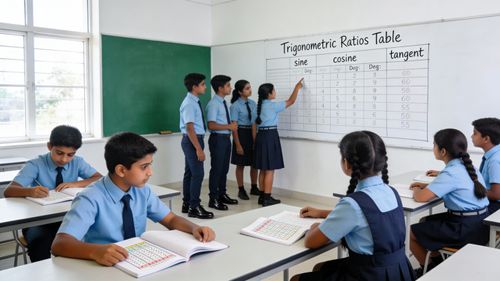

Table of Contents
- Understanding the Trigonometric Ratios Table
- The Six Trigonometric Ratios Explained Clearly
- Trigonometric Ratios Table 0 to 90 Degrees (Complete Explana
- Trigonometric Table Formulas and Identities
- How Students Should Learn the Trigonometric Ratios Table
- Why Most Students Struggle with Trigonometry
- PlanetSpark Math Course: Making Trigonometry Simple and Conf
- A Strong Foundation Today Builds Mathematical Confidence Tom
Understanding the Trigonometric Ratios Table is one of the most important milestones in a student’s mathematics journey. Whether it’s school exams, competitive tests, or building a strong foundation for higher classes, trigonometry plays a decisive role. Yet, for many students, trigonometry feels confusing, formula-heavy, and difficult to memorise.
This blog is designed to solve that exact problem.
If you are searching for a clear explanation of the trigonometric ratios table, want to understand trigonometric ratios values from 0 to 90 degrees, or are looking for a structured way to learn trigonometric table formulas without rote memorisation, you are in the right place. We will break down every concept step by step, explain why the formulas work, and show practical learning strategies used by top educators.
You will also discover how PlanetSpark’s Math Course helps students master trigonometry with confidence through personalised learning, interactive techniques, and concept-focused teaching rather than memorisation.

Understanding the Trigonometric Ratios Table
What Is the Trigonometric Ratios Table?
The Trigonometric Ratios Table is a systematically organised chart that displays the standard values of the six fundamental trigonometric ratios, sine (sin), cosine (cos), tangent (tan), cosecant (cosec), secant (sec), and cotangent (cot), for commonly used angles. These angles typically range from 0° to 90°, which is why it is also widely known as the trigonometric ratios table 0 to 90 degrees.
Each value in the table is derived from the ratios of sides of a right-angled triangle or from unit circle concepts. Because these values remain constant, the table serves as a reliable reference point for solving problems accurately and efficiently.
Instead of repeatedly calculating trigonometric ratios using formulas or diagrams, students can directly refer to the table to find exact values. This makes the table an indispensable tool in both learning and application stages of trigonometry.
The T ratio table is introduced at the school level and gradually becomes the backbone of more complex mathematical concepts. Students commonly use it in:
Class 9 and 10 mathematics curriculum
CBSE, ICSE, and state board examinations
Competitive exams such as Olympiads, NTSE, and scholarship tests
Physics problems involving angles, motion, waves, optics, and forces
Advanced topics like trigonometric identities and equations
Even at higher academic levels, the clarity developed through this table helps students understand graphs, transformations, and real-world applications of trigonometry.
Why the Trigonometric Ratios Table Is Important
Trigonometry is not merely about memorising formulas, it is about understanding the relationship between angles and side lengths in a right-angled triangle. The trigonometric ratios table condenses these relationships into fixed, easy-to-use numerical values, making complex problems more approachable.
Mastering the trigonometric ratios values is essential because it builds both speed and accuracy. When students confidently recall or understand these values, they can focus more on problem-solving strategies rather than calculations.
Key reasons why the trigonometric ratios table is important include:
Saves valuable time during exams by eliminating repetitive calculations
Builds confidence while solving trigonometric identities and equations
Forms the foundation for heights and distances problems
Supports algebraic manipulation in expressions involving sin, cos, and tan
Improves logical and analytical thinking, especially in multi-step problems
Helps avoid common errors caused by incorrect substitutions or approximations
Students who understand the logic behind trigonometric table formulas, such as why sin 30° equals 1/2 or why tan 45° equals 1, find it much easier to remember values naturally rather than memorising them blindly. This conceptual understanding leads to stronger retention and better performance across mathematics and science subjects.
The Six Trigonometric Ratios Explained Clearly
Introduction to Trigonometric Ratios
All trigonometric ratios are defined using a right-angled triangle. These ratios compare the lengths of the sides of the triangle relative to a chosen angle (θ).
The three sides involved are:
Hypotenuse – the longest side opposite the right angle
Opposite side – the side opposite the angle θ
Adjacent side – the side next to angle θ (excluding hypotenuse)
The Three Primary Trigonometric Ratios
Sine (sin θ)
Sin θ = Opposite / Hypotenuse
It measures how “high” the triangle rises relative to the hypotenuse.
Cosine (cos θ)
Cos θ = Adjacent / Hypotenuse
It shows how “wide” the triangle is relative to the hypotenuse.
Tangent (tan θ)
Tan θ = Opposite / Adjacent
It compares height to base directly.
These three ratios form the backbone of the T ratio table and are used most frequently in school-level problems.
The Three Reciprocal Trigonometric Ratios
Each primary ratio has a reciprocal:
Cosec θ = 1 / sin θ
Sec θ = 1 / cos θ
Cot θ = 1 / tan θ
Understanding this relationship makes learning the trigonometric table formulas significantly easier.
Trigonometric Ratios Table 0 to 90 Degrees (Complete Explanation)
Standard Angles Used in the Table
The standard angles used in the trigonometric ratios table 0 to 90 degrees are:
0°
30°
45°
60°
90°
These angles are chosen because their trigonometric ratios have exact, predictable values that can be derived geometrically.
Trigonometric Ratios Values Table
Below is the conceptual understanding of the standard table:
sin 0° = 0, cos 0° = 1, tan 0° = 0
sin 30° = 1/2, cos 30° = √3/2, tan 30° = 1/√3
sin 45° = 1/√2, cos 45° = 1/√2, tan 45° = 1
sin 60° = √3/2, cos 60° = 1/2, tan 60° = √3
sin 90° = 1, cos 90° = 0, tan 90° = undefined
From these values, cosec, sec, and cot values are easily calculated using reciprocals.
Understanding Why These Values Exist
Instead of memorising, PlanetSpark teaches students:
How 30°, 45°, and 60° angles come from equilateral and isosceles triangles
Why tan 90° is undefined
Why sin and cos values complement each other
This conceptual clarity removes fear and confusion.
Trigonometric Table Formulas and Identities
Core Trigonometric Identities
Understanding identities helps students simplify expressions easily:
sin²θ + cos²θ = 1
1 + tan²θ = sec²θ
1 + cot²θ = cosec²θ
These identities are directly connected to the trigonometric ratios table and are frequently tested in exams.
Relationship Between Ratios
sin θ = 1 / cosec θ
cos θ = 1 / sec θ
tan θ = 1 / cot θ
Recognising these relationships reduces memorisation load by nearly 50%.
Common Mistakes Students Make
Mixing up sin and cos values
Forgetting which ratios become undefined
Memorising without understanding
Applying wrong identity under exam pressure
PlanetSpark addresses these issues through practice-based clarity and personalised guidance.
Give your child personalised guidance and confidence in math with the PlanetSpark Math Course, built for long-term success.
How Students Should Learn the Trigonometric Ratios Table
Traditional Memorisation vs Conceptual Learning
Traditional learning often forces students to memorise the entire T ratio table mechanically. This leads to confusion and poor retention.
Conceptual learning focuses on:
Pattern recognition
Visual understanding
Logical derivation
Repeated application
Smart Techniques to Remember Values
Use sin-cos mirror patterns
Learn one row and derive others
Focus on square root patterns
Practice through real-world problems
PlanetSpark integrates all these techniques into live sessions.
Why Most Students Struggle with Trigonometry
Common Gaps in School Teaching
One-size-fits-all teaching pace
Lack of personalised attention
Formula-focused instruction
Limited practice time
How Top Performers Learn Differently
Top students:
Focus on concept clarity
Practice consistently
Get instant doubt resolution
Receive structured feedback
PlanetSpark replicates this high-performance learning environment for every child.

PlanetSpark Math Course: Making Trigonometry Simple and Confident
1:1 Personalized Sessions
Every child learns at a different pace. PlanetSpark offers one-on-one personalised math sessions tailored to individual strengths and learning gaps. This ensures no concept, including the trigonometric ratios table, remains unclear.
Interactive, Game-Based Learning
Math becomes engaging through puzzles, visual activities, and interactive challenges. Trigonometric values are learned through patterns, not pressure.
Concept Clarity Focus
Students understand:
Why formulas exist
How values are derived
Where each ratio is applied
This eliminates fear and boosts long-term retention.
Progress Tracking for Parents
Parents receive detailed progress reports highlighting:
Skill improvement
Concept mastery
Confidence levels
Areas needing reinforcement
Confidence-Building Activities
By removing fear and replacing it with understanding, PlanetSpark helps students develop a growth mindset toward math.
A Strong Foundation Today Builds Mathematical Confidence Tomorrow
Mastering the Trigonometric Ratios Table is not just about scoring marks, it is about building analytical thinking, problem-solving skills, and confidence that lasts beyond the classroom. When students understand trigonometric ratios conceptually, they stop fearing formulas and start enjoying math as a logical, structured subject.
PlanetSpark goes beyond traditional teaching by combining personalised learning, interactive methods, and deep concept clarity. This approach ensures that students not only learn trigonometry but apply it confidently in exams and real-life problem-solving situations.
If you want your child to excel academically while also developing strong communication and reasoning skills, PlanetSpark offers the perfect learning ecosystem.
You may also read:
Frequently Asked Questions
The trigonometric ratios table is used to quickly find the exact values of sin, cos, tan, cosec, sec, and cot for standard angles ranging from 0° to 90°. It helps students solve trigonometric equations, identities, and word problems efficiently without repeatedly calculating ratio values.
Angles between 0° and 90° have fixed trigonometric ratios that are most commonly used in school-level mathematics, board exams, and competitive assessments. Mastering this table ensures accuracy, saves time during exams, and forms the foundation for advanced trigonometric concepts.
Memorising trigonometric ratios values can be helpful for quick recall, especially during exams. However, conceptual understanding—knowing how these values are derived—leads to better long-term retention, fewer mistakes, and stronger problem-solving skills.
The T ratio table presents the standard numerical values of trigonometric ratios at specific angles, while trigonometric table formulas explain the relationships, identities, and transformations between these ratios. Both are essential and work together in solving trigonometric problems.
PlanetSpark helps students master trigonometry through 1:1 personalised sessions, interactive and game-based learning, and a strong focus on concept clarity. The approach builds confidence, improves exam readiness, and helps students understand the why behind every trigonometric formula and value.