
Learn Different Types of Matrices: Develop Logical Thinking
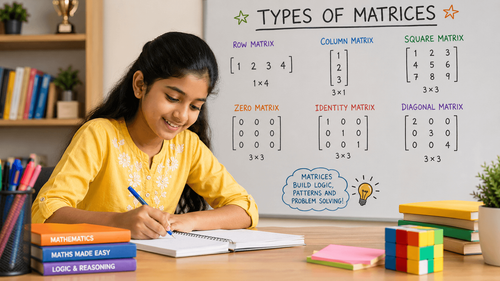

Table of Contents
- What Is a Matrix and Why Does It Matter?
- How Many Types of Matrices Are There?
- Explore the Most Important Different Types of Matrices
- What Are Triangular Matrices and How Are They Different?
- How Learning All Types of Matrix Builds Logical Thinking?
- How PlanetSpark Helps Kids Excel at Logical Thinking Through
- Start Your Child's Journey to Logical Excellence Today!
Have you ever looked at a grid of numbers and wondered what it means? Mathematics introduces us to powerful tools, and one of the most important is the matrix. Understanding different types of matrices helps kids think logically, solve problems faster, and even perform better in competitive exams. Yet, many students find matrices confusing because they have never seen a clear, simple explanation.
This blog covers everything you need to know about matrices. Starting from the basic definition of matrix in maths to examples of matrices in real life, this guide walks you through all types of matrix with child-friendly language. You will also discover how matrices build logical thinking skills that go far beyond the classroom.
What Is a Matrix and Why Does It Matter?
Before exploring the different types of matrices, it is important to understand what a matrix actually is. In simple terms, a matrix is a rectangular arrangement of numbers, symbols, or expressions placed in rows and columns. It looks like a table, but in mathematics, it has a very specific purpose.
The definition of matrix in maths is: an ordered rectangular array of numbers or functions enclosed within square brackets. Each number inside the matrix is called an element. The position of each element is described using its row number and column number.
For example, if a matrix has 2 rows and 3 columns, it is called a 2x3 matrix. This notation tells you the size, or order, of the matrix. Understanding this basics of matrices concept is the first step toward using them confidently.
Matrices are used in everyday life more than most people realise. Computer graphics, data science, weather predictions, and even mobile games use matrices to process information quickly. When a child learns to read and work with a matrix, they are training their brain to recognise patterns and think in a structured, logical way.
How Many Types of Matrices Are There?
This is one of the most commonly asked questions by students and parents alike. How many types of matrices exist, and how are they different from each other? The answer depends on the size, values, and structure of the matrix. There are more than ten recognised types, but the most important ones for kids and beginners are covered below.
Knowing all types of matrix helps students choose the right method when solving problems. Each type has unique properties that make it useful in a specific situation. Think of it like different shapes of containers. A round bowl holds soup better, while a flat plate holds rice better. Similarly, different matrix types are designed for different mathematical purposes.
Here is a quick overview before diving deep into each type:
- Row Matrix
- Column Matrix
- Square Matrix
- Rectangular Matrix
- Zero Matrix (Null Matrix)
- Identity Matrix
- Diagonal Matrix
- Scalar Matrix
- Symmetric Matrix
- Triangular Matrix
Learning to define matrix and its types gives students a strong foundation for higher mathematics, including algebra and data analysis.
Want your child to think logically and love numbers?
Join PlanetSpark Maths Classes.
Book a free trial now!
Explore the Most Important Different Types of Matrices
Row Matrix and Column Matrix
A row matrix has only one row and any number of columns. For example, [1, 2, 3] is a row matrix with 1 row and 3 columns. It is one of the simplest examples of matrices a child will encounter.
A column matrix is the opposite. It has only one column and any number of rows. Both of these are easy to understand and form the building blocks of matrix operations.
Square Matrix and Rectangular Matrix
A square matrix has an equal number of rows and columns. For example, a 3x3 matrix is a square matrix. Square matrices are especially important because operations like finding the determinant are only possible on them.
A rectangular matrix, on the other hand, has a different number of rows and columns, such as a 2x4 or 3x5 matrix. These are among the most common examples of matrices found in textbooks.
Zero Matrix and Identity Matrix
A zero matrix, also called a null matrix, has all elements equal to zero. It is used as a neutral element in matrix addition, similar to how zero works in regular addition.
An identity matrix is a special square matrix where all diagonal elements are 1 and all other elements are 0. It acts like the number 1 in multiplication. When any matrix is multiplied by an identity matrix, the result is the original matrix unchanged.
Diagonal, Scalar, and Symmetric Matrices
A diagonal matrix is a square matrix where all non-diagonal elements are zero. Only the elements along the main diagonal can be non-zero.
A scalar matrix is a diagonal matrix where all diagonal elements are the same value. For instance, if all diagonal elements are 5, it is a scalar matrix.
A symmetric matrix is one where the element at row i and column j is equal to the element at row j and column i. In other words, it is equal to its own transpose.
What Are Triangular Matrices and How Are They Different?
Triangular matrices are square matrices where the elements either above or below the main diagonal are all zero. There are two kinds:
- Upper Triangular Matrix: All elements below the main diagonal are zero.
- Lower Triangular Matrix: All elements above the main diagonal are zero.
These matrix types are especially useful in solving systems of equations. When students begin learning how to define matrix and its types in higher classes, triangular matrices appear frequently in advanced problem-solving.
To make it clearer, consider an upper triangular matrix with three rows and three columns. The numbers in the bottom-left corner will all be zero, while the top-right and diagonal positions can hold any value. This structure makes calculations much faster and more organised.
Understanding triangular matrices also trains children to notice structure and patterns within grids of numbers. This kind of thinking directly strengthens logical reasoning. It is similar to solving a puzzle where recognising the pattern leads you to the answer.
Many students confuse triangular matrices with diagonal matrices. The key difference is simple. In a diagonal matrix, both above and below the diagonal are zero. In a triangular matrix, only one side is zero.
EXAMPLE
Learning the definition of matrix in maths becomes much easier when students see how it connects to the real world. Here are some relatable and fun examples of matrices that children can understand:
- Seating Plans: A classroom seating chart with rows and columns of seats is a real-life matrix. Each seat can be described by its row and column number.
- Pixel Grids: Every image on a computer screen is made up of thousands of tiny squares called pixels. These pixels are arranged in rows and columns, just like a matrix.
- Scorecards: A cricket scorecard showing runs scored by each batsman in each over is a type of matrix with rows for batsmen and columns for overs.
- Puzzle Grids: Games like Sudoku use a 9x9 matrix where each row, column, and smaller grid must contain specific numbers.
- Timetables: A school timetable showing subjects for each period and each day is structured exactly like a matrix.
When children understand that matrices are not just abstract maths but actual tools used in games, sports, and technology, their interest grows. This shift in perspective is one of the reasons why hands-on learning produces better results than rote memorisation.
How Learning All Types of Matrix Builds Logical Thinking?
There is a strong connection between understanding different types of matrices and developing logical thinking. Working with matrices trains the brain in several important ways:
- Pattern Recognition: Identifying whether a matrix is symmetric, diagonal, or triangular requires spotting patterns within numbers.
- Spatial Thinking: Visualising rows and columns, and understanding positions like (row 2, column 3), strengthens spatial awareness.
- Structured Problem Solving: Matrices teach children to approach complex problems by breaking them into smaller, organised parts.
- Attention to Detail: A single wrong element can change the type of a matrix entirely. This encourages children to be precise and careful.
When a child learns to define matrix and its types correctly, they are not just memorising definitions. They are practising the art of logical classification, which is a skill used in coding, science, and decision-making.
According to educators and cognitive researchers, structured mathematical thinking in early years lays the foundation for better academic performance and sharper analytical abilities in adulthood. Basics of matrices is one such structured framework that rewards careful thought and disciplined practice.
Helping children learn matrices does not have to feel like extra homework. With the right approach, it becomes an exciting challenge. Here are some practical tips:
Start with a Grid: Draw a simple 3x3 table and fill it with numbers. Ask your child to identify rows and columns. This creates a visual anchor for all matrix concepts.
Use Colour Coding: Highlight the diagonal elements in one colour and off-diagonal elements in another. This makes it easier to understand diagonal matrices and identity matrices.
Play Matrix Games: Create a simple game where you call out a position like "row 2, column 3" and your child identifies the number at that spot.
Compare with Tables: Show how a multiplication table is actually a matrix. Children already know multiplication tables, so linking them to matrices makes the concept familiar.
Review One Type Per Day: Instead of trying to learn how many types of matrices exist all at once, focus on one type per day. Start with row and column matrices, then move to square and rectangular, and gradually work towards identity and triangular types.
With consistent practice and a structured approach, even young children can confidently understand all types of matrix within a few weeks.
Help your child build a strong maths foundation.
Explore PlanetSpark's expert-led Maths Classes today. Start for free!
How PlanetSpark Helps Kids Excel at Logical Thinking Through Maths
Unlock Your Child's Logical Mind With PlanetSpark Maths Classes
PlanetSpark's Maths classes are designed for children who want to go beyond textbook learning and truly understand concepts like the different types of matrices, number patterns, and logical reasoning. Whether your child is just starting to explore the basics of matrices or wants to strengthen their problem-solving abilities, PlanetSpark offers a structured path to success.
- Live, Interactive Classes: Every session is conducted live with a trained teacher, so children can ask questions, participate, and learn in real time rather than watching recorded videos passively.
- Expert Teachers: PlanetSpark's educators are trained specifically for young learners and know how to make abstract concepts like the definition of matrix in maths engaging and clear.
- Real-World Application: Lessons connect mathematical ideas to everyday situations, helping children see the relevance of what they are learning inside and outside school.
- Personalized Feedback: Each child receives individual attention and feedback on their understanding, so no child is left behind or held back.
- Confidence-Building Framework: Classes are designed to help children speak up, attempt problems bravely, and develop a growth mindset toward challenging topics.
- Structured Curriculum: The curriculum is sequenced carefully to build knowledge layer by layer, from basics of matrices to advanced types, ensuring deep and lasting understanding.
Start Your Child's Journey to Logical Excellence Today!
Understanding different types of matrices is more than a maths exercise. It is the beginning of a journey toward sharper thinking, better problem solving, and greater confidence in academic and real-world challenges. Whether a child is learning to define matrix and its types for the first time or revisiting concepts to prepare for an exam, consistent effort always pays off.
Mathematics rewards curiosity. When children approach topics like matrices with an open mind and a willingness to practice, they discover that what once seemed difficult becomes surprisingly clear. The logical thinking skills built through learning examples of matrices stay with a child for life, helping them in science, technology, sports strategy, and everyday decision-making.
Encourage your child to take one small step every day. Review one type of matrix, draw one grid, solve one problem. Over time, these small habits build into something remarkable. The child who once asked "how many types of matrices are there?" will one day explain them confidently to others. That transformation is the ral reward of learning.
Keep exploring, keep practising, and trust the process. The world of matrices has so much to offer.

Also read: Top 5 Paper Presentation Tips for Students in Board Exams
Frequently Asked Questions
Yes, determinants are essential to determine if a matrix is invertible. A non-zero determinant allows calculation of the inverse, while a zero determinant shows the matrix has no inverse.
Relying solely on formulas won't lead to mastery in matrix operations. It's crucial to understand the structure, order, and logical application of the formulas. A deeper understanding helps students apply formulas accurately in real-world problems.
It helps students communicate clearly and build strong arguments. It is useful in academics, debates, and everyday communication.
Yes, matrices can be used for advanced geometric transformation. Rotation and reflection can be performed using 2×2 matrices, which makes it easier to transform multiple points efficiently.
Yes! PlanetSpark makes learning enjoyable through interactive quizzes, storytelling, word games, and challenges, so kids stay engaged while mastering grammar and sentence formation.
With regular practice and expert guidance, many learners notice improvements in confidence and stakeholder management skills within a few weeks, making it easier to apply these skills at work immediately.