
Understand Types of Symmetry with Simple Shapes
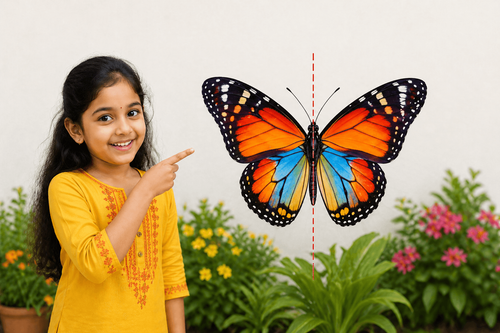

Table of Contents
- What is Symmetry Meaning in Maths?
- Main Types of Symmetry Every Child Should Know
- Types of Symmetry in Common Shapes
- How to Identify Lines of Symmetry Easily
- Why Learning Symmetry Helps Kids Beyond Maths
- Fun Activities to Learn Types of Symmetry at Home
- Common Mistakes Kids Make in Symmetry
- How to Fix These Mistakes
- PlanetSpark Maths Classes for Young Learners
- Discover the Hidden Beauty of Maths Through Symmetry
What if maths was hiding inside butterflies, stars, flowers, and even your own face? That is exactly where symmetry begins.
Many children see matching shapes every day but do not know the concept behind them. Types of symmetry help kids understand how shapes stay balanced when they are flipped, turned, or divided into equal parts. It is one of the most visual and exciting topics in geometry.
In this blog, you will learn the symmetry meaning, major symmetry types, lines of symmetry in common shapes, real-life examples, mistakes to avoid, and fun ways to practice at home. By the end, your child will start spotting symmetry everywhere.
What is Symmetry Meaning in Maths?
The symmetry meaning in maths is simple. A shape, figure, or object is symmetrical when one part matches another part exactly after a transformation such as flipping, turning, or sliding.
This means the shape keeps the same appearance even after movement or division.
For children, symmetry can be explained as balance with matching sides.
Easy Example
Imagine folding a paper heart in half. If both sides match perfectly, the heart has symmetry.
Where Kids See Symmetry Daily
- Butterfly wings
- Human face
- Leaves
- Windows
- Stars
- Snowflakes
- Books opened in the center
Why Symmetry Matters
Learning symmetry helps children:
- Understand Geometry Concepts Faster: Learning symmetry helps children recognize shapes, sides, angles, and equal parts more easily. It builds a strong base for geometry topics taught in higher classes.
- Improve Observation Skills: Children begin to notice details carefully when identifying matching sides and balanced patterns. This sharpens their ability to observe objects more accurately.
- Notice Patterns Clearly: Symmetry trains the mind to identify repeating designs and organized arrangements. This skill is useful in maths, art, and everyday problem-solving.
- Draw Shapes Accurately: When children understand symmetry, they can create balanced drawings with equal proportions. It improves neatness and confidence in sketching shapes.
- Build Logical Thinking: Symmetry encourages children to compare, analyze, and check whether parts match correctly. This strengthens reasoning and step-by-step thinking skills.
Many maths topics later, like angles, polygons, graphs, and coordinates, become easier when symmetry is understood early.
Want your child to enjoy maths instead of fearing shapes?
Book a live trial class now before confusion grows harder to fix.
Main Types of Symmetry Every Child Should Know
There are several types of symmetry in mathematics. For school learners, these are the most important ones.
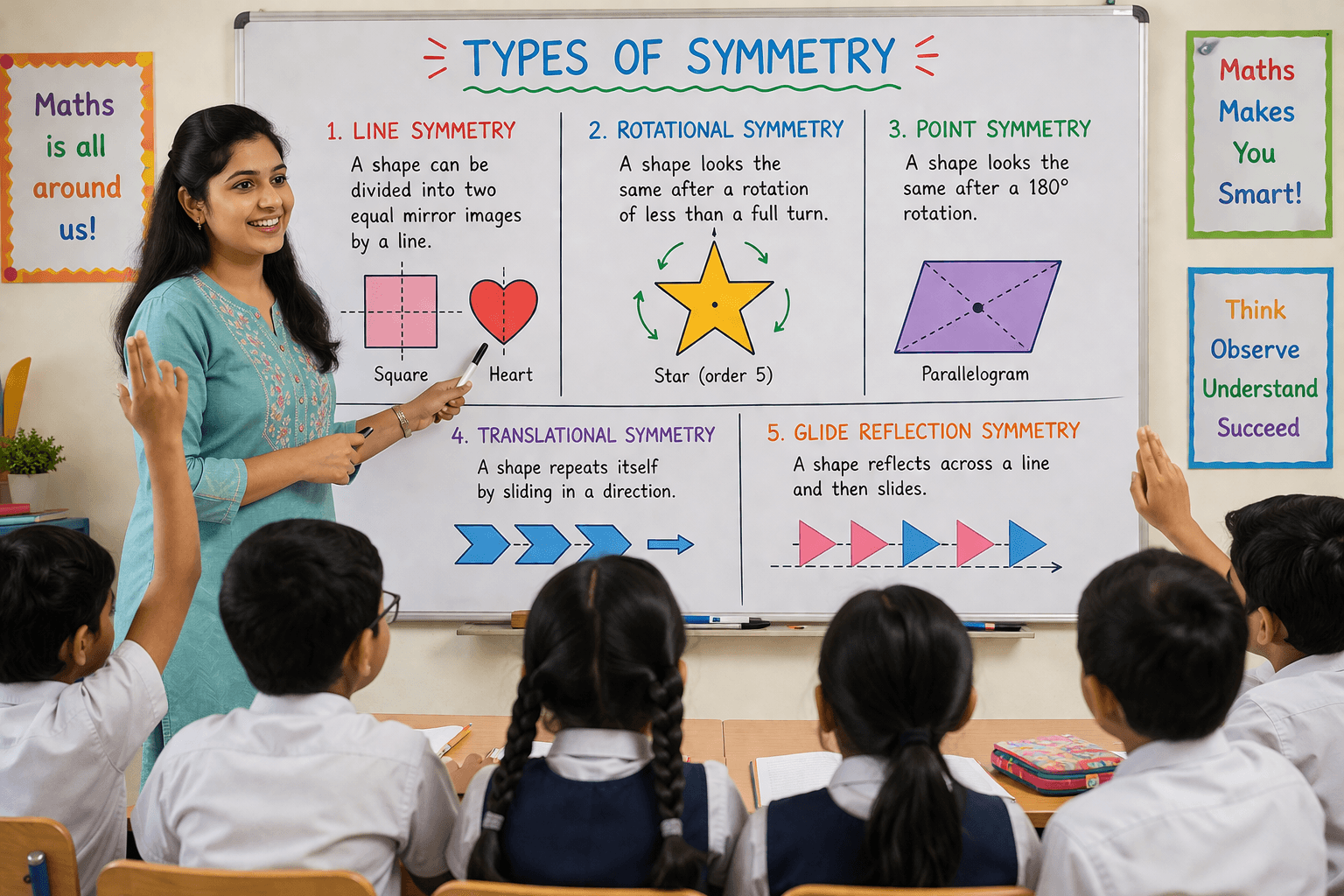
1. Reflectional or Line Symmetry
A shape has reflection symmetry when a line divides it into two equal mirror-image halves.
This line is called the line of symmetry.
Examples:
- Heart
- Butterfly
- Square
- Circle
- Letter A
If folded along the correct line, both sides overlap perfectly.
2. Rotational Symmetry
A shape has rotational symmetry when it looks the same after turning around a center point by less than a full turn.
Examples:
- Square after 90° turn
- Star after partial turn
- Circle after any turn
3. Point Symmetry
Point symmetry happens when every point on one side has a matching point on the opposite side through a center point. This usually means the shape looks the same after 180° rotation.
Examples:
- Letter S
- Letter Z
- Parallelogram
4. Translational Symmetry
A figure repeats itself when slid in one direction without changing shape.
Examples:
- Floor tiles
- Wallpaper patterns
- Brick walls
5. Glide Reflection Symmetry
This combines reflection and sliding.
Seen in:
- Footprints
- Decorative border patterns
Understanding these symmetry types helps children connect maths with the world around them.
Types of Symmetry in Common Shapes
Shapes are the easiest way to learn types of symmetry.
Square
A square has:
- 4 equal sides
- 4 lines of symmetry
- Rotational symmetry
Its symmetry lines are:
- Vertical
- Horizontal
- Two diagonals
Rectangle
A rectangle has:
- Opposite sides equal
- 2 lines of symmetry
Its diagonals are not symmetry lines unless it is a square.
Triangle
Different triangles have different symmetry.
Equilateral Triangle
- 3 equal sides
- 3 lines of symmetry
Isosceles Triangle
- 2 equal sides
- 1 line of symmetry
Scalene Triangle
- No equal sides
- No line symmetry
Circle
A circle has:
- Infinite lines of symmetry
- Rotational symmetry at every angle
Pentagon
A regular pentagon has 5 lines of symmetry.
Hexagon
A regular hexagon has 6 lines of symmetry.
Quick Rule
For regular polygons, the number of lines of symmetry usually equals the number of sides.
Still confused between square and rectangle symmetry?
Book a demo maths class now and master shapes faster than the next test.
How to Identify Lines of Symmetry Easily
Many children know definitions but struggle in worksheets. These methods make symmetry easier.
1. Folding Method
Cut the shape on paper.
Fold it carefully. If both halves overlap perfectly, the fold line is a symmetry line.
Best for:
- Hearts
- Triangles
- Squares
- Stars
2. Mirror Method
Place a mirror along a possible symmetry line.
If the reflection completes the figure correctly, that is a valid line.
3. Grid Method
Draw shapes on graph paper.
Count boxes on both sides of the center line.
4. Visual Check
Ask:
- Are both sides the same size?
- Are both sides the same shape?
- Is the line exactly centered?
Example
Children often think any diagonal in a rectangle is symmetry. It is not. Folding reveals mismatch.
Parent Tip
Use household objects like plates, notebooks, pencils, leaves, and cups to make symmetry practice fun.
Why Learning Symmetry Helps Kids Beyond Maths
Symmetry is not just a chapter in a textbook. It develops real thinking skills that support learning, creativity, and confidence in many areas of life.
1. Better Observation Skills
Children learn to notice balance, matching sides, and small details when studying symmetry. This improves their focus and helps them observe shapes, objects, and patterns more carefully in everyday life.
2. Stronger Geometry Basics
Symmetry builds a strong foundation for geometry by helping children understand shapes, lines, angles, and equal parts. Topics like transformations and polygons become easier to learn later.
3. Improved Drawing and Creativity
Kids use symmetry to draw faces, flowers, butterflies, houses, and designs more neatly. It helps them create balanced artwork and boosts confidence in creative activities.
4. Logical Thinking
Symmetry teaches children to compare two sides, test ideas, and check whether parts match correctly. This develops reasoning skills and encourages step-by-step thinking.
5. Confidence in Problem Solving
When visual maths concepts become easier, children feel more confident answering questions in class. Success in symmetry often motivates them to enjoy other maths topics too.
Real Life Uses of Symmetry
Nature
- Butterfly wings
- Leaves
- Flowers
- Snowflakes
Architecture
Many buildings use symmetry to look balanced and beautiful.
Art and Design
- Rangoli
- Logos
- Jewelry
- Textiles
Technology
Cars, machines, and tools often use balanced designs.
Math confidence grows with guided practice, not guessing.
Secure your child’s trial session today before slots fill this week.
Fun Activities to Learn Types of Symmetry at Home
Children learn best through doing. Use these hands-on activities.
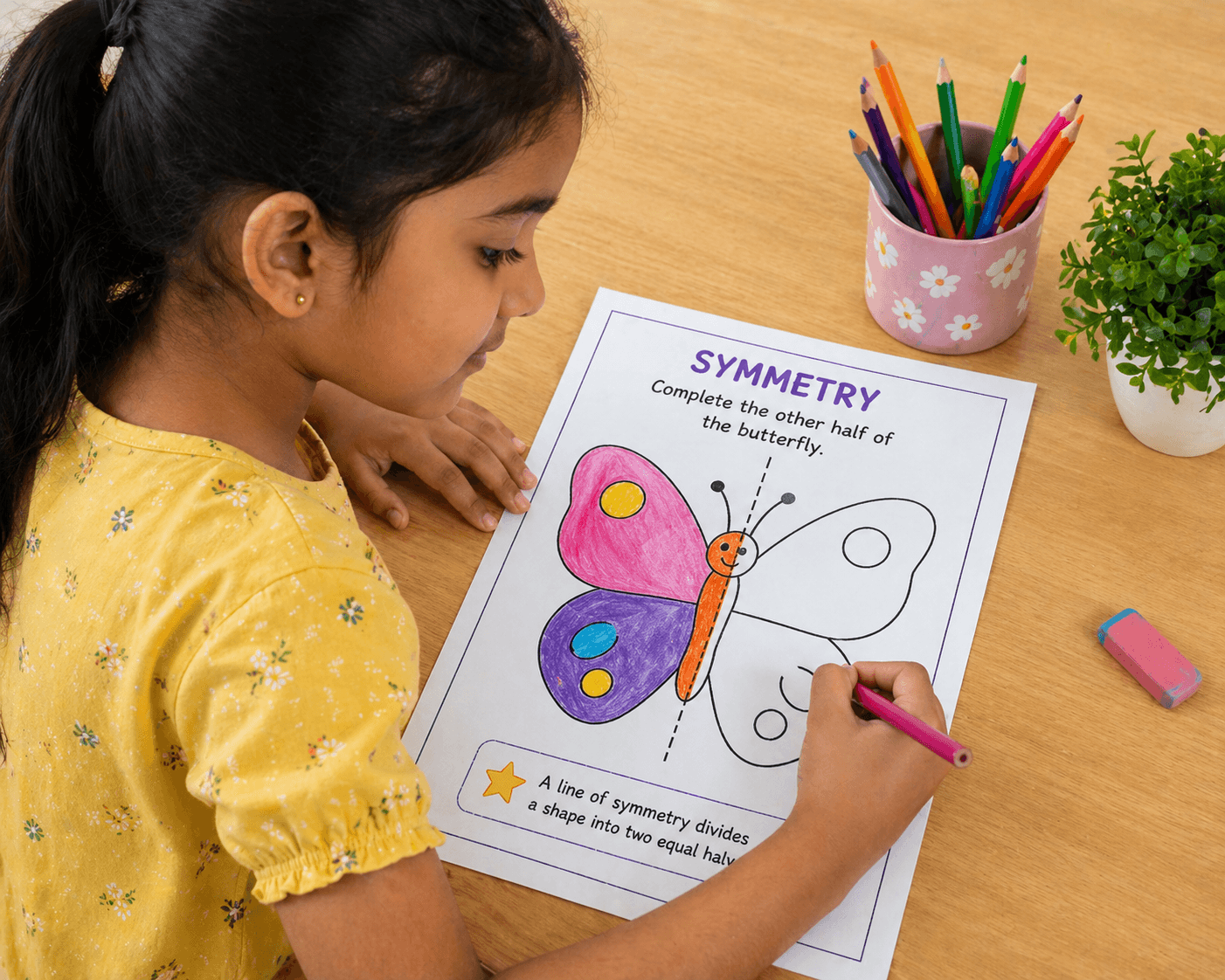
1. Complete the Other Half
Draw half a shape and ask your child to complete it.
Examples:
- Heart
- Star
- Butterfly
- House
2. Paper Folding Art
Fold paper, cut shapes, and open it to reveal symmetry.
3. Mirror Drawing
Use a mirror beside half an image.
4. Symmetry Hunt
Search the house for symmetrical objects.
Examples:
- Spoon
- Plate
- Book
- Window
5. Rangoli Patterns
Traditional rangoli designs are perfect examples of reflectional symmetry.
6. Shape Sorting Game
Sort shapes into:
- Has symmetry
- No symmetry
- One line
- Many lines
7. Turn and Match Game
Use cardboard shapes and rotate them to test rotational symmetry.
These games turn learning into play.
Common Mistakes Kids Make in Symmetry
Even bright learners make predictable mistakes while learning symmetry. With the right practice, these errors can be corrected quickly and confidently.
Mistake 1: Unequal Halves
Many children draw two sides that look similar but are not exactly the same size or shape. In symmetry, both halves must match perfectly to be correct.
Mistake 2: Wrong Center Line
Some students place the line of symmetry off-center or in the wrong direction. The line must divide the shape into two equal matching parts.
Mistake 3: Counting Too Many Lines
Children may think any line drawn through a shape is a symmetry line. Only lines that create identical mirror-image halves should be counted.
Mistake 4: Forgetting Rotation
Students often confuse rotational symmetry with line symmetry. Rotational symmetry means the shape matches after turning, not folding.
Mistake 5: Mixing Shape Names
Children sometimes apply square rules to rectangles or confuse triangle types. Knowing each shape’s properties helps avoid symmetry mistakes.
How to Fix These Mistakes
- Use Graph Paper: Graph paper helps children measure equal distances and draw matching halves more accurately.
- Fold Real Shapes: Paper folding makes symmetry visual and easy to understand through hands-on learning.
- Practice Daily for 10 Minutes: Short regular practice sessions build confidence and improve accuracy over time.
- Start Simple, Then Level Up: Begin with squares and hearts before moving to stars, polygons, and rotations.
- Learn Visually with a Teacher: Guided learning with visual examples helps children understand concepts faster and avoid repeated errors.
Small mistakes today can become big maths gaps tomorrow.
Book a guided trial now and correct concepts before exams begin.
PlanetSpark Maths Classes for Young Learners
Build Concept Clarity with Structured Maths Learning
PlanetSpark offers engaging learning programs that help children become confident learners through interactive teaching methods. For students who find shapes, geometry, calculations, or problem-solving difficult, guided support can make a major difference.
PlanetSpark learning experiences focus on making concepts understandable through examples, practice, and personalized attention. Children learn better when they can ask questions freely and receive feedback in real time.
Who These Classes Are For
- Kids struggling with maths confidence
- Students needing concept clarity
- Learners preparing for school assessments
- Children who enjoy advanced learning challenges
- Parents looking for structured support
What Problems Structured Learning Solves
- Fear of maths
- Weak basics
- Confusion in geometry topics
- Lack of practice routine
- Low confidence during tests
Key Features
- Live interactive classes
- Expert educators
- Child-friendly teaching methods
- Step-by-step concept explanation
- Personalized doubt solving
- Practice worksheets
- Progress tracking and feedback
Why Parents Choose Guided Learning
When children learn alone, errors can become habits. Guided sessions help correct mistakes early and build consistent confidence.

Discover the Hidden Beauty of Maths Through Symmetry
Symmetry shows children that maths is not only numbers on a page. It lives in flowers, stars, buildings, patterns, and everyday objects. When kids understand types of symmetry, they become sharper thinkers, better observers, and more confident learners.
With regular practice, simple activities, and the right guidance, symmetry can become one of the easiest and most enjoyable topics in maths. Keep exploring the world around you because every balanced shape is teaching a lesson.
Also Read: Rotational Symmetry: Learn Core Geometry Concepts with PlanetSpark
Shapes Around Us Class 4: Understand Shapes in Real Life Easily
Frequently Asked Questions
Symmetry means a shape has matching parts that stay the same after flipping, turning, or dividing equally.
The main types are line symmetry, rotational symmetry, point symmetry, translational symmetry, and glide reflection symmetry.
A square has 4 lines of symmetry.
Yes. A rectangle has 2 lines of symmetry.
Any diameter divides the circle into two equal halves, so there are unlimited possible lines.
An equilateral triangle has 3 lines of symmetry.
Use folding paper, mirrors, drawing games, and object hunts.
It helps children understand shapes, patterns, geometry, and logical reasoning.