
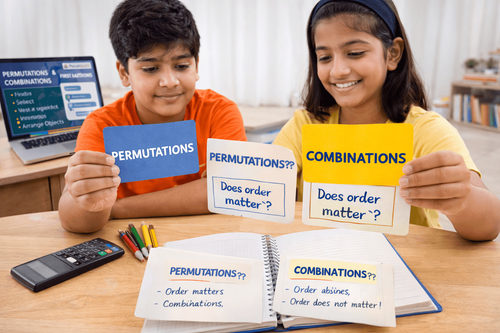

Permutations and combinations are two important topics in mathematics that help students understand how different arrangements and selections are formed. These concepts are widely used in probability, statistics, and logical reasoning, making them essential for middle school and senior school students.
Many students find permutations confusing at first because formulas appear suddenly without enough explanation. However, when these concepts are taught step by step with clear logic and simple examples, they become much easier to understand and apply.
In this blog, we will explain permutations and combinations from the basics, focus on clarity, and help students learn how to use formulas correctly without confusion.
What Are Permutations in Maths?
Permutations deal with arrangements where the order of items matters. Whenever we are arranging objects in a specific sequence, we are dealing with permutations.
In simple words, permutations tell us:
How many different ways objects can be arranged
Where the position of each object is important
For example, arranging books on a shelf or deciding the order of students standing in a line involves permutations.
Simple Permutations Example
Let us understand permutations with a simple example.
Suppose there are three letters: A, B, and C.
The different arrangements possible are:
ABC
ACB
BAC
BCA
CAB
CBA
Even though the same letters are used, each arrangement is different because the order changes. This is why this situation is an example of permutations.

Why Order Matters in Permutations
Understanding why order matters is crucial before learning any permutations formula.
Consider this example:
Selecting a class monitor and a class captain
If Rahul is the monitor and Riya is the captain, it is different from:
Riya being the monitor and Rahul being the captain
Because the roles change, the order matters. This situation uses permutations.
Help your child build strong logical thinking and problem solving skills.
Book a free PlanetSpark trial class today.
What Are Combinations in Maths?
Combinations are used when the order of items does not matter. In combinations, only the selection matters, not the arrangement.
In simple words, combinations tell us:
How many ways objects can be chosen
Where position or order is not important
For example, choosing students for a team or selecting books to read involves combinations.
Difference Between Permutations and Combinations
Students often confuse permutations combination problems. A simple comparison helps clarify the difference.
Permutations involve arrangement and order matters
Combinations involve selection, and order does not matter
Example:
Arranging students on a stage uses permutations
Selecting students for a group uses combinations
Once students learn this distinction, choosing the correct method becomes easier.
Real Life Situations Using Permutations and Combinations
Permutations and combinations are not just exam topics. They appear in daily life more often than students realise.
Examples include:
Creating passwords
Scheduling events
Selecting teams
Arranging seats
Understanding these concepts improves logical reasoning and decision making.
Don’t wait to strengthen your child’s maths foundations.
Sign up for a PlanetSpark maths session today.
Basic Factorial Concept
Before learning any permutations formula, students must understand factorials.
Factorial of a number n is written as n!
It means multiplying all whole numbers from n down to 1.
Examples:
5! = 5 × 4 × 3 × 2 × 1 = 120
4! = 4 × 3 × 2 × 1 = 24
1! = 1
Factorials are the building blocks of permutations and combinations.
Permutations Formula Explained Simply
The most important permutations formula is used to find the number of ways to arrange r objects from n objects.
Permutations formula:
nPr = n! divided by (n − r)!
Where:
n is the total number of objects
r is the number of objects selected
This formula helps calculate arrangements quickly without listing all possibilities.
Permutations Formula Example
Let us apply the permutations formula step by step.
Example
How many ways can 3 students be arranged out of 5 students?
Here:
n = 5
r = 3
Apply the formula:
5P3 = 5! divided by (5 − 3)!
5P3 = 5! divided by 2!
5P3 = (5 × 4 × 3 × 2 × 1) divided by (2 × 1)
5P3 = 60
So, there are 60 different arrangements.
Help your child understand maths formulas with clarity and confidence.
Book a free PlanetSpark trial class today.
More Examples of Permutations for Better Clarity
Practising different types of examples helps students understand how permutations work in real problems.
Example 1: Arranging Digits
How many different numbers can be formed using digits 1, 2, and 3 without repetition?
Step 1: Total digits available
n = 3
Step 2: Number of positions
r = 3
Step 3: Apply the permutations formula
3P3 = 3! = 6
So, 6 different numbers can be formed.
Example 2: Arranging Students
How many ways can 2 students be chosen and arranged from 4 students?
Step 1: Identify values
n = 4, r = 2
Step 2: Use permutations formula
4P2 = 4! divided by 2!
4P2 = 4 × 3 = 12
This means there are 12 possible arrangements.
Special Cases in Permutations
Some permutations problems involve special conditions that students should learn to recognise.
Permutations When All Objects Are Used
When all objects are arranged, the formula becomes:
nPn = n!
Example:
Arranging 5 books on a shelf
Number of ways = 5! = 120
Permutations with Repetition
If repetition is allowed, the number of permutations increases.
Example:
How many 3 digit numbers can be formed using digits 1 and 2 if repetition is allowed?
Each place can have 2 choices.
Total permutations = 2 × 2 × 2 = 8
Understanding whether repetition is allowed is very important in permutations problems.
Common Mistakes Students Make in Permutations
Many students lose marks due to small errors. Being aware of these helps improve accuracy.
Using combinations instead of permutations
Forgetting to check whether order matters
Making mistakes in factorial calculation
Ignoring repetition conditions
Encouraging students to read questions carefully helps avoid these mistakes.

Introduction to Combinations
Now that permutations are clear, let us move on to combinations.
Combinations are used when we want to select objects without caring about the order.
In combinations:
Selection matters
Arrangement does not matter
This is why combinations often give smaller answers than permutations.
Combinations Formula Explained
The combinations formula helps calculate the number of ways to choose r objects from n objects.
Combinations formula:
nCr = n! divided by [r! × (n − r)!]
Where:
n is the total number of objects
r is the number selected
This formula is used in most permutations combination problems.
Simple Combinations Example
Let us apply the combinations formula step by step.
Example
How many ways can 3 students be selected from 5 students?
Step 1: Identify values
n = 5, r = 3
Step 2: Apply the formula
5C3 = 5! divided by (3! × 2!)
Step 3: Simplify
5C3 = (5 × 4) divided by (2 × 1)
5C3 = 10
So, there are 10 possible selections.
Why Combinations Give Smaller Answers
In permutations, order creates multiple arrangements of the same group. In combinations, those arrangements are counted only once.
Example:
AB and BA are different in permutations
AB and BA are the same in combinations
Understanding this difference helps students choose the correct formula confidently.
Don’t wait to strengthen your child’s understanding of core maths concepts.
Sign up for a PlanetSpark maths session today.
More Examples of Combinations for Strong Understanding
Practising combinations through varied examples helps students apply the formula confidently.
Example 1: Selecting Subjects
A student has to choose 2 subjects out of Maths, Science, English, and History.
How many different combinations are possible?
Step 1: Total subjects
n = 4
Step 2: Subjects to be selected
r = 2
Step 3: Apply combinations formula
4C2 = 4! divided by (2! × 2!)
Step 4: Simplify
4C2 = 6
So, there are 6 different combinations.
Example 2: Team Selection
How many teams of 3 students can be formed from a class of 7 students?
Step 1: Identify values
n = 7, r = 3
Step 2: Apply the combinations formula
7C3 = 7! divided by (3! × 4!)
Step 3: Simplify
7C3 = 35
So, 35 different teams can be formed.
Relationship Between Permutations and Combinations
There is a strong relationship between permutations and combinations. Understanding this link helps students move between formulas easily.
The relationship is:
nPr = nCr × r!
This shows that permutations include all possible arrangements of each combination.
Using the Relationship Formula
Example
Find the number of permutations of selecting and arranging 3 students from 5 students.
Step 1: Find combinations
5C3 = 10
Step 2: Multiply by 3!
5P3 = 10 × 6
5P3 = 60
This confirms the result obtained earlier.
How to Decide Between Permutations and Combinations
Students often struggle to decide which method to use. Asking the right questions helps.
Use permutations when:
Order matters
Positions or roles are different
Use combinations when:
Only selection matters
Order does not change the outcome
Reading the question carefully before solving is essential.

Common Mistakes Students Make in Permutations and Combinations
Understanding common mistakes helps students improve accuracy.
Confusing permutations with combinations
Using the wrong formula
Making errors in factorial calculations
Ignoring whether repetition is allowed
Encouraging slow and careful problem reading reduces these errors.
Practice Questions for Permutations and Combinations
Regular practice strengthens understanding and speed.
Question 1
How many ways can 4 students be arranged out of 6 students?
Solution:
6P4 = 6! divided by 2!
6P4 = 360
Question 2
How many ways can 2 students be selected from 6 students?
Solution:
6C2 = 6! divided by (2! × 4!)
6C2 = 15
Question 3
In how many ways can a committee of 3 be formed from 5 people?
Solution:
5C3 = 10
Help your child practise exam ready maths problems with confidence.
Sign up for a PlanetSpark maths session today.
How PlanetSpark Helps Students Master Permutations and Combinations
PlanetSpark focuses on concept clarity and structured learning to help students understand important maths topics.
Step-by-step explanations make formulas easy to understand
Guided practice sessions help students apply concepts correctly
Personalized feedback helps identify and correct mistakes
Logical thinking activities strengthen reasoning skills
With regular practice and expert guidance, students gain confidence in solving permutation combination problems.
Final Summary: Permutations and Combinations Made Simple
Permutations and combinations form a vital part of logical and mathematical thinking. By understanding when order matters, learning the correct permutations formula, and practising combinations step by step, students can solve problems with confidence and accuracy.
With clear explanations, consistent practice, and the right guidance, permutations and combinations become easier and more enjoyable to learn.