
What Are Shapes? Learn with Fun Lessons at PlanetSpark
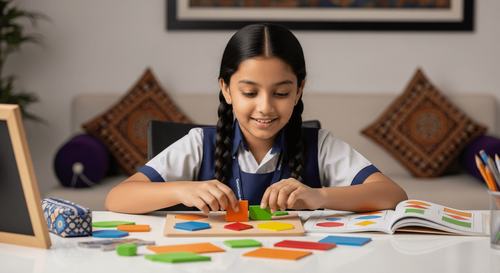

Shapes are everywhere! From the books children read to the toys they play with, understanding shapes is a fundamental part of learning mathematics. This guide explains what shapes are, their types, properties, and how they are used in everyday life. With step-by-step lessons, tables, and examples, kids can learn about geometric shapes in a fun and engaging way.
What Are Shapes in Geometry
In mathematics, shapes are figures that can be flat or solid. They are used to describe and understand the form of objects in space.
- 2D shapes are flat figures with length and width, such as squares, circles, and triangles.
- 3D shapes or solid shapes have length, width, and height, like cubes, cones, and spheres.
- Geometric shapes are precise figures defined by mathematical rules.
Shapes can be found everywhere around us, such as in books, buildings, toys, and nature. Each shape has special properties, like sides, corners, and edges, that make it different from other shapes. Some shapes have straight lines, while others have curved lines. Understanding shapes helps children recognise patterns, compare objects, and improve their observation skills. Learning about shapes also builds a strong foundation for advanced maths concepts like measurement and geometry.
Why Learning Shapes Is Important for Kids
Understanding what shapes are and their properties helps children recognise how objects are formed using sides, corners, and curves. This basic awareness makes it easier for them to describe and compare things around them.
Develops spatial awareness
Learning shapes helps children understand positions, sizes, and directions. This skill supports everyday activities like arranging objects, solving puzzles, and understanding how things fit together.
Improves logical thinking and observation skills
When children identify and compare shapes, they learn to notice patterns, similarities, and differences. This strengthens their reasoning and critical thinking abilities from an early age.
Helps in identifying objects in real life
Shape knowledge allows children to connect classroom learning with the real world. They can easily recognise circles in wheels, rectangles in books, and squares in windows and tiles.
Builds a strong foundation for geometry in higher grades
Understanding basic shapes prepares children for advanced topics like angles, area, and volume. It makes geometry lessons less confusing and more structured later on.
Early knowledge of geometric shapes makes learning advanced maths concepts easier and more enjoyable
When children are familiar with shapes early, they feel more confident while learning new maths concepts. This confidence turns maths into a fun and engaging subject rather than a challenging one.
Many children can name shapes but struggle to explain them and their properties clearly.
Help your child master shapes with PlanetSpark’s expert-guided classes.
Types of Shapes Explained
Shapes are broadly classified into 2D shapes and 3D shapes.
2D Shapes and Their Characteristics
2D shapes are flat and have only two dimensions: length and width.
Introduction to 3D Shapes
3D shapes are solid and have three dimensions: length, width, and height.
Give your child the confidence to understand and explain shapes like never before.
Try PlanetSpark’s Expert-Led Classes for Free
Understanding Shape Properties
Children can explore shapes by looking at their key properties:
How Shapes Are Used in Everyday Life
Shapes are everywhere! Learning geometric shapes is easier when children see them in the real world:
- 2D Shapes:
- Squares → Floor tiles, sticky notes
- Rectangles → Books, windows, doors
- Circles → Clocks, plates, coins
- Triangles → Traffic warning signs, pizza slices
- 3D Shapes:
- Cubes → Dice, boxes
- Cuboids → Bricks, cupboards
- Spheres → Balls, globes
- Cones → Ice cream cones, party hats
- Cylinders → Water bottles, cans
Mini Activity: Take a quick “Shape Hunt” around your home or classroom. Identify at least one 2D and 3D shape from each category.
Simple Activities to Learn Shapes
Turn learning what shapes are into a fun game by using hands-on and playful activities that keep children engaged:
Draw and colour 2D shapes → Let children draw squares, circles, and triangles, then use different colours for each side or angle to help them understand shape features clearly.
Build 3D shapes with clay or blocks → Encourage children to make a cube, pyramid, or cylinder using clay, building blocks, or even recycled boxes to understand solid shapes better.
Count faces, edges, and vertices → Ask simple questions like, “How many corners does a cube have?” to improve counting skills and shape awareness at the same time.
Identify shapes around the house → Help children spot rectangles in doors, circles in plates, and squares in windows to connect learning with everyday life.
Match objects with their shape names → Turn this into a quick quiz game where children match real objects or pictures with the correct shape name for fun learning.
Why Planet Spark is the Best for Math Learning
Many children can identify shapes but struggle to explain their properties or apply them in real life.
- Interactive classes led by expert educators teach what shapes are and their properties through visual examples.
- Hands-on activities help students learn about 2D and 3D shapes actively.
- Practice modules focus on counting sides, vertices, faces, and understanding symmetry.
- Real-life connections strengthen understanding of geometric shapes.
- Personalised guidance ensures that each child masters shape concepts step by step.
Closing Thoughts
Learning shapes, their properties, and real-life applications helps children develop a solid foundation in geometry. With interactive lessons, tables, examples, and expert guidance from PlanetSpark, children can confidently identify, explain, and apply both 2D and 3D shapes in everyday life.
Frequently Asked Questions
Shapes are figures with specific forms. They can be flat (2D) or solid (3D) and include geometric shapes like squares, circles, cubes, and cones.
Solid shapes are 3D objects with length, width, and height. Examples include cubes, cones, cylinders, and spheres.
Geometric shapes are precise figures defined by mathematical rules, such as triangles, rectangles, circles, cubes, and spheres.
Understanding shapes helps children develop spatial awareness, improve problem-solving skills, and connect maths to real-life objects.
PlanetSpark uses interactive lessons, hands-on activities, and real-life examples to teach what shapes are, their properties, and applications in a fun, easy-to-understand way.